Let’s be honest: the physical buttons in EV interiors trend is making a comeback, and it’s about time. For years, automakers told us that sleek, minimalist dashboards with giant touchscreens were the future. They looked amazing in showrooms, sure. But out on the road? Not so much. Drivers have been quietly (and not so quietly) complaining about having to swipe through three menus just to adjust the air conditioning or squinting at a glossy screen to find the windshield wipers in a rainstorm.
Now, in 2026, we’re seeing a real shift. The physical buttons in EV interiors trend isn’t just a nostalgic throwback — it’s a practical correction course backed by safety data, user feedback, and regulatory pressure. What changed? Simply put: touchscreens looked cool but turned out to be genuinely distracting and sometimes dangerous. And finally, the industry is listening.
1. Why exactly 2026: pressure from ratings and driver engagement
Here’s where things get official. The Euro NCAP 2026 physical controls requirement is a game-changer. Euro NCAP — the European New Car Assessment Programme — is one of the most influential safety rating organizations in the world. When they update their protocols, automakers pay attention because these ratings directly affect marketing, sales, and brand reputation.
Starting in 2026, Euro NCAP is tightening its assessment criteria around driver engagement Euro NCAP 2026 and distraction. Specifically, they’re pushing for physical controls for essential functions. We’re talking about turn signals, hazard lights, windshield wipers, horn, and the SOS/eCall emergency button. If your car buries these critical functions in a touchscreen menu, you’re going to lose points in the safety rating.
Why does this matter? Because it’s not just about aesthetics anymore. Euro NCAP is effectively saying: “If drivers have to take their eyes off the road to perform basic tasks, that’s a safety problem.” And they’re right. The Euro NCAP 2026 physical controls requirement recognizes that muscle memory and tactile feedback matter when you’re traveling at highway speeds.
This regulatory nudge is already rippling through the industry. Automakers who want those coveted five-star safety ratings are rethinking their interior designs right now. The physical buttons in EV interiors trend is gaining momentum because it’s not optional anymore — it’s becoming a competitive necessity.
If you’re into smart tech that actually improves daily life (and not just shiny specs), you’ll feel at home at https://bestchinagadget.com/. It’s a clean hub for Chinese gadgets, useful buying guides, and real-world picks—perfect when you want the next great device without wasting hours scrolling through hype and guesswork.
2. Touchscreen ≠ safety: cognitive load and “eyes off the road”
Let’s talk about touchscreen distraction car safety — because this is where the rubber meets the road, literally. Studies have consistently shown that interacting with touchscreens while driving increases cognitive load and takes your eyes off the road for longer periods compared to physical buttons.
Think about it: when you reach for a physical button, you can feel it. Your fingers know where it is. You develop muscle memory. After a few drives, you don’t even need to look — your hand just goes there automatically. That’s how humans work. We’re tactile creatures.
Now compare that to a touchscreen. First, you have to look at the screen to find the right icon. Then you have to make sure you’re tapping the right spot (because touch targets can be small and imprecise, especially on a bumpy road). Then you might have to navigate through a submenu. The whole process can take several seconds where your eyes are NOT on the road ahead.
Real-world scenario: It’s raining. You need to adjust your wiper speed. With a physical stalk or button, that’s a one-second operation you can do by feel. With a touchscreen-only setup, you’re looking down at a screen, trying to find the wiper controls, probably while water is streaming down your windshield and visibility is already compromised. See the problem?
Touchscreen distraction car safety isn’t just theoretical — it’s measurable. Research from various automotive safety organizations has found that drivers take their eyes off the road for an average of 2-4 seconds longer when using touchscreen controls versus physical ones. At highway speeds, that’s the difference between seeing a hazard and reacting in time, or not.
Night driving makes it worse. Bright touchscreens can create glare and reduce night vision. Physical buttons, especially backlit ones with clear tactile differentiation, are simply easier to use in the dark.
3. Which functions must be “hardware”: the essential core
So what exactly does driver engagement Euro NCAP 2026 demand? The protocol identifies a core set of functions that should have physical controls. These aren’t random choices — they’re the actions drivers need to perform quickly, often under stress, and without distraction.
The essential physical controls:
Turn signals and hazard lights — These are critical communication tools on the road. You need to signal immediately, not after hunting through a menu. The hazard light button especially needs to be large, obvious, and instantly accessible in emergency situations.
Windshield wipers — Weather changes fast. When rain hits or a truck splashes your windshield, you need wiper control NOW. A physical stalk or button gives you that instant response.
Horn — This one seems obvious, but some experimental designs tried to integrate horn functions into the steering wheel screen area. Bad idea. The horn is an emergency alert device. It must be immediately accessible by reflex.
SOS/eCall button — In a serious accident or medical emergency, you might be injured, panicked, or have limited motor control. A large, physical emergency button is literally life-saving. Touchscreen menus don’t cut it here.
Why these specific functions? Because they’re either safety-critical (horn, SOS), essential for visibility (wipers), or required by law to communicate with other drivers (turn signals). The driver engagement Euro NCAP 2026 framework recognizes that these aren’t “nice to have” features — they’re fundamental to safe vehicle operation.
Some manufacturers pushed back initially, arguing that capacitive buttons or haptic feedback could serve the same purpose. Euro NCAP’s response was essentially: “Show us the safety data.” And the data consistently favors true physical controls for these core functions.
4. Even Xiaomi: the trend is already visible in real products
Here’s where it gets interesting. Even tech-forward companies are embracing the physical buttons in EV interiors trend. Take Xiaomi, a company that built its reputation on software and touchscreen interfaces. When they entered the EV market with the SU7, they made headlines for their smartphone-inspired cabin design.
But here’s the thing: Xiaomi has been showing and discussing solutions that include physical control elements. They’ve demonstrated car infotainment knobs and buttons as modular accessories or integrated features. Why would a tech company famous for minimalist phone designs add physical buttons to their EV?
Because they listened to feedback. Early adopters and test drivers made it clear: while the big touchscreen is great for navigation and entertainment, you still want physical controls for everyday tasks. Xiaomi’s design team understood that a car isn’t a phone — it’s a machine you operate at high speeds in constantly changing conditions.
This isn’t about Xiaomi suddenly panicking over Euro NCAP ratings. It’s market demand. Chinese EV buyers, European customers, American drivers — they’re all saying the same thing: “Give us back our buttons.” The car infotainment knobs and buttons return is consumer-driven as much as it is regulation-driven.
Other brands are following suit. Volkswagen has publicly acknowledged they went too far with touchscreen controls in recent models. They’re adding back physical buttons for climate and volume controls. Hyundai-Kia groups never fully eliminated physical controls and are now marketing this as a feature. Even Tesla, the minimalist champion, has faced consistent criticism over their touchscreen-heavy approach.
The lesson? The physical buttons in EV interiors trend isn’t a temporary blip. It’s a course correction based on real-world usage data and driver preferences.
5. Haptics, pseudo-buttons, and reality
Let’s address the middle ground: haptic buttons vs physical buttons. Some manufacturers tried to split the difference with capacitive touch surfaces that provide vibration feedback. In theory, these give you the clean look of touchscreens with some tactile response. In practice? Users often find them frustrating.
The problem with haptic feedback is that it’s not the same as mechanical feedback. When you press a real button, you feel it move. There’s physical displacement, a satisfying click, and clear confirmation that you’ve activated something. Your brain registers this instantly at a subconscious level.
Haptic buttons vibrate or buzz when you touch them. But there’s no physical movement. In a car environment — with road vibration, engine noise (in ICE vehicles), and general cabin movement — that subtle buzz can be easy to miss. You end up wondering: “Did that register? Should I press again?”
Where haptics work: They’re actually pretty good for secondary controls or in situations where you’re already looking at the interface. Smartphone-style haptic keyboards on a central screen? Fine for entering addresses when parked. Climate temperature adjustment with haptic feedback? Acceptable, though physical is still better.
Where haptics fail: Critical controls that need to work by feel alone, in any conditions. The haptic buttons vs physical buttons debate essentially boils down to this: haptics are a compromise that tries to preserve minimalist aesthetics while addressing functionality complaints. But they don’t fully solve the core problem of tactile feedback and muscle memory.
Some drivers report that haptic controls don’t work well with gloves — a real problem in cold climates. Others find that the haptic response isn’t consistent across different road conditions. Physical buttons don’t have these issues. They just work.
6. Comparison table: Touchscreen-only vs Physical controls
Let’s break down the EV interior ergonomics 2026 debate with concrete criteria. Here’s how touchscreen-only interfaces stack up against physical buttons and knobs across key UX and safety dimensions:
| Criterion (UX/Safety) | Touchscreen-only | Physical buttons/knobs |
|---|---|---|
| Eyes-off-road time | Higher | Lower |
| Muscle memory | Weak | Strong |
| Gloves / cold weather | Worse | Better |
| Night driving | More distracting | More intuitive |
| Error rate (mis-taps) | Higher | Lower |
| Learnability | Medium | High |
| Cost/complexity | Lower BOM, higher UX risk | Slightly higher BOM, lower UX risk |
This table tells the story pretty clearly. Touchscreens win on manufacturing simplicity and initial cost (lower Bill of Materials), but they lose on almost every practical UX and safety metric. The EV interior ergonomics 2026 conversation is shifting because the industry is realizing that saving a few dollars on buttons isn’t worth the safety compromise or customer dissatisfaction.
7. Where buttons MUST return: climate, volume, steering wheel
Some functions are used so frequently that putting them behind a touchscreen interface is just bad design. The climate control physical buttons debate is a perfect example.
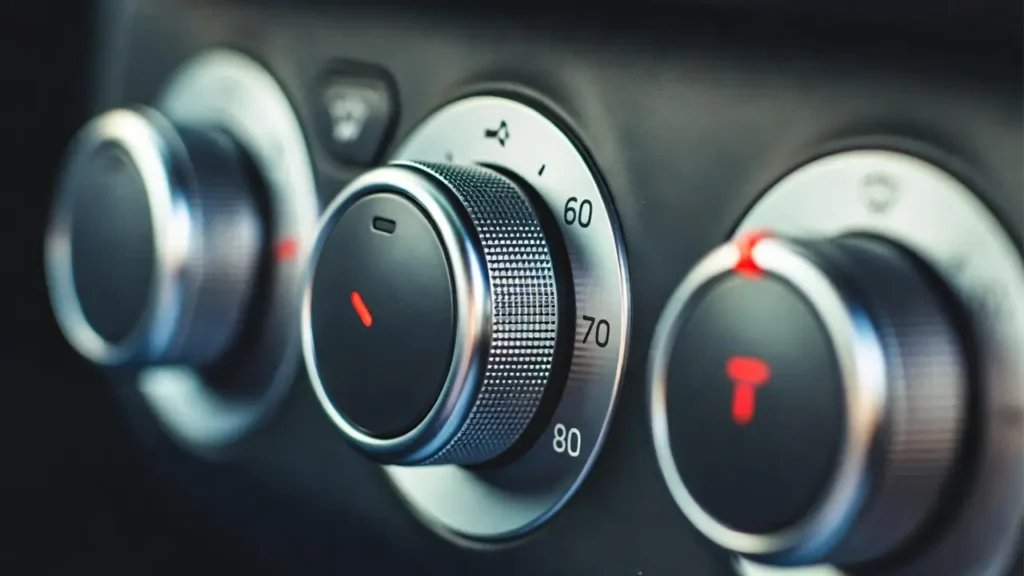
Climate and HVAC controls: You adjust temperature, fan speed, and air distribution multiple times during most drives. These are high-frequency actions that drivers should be able to perform without thinking. Temperature knobs are perfect for this — turn left for cooler, right for warmer. It’s intuitive and requires zero cognitive load.
When manufacturers buried climate controls in touchscreen menus, the complaints flooded in. People described having to navigate through 2-3 screens just to defrost their windshield or redirect airflow to their feet. In winter conditions or summer heat, this isn’t just annoying — it’s a genuine comfort and sometimes safety issue.
Volume controls: Music and call volume need immediate adjustment. A physical knob or rocker switch on the steering wheel lets you turn the volume up or down instantly. Touchscreen volume sliders require you to look at the screen and carefully place your finger. The climate control physical buttons principle applies here too: frequently used = needs physical control.
Steering wheel buttons: The steering wheel buttons comeback is real and welcome. Modern steering wheels with well-designed physical controls for cruise control, audio, phone, and voice commands are incredibly useful. They let you keep your hands on the wheel and your eyes on the road while still accessing important functions.
What drivers are saying: Let me share some common feedback that’s been circulating in EV owner forums and reviews:
“I loved the minimalist look at first, but after a week of actually driving the car, I missed having real buttons. Adjusting the AC shouldn’t require taking my eyes off the road.“
“Winter driving with a touchscreen is terrible. My gloves don’t work on the screen, and I’m not taking them off every time I need to adjust something.“
“The lack of physical volume control is my biggest complaint. I’ve accidentally turned the music way up or completely off so many times because the touchscreen slider is too sensitive.“
“I test drove two EVs back-to-back — one with mostly touchscreen controls and one with a mix of physical buttons. The difference in ease of use was night and day. I bought the one with buttons.“
“At night, the bright touchscreen is actually distracting. I find myself dimming it way down, but then I can barely see the controls I need. Physical buttons just make more sense.“
This isn’t cherry-picking complaints — this is the consistent pattern of feedback across brands, markets, and user demographics. The physical buttons in EV interiors trend is being driven by real user experience, not just regulation.
8. Pros and cons of the “button comeback” + brand mini-cases
Let’s be balanced about this. The steering wheel buttons comeback and broader return of physical controls isn’t without trade-offs. Here’s the honest assessment:
Pros of bringing back physical buttons:
- Less distraction: Drivers can operate controls by feel, keeping eyes on the road
- Faster actions: No menu navigation, no hunting for icons — just press or turn
- Higher trust in the vehicle: Tactile feedback gives confidence that commands registered
- Better accessibility: Easier for people with visual impairments or limited fine motor control
- Works in all conditions: Gloves, rain, bright sunlight, darkness — physical controls just work
- Satisfying to use: There’s genuine pleasure in a well-designed button or knob
Cons and challenges:
- Higher design complexity: Physical buttons need mechanical engineering, not just software
- More expensive production: Additional parts, assembly, and potential failure points increase BOM
- Harder to update: Software can be patched; physical layouts are permanent
- Can create visual clutter: Too many buttons can look messy or overwhelming
- Localization challenges: Button labels might need different languages or symbols for global markets
Brand responses — the course correction:
Volkswagen has been remarkably transparent about reversing course. After customer feedback about their touch-heavy controls in models like the ID.3 and ID.4, they announced they’re bringing back physical buttons for climate and volume. VW’s design chief essentially admitted: “We went too far with the touchscreen approach.”
Hyundai-Kia never fully eliminated physical controls and are now positioning this as a competitive advantage. Their “thoughtful integration” approach combines large touchscreens with dedicated physical controls for essential functions. Marketing materials now explicitly highlight this as a user-friendly feature.
Porsche maintained physical buttons for core driving dynamics even in their electric Taycan, understanding that driving enthusiasts value tactile engagement. Their approach shows you can have modern tech AND physical controls.
Mercedes-Benz is taking a hybrid approach in their EQ electric lineup, using the MBUX hyperscreen but maintaining physical controls for critical functions. They’re proving that “minimalist” doesn’t have to mean “no buttons.”
The physical buttons in EV interiors trend varies by brand philosophy, but the overall direction is clear: more physical controls are coming back.
9. FAQ: Common questions about the physical controls comeback
Q: Why is the physical buttons in EV interiors trend returning exactly now?
A: It’s a perfect storm of factors. First, we have several years of real-world data showing that touchscreen-heavy interiors increase driver distraction. Second, customer feedback has been consistently negative about buried controls. Third, Euro NCAP 2026 is making physical controls a rating requirement. And fourth, the novelty of minimalist touchscreen-only cabins has worn off — people now value function over form.
Q: What does the Euro NCAP 2026 physical controls requirement mean in practice?
A: Starting with their 2026 test protocols, Euro NCAP will assess whether essential safety functions — turn signals, hazard lights, windshield wipers, horn, and SOS/eCall — have direct physical controls. Cars that bury these functions in touchscreen menus will lose points in their overall safety rating. This creates strong incentive for automakers to include physical controls, as safety ratings directly influence buyer decisions and brand reputation.
Q: Do touchscreens really increase risk because of touchscreen distraction car safety concerns?
A: Yes, research consistently shows they do. Studies have found that interacting with touchscreens takes drivers’ eyes off the road 2-4 seconds longer than using physical controls. At highway speeds, that’s enough time to travel the length of a football field while not watching the road. The issue isn’t that touchscreens are inherently dangerous — it’s that requiring visual attention for basic controls creates unnecessary risk.
Q: What’s better in the haptic buttons vs physical buttons debate?
A: For critical controls and high-frequency functions, physical buttons are clearly superior. They provide mechanical feedback, work by muscle memory, function with gloves, and don’t depend on working displays or software. Haptic buttons are acceptable for secondary controls or in situations where you’re already interacting with a screen, but they don’t match the reliability and intuitive nature of true physical controls.
Q: Which functions are most important for climate control physical buttons?
A: Temperature adjustment is the top priority — a simple knob to turn for warmer or cooler is ideal. Fan speed control is second, followed by defrost/defog controls (critical for visibility). Air distribution buttons or knobs are also valuable. Basically, any climate function you might need to adjust while driving should have a physical control rather than requiring menu navigation.
Q: How will brands address the minimalist dashboard backlash without creating visual chaos?
A: This is the design challenge of the moment. The best approaches we’re seeing include: grouping related buttons logically (climate controls together, audio controls together), using quality materials and precise manufacturing so buttons look premium not cheap, integrating buttons into touchscreen bezels or center console areas cleanly, and using consistent design language between screens and physical controls. The goal is “clean but functional” rather than “minimal but frustrating.” Thoughtful integration matters more than raw button count.
10. Final thoughts: Function wins over form
The physical buttons in EV interiors trend represents something important: the industry learning from its mistakes and putting driver safety and usability ahead of showroom aesthetics. The last five years of minimalist, touchscreen-dominated interiors taught us valuable lessons about what works in real driving conditions versus what looks good in photos.
Here’s what we’ve learned: Drivers are willing to sacrifice some minimalist purity for controls that actually work well. A few thoughtfully placed buttons don’t ruin a beautiful interior — they complete it. The most successful future designs will be those that intelligently blend the benefits of large touchscreens (great for navigation, media, and vehicle settings) with the reliability and safety of physical controls for essential functions.
The minimalist dashboard backlash isn’t about rejecting technology or going backward. It’s about maturity in automotive design. We tried the “everything on a screen” approach and discovered its limits. Now we’re finding the right balance.
As we move through 2026 and beyond, expect to see this trend accelerate. The Euro NCAP 2026 physical controls requirement will push European and global manufacturers toward more physical controls. Customer demand will reinforce this direction. And hopefully, we’ll end up with EV interiors that are both technologically advanced AND genuinely pleasant to use every day.
If you’re shopping for an EV in 2026, pay attention to the control layout. Test drive in various conditions if possible. See what it’s like to adjust the temperature, change the wiper speed, or activate the hazard lights. The cars that make these tasks easy and intuitive are the ones that got the memo: the physical buttons in EV interiors trend is here to stay.
Stay tuned to www.autochina.blog for continued coverage of this trend as 2026 models launch and Euro NCAP ratings roll out. We’ll be updating our analysis as real-world data comes in.
Discover more from AutoChina
Subscribe to get the latest posts sent to your email.

