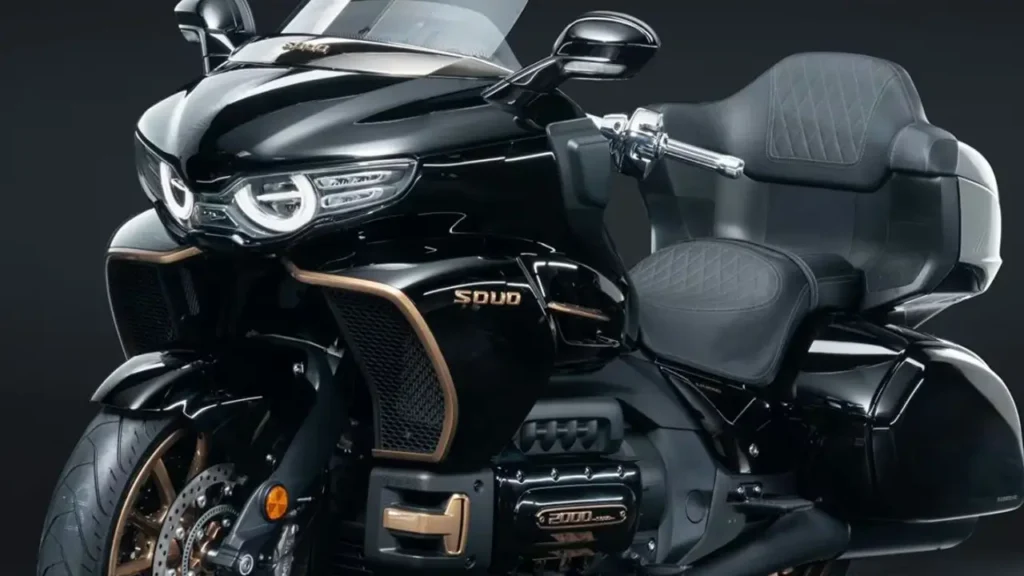
GWM Souo vs Honda Goldwing comparison has become the hottest topic in the touring motorcycle world, and for good reason. When GWM unveiled the Souo S2000 with its groundbreaking boxer-eight engine, the internet collectively stopped scrolling and asked, “Wait, what just happened?” This isn’t just another touring bike trying to compete with the legendary Honda Gold Wing—this is a full-blown engineering statement that’s rewriting the rulebook for luxury touring motorcycles.
The touring segment has been Honda’s playground for decades. The Gold Wing Tour DCT has set the benchmark for what a luxury tourer should be: smooth, powerful, loaded with tech, and reliable enough to cross continents without breaking a sweat. But GWM’s entry with the Souo S2000 eight-cylinder motorcycle isn’t a polite knock on the door—it’s a full-throttle challenge that brings an unprecedented eight-cylinder configuration to a segment that thought six was already plenty.
If you’re tired of piecing together information from scattered forum posts and conflicting spec sheets, you’re in the right place. We’re breaking down everything you need to know about this epic showdown, from engine architecture to real-world riding impressions. And when you want the complete picture without the Google quest, head over to www.autochina.blog understanding Chinese motorcycles shouldn’t require a research degree.
GWM Souo vs Honda Goldwing comparison: Quick Specs Table
Let’s get straight to the numbers. Here’s how these two touring titans stack up on paper:
| Spec | GWM Souo S2000 | Honda Gold Wing Tour |
|---|---|---|
| Engine | 1,999cc boxer-eight | 1,833cc flat-six |
| Gearbox | 8-speed dual-wet clutch | DCT available |
| Torque | ~190 Nm @ 4,500 rpm | 170 Nm @ 4,500 rpm |
| Category | Touring | Touring |
| Key Vibe | “New challenger” | “Segment benchmark” |
Those numbers tell an interesting story. The GWM Souo S2000 specs show a machine that’s not trying to match the Gold Wing—it’s trying to exceed it in pure mechanical drama. That extra displacement and those two additional cylinders aren’t just marketing fluff; they represent a fundamentally different approach to touring performance.
GWM Souo vs Honda Goldwing comparison: The Engine Story
Let’s talk about why the Souo S2000 eight-cylinder motorcycle matters beyond just the bragging rights. In the world of touring motorcycles, where comfort trumps outright speed, you might wonder why anyone would bother with eight cylinders when six already does the job brilliantly.
The answer lies in what engineers call “firing impulses” and what riders feel as smoothness. Every time a piston fires, it creates a power pulse. More cylinders mean more frequent power pulses, which translates to smoother power delivery. It’s the difference between waves lapping gently at a beach versus occasional swells—both get you there, but one feels more refined.
The boxer-eight engine motorcycle configuration takes this concept to its logical extreme. With eight cylinders arranged in a flat layout, the Souo S2000 delivers power in incredibly smooth increments. This isn’t about making the bike faster in a straight line—though that 190 Nm of torque certainly helps when you need to merge on a highway with a passenger and full luggage. It’s about making every mile feel effortless.
Think of it this way: long-distance touring isn’t a sprint; it’s an endurance event where comfort and refinement matter more than peak performance. The Gold Wing mastered this equation with six cylinders. GWM looked at that formula and asked, “What if we could make it even smoother?” The eight-cylinder answer might seem excessive until you’ve spent ten hours in the saddle, and you realize that “excessive” smoothness is exactly what your body was craving.
GWM Souo vs Honda Goldwing comparison: boxer-eight vs flat-six
Here’s where terminology matters, and it’s worth getting precise because the internet loves to mix things up. The boxer-eight engine motorcycle configuration isn’t technically a “V8″—it’s a flat-eight or boxer-eight, where cylinders are horizontally opposed across the crankshaft.
The distinction might seem academic, but it affects everything from the bike’s center of gravity to how it handles in corners. The flat layout keeps mass low and centralized, which is crucial when you’re talking about a motorcycle that’s already carrying substantial weight with its touring equipment. The Honda Gold Wing Tour DCT uses a flat-six for exactly this reason—it’s a proven configuration that balances power with handling dynamics.
GWM’s boxer-eight takes this concept and amplifies it. Instead of the 120-degree firing intervals you get with a flat-six, the eight-cylinder configuration creates even smaller gaps between power pulses. The result is a motor that feels like silk at idle and delivers thrust with the relentlessness of a turbine at speed.
From a technical standpoint, both the flat-six and boxer-eight share common advantages: naturally balanced primary forces, a low center of gravity, and excellent cooling characteristics thanks to cylinders positioned out in the airstream. The difference is in degree—the Souo S2000’s boxer-eight engine motorcycle setup pushes refinement to a new threshold in the touring segment.
GWM Souo vs Honda Goldwing comparison: Transmission and Control
The Souo S2000 8-speed DCT represents another area where GWM went big. Eight forward gears in a motorcycle transmission might sound like overkill, but in the context of luxury touring motorcycle comparison, it makes perfect sense.
More gears mean tighter ratio spacing, which means the engine can stay in its sweet spot more often. For a touring bike, this translates to better fuel economy at highway speeds, quieter cruising, and more responsive acceleration when you need it. The dual-wet clutch system that GWM employs is particularly well-suited to this application—it handles heat better than a traditional dry clutch setup, which is crucial when you’re managing eight forward gears in stop-and-go traffic.
The “dual-wet clutch” terminology might sound fancy, but it’s essentially a DCT that uses oil for cooling and lubrication. This setup is more forgiving in urban environments and requires less maintenance than a conventional clutch system. For touring riders who might find themselves crawling through city traffic one day and bombing down an interstate the next, it’s a practical solution that removes one more thing to think about.
Honda’s approach with the Gold Wing Tour DCT is similar in philosophy but different in execution. Their seven-speed DCT is a proven system that’s been refined over multiple generations. It’s smooth, predictable, and backed by Honda’s legendary reliability. The question for riders becomes: is the Souo S2000’s extra gear and torque advantage worth taking a chance on a newcomer?
GWM Souo vs Honda Goldwing comparison: Gold Wing’s Tech Baseline
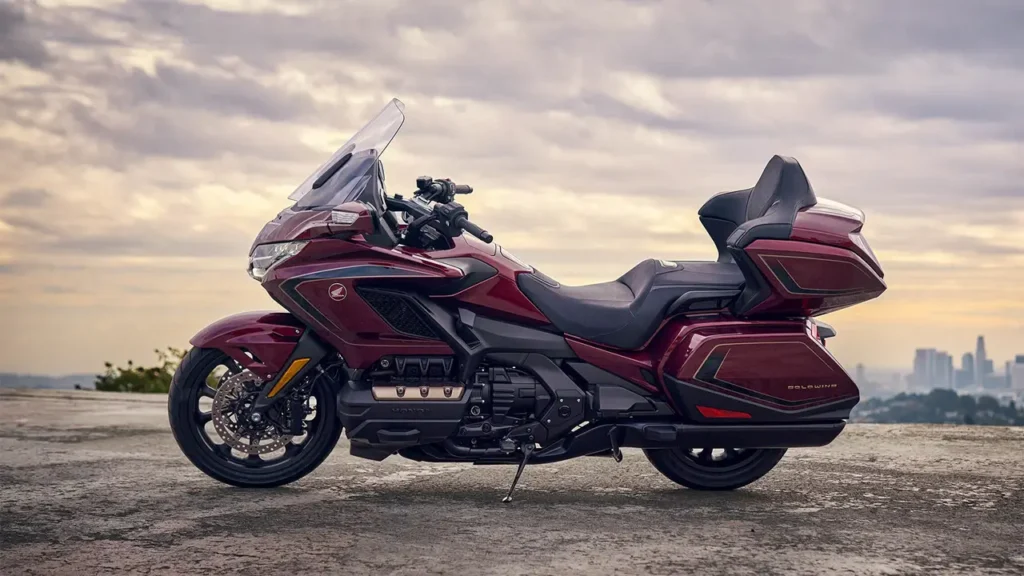
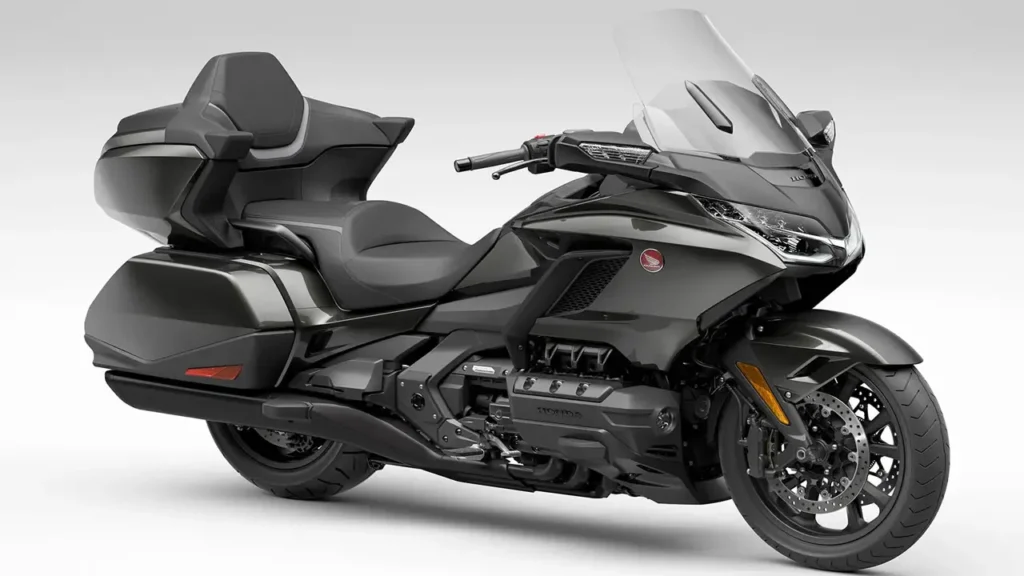
Let’s give credit where it’s due—the Honda Gold Wing Tour DCT didn’t become the segment benchmark by accident. Honda’s engineering team has had decades to perfect the touring formula, and it shows in every detail.
The current Gold Wing comes standard with features that were science fiction when the model first launched in 1975. Multiple riding modes let you adjust power delivery and suspension stiffness on the fly. The electrically adjustable windscreen means you can dial in your preferred level of wind protection without stopping. The audio system is Apple CarPlay and Android Auto compatible, so your smartphone integrates seamlessly with the bike’s infotainment.
But beyond the feature list, the Gold Wing represents something more valuable: institutional knowledge. Honda knows where touring riders take their bikes, what breaks, what annoys them, and what keeps them comfortable mile after mile. This knowledge is baked into every component, from the seat design to the placement of storage compartments.
The Honda Goldwing 2026 features build on this foundation with refinements rather than revolutions. The suspension has been retuned for better low-speed maneuverability. The audio system received processing upgrades for clearer sound at highway speeds. The navigation system now offers more detailed route planning with rider-specific features like avoiding highways or prioritizing scenic routes.
These might seem like minor updates, but they reflect Honda’s philosophy: get the fundamentals perfect, then make them better. It’s an approach that’s kept the Gold Wing relevant across five decades and multiple generations.
GWM Souo vs Honda Goldwing comparison: What’s New in the 2026 Vibe
Speaking of the Honda Goldwing 2026 features, it’s important to understand that the Gold Wing isn’t resting on its laurels while GWM makes noise with the Souo S2000. Honda continues to evolve their flagship tourer in ways that might not grab headlines but matter tremendously to riders.
The 2026 model year brings subtle but meaningful improvements. The electronic suspension system now learns from your riding habits and adjusts preload settings automatically based on typical load conditions. If you regularly ride two-up with luggage, the bike remembers and adjusts accordingly. The traction control system has been recalibrated to be less intrusive in wet conditions while maintaining safety margins.
Honda has also refined the Gold Wing’s thermal management, addressing one of the few complaints longtime owners had—heat radiating toward the rider in stop-and-go traffic. New cooling pathways and revised bodywork direct more heat away from the rider’s legs. It’s the kind of detail that you might not notice immediately but appreciate deeply during a summer ride through urban areas.
The Gold Wing’s tech ecosystem remains one of its strongest selling points. The integration between the bike’s systems is seamless in a way that comes from years of refinement. Voice commands work reliably, navigation doesn’t require pulling over to input destinations, and the rider information display presents data without causing information overload.
This is where the luxury touring motorcycle comparison gets nuanced. The Souo S2000 brings wow-factor engineering with its eight-cylinder motor. The Gold Wing brings the confidence of proven technology and an ecosystem that works together harmoniously. Neither approach is wrong—they’re targeting different rider priorities.
GWM Souo vs Honda Goldwing comparison: Price and Market Reality
Now we get to the part where rubber meets road—the Souo S2000 price situation. This is where things get complicated because GWM hasn’t released official global pricing for the Souo S2000, and availability outside of China remains unclear.
Based on Chinese market indicators and early auction results, industry observers expect the Souo S2000 to be priced competitively against the Gold Wing, potentially undercutting Honda’s flagship by a meaningful margin. However, these numbers should be taken with appropriate skepticism until official announcements arrive.
The Gold Wing Tour DCT has well-established pricing: the base model starts around $28,500 USD, with the Tour version pushing closer to $30,000 when you add premium paint and accessories. It’s a significant investment, but you’re buying into a proven platform with an extensive dealer network and decades of parts availability.
GWM’s pricing strategy with the Souo S2000 will likely aim to undercut this established pricing while offering comparable or superior specifications. The eight-cylinder engine and eight-speed transmission suggest GWM is targeting the premium end of the touring market, not trying to be a budget alternative.
The real question for potential buyers isn’t just sticker price—it’s total cost of ownership. This includes maintenance costs, parts availability, service network density, and resale value. Honda has built this infrastructure over decades. GWM is building it now, which means early adopters are taking on additional risk in exchange for being part of something new and exciting.
Market reaction has been fascinating to watch. Chinese enthusiasts are rightly proud of the engineering achievement the Souo S2000 represents. International observers are intrigued but cautious, waiting to see how the bike performs in real-world conditions and whether GWM’s service network can support international customers.
GWM Souo vs Honda Goldwing comparison: Pros, Cons, and Real Rider Reactions
Let’s break down the GWM Souo S2000 review landscape with honest pros and cons for each machine, along with what actual riders are saying.
GWM Souo S2000 Pros:
- Unprecedented eight-cylinder smoothness in a production motorcycle creates a unique riding experience that stands apart from anything else in the segment
- Impressive torque figures that should translate to effortless overtaking and cruising performance, particularly valuable for two-up riding with full luggage
- Modern technology package that matches or exceeds current standards, showing GWM isn’t cutting corners on the electronics side
- The wow factor of owning something genuinely different, a conversation-starter that turns heads at every fuel stop
- Potential pricing advantage if GWM follows its typical strategy of undercutting established competitors
GWM Souo S2000 Cons:
- Unproven reliability in long-term real-world conditions; the eight-cylinder configuration is innovative but complex
- Limited service network outside China means owners might face challenges finding qualified technicians
- Weight concerns—eight cylinders and robust construction likely mean serious mass, which affects low-speed handling
- Parts availability and long-term support remain question marks for international customers
- Resale value is unpredictable for a first-generation model from a manufacturer new to the touring segment
Honda Gold Wing Tour DCT Pros:
- Legendary reliability backed by decades of real-world testing and continuous refinement
- Comprehensive dealer network means service is available almost anywhere you might tour
- Proven platform with known maintenance intervals and predictable ownership costs
- Strong resale value thanks to Honda’s reputation and the Gold Wing’s iconic status
- Complete ecosystem of accessories and modifications supported by both Honda and aftermarket manufacturers
Honda Gold Wing Tour DCT Cons:
- Higher initial purchase price compared to expected Souo pricing
- The flat-six engine, while excellent, lacks the novelty factor of the Souo’s eight-cylinder
- Some riders find the current generation’s styling conservative compared to more dramatic alternatives
- Weight remains substantial, requiring confidence and skill in low-speed maneuvers
- Premium features and refinements can push the price significantly higher when options are added
What Riders Are Actually Saying
The rider reaction to this GWM Souo vs Honda Goldwing comparison has been fascinating to track across forums, social media, and motorcycle communities. The responses generally fall into three camps.
The Enthusiasts: These riders are genuinely excited about the Souo S2000. They see it as proof that Chinese manufacturers are serious about competing at the highest levels of motorcycle engineering. Comments typically focus on the engineering achievement and the desire to experience that eight-cylinder smoothness firsthand. They’re willing to accept some risk for the opportunity to own something unique.
The Skeptics: This group wants to see long-term reliability data before committing. They’ve watched the Gold Wing evolve over decades and appreciate Honda’s methodical approach to refinement. Common concerns include parts availability, service quality, and whether GWM will support the model five or ten years down the road. These riders typically say they’ll wait for the second or third generation.
The Pragmatists: These riders evaluate both bikes on practical criteria—where they plan to ride, what kind of support they’ll need, and how the bike fits their specific use case. They’re less interested in brand loyalty or innovation for its own sake and more focused on which machine will best serve their touring needs. Many in this group acknowledge the Souo’s appeal while ultimately gravitating toward the Gold Wing’s proven track record.
Across all three groups, there’s respect for what GWM has accomplished. Even skeptical riders acknowledge that bringing an eight-cylinder touring motorcycle to market represents a significant engineering achievement. The debate centers on whether innovation alone is enough to overcome Honda’s decades of refinement and infrastructure.
Final Verdict: GWM Souo vs Honda Goldwing comparison
So how does this luxury touring motorcycle comparison shake out? The honest answer is that it depends entirely on what kind of rider you are and what you value most in a touring motorcycle.
Choose the Honda Gold Wing Tour DCT if you:
- Value proven reliability above all else, especially for long-distance touring where being stranded isn’t an option
- Want the peace of mind that comes with an extensive dealer network and established parts supply chain
- Prefer evolutionary refinement over revolutionary technology, appreciating Honda’s methodical approach to improvement
- Plan to keep the bike for many years and want predictable maintenance costs and strong resale value
- Need a machine that can handle any touring scenario you throw at it, from urban commuting to transcontinental journeys
Choose the GWM Souo S2000 if you:
- Want to experience genuinely unique engineering with that eight-cylinder smoothness that no other production motorcycle offers
- Enjoy being an early adopter and don’t mind taking on some additional risk for the opportunity to own something special
- Have access to competent service facilities that can work on less common motorcycles
- Value the conversation-starter aspect and don’t mind explaining what you’re riding to curious onlookers
- Are willing to work around potential parts delays or service challenges in exchange for riding something truly different
The reality is that both motorcycles represent legitimate approaches to luxury touring. The Gold Wing is the refined culmination of decades of continuous improvement—a known quantity that delivers excellence without surprises. The Souo S2000 is the ambitious newcomer bringing fresh ideas and genuine innovation but carrying the uncertainty that comes with being first.
For riders who prioritize peace of mind and want a machine that will reliably serve them anywhere in the world, the Gold Wing remains the logical choice. Its higher purchase price is offset by predictable ownership costs and the confidence that comes from Honda’s support network.
For riders who crave something different and are willing to accept some unknowns in exchange for that eight-cylinder experience, the Souo S2000 represents an exciting opportunity. It’s a chance to be part of something new while riding a machine that pushes the boundaries of touring motorcycle engineering.
Making Your Decision
The GWM Souo vs Honda Goldwing comparison ultimately comes down to personal priorities. This isn’t a situation where one bike is objectively better than the other—they excel in different ways and appeal to different rider sensibilities.
If you’re reading this and finding yourself drawn to the Souo S2000’s innovation but worried about the unknowns, that’s a perfectly reasonable position. Waiting for more real-world reviews and long-term reliability data makes sense. There’s no shame in being a second or third generation adopter once GWM has proven the platform.
Conversely, if you’re a Gold Wing loyalist but intrigued by what GWM is doing, keep an eye on the Souo’s development. Competition benefits everyone—Honda will be forced to respond to this challenge, which means better motorcycles for all touring enthusiasts regardless of which brand you choose.
The touring motorcycle segment is healthier when manufacturers push each other to innovate and improve. GWM’s entry with an eight-cylinder machine forces Honda to justify the Gold Wing’s premium pricing through continued refinement. Honda’s established excellence gives GWM a clear target to aim for and exceed. Riders win regardless of which machine they ultimately choose.
If you’re looking for clear, straightforward information about the luxury touring motorcycle comparison scene without the forum drama and conflicting opinions, www.autochina.blog is your destination. We track these developments as they happen and provide context that helps you make informed decisions—no quest through scattered sources required.
Whether you choose the proven excellence of the Honda Gold Wing Tour DCT or take a chance on the innovative GWM Souo S2000, you’re getting a machine capable of delivering memorable touring experiences. The eight-cylinder revolution is here, and it’s pushing the entire segment forward. That’s something every touring enthusiast can celebrate, regardless of which logo is on their tank.
If you’re into bold Chinese engineering, don’t stop at bikes. For the latest Chinese tech—smartphones, gadgets, accessories, and the gear riders actually use every day—check out https://bestchinagadget.com/. It’s a fast, practical hub for real picks, quick reviews, and what’s trending right now without the fluff.
Discover more from AutoChina
Subscribe to get the latest posts sent to your email.