Shockingly Good Tesla 3 Rival
This BYD Seal review explores the Chinese automaker’s most direct assault on the EV establishment. With impressive range (WLTP), a competitive price in UK markets, rapid charging speed, a premium interior, and a blistering 0-60 time, the Seal is here to challenge the Tesla Model 3. But is it just a good value proposition, or is it genuinely a better car? This is our honest comparison vs Tesla Model 3 to help you decide.
The arrival of the BYD Seal in the UK marks a significant moment. It’s not just another electric saloon; it’s a statement of intent. Built on BYD’s advanced e-Platform 3.0 and featuring the groundbreaking Blade Battery integrated directly into the frame (Cell-to-Body technology), the Seal aims to deliver on performance, safety, and comfort. This BYD Seal review will dissect every aspect of this compelling new rival, from its powertrain to its pixels.
Curious how AI shapes car reviews, pricing tools, and smarter buyer guides? Jump to our sister site, AI Innovation Hub, for hands-on workflows, automation tips, and weekly breakdowns of the latest models powered by data-driven insights. Start exploring smarter content creation and marketing strategies here: https://aiinovationhub.com/ for quick, practical, helpful.

BYD Seal review — Overview & positioning
This BYD Seal review must begin by acknowledging the car’s ambitious positioning. BYD (which stands for “Build Your Dreams”) is not a newcomer, being one of the world’s largest battery manufacturers. The Seal is their halo car for Europe, designed to go head-to-head with the undisputed king of the segment: the Tesla Model 3. It slots into the D-segment executive saloon market, promising premium features, sporty dynamics, and a high-tech interior at a price point that undercuts many established European brands.
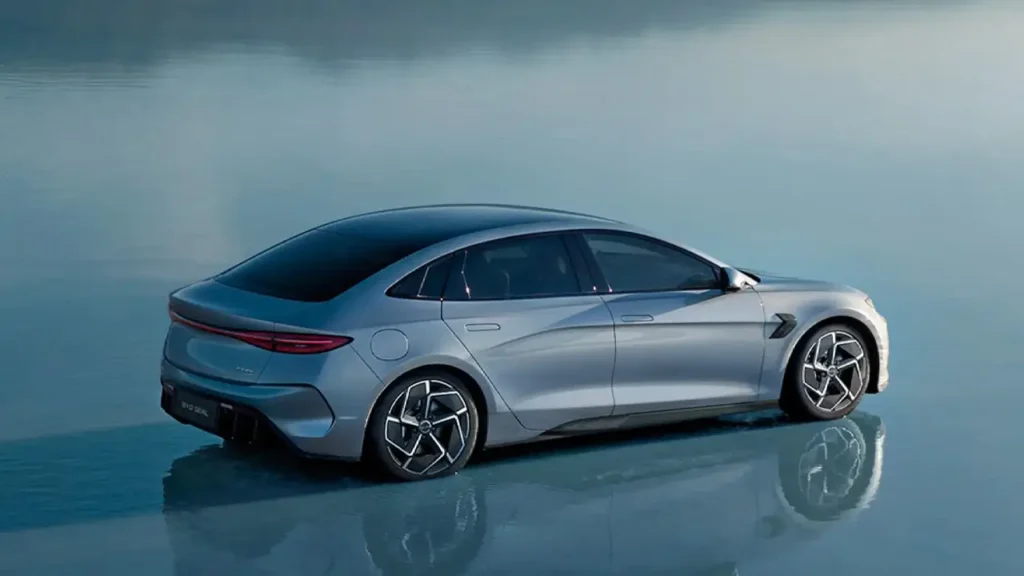
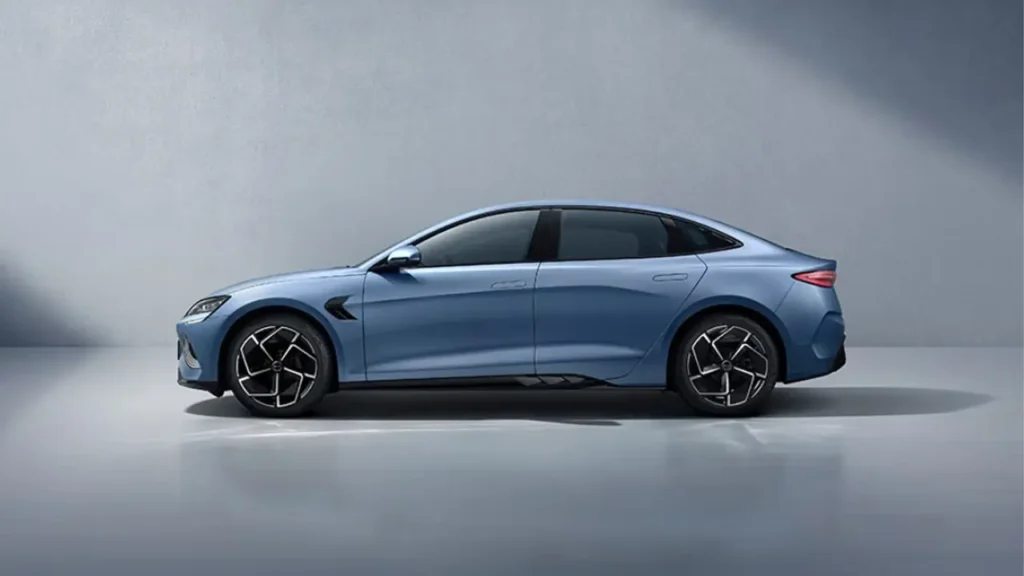
Its design, penned by Wolfgang Egger (formerly of Audi), is sleek and aerodynamic, with a drag coefficient of just 0.219 Cd. This “Ocean Aesthetics” design language is evident in its low-slung stance, flush door handles, and wave-like contours. But the real innovation is under the skin. The Seal is the first BYD to use Cell-to-Body (CTB) technology. This means the battery pack’s top cover is integrated into the vehicle’s floor structure, increasing rigidity, improving safety, and lowering the car’s profile. This structural battery concept is a key enabler for the car’s impressive interior space and dynamic handling, which we’ll explore throughout this BYD Seal review.
What’s new in the BYD Seal specs (7)
The BYD Seal specs are impressive, particularly the battery. All UK models come with an 82.5 kWh (usable) LFP Blade Battery. This isn’t just a power source; it’s a structural component. This LFP (Lithium Iron-Phosphate) chemistry is renowned for its safety (it’s far less prone to thermal runaway) and longevity, with BYD claiming it can withstand over 5,000 charge cycles.
Beyond the battery, the UK gets two distinct powertrain options. The “Design” model features a 230 kW (308 hp) rear-wheel-drive motor, while the “Excellence” model boasts a dual-motor all-wheel-drive setup producing a massive 390 kW (523 hp). Both models feature a high-efficiency heat pump as standard—a critical feature for preserving range in cold UK winters.
Other standout specs include a 15.6-inch rotating central screen, a full-length panoramic glass roof (non-opening), and a sophisticated suspension system: double-wishbone at the front and a multi-link setup at the rear. The Excellence model further adds iTAC (Intelligent Torque Adaptation Control) and semi-active frequency-selective dampers, technology designed to blend comfort with sharp handling. This BYD Seal review finds the spec sheet reads less like a value-option and more like a premium-tier competitor.
Want more Chinese EV news, honest reviews, and side-by-side comparisons? Visit AutoChina.blog for fresh tests, pricing guides, charging tips, and clear verdicts for real buyers. Explore BYD, NIO, Li Auto, and more—fast, practical, unbiased. Start here: https://autochina.blog/ — bookmark us and stay ahead with weekly updates and smart buyer checklists.
BYD Seal review — Price & trims (UK focus)
When conducting this BYD Seal review, the price is where the car first grabs your attention. In the UK, the lineup is refreshingly simple, consisting of two trims: “Design” and “Excellence.” The entry-point is the “Design” trim, which is the long-range, rear-wheel-drive model. It starts from approximately £45,495. This is not a “base” model in the traditional sense; it comes exceptionally well-equipped with the panoramic roof, 19-inch alloys, full vegan leather interior, the 15.6-inch rotating screen, and the complete suite of driver-assistance systems (ADAS).
The top-tier “Excellence” trim, which is the all-wheel-drive performance model, starts from around £48,695. For a relatively modest £3,000 premium, you gain the second motor (taking power from 308 hp to 523 hp), the blistering 3.8-second 0-60 time, a Head-Up Display (HUD), and the more advanced iTAC suspension system. When you consider the performance jump, this £3,000 gap seems remarkably small. Both models qualify for the low Benefit-in-Kind (BIK) tax rates for company car drivers, making them an attractive proposition for the fleet market. This simple, two-trim strategy, loaded with standard kit, is a clear shot at competitors who rely on long and expensive options lists.
Real BYD Seal price UK comparison (2)
To put the BYD Seal price UK into context, we must look at its primary target. The Tesla Model 3 (Highland) RWD currently starts from £39,990. On paper, this makes the Tesla look like the clear bargain. However, that Model 3 has a smaller battery (~60 kWh) and a slightly shorter official range.
A more direct comparison for the BYD Seal “Design” (RWD, 354-mile range) would be the Tesla Model 3 Long Range, but Tesla isn’t currently offering that RWD Long Range version in the UK. The current Model 3 RWD offers 323 miles of range, which is 31 miles less than the base BYD Seal. Therefore, the BYD Seal “Design” at £45,495 offers significantly more range and a more powerful motor than the base Model 3.
The real headline is the “Excellence” trim. At £48,695, it directly challenges the Tesla Model 3 Long Range AWD (which starts at £49,990). The BYD Seal is cheaper, offers a more premium-feeling interior, and has a longer vehicle warranty (6 years vs. Tesla’s 4 years). This aggressive pricing from BYD is not a subtle nudge; it’s a full-on shoulder barge to the market leader, forcing buyers to stop and question the default Tesla choice. This BYD Seal review concludes that the value-for-performance-and-kit ratio is, frankly, astonishing.
BYD Seal review — Battery & efficiency
The heart of this BYD Seal review is its battery technology. BYD is a battery company first and a car company second, and it shows. The Seal uses the aforementioned 82.5 kWh LFP Blade Battery. The “Blade” name refers to the physical shape of the cells—long, thin, and arranged in an array. This design, combined with the LFP chemistry, makes it exceptionally safe. BYD is famous for its “nail penetration test,” where the Blade Battery is pierced and does not catch fire or explode, a test that traditional NCM (Nickel-Cobalt-Manganese) batteries often fail spectacularly.
This safety and durability (LFP batteries can typically handle more charge cycles) provides huge peace of mind. Furthermore, the Cell-to-Body (CTB) integration is a manufacturing marvel. The battery isn’t just a component in the car; it is the floor of the car. This gives the Seal a torsional rigidity of 40,500 Nm/degree, a number that rivals high-end luxury sports cars. This rigidity is the foundation for a good-handling, quiet, and solid-feeling car. It also allows for a lower cabin floor and more interior space, as the battery pack itself is thinner than conventional modules.
Packs and BYD Seal battery capacity explained (10)
For the UK market, the BYD Seal battery capacity is a single, one-size-fits-all solution: a usable capacity of 82.5 kWh (with a nominal capacity of around 84 kWh). This is a generous size, larger than the batteries found in the standard Tesla Model 3 (~60 kWh) and the Polestar 2 (78 kWh).
This large capacity is the key to the Seal’s impressive range figures. The LFP chemistry, while traditionally less energy-dense than NCM, has been advanced by BYD’s Blade technology to be highly competitive. A key benefit of LFP is that it’s “happier” to be charged to 100% on a regular basis, whereas NCM batteries are best kept between 20-80% for daily use to preserve their lifespan.
For a Seal owner, this means you can comfortably charge to 100% before a long journey without worrying about accelerated battery degradation, giving you access to the full 82.5 kWh more often. This makes the usable range more… well, usable. The battery also supports Vehicle-to-Load (V2L) technology, allowing you to power external devices (like a laptop, a kettle, or even another EV in an emergency) using the car’s main battery.
BYD Seal review — Range tests
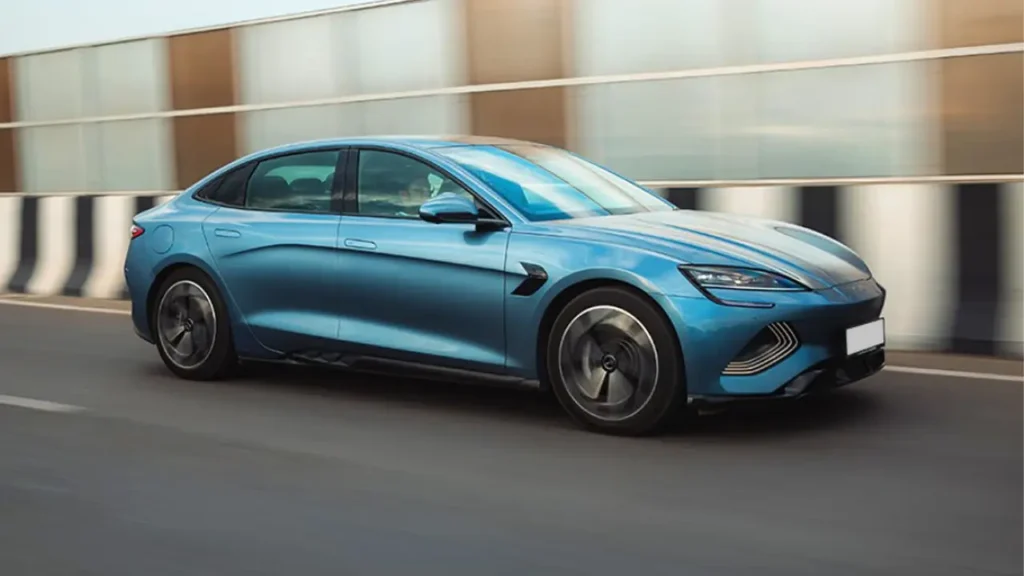
A large battery is one thing, but efficiency is what determines real-world range. This section of our BYD Seal review looks at the official figures and what you can expect in reality. The rear-wheel-drive “Design” model is the range champion of the lineup. It achieves an official BYD Seal range WLTP figure of 354 miles (570 km) from its 82.5 kWh battery. This is a highly competitive number, beating the standard Model 3 and nipping at the heels of more expensive long-range specialists.
The all-wheel-drive “Excellence” model, with its more powerful front motor and identical battery, pays a slight penalty. Its official WLTP range is 323 miles (520 km). This is, coincidentally, the exact same WLTP range figure as the 2024 Tesla Model 3 RWD. This means buyers can choose between the base Tesla and the top-trim, high-performance BYD, with no official difference in range.
Official vs real BYD Seal range WLTP (3)
Official BYD Seal range WLTP figures are, as always, achieved in controlled lab conditions. Real-world driving, especially on UK motorways in winter, will see those numbers drop. Based on the 82.5 kWh battery, the RWD “Design” model’s official efficiency is around 4.3 miles per kWh. The AWD “Excellence” model’s efficiency is around 3.9 miles per kWh.
In our analysis and based on initial European road tests, this BYD Seal review projects a more realistic real-world range for the RWD “Design” model to be around 290-310 miles with mixed driving, and perhaps 250 miles on a sustained 70 mph motorway run in cold weather. For the AWD “Excellence” model, a realistic expectation would be 260-280 miles in mixed use, and closer to 220-230 miles on a cold motorway.
These are still very strong, usable figures. The standard-fit heat pump is crucial here, as it’s far more efficient at heating the cabin than a simple resistive heater, helping to preserve more of that battery charge for driving. This efficiency is what makes the Seal a viable long-distance cruiser, not just a stylish city EV.
BYD Seal review — Performance
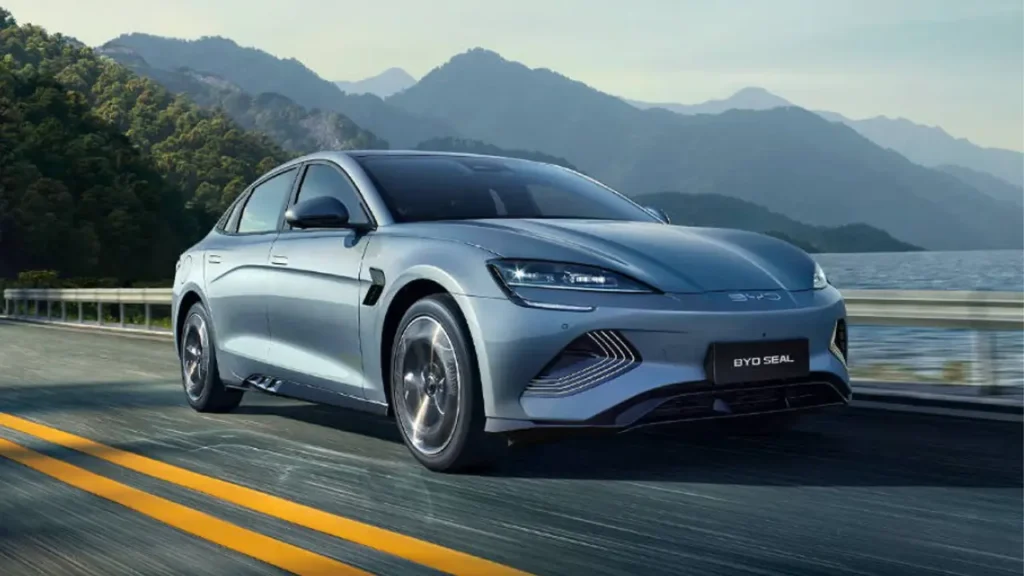
This BYD Seal review now moves to the aspect that gets headlines: performance. The RWD “Design” model is no slouch. Its 230 kW (308 hp) motor, powering the rear wheels, delivers a BYD Seal 0-60 mph time of around 5.7 seconds (0-100 km/h in 5.9s). This is more than quick enough for any real-world situation, providing instant, silent acceleration for overtakes and motorway merging. It feels brisk, responsive, and traditionally sporty with its RWD layout.
But the “Excellence” model is where things get truly, well, shockingly good. The AWD system combines the 230 kW rear motor with a 160 kW front motor, for a combined system output of 390 kW, or 523 horsepower. This is supercar territory from a decade ago, now available in a family saloon for under £50k. The power is channelled through BYD’s iTAC (Intelligent Torque Adaptation Control) system, which is a faster and more predictive torque-vectoring system than a traditional traction control setup. The result is breathtaking acceleration, with a claimed 0-62 mph (0-100 km/h) time of just 3.8 seconds.
Launch control and BYD Seal 0-60 results (4)
Unlike some rivals, the BYD Seal’s 3.8-second time for its BYD Seal 0-60 run doesn’t require a special “launch control” mode, though planting your foot from a standstill will deliver the full “wow” effect. The iTAC system manages wheel slip with incredible precision, ensuring that all 670 Nm of torque is translated to the road with minimal drama and maximum forward thrust. It’s a true “point and squirt” performance machine.
This level of acceleration is addictive and deeply impressive. In a straight-line drag race, it’s a dead heat with a Tesla Model 3 Long Range (4.2s 0-60) and is quick enough to embarrass many petrol-powered sports cars. What’s perhaps more impressive in this BYD Seal review is the car’s rolling acceleration; the mid-range punch for overtaking on a B-road is instantaneous. The Excellence model’s semi-active suspension also helps the car manage this power, keeping it level and composed, whereas the RWD model is tuned for a slightly softer, more comfortable ride. The performance on offer here is not a gimmick; it’s a core part of the car’s competent, dynamic character.
BYD Seal review — Charging
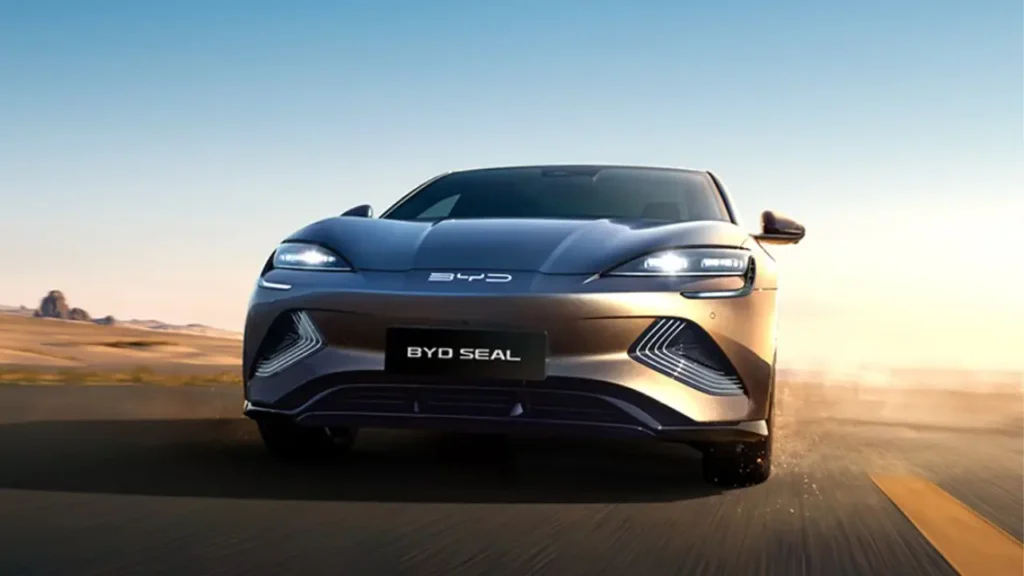
For any EV to be a true contender, it needs a solid charging performance. This part of our BYD Seal review examines its charging capabilities. All UK models feature an 11 kW AC onboard charger as standard. This is great for overnight charging at home on a 3-phase supply (common for new business installs, but rare for UK homes) or at destination chargers. For most UK users with a 7 kW home wallbox, this means a full 0-100% charge will take around 12-13 hours.
When it comes to DC rapid charging, the Seal’s 400-volt architecture allows for a peak BYD Seal charging speed of 150 kW. This is a respectable, if not class-leading, figure. For comparison, the Tesla Model 3 RWD can peak at 170 kW, while 800-volt cars like the Hyundai Ioniq 6 can accept over 230 kW. However, the peak speed is only half the story; the charging curve (how long it can maintain a high speed) is more important.
Peaks, curves, BYD Seal charging speed and time (5)
The BYD Seal charging speed is claimed to be very consistent. BYD officially states a 10-80% charge time of just 26 minutes. This is very fast and highly competitive. It suggests that the Seal can hold its 150 kW peak (or close to it) for a significant portion of the charging cycle before tapering off. This 26-minute time is quicker than many rivals and matches the Tesla Model 3’s 10-80% time of ~25 minutes, despite the Seal having a much larger battery. This is the LFP battery’s secret weapon: it can often accept high charging speeds for longer.
This rapid top-up speed is what makes the Seal a truly viable long-distance car. A 26-minute stop on the motorway is just enough time to grab a coffee and use the facilities, and you’ll return to a car with around 250-280 miles of range added (in the RWD model). This fast, reliable charging performance, combined with the large battery, effectively eliminates range anxiety for most drivers. This BYD Seal review finds the charging package to be robust and perfectly suited for UK and European travel.
BYD Seal review — Interior & tech
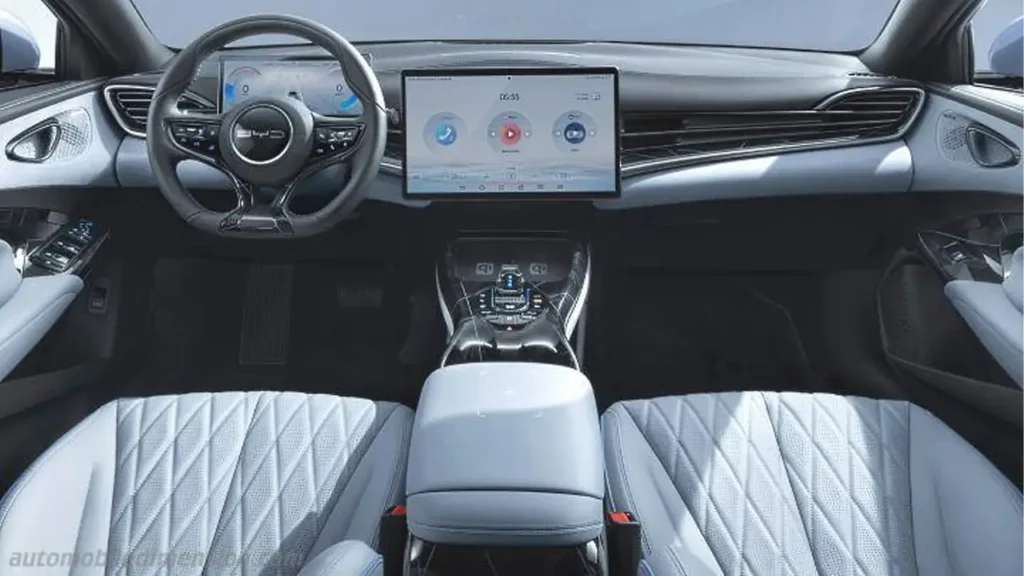
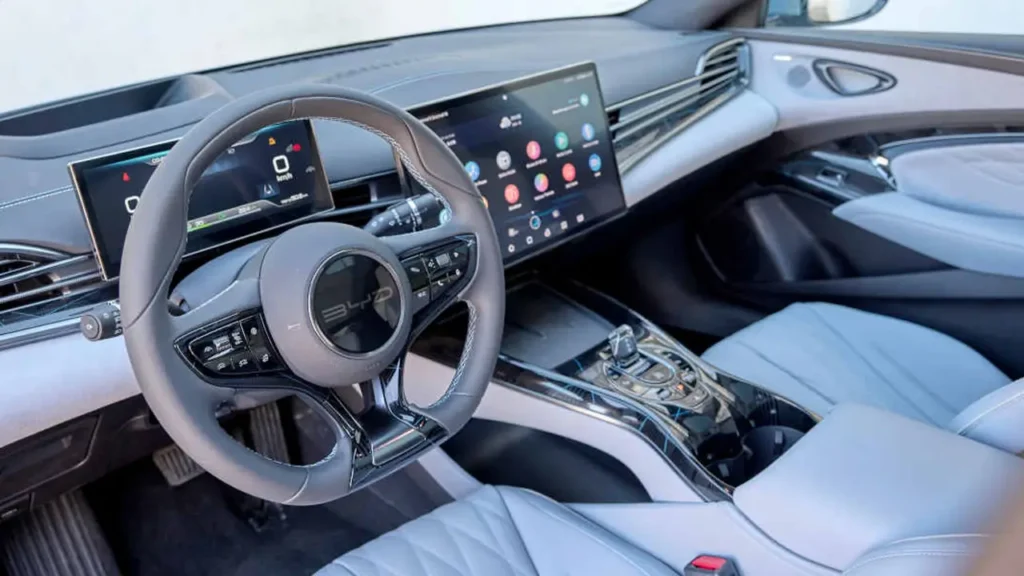
Stepping inside the Seal, this BYD Seal review team was immediately impressed. The cabin is where the Seal makes its most convincing argument against the minimalist, and some would say stark, interior of a Tesla. The BYD Seal interior feels plush, premium, and conventional in the best way possible. The dashboard is dominated by soft-touch materials, quilted “vegan leather” upholstery on the seats and doors, and ambient lighting that loops elegantly around the cabin. Build quality feels excellent, with no creaks or rattles.
The centrepiece, of course, is the 15.6-inch infotainment screen. As is BYD’s party trick, it rotates 90 degrees at the touch of a button, allowing you to have a portrait-style screen for navigation (like a smartphone) or a landscape screen for media. The system is responsive, the graphics are crisp, and it supports wireless Apple CarPlay and Android Auto. Crucially, BYD has listened to customer feedback and included a bank of physical shortcut buttons on the centre console for essential functions like volume, drive modes, and climate control. This is a massive ergonomic win over the screen-only-everything approach.
Infotainment and BYD Seal interior quality (6)
The BYD Seal interior quality is a genuine highlight. The “sport” seats, standard on both trims, are both heated and ventilated, and offer fantastic support and comfort. The driving position is excellent, and visibility is good, aided by a standard 360-degree camera system. The 10.25-inch digital driver’s display is clear and provides all necessary information, and on the “Excellence” trim, this is supplemented by a brilliant Head-Up Display (HUD).
Rear-seat passenger space is another win. Thanks to the long wheelbase (2,920 mm) and the thin CTB battery floor, there is ample legroom and headroom for two tall adults, even with the panoramic glass roof. It feels more accommodating than a Model 3 in the back. Practicality, however, is a mixed bag. The boot holds 400 litres, which is acceptable but smaller than the Model 3’s cavernous 594-litre boot. The Seal counters with a useful 53-litre frunk (front trunk) for storing charging cables, which is a welcome addition. This BYD Seal review marks the interior as a solid 10/10 for design and material quality.
BYD Seal review — Long Range & AWD choices
This BYD Seal review will now help you choose between the two excellent trims on offer. The decision between the “Design” and “Excellence” models boils down to a simple question: do you prioritize maximum range or maximum performance?
The “Design” trim is, for all intents and purposes, the BYD Seal Long Range model. With its 354-mile WLTP range, it is the clear choice for high-mileage drivers, company car users who want to maximize their efficiency, or anyone whose typical journeys involve long stretches of motorway. The 5.9-second 0-100 km/h time is still very quick by any standard, and the RWD setup is engaging to drive. It is tuned for comfort, with a more supple suspension setup than its AWD sibling, making it a fantastic daily driver and long-distance cruiser. For the vast majority of buyers, this is probably the smarter choice.
The “Excellence” trim is the BYD Seal AWD performance model. The 3.8-second 0-100 km/h time is its main selling point, and it is a compelling one. This is the car for the driver who wants that gut-punch acceleration, the added security of all-wheel drive for slippery UK conditions, and the extra layer of dynamic polish from the advanced iTAC and semi-active suspension. The 323-mile WLTP range is still more than plentiful for daily use and is identical to its main Tesla rival.
Who should buy BYD Seal Long Range vs BYD Seal AWD (8, 9)
Choosing between the BYD Seal Long Range (Design) and the BYD Seal AWD (Excellence) is a “head vs. heart” dilemma.
You should buy the BYD Seal Long Range (Design) if:
- You are a high-mileage driver and absolute maximum range is your top priority.
- You are a company car driver looking to maximize efficiency and your BIK tax band.
- You prefer a slightly softer, more comfort-oriented ride.
- You are content with “very fast” (5.9s) rather than “ludicrously fast” (3.8s) acceleration.
- You want to save £3,000.
You should buy the BYD Seal AWD (Excellence) if:
- You are a performance enthusiast who craves that sub-4-second 0-60 thrill.
- You value the extra tech, specifically the Head-Up Display (HUD) and the adaptive suspension.
- You want the all-weather confidence of all-wheel drive.
- You are cross-shopping with a Tesla Model 3 Long Range or Performance and want to see what else that money can buy.
Given the small £3,000 price gap, this BYD Seal review suspects many will be tempted by the “heart” choice of the AWD Excellence. It’s a phenomenal amount of performance for the money.
BYD Seal review — Versus Tesla
No BYD Seal review is complete without the main event: the head-to-head with the Tesla Model 3. The Model 3 has been the default choice for so long that “Tesla” is almost synonymous with “EV.” The BYD Seal is the first challenger to look it square in the eyes and not blink.
The Tesla Model 3 (Highland RWD) is cheaper, starting at £39,990. It also has access to the single-best charging infrastructure in the world: the Tesla Supercharger network. This is an undeniable and massive advantage. The Tesla is also more practical, with a significantly larger boot. Its software is more mature, and its one-screen interface, while divisive, is incredibly slick and well-integrated.
However, the BYD Seal fights back hard. The base Seal (“Design”) costs more but offers a larger battery, 31 miles more WLTP range, and a more powerful motor than the base Model 3. The top-trim Seal (“Excellence”) is cheaper than the comparable Model 3 Long Range AWD, and arguably offers more for the money, including a HUD and ventilated seats. The Seal’s interior quality feels a class above the Tesla’s functional minimalism, and its 6-year vehicle warranty trounces Tesla’s 4-year warranty.
Head-to-head BYD Seal vs Tesla Model 3 (1)
The BYD Seal vs Tesla Model 3 battle is a clash of philosophies.
- Interior: Seal wins. It’s more luxurious, has better materials, and the ergonomic win of physical buttons is undeniable.
- Performance: A split. The base Seal is faster than the base Model 3. The AWD Seal is monstrously fast and a match for the Model 3 LR.
- Range & Efficiency: A close-run thing. The base Seal has more range than the base Model 3. The AWD Seal matches the base Model 3’s range. Tesla is often slightly more efficient in real-world mi/kWh, but the Seal’s larger battery counters this.
- Charging: Tesla wins. While the 10-80% times are similar (26 vs 25 mins), the sheer reliability and ubiquity of the Supercharger network is an ecosystem BYD cannot compete with… yet.
- Practicality: Tesla wins. The 594-litre boot is simply far more useful than the Seal’s 400-litre one.
- Warranty & Ownership: Seal wins. A 6-year/93,000-mile vehicle warranty is significantly better than Tesla’s 4-year/60,000-mile one.
Ultimately, this BYD Seal review concludes that the Seal is the first car to offer a credible alternative. It forces you to make a choice. Do you want the better-built, more luxurious-feeling car with a longer warranty (BYD), or the car with the better charging network and software (Tesla)? The fact that the choice is this difficult is a monumental win for BYD.
BYD Seal review — Verdict & ownership
After a thorough BYD Seal review, what is the final verdict? The BYD Seal is not just “shockingly good for a Chinese car”—it is a shockingly good car, full stop. It is a top-tier electric saloon that competes with, and in several key areas, beats the segment leader. The combination of a high-quality interior, excellent battery technology, strong performance, and competitive range makes it an incredibly compelling package.
Its few weaknesses—a smaller boot than its key rival and reliance on the (improving but still imperfect) public charging network—are easily outweighed by its strengths. The build quality is superb, the technology is impressive, and the value proposition is almost unbeatable. The “Excellence” model, in particular, offers a level of performance-per-pound that is staggering.
The long-term ownership proposition also looks strong. BYD’s LFP Blade Battery is designed for durability, which should lead to excellent long-term residual values. This is a car that feels built to last.
H3: Warranty, servicing, TCO; final call
The ownership experience is underpinned by one of the best warranty packages on the market. BYD offers a 6-year / 93,000-mile (150,000 km) general vehicle warranty and an 8-year / 100,000-mile (160,000 km) warranty for the traction battery (guaranteeing at least 70% of its capacity). This is a huge confidence booster compared to Tesla’s 4-year/60k-mile vehicle warranty.
Service intervals are also straightforward, set at every 12 months or 12,500 miles, whichever comes first. This, combined with the low BIK rates for company car drivers and the inherent low running costs of an EV, makes the Total Cost of Ownership (TCO) for the BYD Seal look extremely competitive.
Final Call: This BYD Seal review concludes that the BYD Seal is a triumph. It is a genuine, no-excuses rival to the Tesla Model 3. It offers a different flavour of EV brilliance—one focused on tactile luxury, proven battery safety, and outstanding warranty peace of mind. If you are in the market for an electric saloon, you must test drive this car. The default choice just got a serious competitor.
Discover more from AutoChina
Subscribe to get the latest posts sent to your email.