The Mazda CX-6e EREV China story is not simply the tale of a new SUV entering a crowded market. It is the story of a Japanese automaker making one of the most consequential strategic bets in its recent history — deciding that to survive in China, you must think like China. And at the center of that bet sits one technology: the Extended-Range Electric Vehicle, or EREV.
China’s passenger vehicle market has become, by most accounts, the most competitive automotive environment on the planet. Local brands now account for nearly 69% of all shipments, having nearly doubled their share in just five years. Every unit of year-over-year market growth has gone to Chinese brands. If the market expanded, a Chinese brand captured it. If it contracted, a foreign brand lost it. Into this environment, Mazda has launched the CX-6e EREV — and made it very clear this is not business as usual.
What Is the Mazda CX-6e EREV? The Technology Explained
To understand what Mazda is doing with the Mazda CX-6e EREV China launch, you first need to understand the EREV concept itself — because it is not the same thing as a traditional hybrid, and that distinction matters enormously in China right now.
An Extended-Range Electric Vehicle, or EREV, is fundamentally an electric car with an insurance policy. The vehicle drives primarily on electricity from its battery pack, using an electric motor as the sole source of propulsion. When the battery depletes, a small internal combustion engine — acting purely as a generator, not driving the wheels directly — kicks in to produce electricity and extend the driving range. The result is a car that feels and performs like a pure EV in daily driving, but that never suffers from range anxiety on long trips.
This is meaningfully different from a conventional parallel hybrid or plug-in hybrid, where the petrol engine can directly drive the wheels. In an EREV, the combustion engine is completely decoupled from the drivetrain — it exists only to charge the battery. That architectural difference translates into a smoother, quieter, and more consistently electric driving experience.
Mazda EREV technology in the CX-6e is not developed in isolation. The vehicle is produced by the Changan Mazda joint venture and is built on Changan’s EPA1 platform — the same architecture that underpins the Deepal S07. This is a critical point. Mazda did not try to reinvent the wheel from its Hiroshima headquarters. Instead, it tapped into one of China’s most capable and proven electric vehicle platforms, adapted it to Mazda’s design and engineering standards, and brought it to market at competitive Chinese speed.
Why is EREV technology a trend among extended range electric vehicles in China right now? The answer lies in the specific realities of Chinese consumers. Fast-charging infrastructure, while growing rapidly, is still unevenly distributed outside major cities. Many Chinese apartment dwellers cannot install home chargers. And Chinese drivers routinely make long-distance trips during national holidays — distances that would challenge even the best pure-EV battery pack. EREV solves all of these problems at once. You get the clean, responsive electric drive for daily city commuting, and the unlimited range of a petrol-powered car when you need it. It is, for millions of Chinese buyers, the most practical form of electrification available today.
Mazda CX-6e Specs China: What You Actually Get
Let us look at the numbers, because the Mazda CX-6e specs China figures are genuinely impressive for a vehicle at this price point.
The EREV powertrain pairs a 31.73 kWh lithium iron phosphate battery pack — supplied by CATL-Changan, a joint venture between CATL and Mazda’s Chinese partner — with a 1.5-litre naturally aspirated engine producing 72 kW, or 97 horsepower. This engine acts purely as a range extender generator and never connects to the driven wheels. The electric motor, mounted at the rear axle, produces 190 kW, or 255 horsepower. Top speed is rated at 185 km/h.
Under CLTC testing standards, the Mazda CX-6e range km figures break down as follows: approximately 200 km on pure electric power, and up to 1,300 km of combined range when the fuel tank is full. That combined range figure is the headline number that matters most to Chinese consumers — it means you can drive from Beijing to Shanghai and back without a single charging stop if you do not want one.
The body of the CX-6e is substantial: 4,850 mm in length, 1,935 mm in width, and 1,620 mm in height, riding on a 2,902 mm wheelbase. That puts it firmly in mid-size SUV territory — large enough to be genuinely practical for family use. Curb weight ranges from 2,048 to 2,180 kg depending on trim, and the suspension setup uses McPherson struts at the front and multi-link geometry at the rear.
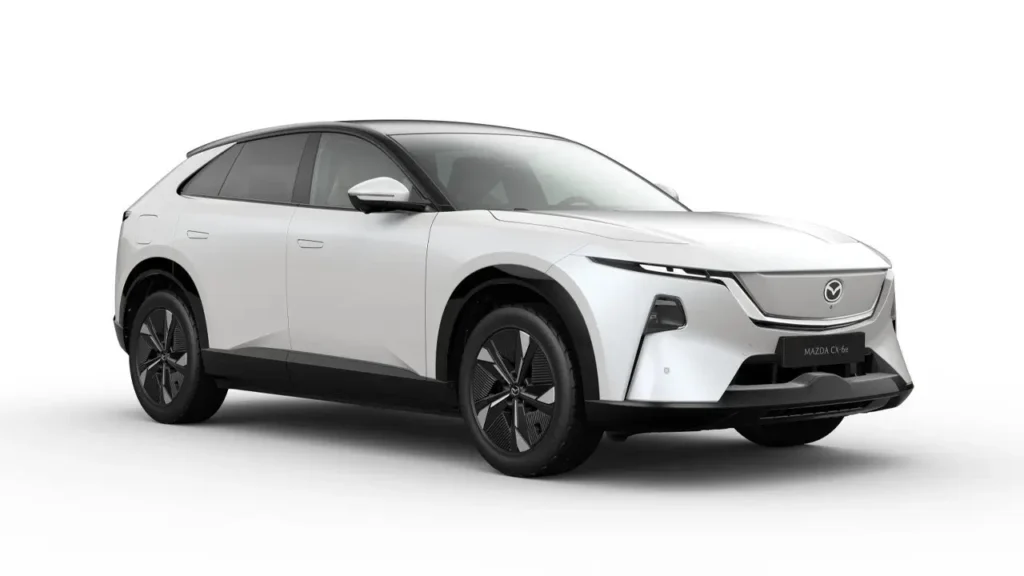
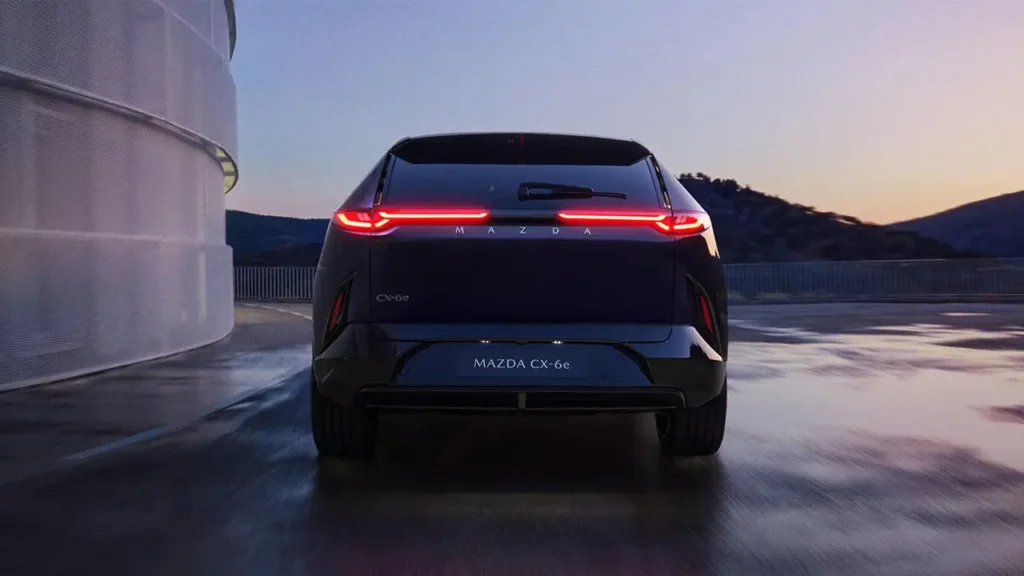
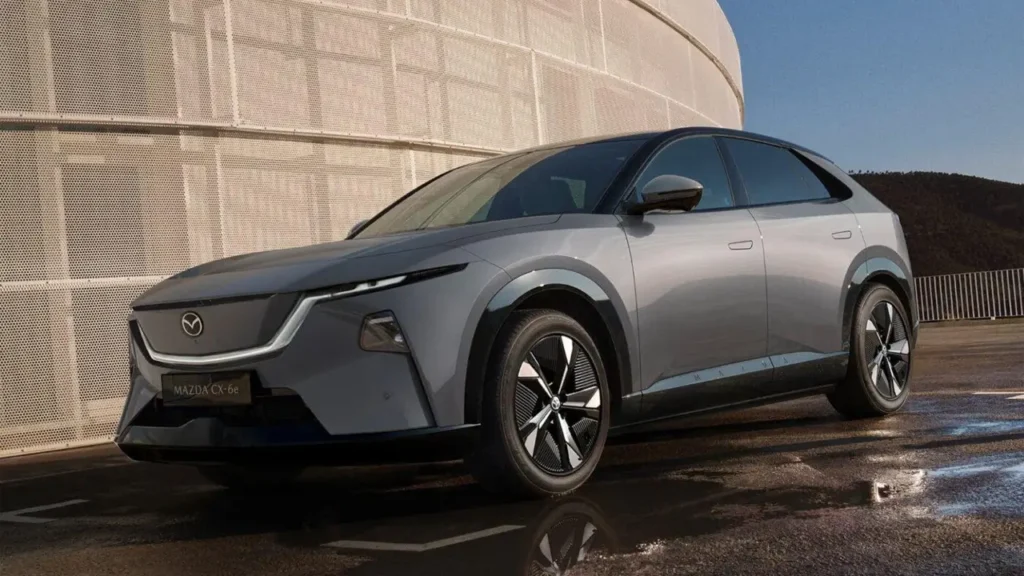
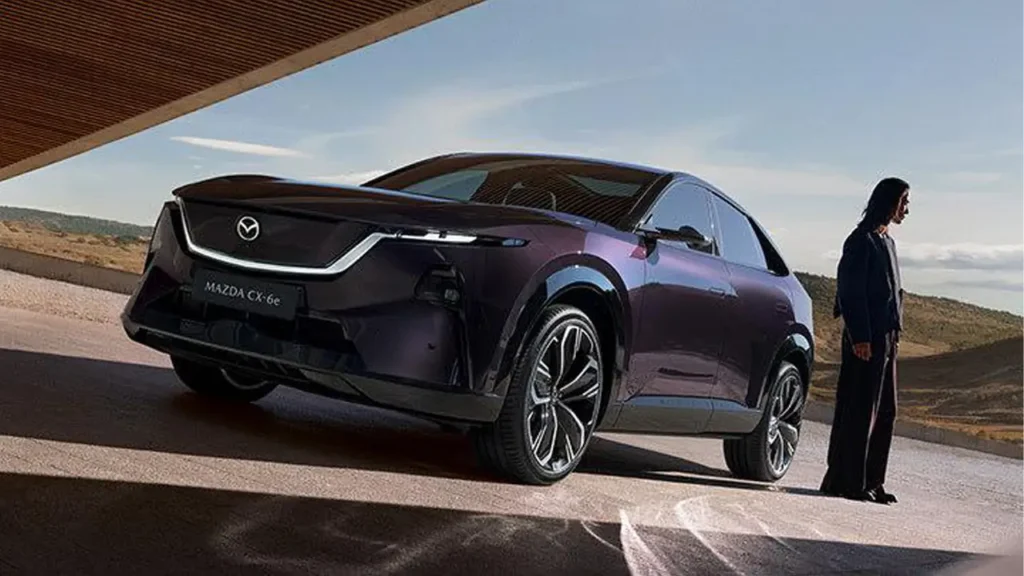
In terms of exterior design, the CX-6e follows Mazda’s Kodo design language while adapting to the requirements of new energy vehicles. The front adopts a closed grille layout with an illuminated Mazda badge, split headlamp clusters, and slim daytime running lights. Hidden door handles, electronic side mirrors, and aerodynamic channels built into the D-pillars and front bumper all contribute to a modern, distinctly premium appearance that is noticeably different from typical mass-market Chinese EVs.
The CX-6e is sold in China under the name EZ-60 and is available in six configurations — three battery electric and three EREV, each named Base, Pro, and Max. The pure-electric EV version uses a larger 77.94 kWh LFP battery pack from CALB, producing the same 190 kW rear motor output with a CLTC range of 600 km.

EREV vs Hybrid China Cars: Why the Range Wins Every Time
When comparing EREV vs hybrid China cars, the distinction is not just technical — it is experiential, and it has enormous implications for how buyers make purchasing decisions.
A conventional PHEV, or plug-in hybrid electric vehicle, typically operates in one of two modes: electric-only up to a certain speed or for short distances, or hybrid mode where the petrol engine and electric motor work in combination. In many PHEVs, once the battery is depleted, the car essentially becomes a conventional petrol car with mild electric assistance. The transition can feel abrupt, and fuel consumption rises considerably once the battery is flat.
An EREV, by contrast, maintains its fundamental electric character throughout the entire driving experience. Because the engine only generates electricity — never driving the wheels — the car always accelerates from its electric motor. The power delivery is linear, smooth, and instant, regardless of battery state. Even when running on the range extender, the vehicle feels nothing like a petrol car.
For Chinese consumers specifically, this matters because driving style and road conditions in China favor electric torque delivery. Urban stop-and-go traffic, expressway cruising, and the psychological preference among younger Chinese buyers for a “tech-forward” driving feel all align naturally with the EREV architecture. The EREV wins over the conventional hybrid on range, feel, and image — and in China’s current market, image counts for a great deal.
On total driving range, the advantage is clear. A standard PHEV might offer 70 to 130 km of pure electric range and 1,000 to 1,100 km combined. The Mazda CX-6e EREV delivers 200 km of pure electric range and up to 1,300 km combined — a meaningful improvement over conventional plug-in hybrids, achieved through the more efficient, single-source electric drivetrain architecture.
Mazda CX-6e EREV vs BYD DM-i vs Li Auto L7: The Real Competition
No discussion of EREV vs BYD DM-i is complete without acknowledging what BYD has achieved with its fifth-generation DM hybrid technology. BYD’s Super DM, or Dual Mode, system is a parallel hybrid architecture where both the electric motor and the petrol engine can drive the wheels. It is extremely fuel-efficient, with consumption as low as 3.9 litres per 100 km in depleted-battery mode, and the latest Song L DM-i delivers up to 1,630 km of combined range with 200 km of pure electric driving.
However, BYD’s DM-i system, while technically impressive, delivers a driving experience that differs from a pure EREV. In high-demand driving scenarios, the engine engages with the drivetrain directly, which some drivers find less seamless than a fully decoupled EREV system. BYD has largely addressed this through software refinement in the fifth-generation system, but the fundamental architecture remains a parallel hybrid rather than a true serial EREV.
The Li Auto vs Mazda CX-6e comparison is perhaps the more instructive one for understanding market positioning. Li Auto pioneered the premium EREV segment in China with its L-series SUVs and has built an enormously loyal customer base around the concept of a luxury, family-oriented EREV. The Li Auto L7, the company’s five-seat flagship, uses a 52.3 kWh battery pack delivering up to 286 km of pure electric range and up to 1,421 km of combined range under CLTC standards. Its dual-motor system produces 330 kW of combined output with a 0 to 100 km/h time of 5.3 seconds. The L7 starts at approximately 42,000 USD in China.
The Mazda CX-6e sits in a very different price bracket, starting from approximately 17,000 to 20,500 USD in China — roughly half the cost of an entry-level Li Auto L7. This means Mazda is not directly competing with Li Auto for the same buyer. Instead, Mazda is targeting the middle market: buyers who want the credibility and comfort associated with a Japanese premium brand, the practicality of an EREV drivetrain, and a price point that does not require a premium-segment budget.
Below is a technology comparison of the three key players in the Chinese EREV and advanced hybrid SUV space:
| Model | EV Range (CLTC) | Combined Range | Starting Price (USD) | Segment | System Type |
|---|---|---|---|---|---|
| Mazda CX-6e (EZ-60) EREV | ~200 km | ~1,300 km | ~17,000 | Mid-size SUV | Serial EREV |
| BYD Song L DM-i | ~200 km | ~1,630 km | ~14,000 | Mid-size SUV | Parallel PHEV (DM) |
| Li Auto L7 (2025) | ~286 km | ~1,421 km | ~42,000 | Premium SUV | Serial EREV |
What this table makes immediately clear is that the Mazda CX-6e EREV occupies a unique market gap: a genuine serial EREV at a mass-market price point, positioned between the budget-focused BYD and the premium-focused Li Auto. That is, strategically speaking, a very deliberate place to be.
Mazda CX-6e Price China and Market Positioning
The Mazda CX-6e price China figures are one of the most surprising and strategically important elements of this vehicle’s launch. The EZ-60 — as it is sold domestically — launched in September 2025 with prices ranging from 119,900 to 160,900 yuan, equivalent to approximately 17,000 to 22,600 USD. The EREV trims start from 119,900 yuan, or roughly 16,800 USD at launch pricing, while the pure-electric EV trims command a small premium starting from 139,900 yuan, or approximately 19,600 USD.
In April 2026, ahead of the Beijing Auto Show, Mazda launched a special “Year of the Horse” edition of the CX-6e, with the EREV trim priced from 139,900 yuan and the EV trim from 145,900 yuan. These updated prices place the CX-6e firmly in the heart of China’s most competitive new energy vehicle price band — a segment where BYD, Changan, Geely, and dozens of emerging Chinese brands fight fiercely every month.
For context, a foreign brand selling a legitimate EREV SUV at under 20,000 USD would have been essentially unthinkable three years ago. The only way Mazda can achieve this price point is through deep localization — using a Chinese partner’s platform, Chinese battery suppliers, and Chinese manufacturing. This is not a compromise; it is the strategy.
The positioning is clever. Mazda retains genuine brand equity in China among buyers who associate the name with build quality, refined driving dynamics, and tasteful design. The CX-6e delivers all of those things — but now also delivers the new energy technology that Chinese consumers increasingly require before even considering a purchase. By pricing the vehicle aggressively, Mazda is not trying to be a niche premium player. It is aiming squarely at volume.
BestChina3DPrinters
Expert Reviews & Rankings
Independent 3D Printer Reviews
Your trusted source for Chinese 3D printer reviews, rankings, and comparisons. We buy, test, and review every printer so you can make informed decisions.
Foreign Brands China EV Strategy: What Mazda Is Telling the Industry
The Mazda CX-6e EREV China launch is part of a much broader shift in how foreign brands approach China’s EV market. The old model — design a car in Europe or Japan, ship it to China or assemble it there with minimal local adaptation — is effectively dead. The new model is what industry analysts have started calling the “joint venture in reverse.”
For decades, Chinese automakers needed foreign brands for their technology, their brand recognition, and their manufacturing expertise. Today, the dynamic has partially reversed. Foreign brands are seeking out Chinese joint venture partners for their technology, their EV platforms, their battery supply chains, and their ability to develop and launch vehicles at “China speed” — a development cycle that can compress a five-year program into 18 months.
The Mazda EZ-60, which became the CX-6e, is a direct product of this model. Developed by the Changan Mazda joint venture, built on Changan’s EPA1 platform, using batteries from CATL-Changan — the vehicle reflects deep Chinese technological and industrial input. Mazda contributed its design language, its brand identity, and its quality standards. Changan contributed the platform, the drivetrain expertise, and the manufacturing capacity.
This approach is not unique to Mazda. By 2025, Volkswagen was co-developing software with XPeng, Audi was collaborating with Huawei on autonomous driving, and Toyota had committed to producing Lexus EVs in Shanghai at Chinese development speed. Models like the Nissan N7 and the SAIC Audi E5 were similarly developed on joint venture partners’ platforms. The Mazda EZ-60 sits in distinguished company.
In May 2025, Mazda took an even more explicit step, announcing a 1.4 billion USD investment in its Changan joint venture, targeting a doubling of production capacity primarily for export purposes, with an annual export value target of 1.4 billion USD. This signals that Mazda views the Changan partnership not just as a vehicle for surviving the Chinese domestic market, but as a global manufacturing and export platform. The CX-6e, sold as such in Europe and Australia, is already proving this strategy viable.
The McKinsey 2025 China Auto Consumer Insights report identified a key theme underpinning this entire shift: for automakers operating in China, the winning formula is to combine a globalized brand platform with deeply localized product scenarios, because there is no one-size-fits-all approach in the smart EV era. Mazda appears to have taken that lesson seriously.
Mazda Electric SUV China: Strengths and Weaknesses
Every vehicle has its case for and against, and the Mazda CX-6e EREV China is no exception. Let us be honest about both sides.
On the positive side, the CX-6e offers a genuinely compelling package for Chinese buyers who want something different from the domestic norm. The Kodo design language gives the vehicle a distinct visual identity that stands apart from the somewhat homogenized look of many Chinese-brand EVs. The EREV architecture delivers smooth, consistent electric-character driving with minimal range anxiety. With up to 1,300 km of combined range, the CX-6e covers virtually any real-world driving scenario a Chinese family will encounter. The use of CATL-affiliated battery chemistry and Changan’s proven EPA1 platform gives buyers confidence in the reliability of the drivetrain. And the price, starting under 17,000 USD, makes the technology genuinely accessible at scale.
The CX-6e’s 31.73 kWh battery, while smaller than what you find in a Li Auto L7, is appropriate for the EREV architecture — because the range extender compensates so effectively that the absolute battery size becomes less important than in a pure EV. The 200 km of pure electric range is sufficient for the vast majority of daily driving cycles in Chinese cities, where the average commute does not exceed 50 km.
On the challenging side, the CX-6e faces fierce competition from deeply established Chinese brands in the same price band. BYD’s Song L DM-i offers similar range performance at a lower starting price, backed by a far more extensive dealer and service network across China. EREV vs BYD DM-i comparisons will always raise this price sensitivity question, and Mazda does not have an easy answer beyond brand cachet.
The CX-6e’s smart technology ecosystem is another potential vulnerability. Chinese consumers in 2025 expect sophisticated voice control, over-the-air updates, intelligent driving assistance, and deep integration with domestic apps and services. Li Auto’s MIND GPT, BYD’s DiLink system, and the smart cockpit features of brands like Xpeng and Huawei-backed vehicles have set an extremely high bar. Mazda’s infotainment and smart features, while improved, are not perceived as market-leading in this space.
There is also the broader structural challenge: according to industry analysis from Automobility, German OEMs fell 6.8% year-on-year in China through Q3 2025, and Japanese brands declined 3.2%. While Mazda is making the right moves, it is swimming against a strong current. Brand trust in foreign names has eroded among younger Chinese buyers, who increasingly see domestic brands like BYD, Li Auto, Huawei-backed Aito, and Xiaomi as the prestige choices of the modern era — not legacy imports.
Conclusion: Mazda CX-6e EREV China Is a Signal Worth Watching
The Mazda CX-6e EREV China story is, ultimately, bigger than one car. It is a case study in how a foreign legacy automaker can adapt, survive, and potentially thrive in the world’s most demanding automotive market — if it is willing to abandon old assumptions and play by new rules.
By embracing the Changan partnership fully, adopting the EPA1 platform, pricing the vehicle aggressively, and delivering an EREV product that meets Chinese consumers where they actually are, Mazda has done something that many foreign brands have struggled to do: it has produced a vehicle that is genuinely competitive, not just nominally present, in the Chinese market.
The CX-6e is already proving its international utility. Exports have begun to Australia and Europe, where it carries the CX-6e nameplate and competes against a very different set of rivals. In those markets, the EREV variant — which remains China-exclusive for now — is particularly relevant, as charging infrastructure gaps mirror exactly the concerns that drove Chinese consumers toward EREV in the first place.
The broader question is whether Mazda’s approach can be replicated at scale, and whether brand loyalty can be rebuilt in a market where Chinese brands hold nearly 70% share and are improving rapidly. The data from analysts at AlixPartners and McKinsey suggest that foreign brands face a structural disadvantage in China’s domestic NEV market that will not reverse quickly, regardless of product quality. China’s automotive competitive advantages — platform speed, battery supply chain depth, software ecosystem integration — are systemic, not temporary.
And yet, the CX-6e EREV shows that foreign brands are not powerless. With the right partner, the right platform, the right price, and the right technology, there is still a lane to drive in. Mazda used to promise zoom-zoom. In China today, it is making a different, quieter, but equally serious promise: range-range.
For more deep dives into China’s most interesting new energy vehicles and the industry dynamics shaping the global automotive future, visit www.autochina.blog
- 🇬🇧 English
This article about Mazda CX-6e EREV China is incredibly insightful. The comparison with BYD and Li Auto is clear and useful. I really like how autochina.blog explains complex EV strategies in a simple way. Definitely one of the best sources for Chinese car market analysis!
- 🇪🇸 Español
El artículo sobre Mazda CX-6e EREV China está muy bien explicado. La comparación con BYD y Li Auto es muy clara. autochina.blog ofrece contenido profesional pero fácil de entender. Sin duda, una excelente fuente sobre coches chinos y tecnología eléctrica.
- 🇸🇦 العربية
المقال عن Mazda CX-6e EREV China رائع ومفيد للغاية. التحليل واضح خاصة عند مقارنة BYD و Li Auto. موقع autochina.blog يقدم معلومات احترافية بطريقة سهلة الفهم. أنصح به لكل من يهتم بالسيارات الكهربائية في الصين.
- 🇨🇳 中文
关于 Mazda CX-6e EREV China 的文章非常专业且易于理解。与比亚迪和理想汽车的对比分析很有价值。autochina.blog 提供了高质量的中国汽车市场内容,是了解新能源趋势的绝佳平台。
- 🇫🇷 Français
L’article sur Mazda CX-6e EREV China est très intéressant et bien structuré. La comparaison avec BYD et Li Auto est claire et pertinente. autochina.blog propose un contenu de qualité sur les voitures chinoises et les nouvelles technologies électriques.
- 🇩🇪 Deutsch
Der Artikel über Mazda CX-6e EREV China ist sehr informativ und gut erklärt. Der Vergleich mit BYD und Li Auto ist besonders hilfreich. autochina.blog ist eine hervorragende Quelle für aktuelle Trends im chinesischen Automarkt.
Discover more from AutoChina
Subscribe to get the latest posts sent to your email.

