If you’ve been following the rapid evolution of autonomous driving technology, you’ve probably noticed that LiDAR — the laser-based sensing technology that allows vehicles to “see” the world in three dimensions — is going through a genuine revolution. For years, LiDAR systems were bulky, expensive, and largely reserved for robotaxis and experimental platforms. Today, that narrative is changing fast, and one of the biggest catalysts for that change is the RoboSense Eocene SPAD-SoC LiDAR platform.
Unveiled at RoboSense’s 2026 Tech Day in Shenzhen, Eocene represents something quite different from a typical product launch — it is a foundational architectural shift that could reshape how LiDAR is developed, manufactured, and deployed in mass-market vehicles around the world. Let’s dig into what makes it special and why it matters for the future of chip-level LiDAR ADAS technology.
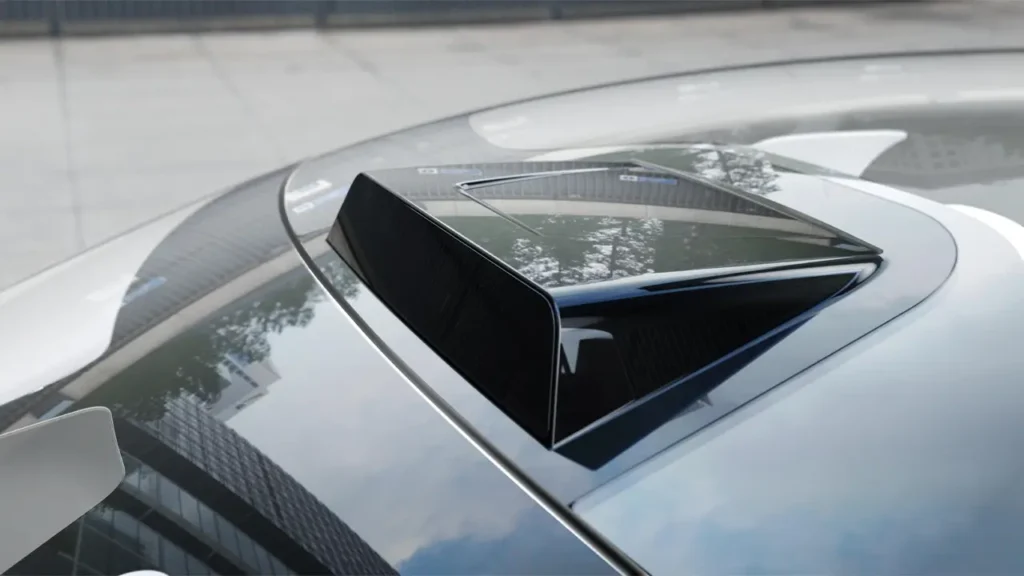
What Is SPAD-SoC LiDAR Technology?
Before diving into Eocene’s specifics, it helps to understand the underlying technology it is built on. SPAD stands for Single-Photon Avalanche Diode — a type of photodetector capable of detecting individual photons of light with extraordinary sensitivity. In a LiDAR system, the sensor fires laser pulses toward the environment and waits for the reflected light to return. The faster and more sensitively it can detect that returning light, the more accurately it can measure distance and build a detailed 3D map of the surroundings.
Traditional LiDAR systems relied on discrete, separately assembled components — individual transmitters, receivers, and processors each designed independently and then connected together. This approach worked, but it introduced complexity, added cost, and made miniaturization difficult. The SPAD SoC LiDAR technology approach changes that fundamentally by integrating the SPAD photodetector array and the signal processing System-on-Chip into a single unified semiconductor. Think of it like the difference between assembling a desktop computer from separate components versus having everything integrated into a sleek, compact mobile processor. The result is a smaller physical footprint, lower power consumption, higher performance, and — critically for automotive applications — dramatically reduced manufacturing cost per unit.
This is exactly what SPAD SoC LiDAR technology promises to deliver at scale, and RoboSense has now codified its own approach to this paradigm under the Eocene architecture name. It is a platform play, not just a product launch, and that distinction matters enormously for the long-term competitive landscape of the industry.
BestChina3DPrinters
Expert Reviews & Rankings
Independent 3D Printer Reviews
Your trusted source for Chinese 3D printer reviews, rankings, and comparisons. We buy, test, and review every printer so you can make informed decisions.
Architecture of the RoboSense Eocene SPAD-SoC Platform
RoboSense introduced Eocene as a platform designed to mark a fundamental transition from discrete technical breakthroughs to a scalable, repeatable production model. By codifying nine years of full-stack experience into a standardized research and development paradigm, the architecture enables the rapid incubation of a high-performance SoC portfolio while establishing what the company describes as a systematic competitive barrier through efficient, structured innovation.
The name itself carries symbolic weight — Eocene refers to a geological epoch defined by the dawn of new life forms, a fitting metaphor for what RoboSense sees as the beginning of a new era in 3D perception technology.
In terms of RoboSense Eocene specs, the architecture is built on four core functional layers. The first is the Fundamental Process Layer, which uses a unified 28nm advanced process node with automotive-grade design, featuring a third-generation ultra-sensitivity SPAD with a world-leading 45% Photon Detection Efficiency (PDE) and a second-generation 3D-stacking process delivered via wafer-level hybrid bonding. A 45% PDE means nearly half of all photons hitting the detector are successfully registered — an exceptional figure that enables highly reliable detection even at long range and in challenging lighting or weather conditions.
The second is the Core Computational Layer, which consists of a configurable 4,320-core heterogeneous compute array powered by a high-bandwidth network-on-chip supporting 495 billion point-cloud samplings per second and an up to thousand-beam ultra-HD perception enhancement engine. Processing nearly half a trillion point-cloud samples per second in real time is a remarkable computational achievement that enables the kind of dense, high-resolution 3D imaging that advanced ADAS systems demand.
The two remaining layers handle signal transmission and system management, ensuring the entire chip stack meets the rigorous reliability and functional safety standards required for deployment in production vehicles. All of this is packaged under the automotive-grade manufacturing norms that regulators and OEMs expect, including extended temperature range operation and resistance to vibration and electromagnetic interference.
Built on top of this architecture, RoboSense introduced two flagship chipsets at the 2026 Tech Day event. The Phoenix chipset is the industry’s first automotive-grade monolithic SPAD-SoC, delivering 2,160-beam image-grade output to establish a new benchmark for high-definition 3D perception in the automotive sector. The Peacock chipset, by contrast, is a fully solid-state, ultra-large array SPAD-SoC designed specifically for robotics applications, propelling that industry into the era of image-grade 3D perception as well.
Why Chip-Level Integration Matters for LiDAR
One of the most exciting aspects of solid-state LiDAR chip integration is what it enables beyond just better performance numbers. When you consolidate the sensing, signal processing, and output functions of a LiDAR system into a single monolithic chip, you fundamentally change the economics and engineering dynamics of the entire product.
First, there is the supply chain simplification. Instead of sourcing and assembling dozens of discrete components — each with its own vendor, qualification process, and failure mode — you are dealing with a single integrated part. For automotive manufacturers who are obsessed with reliability, repeatability, and cost predictability across millions of units, this is hugely appealing.
Second, there is the performance benefit. When the SPAD array and the processing logic are physically co-located on the same die and connected through high-bandwidth on-chip interconnects, latency drops dramatically compared to systems where signals must travel off-chip to a separate processor. Lower latency means faster response to dynamic road conditions — a direct safety benefit in real ADAS deployment.
Third, and perhaps most importantly for the Chinese EV market and global automotive industry alike, there is the cost reduction trajectory. In semiconductor manufacturing, once a chip design is mature and moving through high-volume production lines, the cost per unit follows well-understood learning curves downward. The more chips you make, the cheaper each one becomes. By architecting Eocene as a platform that can spawn multiple chip variants from a shared production foundation, RoboSense has positioned itself to ride those learning curves across a wide range of products simultaneously, compressing the timeline to affordable, widespread solid-state LiDAR chip integration in consumer vehicles.
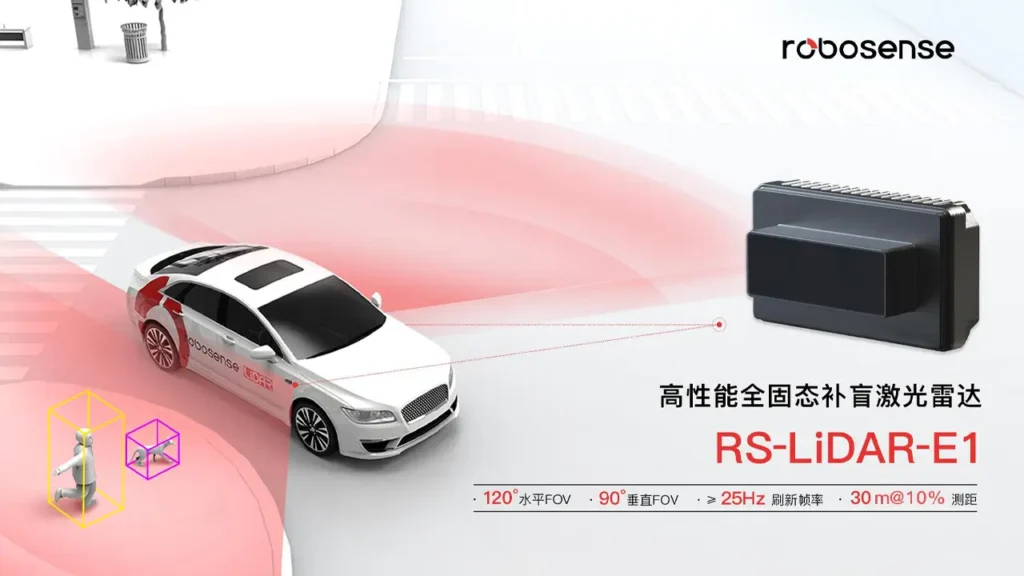
Cost Disruption in Automotive LiDAR
LiDAR cost reduction for automotive applications has been one of the defining challenges of the industry for over a decade. Early spinning LiDAR units used on autonomous research vehicles cost tens of thousands of dollars each — clearly unsuitable for mass-market consumer cars. The transition to solid-state designs brought costs down into the hundreds of dollars range, but even that remained a meaningful barrier to widespread adoption across entry-level and mid-range vehicles.
RoboSense’s approach with Eocene directly attacks this cost structure at the silicon level. By standardizing on a 28nm process node shared across all chipsets in the portfolio, the company can amortize its chip development and fabrication costs across a much larger volume of production. The wafer-level hybrid bonding used in the 3D-stacking process further reduces assembly complexity compared to conventional packaging approaches, cutting both material costs and manufacturing cycle time.
From a business standpoint, the structural cost advantage of chip-level integration is not just about producing cheaper LiDAR units. It is about making the cost reduction durable and defensible over time. A company that controls its own chip architecture can optimize it continuously, iterating on each generation to squeeze out more performance per dollar spent. Companies that rely on third-party sensor components, by contrast, have limited ability to influence their own cost trajectory.
RoboSense reported its first-ever profitable quarter in Q4 2025, achieving a net profit of 103.7 million yuan. That milestone coincides with exactly this kind of chip-level cost optimization taking hold across its product portfolio, suggesting the Eocene platform is not just a technical showcase but a commercially validated direction for the business.
Comparison — Huawei 896-Line LiDAR vs RoboSense Eocene
The Huawei 896-line LiDAR comparison is an instructive exercise, because both companies are pushing the boundaries of what mass-produced automotive LiDAR can do — but from very different directions and with very different strategies.
Huawei unveiled its 896-line dual-optical-path image-grade LiDAR at the HarmonyOS Smart Driving Technology Innovation event in March 2026, claiming the distinction of being the world’s highest-specification LiDAR currently in mass production. The system uses a dual-optical-path architecture, integrating two laser receiving units with different focal lengths — one wide-angle for situational awareness and one telephoto for long-distance detail. This design quadruples resolution compared to previous 192-line systems and enables the detection of obstacles as small as 14 centimeters in height from 120 meters away, including low-reflectivity targets like fallen traffic cones and flat tires.
That is genuinely impressive engineering. The AITO M9 and Maextro S800 are the first vehicles to carry this system, with additional models from AVATR and Voyah also confirmed to adopt it. The price point of those vehicles — the AITO M9 retails from approximately 479,800 yuan — signals that the 896-line system is currently positioned in the premium segment.
RoboSense’s Eocene platform, by contrast, takes a chip-architecture-first approach that prioritizes scalability and cost accessibility. The Phoenix chipset delivers 2,160-beam image-grade output as an automotive-grade monolithic SoC, which means its performance can in principle be deployed at much lower bill-of-materials cost than a module-based system like Huawei’s. Where Huawei’s strength lies in squeezing maximum resolution and range out of a sophisticated dual-optical module designed for luxury vehicles, RoboSense is engineering a foundation that can scale from premium to mainstream vehicles without requiring a completely different product architecture.
In short, both systems are advancing the industry’s transition to image-grade LiDAR perception, but they represent complementary strategies. Huawei is leading on resolution at the top of the market; RoboSense is building the infrastructure to make similar-caliber perception affordable across a broader range of vehicles.
Advanced Polymer Engineering Solutions

Discover modern polymer technologies, industrial materials, and engineering solutions designed for high-performance manufacturing and innovative industries.
Visit Polimerukr.com →
Market Positioning vs Hesai FT120
The Hesai FT120 versus RoboSense comparison highlights a different dimension of the competitive landscape — the battle for volume in the ADAS supplementary sensor market.
Hesai’s FT120, introduced in late 2022, was designed as a fully solid-state near-range blind-spot LiDAR. It features a 100-degree by 75-degree ultra-wide field of view, a maximum detection range of 100 meters, a resolution of 160 by 120, and a data rate of 192,000 points per second. With no moving parts and a compact form factor that can be embedded in fenders, grilles, or bumpers, the FT120 was purpose-built for ADAS series production vehicles that need supplementary coverage around the vehicle perimeter. By the time of its official launch, the FT120 had already secured pre-orders exceeding one million units from leading OEMs — a remarkable early-stage commercial achievement that demonstrated genuine market demand for affordable solid-state gap-filling LiDAR.
The Polestar 01 became one of the first production vehicles to deploy the FT120, equipping the car with one Hesai AT128 front LiDAR and two FT120 side units — a configuration that provides comprehensive 360-degree LiDAR coverage for a production passenger vehicle.
RoboSense, for its part, has built a multi-platform portfolio that competes across different segments of the ADAS sensor market. While Hesai’s FT120 established the template for affordable supplementary LiDAR, RoboSense’s Eocene-based chipsets are positioned to offer a next-generation alternative that can match or exceed the FT120’s coverage function while delivering the image-grade resolution and chip-level cost structure needed for the next wave of ADAS sensor evolution. The Phoenix chipset’s 2,160-beam output represents a resolution class that simply was not achievable in mass-production LiDAR when the FT120 was designed, illustrating how rapidly the baseline performance expectation has shifted in just a few years.
Role in the Chinese EV Ecosystem
Chinese EV LiDAR systems have become a genuinely global story, with Chinese manufacturers not just supplying their domestic market but setting the pace of innovation for the entire automotive industry worldwide. RoboSense occupies a central position in this ecosystem, having partnered with over 310 automotive brands and Tier-1 suppliers globally. As of 2025, the company ranked first in LiDAR market share in the robotics sector and has secured design wins from top-tier global automakers for its new Eocene-based Phoenix chipset.
The Chinese EV market’s unique characteristics make it an ideal proving ground for advanced LiDAR technology. Chinese consumers have shown a strong appetite for vehicles loaded with advanced smart driving features, and Chinese automakers have responded by specifying more sensors per vehicle than their counterparts in other markets. This high-volume, feature-rich environment provides exactly the production scale needed to drive down LiDAR costs along learning curves that ultimately benefit the global market.
It is telling that the competitive intensity in Chinese automotive LiDAR — with RoboSense, Hesai, Huawei Intelligent Automotive Solutions, and others all pushing new technology to market within weeks of each other — has produced a pace of innovation that would be difficult to replicate anywhere else. The Eocene platform launch at RoboSense’s 2026 Tech Day came just days after a competing tech event from Hesai, itself an indication of how seriously these companies take the race to define the next generation of perception infrastructure for smart vehicles.
Beyond automotive, RoboSense has extended its technology into robotic manipulation, launching robotic vision systems, dexterous hands, and hand-eye coordination solutions. The Peacock chipset targets this robotics sector directly, bringing image-grade 3D perception to logistics robots, autonomous lawn mowers, humanoid robots, and other physical AI platforms that are proliferating rapidly in China and globally.
Impact on ADAS Scalability and Sensor Cost Optimization
ADAS sensor cost optimization is arguably the most consequential dimension of what the Eocene platform represents for the broader automotive industry. The challenge of scaling ADAS from the luxury segment to mainstream vehicles has always been fundamentally an economics problem: the sensors that enable genuine highway pilot, automated parking, and urban navigate-on-autopilot functions need to cost tens of dollars, not hundreds, before they can be standard equipment on a 25,000-dollar family sedan.
The chip-level architecture of Eocene directly addresses this bottleneck. By building the entire LiDAR sensing and processing stack into a single automotive-grade SoC manufactured on a 28nm process node, RoboSense creates the conditions under which the cost per unit can compress dramatically as production volumes scale. The 4,320-core heterogeneous compute array embedded in the chip handles perception enhancement functions that would otherwise require an expensive external processor, further simplifying the bill of materials at the system level.
For ADAS system integrators and OEM engineering teams, this changes the design calculus significantly. Instead of budgeting for a LiDAR subsystem that includes the sensor head, a separate signal processing module, and the associated wiring and calibration hardware, they can work with a much more compact, integrated solution. Fewer components mean fewer failure modes, simpler vehicle integration, lower warranty risk, and ultimately a more confident path toward the volume production targets needed to hit mainstream price points.
The 495 billion point-cloud samplings per second processing capability built into the Eocene compute layer is also noteworthy in this context. High-throughput on-chip processing means the raw point cloud data can be filtered, enhanced, and structured before it even leaves the LiDAR unit, reducing the computational burden on the vehicle’s central domain controller. In an era where automakers are already straining their onboard compute budgets with camera vision, radar, and AI inference workloads, offloading perception processing to the LiDAR sensor itself is a meaningful system-level contribution.
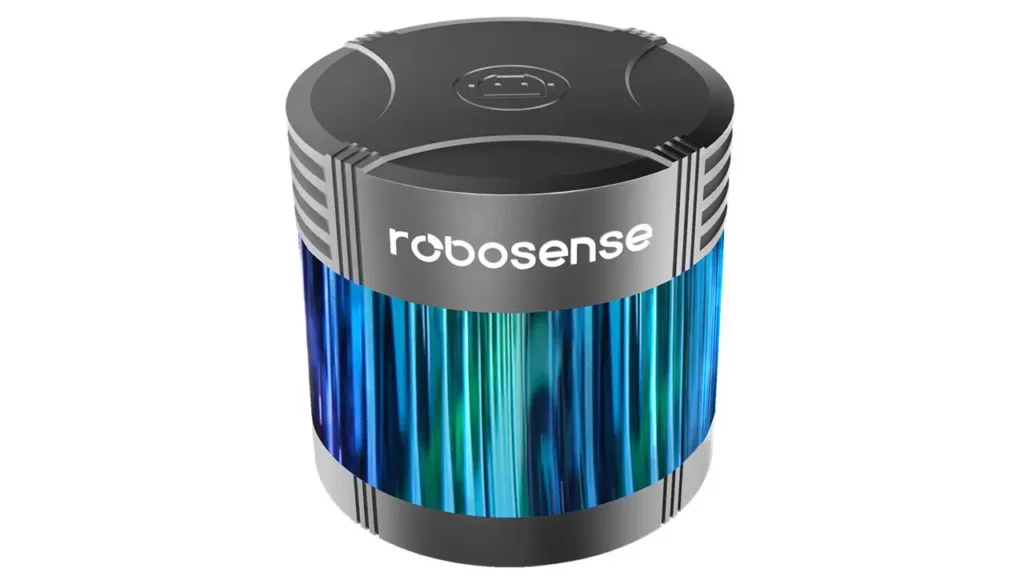
Future Outlook and Mass Production Potential
Looking ahead, the automotive LiDAR mass production landscape is entering what may be its most consequential period. The convergence of chip-level integration, advanced SPAD photodetector technology, and mature 28nm semiconductor manufacturing processes creates a pathway toward LiDAR being as ubiquitous in vehicles as radar is today — a standard component specified across entire model ranges rather than a premium differentiator reserved for flagship trims.
RoboSense has already signaled its ambitions in this direction. The company is developing an RGBD sensor — combining Red, Green, Blue color imaging with depth data — that is planned for official release by the end of 2027. This product would fuse the high-density spatial data from Eocene-based Peacock chipsets with color filter array technology, creating a sensor capable of delivering colorized 3D point clouds that could dramatically simplify the perception pipeline for both autonomous driving and robotics applications.
Deutsche Bank analysts described the Eocene platform launch as marking a paradigm shift in 3D perception technology, noting that it solidifies RoboSense’s position as the architect of the industry’s next technological cycle. The new Phoenix chipset has already secured design wins from top global automakers, which indicates that the technology is not merely a research demonstration but a product heading toward actual production vehicle deployment.
The broader trajectory is clear: the LiDAR industry is transitioning from an era dominated by analog architectures and module-based assemblies toward a digital imaging architecture built on chip-level SoC integration. Companies like RoboSense, Hesai, and Huawei’s automotive division are each staking out positions in this new landscape, and the competition between them is accelerating the pace of improvement in performance, integration, and cost accessibility simultaneously.
For consumers, this ultimately means that the kind of rich 3D environmental sensing that makes advanced autonomous driving functions possible will reach vehicles at lower price points, sooner than most industry observers expected even a few years ago. The RoboSense Eocene SPAD-SoC LiDAR platform is not just a technical milestone for one company — it is a signal that the infrastructure for widespread ADAS adoption is genuinely coming together.
LiDAR System Comparison Table
| LiDAR System | Resolution / Beams | Range (m) | Cost Level | Integration Type |
|---|---|---|---|---|
| RoboSense Eocene (Phoenix) | 2,160-beam image-grade (SPAD-based) | 200+ | Low (chip-level) | Monolithic SoC |
| Huawei Qiankun 896-Line | 896-line ultra-high (dual-optical path) | 120–162 | High (premium segment) | Module-based (dual-path) |
| Hesai FT120 | 160 x 120 (192k pts/s) | 100 | Medium (volume ADAS) | Solid-state hybrid |
Conclusion
The RoboSense Eocene SPAD-SoC LiDAR platform is a genuinely exciting development for anyone who cares about where automotive safety technology is headed. By building a scalable chip architecture from the ground up on a 28nm process node, integrating world-leading SPAD photodetection efficiency, and enabling 495 billion point-cloud samplings per second of on-chip processing, RoboSense has created a foundation that could power automotive LiDAR systems from the current generation of premium vehicles all the way down to future mainstream models at accessible price points.
The competition from Huawei’s impressive 896-line dual-optical-path system and the established volume presence of Hesai’s FT120 ensures that no single player will dominate without continuing to innovate. But the Eocene platform’s structural advantages — chip-level cost reduction, unified 28nm process across the entire portfolio, and a proven trajectory toward image-grade perception — make RoboSense a compelling force in shaping what automotive LiDAR looks like in the second half of this decade. The era of image-grade 3D perception for mass-market vehicles is approaching faster than many expected, and Eocene is one of the clearest signals yet that it is almost here.
🇬🇧 English
Great breakdown of RoboSense Eocene SPAD-SoC LiDAR! The article explains complex tech in a simple, engaging way. Loved how it connects LiDAR innovation with real-world ADAS impact. autochina.blog is quickly becoming my go-to source for Chinese automotive tech.
🇪🇸 Español
Excelente análisis del RoboSense Eocene SPAD-SoC LiDAR. La información es clara, moderna y muy útil para entender el futuro del ADAS. autochina.blog ofrece contenido de alta calidad que realmente destaca en el mundo automotriz.
🇸🇦 العربية
مقال رائع يشرح تقنية RoboSense Eocene SPAD-SoC LiDAR بطريقة سهلة ومفهومة. المحتوى احترافي ويعطي رؤية واضحة لمستقبل أنظمة ADAS. موقع autochina.blog أصبح من أفضل المصادر لدي.
🇨🇳 中文
这篇关于RoboSense Eocene SPAD-SoC LiDAR的文章非常专业且易于理解。内容清晰地解释了激光雷达如何改变ADAS成本结构。autochina.blog是了解中国汽车科技的优秀平台。
🇫🇷 Français
Très bon article sur le RoboSense Eocene SPAD-SoC LiDAR. Les explications sont claires et pertinentes, même pour les sujets techniques. autochina.blog propose un contenu moderne et informatif sur l’automobile chinoise.
🇩🇪 Deutsch
Starker Beitrag über RoboSense Eocene SPAD-SoC LiDAR! Komplexe Technologie wird verständlich erklärt und gut strukturiert dargestellt. autochina.blog ist definitiv eine empfehlenswerte Plattform für Auto- und Tech-News.
Discover more from AutoChina
Subscribe to get the latest posts sent to your email.