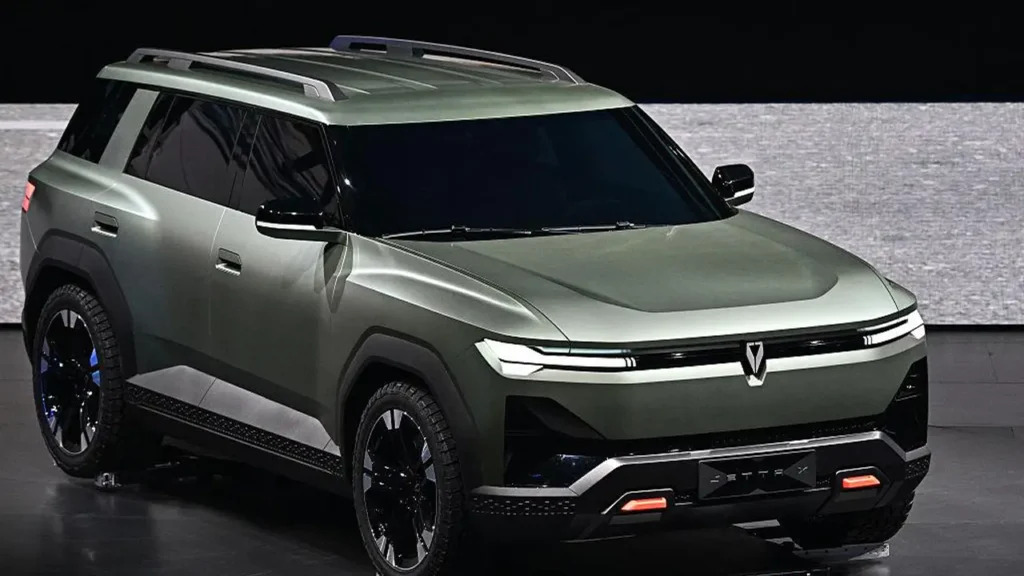
VW Jetta X concept EV. Something remarkable happened at the Beijing Auto Show in April 2026. Volkswagen — a brand almost universally associated with European engineering heritage, modest interiors, and that unmistakable sense of German solidity — arrived with a boxy, rugged-looking electric SUV wearing absolutely no VW badge. It carried the Jetta name instead. And it was aimed squarely at a segment that, just a few years ago, most Western automakers would not have even considered: the sub-$15,000 EV market in China.
The Jetta brand is now targeting the entry-level NEV market priced around 100,000 yuan, approximately $14,660. That single data point tells you everything about the scale of ambition — and the scale of pressure — that Volkswagen is operating under right now in its most important global market.
The Jetta X concept is not merely a car. It is a calculated signal. It tells us where Volkswagen believes the Chinese market is heading, how the group intends to compete against fast-moving domestic rivals, and what the word “affordable” actually means on the world’s most competitive EV battlefield. In this deep-dive, we walk through all of it: the market context, the competitive landscape, the technology choices, the pricing strategy, and ultimately whether this move represents a bold comeback or a very late arrival to a party already in full swing.
The $15,000 Electric Car China Market: How It Became the World’s Most Competitive Segment
To understand why the Jetta X matters, you first need to understand what has happened to China’s affordable EV segment over the last three years. It has essentially rewritten the global rulebook for electric mobility pricing.
The Chinese EV market has compressed what used to take a decade of technology cost reduction into just a few annual model cycles. BYD, SAIC-GM-Wuling, Geely, and dozens of other domestic brands have pushed extraordinary technology — LFP battery chemistry, smart cockpits, fast charging, and basic driver assistance systems — into vehicles priced between $8,000 and $15,000. This was once considered impossible at scale. Today it is the baseline expectation of a young Chinese car buyer.
Compact NEVs are projected to claim half the Chinese market by 2030, according to Volkswagen’s own internal projections. That forecast is not optimism — it is a statement of urgency. The entry-level EV segment in China is not a niche. It is the fastest-growing, most price-sensitive, and most fiercely contested automotive battleground on the planet.
For years, Volkswagen watched this segment develop from the sidelines, focusing its China EV efforts on the mid-range ID. family. The ID.4, ID.6, and related models sold reasonably well initially, but they were positioned above the hottest growth zone in the market. Meanwhile, domestic brands were locking in millions of first-time EV buyers at prices VW simply could not match — until now.
Advanced Polymer Engineering Solutions

Discover modern polymer technologies, industrial materials, and engineering solutions designed for high-performance manufacturing and innovative industries.
Visit Polimerukr.com →
Volkswagen China EV Strategy: The “In China, For China” Transformation
Volkswagen’s response to its China challenge is structural, not cosmetic. The group has launched what it officially calls its “In China, for China” strategy, which goes well beyond adapting existing European models for local tastes. It means building vehicles from the ground up in China, using Chinese technology partners, Chinese supply chains, and Chinese consumer research.
The centrepiece of this strategy is the Volkswagen China Technology Company, known as VCTC, a 100% VW-owned R&D subsidiary based in Hefei, Anhui Province. VCTC has invested 2.5 billion euros into this innovation hub, and it is responsible for two critical new tools: the China Main Platform, or CMP, and the China Electrical Architecture, or CEA.
The CMP is a dedicated electric vehicle platform developed specifically for the Chinese market — not adapted from any European architecture. It is designed to enable cost efficiency at scale, targeting a 40% cost reduction compared to VW’s existing EV platforms for entry-level compact models. The CEA is the software and electronics backbone that sits on top of the CMP, enabling modern digital services, AI-powered smart cockpits, and advanced driver assistance systems.
FAW-Volkswagen — VW’s joint venture with China’s First Auto Works — has announced plans to launch 11 new models from 2026, of which 10 are new energy vehicles. Among those are six battery electric models, two plug-in hybrids, and two extended-range electric vehicles. The CMP platform underpins the BEV and PHEV models, and the Jetta X is expected to ride on precisely this architecture.
To accelerate software development, Volkswagen has also entered a strategic partnership with Xpeng, one of China’s leading smart EV manufacturers. The collaboration gives VW access to Xpeng’s 800-volt platform technology and AI-enhanced driving software — a shortcut that would have taken the German automaker years to develop independently. The ID. Unyx series, developed under this partnership, is one concrete example of the results.
This is not a minor product refresh. It is a fundamental reimagining of how a legacy automaker can compete in a market that has leapfrogged conventional development timelines.
VW Jetta X Concept EV: Cost Structure vs BYD Seagull and SAIC-GM-Wuling Bingo
Positioning the Jetta X at approximately $14,660 places it in one of the most crowded price windows in any automotive market anywhere in the world. To understand the competitive challenge, let’s look at exactly who Volkswagen is up against.
The BYD Seagull launched in 2023 and immediately became a benchmark for what entry-level EVs could deliver. Its 2025 variants are priced from approximately $9,700 to $11,900 in the Chinese market, depending on the trim. It offers a 30 kWh or 38.88 kWh LFP Blade Battery, delivering a CLTC-rated range of 305 km or 405 km respectively.
The Seagull is powered by a 55 kW permanent magnet synchronous motor, supports DC fast charging from 30% to 80% in 30 minutes, and features a 10.1-inch rotatable touchscreen running BYD’s own DiLink connected system. It sold its one-millionth unit in mid-2025 — just two years after launch. This is a vehicle with enormous brand momentum, a loyal customer base, and a dealer network that covers virtually every corner of China.
The Wuling Bingo, manufactured by SAIC-GM-Wuling — a joint venture involving General Motors, SAIC Motor, and Wuling — takes an even more aggressive pricing approach. The base Bingo hatchback starts at around $8,300 to $9,500 depending on the battery option, with a 32 kWh LFP pack and 333 km of CLTC range. The expanded Bingo Plus SUV range, now priced under 90,000 yuan (approximately $12,350), offers 330 km, 401 km, and 510 km variants, all powered by a 75 kW water-cooled motor. Wuling’s brand appeal is particularly strong among young urban buyers and first-time car owners who value low cost of ownership above all else.
Against these two formidable competitors, the Jetta X will need to deliver genuine added value to justify its premium positioning within the same broad segment. Volkswagen is betting that brand trust, build quality, a more mature dealer and service infrastructure, and access to advanced CEA-powered technology can bridge that gap. Whether Chinese consumers agree is the central question the brand must answer.
| Model | Price (USD) | Range (km) | Battery | Key Features | Dealer Network |
|---|---|---|---|---|---|
| VW Jetta X EV | ~$14,660 | 300–400 (est.) | LFP (CMP platform) | CEA architecture, AI cockpit, ADAS, large touchscreen | Strong (FAW-VW CN) |
| BYD Seagull | $9,700–$11,900 | 305–405 | LFP Blade (30–38.88 kWh) | 10.1-inch screen, DiLink OS, 6 airbags, fast charge 30 min | Massive nationwide |
| Wuling Bingo / Bingo Plus | $8,300–$12,350 | 333–510 | LFP (32–51 kWh) | Urban focus, compact design, retro styling, multiple range options | Very dense urban network |
VW Jetta X Concept EV: Platform Sharing Economics and Localization Strategy
One of the most important — and often underappreciated — factors in winning the affordable EV segment is platform economics. Producing a competitive $15,000 electric vehicle is not simply a matter of deciding to build one. It requires manufacturing infrastructure, supply chain relationships, battery sourcing agreements, and an electrical architecture that can spread development costs across multiple models simultaneously.
This is precisely where the CMP platform becomes Volkswagen’s most important strategic asset in China. Unlike the European MEB platform, which was designed for higher price points and Western market expectations, the CMP has been engineered from the outset with the Chinese cost structure in mind. Volkswagen has officially stated that it aims to achieve cost parity with local BEV competitors for entry-level compact models by 2026, with CMP targeting a 40% cost reduction in its vehicle class.
At least four models are planned on the CMP platform from 2026 onward, which means that development and tooling costs are distributed across a meaningful volume base. The Jetta X production vehicle is expected to be among the first of these. Manufacturing will be handled through FAW Volkswagen Jetta Automotive Technology Co., a newly established independent entity based in Chengdu, Sichuan Province. This structure gives the Jetta brand the operational flexibility to make faster decisions, adapt more quickly to local market shifts, and integrate Chinese supply chain partners without waiting for approvals through the slower global VW Group hierarchy.
The CEA architecture adds another layer of cost efficiency. By standardising the digital backbone across multiple models — covering smart cockpit interfaces, over-the-air update capability, connectivity services, and AI-assisted driving features — Volkswagen can spread software development costs broadly, just as domestic Chinese brands have done for years. This is actually the same playbook that made BYD and Xpeng so competitive: invest heavily in a software platform, then amortise it across high volumes.
The Jetta brand’s new independence as FAW Volkswagen Jetta Automotive Technology Co. also enables direct collaboration with local technology suppliers, battery manufacturers, and logistics networks in the Sichuan region — one of China’s most active automotive manufacturing hubs. This is not symbolic. It translates directly into faster procurement cycles and more competitive component pricing.
Technologies and Equipment: Balancing Price and Features
A common misconception about budget EVs is that affordability requires compromise across the board. The Chinese market has largely disproved this assumption, and the Jetta X concept suggests Volkswagen has understood the lesson.
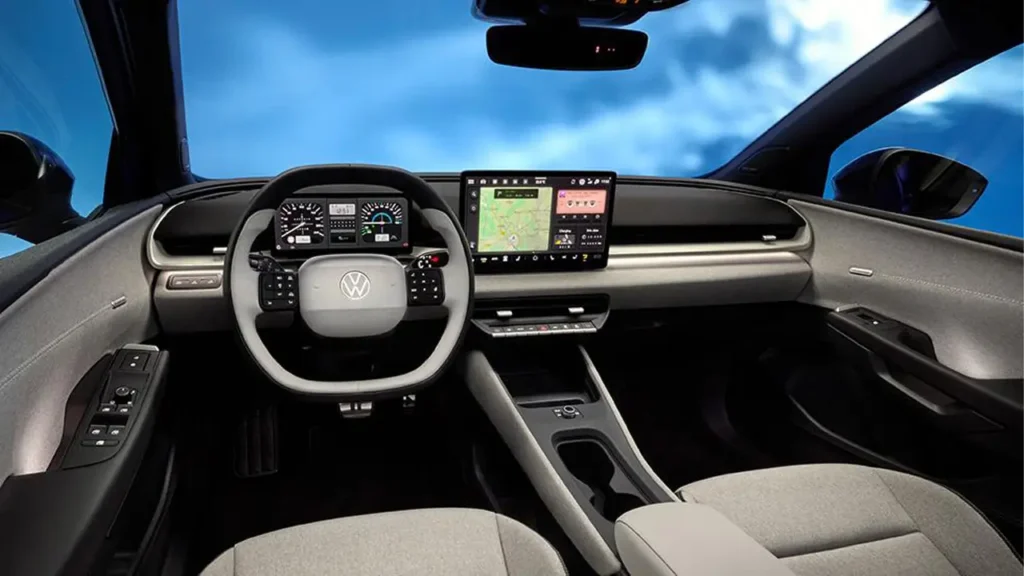
The Jetta X concept interior features a large central touchscreen paired with a secondary passenger display — a configuration that signals a clear commitment to the screen-centric experience that Chinese consumers expect and actively seek. VW Group China CEO Ralf Brandstaetter previously noted publicly that Chinese buyers want AI-first, connected vehicles with seamless voice control and smart cockpits. The Jetta X interior takes this directly on board.
The CEA electrical architecture enables not only infotainment connectivity but also ADAS (Advanced Driver Assistance Systems) functionality. VW’s software arm, Carizon, is enhancing these ADAS solutions with AI for smart driving on both highways and city roads. At a $15,000 price point, offering any meaningful level of driver assistance is itself a competitive statement — it is a feature that until very recently was reserved for vehicles costing significantly more.
The exterior design language, which Volkswagen calls “Modern Robust,” features short overhangs, pronounced fenders, trapezoidal wheel arches with black cladding, narrow LED light signatures front and rear, and a skid-plate trim with distinctive red tow hooks. The concept also introduces an illuminated brand logo for the first time in the Jetta lineup. For a brand that was previously selling dated-looking sedans in China, this is a significant aesthetic leap. The floating roof design and matte forest green body color of the show car signal a deliberate appeal to younger, style-conscious buyers who currently gravitate toward BYD and Wuling products.
Importantly, the interior avoids Volkswagen badges entirely. This is a deliberate brand decision — the Jetta X must stand on its own identity, not lean on parent brand associations that Chinese buyers in this segment may not find compelling.
Budget EV Range in China: What the Numbers Actually Mean
Range is one of the most emotionally loaded specifications in the EV market, but in China’s budget segment, the conversation is more nuanced than simple kilometre counts.
The BYD Seagull offers 305 km or 405 km on China’s CLTC cycle, which is a relatively optimistic testing standard. Real-world range for the base model in mixed urban and highway use is typically in the 250 to 320 km range. The Wuling Bingo’s 333 km CLTC figure translates to somewhat less in practice, with the vehicle more suited to urban commuting patterns than long-distance travel. Even the extended Bingo Plus variants with up to 510 km rated range are primarily targeting buyers who want psychological reassurance rather than those regularly driving across provinces.
For the Jetta X, Volkswagen has not yet disclosed official battery specifications, dimensions, or powertrain details — the concept is still in pre-production form. However, the CMP platform has been designed to support the entry-level compact class, and market positioning at 100,000 yuan strongly implies a CLTC range target in the 300 to 400 km band to remain credible against the Seagull and Bingo benchmarks.
What Volkswagen can potentially offer that domestic rivals currently do not at this price point is the reassurance of a German brand’s quality control standards and a dealer service network with nearly four decades of experience in China. For buyers who use their vehicle for family errands, school runs, and weekly inter-city drives, the combination of a 300-plus kilometre range and trusted after-sales support may be more compelling than chasing the highest raw range number.
Localization of Production: The Key to Volkswagen’s Competitiveness
No element of Volkswagen’s China strategy is more structurally important than its commitment to deep, genuine localization. The company has learned — sometimes painfully — that adapting European products for China is no longer sufficient. Domestic brands develop and launch new vehicles in 18 to 24 months. Traditional global OEM timelines run to 48 months or more. That gap is lethal in a market moving as fast as China’s.
The VCTC hub in Hefei is Volkswagen’s answer to this speed deficit. By co-locating vehicle development, electrical architecture work, and procurement in the same facility and time zone as its joint venture partners and Chinese technology suppliers, Volkswagen has structurally reduced the coordination overhead that previously slowed its China-specific development.
The newly created FAW Volkswagen Jetta Automotive Technology Co. in Chengdu takes this a step further for the Jetta brand specifically. By operating as a distinct legal and operational entity, the Jetta brand can source batteries from domestic Chinese suppliers — most likely LFP cells from one of China’s large battery manufacturers — at locally competitive pricing. It can negotiate software and connected services contracts with Chinese AI and cloud companies directly. And it can adapt the vehicle’s feature set to match local market trends in near-real-time, without waiting for sign-off from Wolfsburg.
The partnership with Xpeng, from which VW has licensed software and electronic architecture elements, is another layer of localisation that gives Volkswagen genuine Chinese technology DNA in its new products. This is not a marketing claim — it has tangible engineering consequences for the CEA architecture that will power the Jetta X and its siblings.
China EV Price Competition: The Dynamics of an Ongoing Price War
The entry-level Chinese EV segment does not operate like a normal automotive market. It is characterised by aggressive and ongoing price cuts that would be considered extraordinary in any other market context.
BYD has cut the Seagull’s base price multiple times since its 2023 launch. The base Vitality model, originally priced at 69,900 yuan, was listed at 55,800 yuan by mid-2025 following a significant price reduction. Wuling fired its own shot in January 2025, reducing the entire Bingo SUV range to under 90,000 yuan, framing the move explicitly as the opening salvo of that year’s price war.
For Volkswagen, this price war presents a genuine structural challenge. The Jetta X’s 100,000 yuan target sits above both the Seagull and the Bingo family in absolute terms. If domestic brands continue to cut prices, the gap between Jetta X and its competitors will widen rather than narrow over the vehicle’s model life. Volkswagen cannot easily match BYD’s pricing because BYD is vertically integrated — it manufactures its own LFP batteries, its own chips, its own motors, and increasingly its own semiconductor components. That vertical integration gives BYD a cost structure that no foreign automaker can currently replicate through supply chain relationships alone.
Volkswagen’s answer is differentiation rather than direct price matching. The Jetta X aims to occupy a “premium entry-level” position — offering more perceived quality, more brand credibility, and a more sophisticated technology package than pure budget competitors, while remaining accessible enough to attract first-time EV buyers stepping up from ride-sharing or two-wheel transport.
Volkswagen Group’s overall China deliveries declined 2.3% in the first half of 2025, and pure electric vehicle deliveries in China dropped 34.5% in the same period. These are not comfortable numbers. The Jetta brand’s own sales fell 10% year over year in March 2026. The pressure on the Jetta X to perform is therefore substantial — not just as a product, but as a validation of the entire “In China, for China” strategy.
Final Verdict: Late Entry or Smart Move?
Having walked through the market context, the competitive landscape, the platform strategy, the technology choices, and the pricing dynamics, we arrive at the central question: Is the VW Jetta X concept EV a late entry into a market already won by domestic brands, or is it a genuinely smart strategic play?
The honest answer is that it is both — and that is not necessarily a contradiction.
It is unquestionably late. BYD had already sold one million Seagull units by mid-2025. Wuling was already in a multi-model, multi-segment entry-level EV offensive. The idea that Volkswagen will simply walk into this space and recapture its historic dominance through one concept reveal is naive. The brand has been losing ground in China for several consecutive quarters, and entry-level EV buyers in China have already formed strong brand preferences with domestic manufacturers.
But it is also genuinely strategic. Volkswagen is not trying to undercut BYD on price — it would lose that battle. It is trying to reposition the Jetta name as a credible, technology-forward, affordable EV brand for Chinese consumers who want something slightly more premium than a Seagull but still accessible without reaching into the mid-range segment. That is a real gap. It is not enormous, but it is real.
The CMP platform is a proper investment, not a quick fix. The CEA architecture gives Volkswagen a software foundation it genuinely lacked. The FAW Volkswagen Jetta Automotive Technology Co. gives the brand operational speed it has never previously had in China. The Xpeng partnership brings Chinese technology credibility that marketing alone could never achieve. And the “Modern Robust” design of the Jetta X is, by any honest assessment, a significant step forward from the ageing sedans that previously defined the Jetta brand in China.
The Jetta brand has set a medium-term target of 400,000 to 500,000 annual units. That is an ambitious number that will require the X and its three NEV siblings to all succeed in a market that forgives very little. The first production NEV from the new Jetta lineup is expected in the second half of 2026, with three additional models following through 2028.
The Jetta X concept EV represents Volkswagen acknowledging, at last, that competing in China means playing by China’s rules — on China’s timelines, with China’s technology, at China’s prices. Coming from a company that once defined the Chinese car market almost single-handedly, that acknowledgment is itself a kind of progress. Whether it translates into sales is a story that begins in showrooms later this year.
🇺🇸 English Review
Just finished reading the article about the VW Jetta X Concept EV on www.autochina.blog — honestly one of the clearest explanations of China’s affordable EV market I’ve seen lately. The comparison with BYD and Wuling was super useful. If you follow Chinese electric cars, this site is a goldmine.
➡️ Visit: www.autochina.blog
🇪🇸 Reseña en Español
Acabo de leer el análisis del VW Jetta X Concept EV en www.autochina.blog y me sorprendió la calidad del contenido. Explican muy bien cómo Volkswagen quiere competir en el mercado chino de coches eléctricos baratos. Muy recomendado para fans de los EV chinos.
➡️ Visita: www.autochina.blog
🇸🇦 مراجعة باللغة العربية
قرأت مقال VW Jetta X Concept EV على موقع www.autochina.blog وكان التحليل ممتازًا وسهل الفهم. الموقع يشرح سوق السيارات الكهربائية الصينية بطريقة احترافية وممتعة. إذا كنت مهتمًا بالسيارات الصينية الحديثة فهذا الموقع يستحق المتابعة.
➡️ زيارة الموقع: www.autochina.blog
🇨🇳 中文评价
我刚刚阅读了 www.autochina.blog 关于 VW Jetta X Concept EV 的文章,内容非常专业,而且容易理解。文章详细分析了大众如何进入中国15,000美元级别电动车市场。喜欢中国新能源车的人一定会喜欢这个网站。
➡️ 访问网站:www.autochina.blog
🇫🇷 Avis en Français
Je viens de lire l’article sur le VW Jetta X Concept EV sur www.autochina.blog et franchement le contenu est excellent. Les comparaisons avec BYD et Wuling sont très utiles et faciles à comprendre. Un super site pour suivre l’évolution des voitures électriques chinoises.
➡️ Visitez : www.autochina.blog
🇩🇪 Deutsche Bewertung
Ich habe gerade den Artikel über den VW Jetta X Concept EV auf www.autochina.blog gelesen. Wirklich starke Analyse des chinesischen EV-Marktes und der neuen Volkswagen-Strategie. Die Seite ist perfekt für alle, die sich für chinesische Elektroautos interessieren.
➡️ Besuchen Sie: www.autochina.blog
Discover more from AutoChina
Subscribe to get the latest posts sent to your email.

