When Machines Start to Feel the World
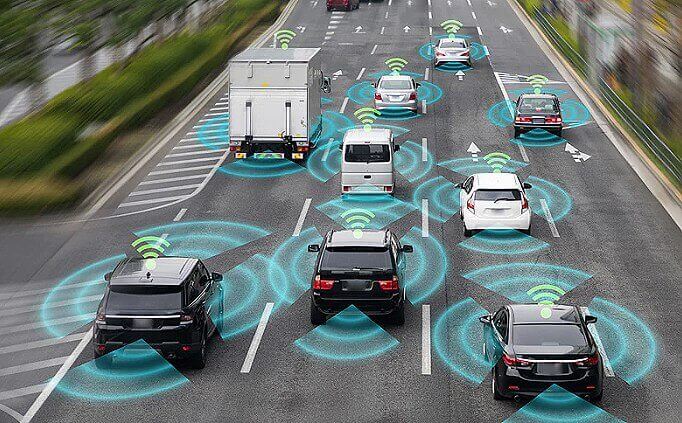
Something remarkable is happening in China’s automotive sector. It is not just about electric vehicles anymore — though China’s EV market is extraordinary by any measure. The bigger story is about a new kind of intelligence: one that does not live in the cloud, does not just crunch numbers on a server farm, and does not merely talk to you through a chat window. This intelligence has hands. It has eyes. It moves through the physical world, plugs in a charging cable, assembles a car door, and swaps its own battery when it runs low. Welcome to the era of embodied intelligence in the automotive world — and China is firmly in the driver’s seat.
Embodied intelligence — often called physical AI — refers to AI systems that are integrated into physical bodies or machines capable of interacting with the real world. Unlike traditional software AI that processes text or images and returns a result, physical AI acts. It perceives its environment through sensors, makes decisions in real time, and executes physical tasks autonomously. In the context of the automotive industry, this translates into service robots at charging stations, humanoid workers on EV assembly lines, intelligent cockpit systems that understand your gestures and voice, and fully autonomous logistics chains that never sleep.
The convergence of embodied intelligence and the automotive world in China is not accidental. China’s EV makers are no longer just car manufacturers — they are innovation hubs that have evolved beyond simple transportation into sophisticated mobile computing platforms. And now, with physical AI entering the equation, these platforms are spilling off the road and into factories, garages, charging stations, and warehouses across the country. This article walks you through what is happening, who is driving it, and why it matters for the global automotive industry.
Embodied Intelligence Automotive China: Physical AI Applications in Vehicle Ecosystems
Defining the Shift from Digital to Physical Intelligence
Let’s get a clear picture before diving into the market data. Traditional AI — the kind most people are familiar with — is disembodied. It lives in software and operates on data. A navigation algorithm, a recommendation engine, a chatbot — these are all examples of AI that exists purely in the digital realm. They can tell you what to do, but they cannot do it for you.
Physical AI, or embodied intelligence, is fundamentally different. According to the China Academy of Information and Communications Technology (CAICT), a research body under China’s Ministry of Industry and Information Technology, embodied AI enables autonomous hardware systems to learn from human coworkers through natural language interfacing, gestures, and motion. In other words, these systems do not just follow a script. They observe, learn, adapt, and act — in the physical world, in real time.
In the automotive context, the difference is enormous. A traditional AI system might predict that your car needs maintenance and send you a notification. An embodied intelligence system sends a robot to actually perform that inspection. A conventional AI might optimize a charging schedule. A physical AI robot physically connects a charging cable to your vehicle while you are parked, without any human involvement. The gap between these two realities is where China’s most exciting technological race is being run right now.
China’s Ministry of Industry and Information Technology has formally identified embodied AI as a national priority. The second annual China Embodied AI Conference, co-organized by the Chinese Association for Artificial Intelligence along with leading universities including Tsinghua and Tongji, culminated in the publication “15 Key Research Directions in Embodied Intelligence,” which highlighted multimodal embodied perception, world model construction, and embodied AI safety as top priorities. This document is reportedly the first systematic roadmap for embodied AI development in China, and it signals that this is not a fringe technology trend — it is a deliberate national strategy.

To understand why embodied intelligence automotive China is such a hot topic, you need to look at the scale of the underlying markets. The figures are genuinely staggering.
China’s installed base of industrial robots surpassed 2.027 million units in 2024, by far the largest of any country in the world, according to the International Federation of Robotics (IFR). In 2024 alone, Chinese factories added approximately 295,000 new robots — more than every other country in the world combined. By the first nine months of 2025, industrial robot production in China had already reached 595,000 units, up nearly 30 percent year-on-year and surpassing the total output for all of 2024.
On the electric vehicle side, China is equally dominant. In 2024, new energy vehicles accounted for nearly half of all new cars sold in China — roughly 11 million electric and plug-in hybrid vehicles in a single year, representing about two-thirds of all EVs sold worldwide. Beijing set an official goal of 15.5 million NEVs sold in 2025, representing around 60 percent of all Chinese car sales. BYD alone built over 4 million NEVs in 2024, surpassing Tesla’s global sales volume.
The fusion of these two gigantic sectors — robotics and EVs — is where embodied intelligence finds its most fertile ground. As the IFR data confirms, automotive and electronics manufacturing are the two largest and oldest sources of demand for automation in China. The robotics boom and the EV boom are colliding, and the result is a physical AI revolution that is transforming everything from factory floors to roadside service stations.
Investment is flowing in at a historic pace. By the end of May 2025, investment in robotics and embodied intelligence in China had already exceeded the full-year 2024 total. By July 2025, China had invested an estimated 3.4 billion dollars in new robotics ventures — 42 percent more than the United States and five times that of Europe. The Chinese government has also allocated over 20 billion dollars in subsidies to the robotics industry through grants, loans, tax credits, and state-backed venture capital.
Embodied Intelligence Automotive China: FAROBOT, KingKong Tech and the Supplier Ecosystem
The Companies Building the Physical AI Backbone
Behind the headlines about humanoid robots dancing at Chinese New Year galas and EV factories running around the clock is a dense ecosystem of suppliers, startups, and industrial automation companies. Two names that stand out in the context of embodied intelligence for automotive applications are FAROBOT and KingKong Tech — companies that are embedding physical AI directly into EV service and industrial infrastructure.
FAROBOT focuses on service robotics designed for real-world deployment in vehicle-related environments. Their systems are designed to operate in EV charging zones, service bays, and parking facilities, performing tasks like autonomous vehicle navigation within enclosed spaces, charging initiation, and vehicle positioning. The company’s approach centers on combining sensor fusion, computer vision, and real-time decision-making to enable robots to handle the unpredictable nature of service environments — where vehicles arrive at different angles, in different conditions, and require individualized handling.
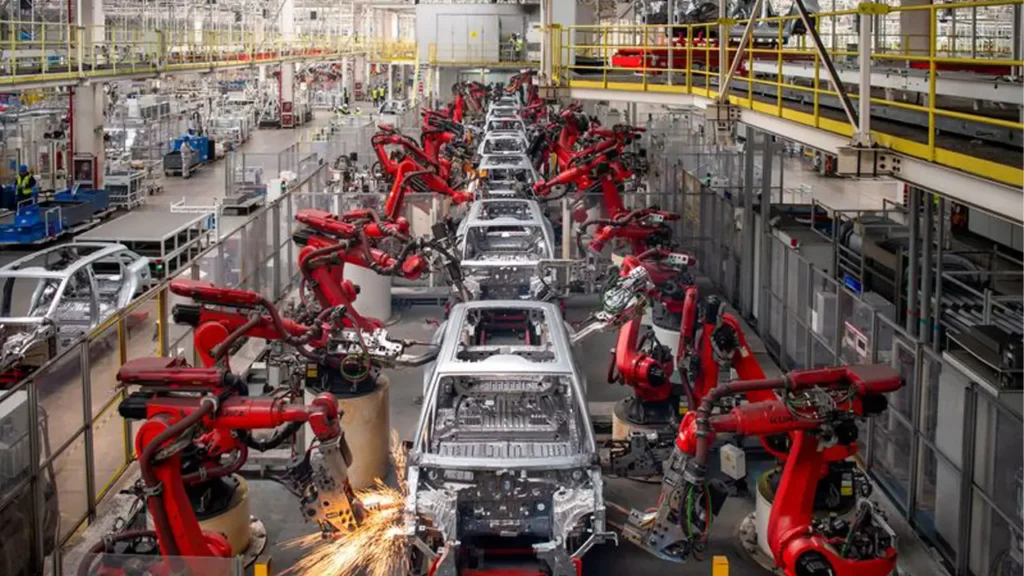
KingKong Tech operates at the intersection of industrial automation and EV manufacturing. Their platforms target high-throughput environments where precision, speed, and reliability are non-negotiable — battery assembly lines, quality inspection stations, and component logistics within smart factories. KingKong Tech’s robotics solutions exemplify the broader trend of physical AI systems that are not merely automated machines but genuinely intelligent actors capable of adjusting to variations in their environment.
Together, these companies represent a broader supplier ecosystem that is enabling the largest automotive manufacturers in China — BYD, NIO, Xpeng, GAC, Chery, and others — to integrate physical AI throughout their operations. The EV-to-robotics pipeline is becoming a defining feature of China’s industrial landscape.
It is also worth noting that Chinese automakers themselves are becoming robotics developers. Multiple major automakers have announced direct forays into humanoid robotics. GAC Group unveiled GoMate, its third-generation intelligent humanoid robot, in late 2024 — a wheeled and bipedal hybrid robot capable of climbing stairs, carrying heavy loads, and executing complex movements. GAC is targeting limited production of GoMate beginning in 2026, with applications in automotive after-sales service, security, and elderly care. Chery has partnered with AI company Aimoga to develop the Mornine humanoid robot, designed to understand human language and convert it into physical action strategies. NIO has launched a dedicated team to develop robot platforms as well.
The humanoid robot market in China was valued at approximately 2.76 billion yuan in 2024. Industry forecasts from the 2024 World AI Conference project this market will reach 75 billion yuan by 2029, representing 32.7 percent of the global market — and potentially 300 billion yuan by 2035.
| Company | Focus Area | Key Application | EV Integration |
|---|---|---|---|
| FAROBOT | Service Robotics | EV charging zones, parking automation | Charging station robots, vehicle positioning |
| KingKong Tech | Industrial Automation | Battery assembly, quality inspection | Smart factory integration, component logistics |
| UBTech | Humanoid Robotics | Assembly lines, logistics, inspection | BYD, NIO, Zeekr factory deployments |
| GAC Group | OEM + Robotics Developer | Humanoid robot GoMate | After-sales automotive services |
| U Power | EV Energy Solutions | Autonomous battery swapping vehicles | Unmanned logistics & last-mile delivery |
| Xpeng | EV + AI + Robotics | Iron humanoid robot, Turing AI chip | Robotaxis, autonomous driving, VLA models |
Service Robotics in the EV Industry: The New Face of the Garage
Walk into a modern EV service facility in China today and you may not see a single mechanic. What you are more likely to see are Chinese EV service robots — autonomous units gliding across floors, scanning vehicles with sensor arrays, connecting charging equipment, and logging maintenance data to a central AI system.
Physical AI-powered vehicle maintenance in China is advancing rapidly because EVs create a unique opportunity for robotic service. Unlike internal combustion engine vehicles with hundreds of moving mechanical parts, an electric motor typically has only two. The complexity of an EV lies in its battery pack, software systems, and electronics — areas where sensors and AI excel. A robot equipped with thermal imaging, voltage analysis tools, and computer vision can inspect a battery pack faster and more consistently than a human technician. It never gets tired, never misses a data point, and its findings feed directly into predictive maintenance algorithms that can flag issues before they become failures.
AI-powered vehicle maintenance in China is not just a concept — it is already operational. Automotive inspection robots at facilities like those operated by Jiangling Motors in Jiangxi Province use AI to check vehicles at general assembly workshops, replacing manual quality checks with continuous, automated inspection loops. The result is a dramatic reduction in defect rates. China’s most advanced smart factories report that development cycles are roughly 30 percent shorter and defect rates have been cut in half compared to traditional facilities.
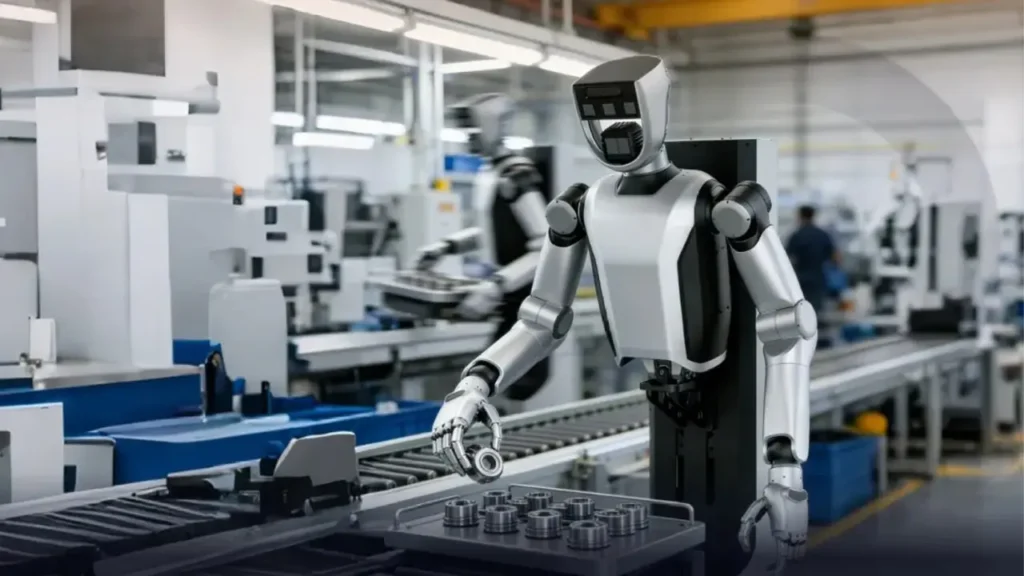
The service robot ecosystem is also benefiting from cross-pollination with humanoid robotics research. As humanoid robots like UBTech’s Walker S2 prove their capability in demanding industrial environments — operating 24 hours a day, 7 days a week with autonomous battery swapping — the technology is being adapted for vehicle service contexts. The Walker S2, deployed in pilot programs at BYD, NIO, and Zeekr facilities, stands 162 centimeters tall, weighs just 43 kilograms, features 52 degrees of freedom, and can handle loads of up to 15 kilograms per arm. Its pure RGB binocular stereo vision system gives it human-like depth perception, enabling it to operate in the dynamic, cluttered environments typical of automotive service bays.
Smart Charging and Infrastructure: Physical AI Meets the Power Grid
One of the most visually striking applications of embodied intelligence in automotive China is smart EV charging automation. China’s charging infrastructure is already the largest in the world — 14.4 million charging points serving 31.4 million EVs as of mid-2025. But sheer numbers alone are not enough. The next challenge is making charging smarter, faster, and entirely hands-free. That is exactly where physical AI comes in.
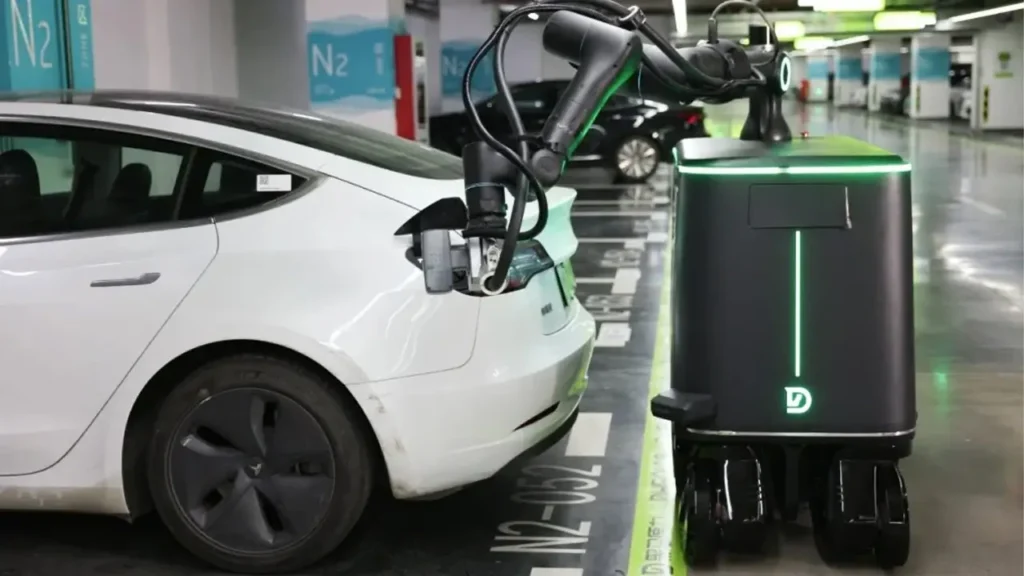
Chinese companies are pioneering robotic charging systems that eliminate the last human touchpoint in the EV ownership experience: plugging in the cable. Li Auto, working with technology partner CGXi, is developing what they describe as the world’s first rail-based unmanned robotic charging arm. The system moves along a sled-style rail mounted above parking spaces, integrating sensor arrays and vision systems to identify the charging port location and orientation on any vehicle parked below. Li Auto’s CEO confirmed the system was in active testing as of July 2025.
A company called Wawa Charging has deployed a system called the HAVA Robot — an 18-degree-of-freedom flexible robotic arm that rides on an H-shaped overhead track. The company claims a single unit can serve eight or more parking spaces, effectively turning an entire garage section into a fully automated charging zone. The robot navigates the overhead rail system, locates the vehicle’s charging port using computer vision, positions the connector precisely, and initiates the charging session — all without any action required from the vehicle owner.
This is smart EV charging automation in its most literal form: a physical AI system managing the entire charging interaction, from queue management and space assignment to cable connection and session monitoring. China’s government is backing this push, with plans to install 100,000 ultra-fast public charging stations by 2027. These plans include requirements for smart charging with dynamic pricing, solar integration, and battery storage — and robotic charging systems fit neatly into this framework.
| Technology | Developer | Key Feature | Status (2025–2026) |
|---|---|---|---|
| Rail-based charging arm | Li Auto + CGXi | Overhead rail, vision-guided port ID | Active testing (July 2025) |
| HAVA Robot charging arm | Wawa Charging | 18-DOF arm, serves 8+ spaces per unit | Commercial deployment |
| SkyvoltRobot framework | Academic (ScienceDirect 2024) | Engineering foundation for overhead systems | Research / informing commercial builds |
| Intelligent charging robots (Zhejiang) | Multiple operators | NEV charging at highway service areas | Operational (Jan 2025) |
Logistics Automation: The Autonomous EV Ecosystem Behind the Scenes
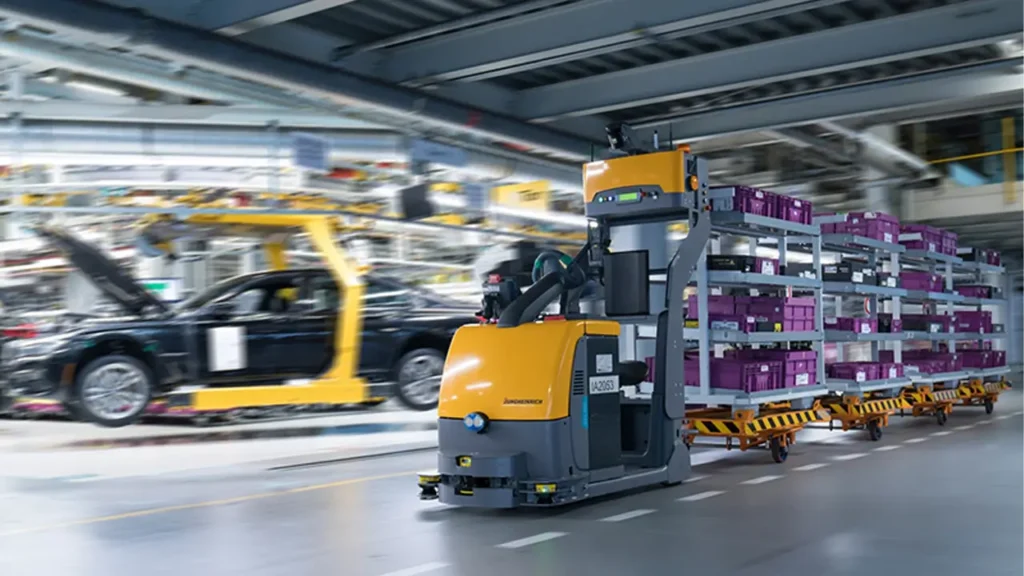
The public tends to focus on the dramatic — humanoid robots on factory floors, robotic arms plugging in charging cables. But some of the most impactful work happening in the autonomous logistics EV ecosystem is less visible and arguably more transformative.
China’s U Power, a leading EV battery power solutions provider, has launched what it describes as the world’s first fully autonomous battery swapping logistics vehicle. This system integrates AI-driven autonomous driving technology with automated battery swapping stations, allowing logistics vehicles to operate continuously without any human intervention — no driver, no charging stop, no maintenance break. The system uses advanced AI algorithms including Convolutional Neural Networks for real-time path planning and emergency response. U Power’s CEO has stated that this innovation is expected to reduce green logistics operating costs by more than 46 percent.
UBTech’s Walker S2 takes this concept into humanoid form. Deployed at pilot sites including BYD, NIO, Geely, FAW-Volkswagen, and Foxconn, Walker S2 is the world’s first humanoid robot capable of autonomously replacing its own battery — doing so in just three minutes with no human assistance. This means a Walker S2 unit can theoretically operate indefinitely as long as replacement batteries are available. In logistics terms, this is a revolution. Warehouse robots that need to be plugged in create scheduling bottlenecks. A robot that manages its own energy needs is a genuinely new category of industrial asset.
Walker S2 stands 162 centimeters tall and weighs 43 kilograms, features a dual 48-volt lithium battery system, moves at up to 7.2 kilometers per hour, and is equipped with Wi-Fi, Bluetooth, and 3D stereoscopic vision. It has already received cumulative orders exceeding 1.1 billion yuan since shipments began in late 2025. UBTech aims to deliver 500 industrial humanoids by the end of 2025 and scale to 10,000 units annually by 2027.
At the warehouse level, the autonomous logistics EV ecosystem extends to battery swapping stations that handle the energy needs of fleets of unmanned logistics vehicles. These stations function as intelligent hubs — managing which vehicles need swaps, sequencing the process automatically, and logging all energy data to cloud platforms for analysis. The human role in this system is not elimination but elevation: people move from driving forklifts and managing charging schedules to overseeing data dashboards and handling exception cases that the AI cannot resolve.
Cockpit AI Evolution: The Vehicle That Reads Your Mind
Step inside a high-end Chinese EV in 2025 and you are stepping into an intelligent environment. The intelligent cockpit assistants that Chinese automakers have developed over the past few years represent one of the most mature and consumer-facing manifestations of physical AI in the automotive world — and they are evolving rapidly.
China’s EV industry model relies on deep integration with its AI sector to produce software for smart cockpits and smart driving. Companies like Xpeng, NIO, BYD, and Xiaomi have invested massively in in-vehicle AI systems that go far beyond voice recognition. Modern intelligent cockpits in Chinese EVs incorporate multimodal interaction: voice commands, gesture recognition, gaze tracking, and even mood analysis based on facial expression. The vehicle does not wait for you to give an instruction — it anticipates.
Xpeng’s Turing AI chip, which powers its latest vehicles and humanoid robot platforms, delivers 3,000 TOPS of in-car computing power — described by the company as the highest in the world. This enables a “vision-language-action” model that allows the vehicle to perceive its environment, understand natural language commands, and take physical actions in response. The same AI architecture that helps a humanoid robot navigate a factory floor is helping a Chinese EV navigate an urban intersection and respond to a driver’s request to adjust the cabin temperature before they even say a word.
Human-machine interaction in EV China is also being shaped by the broader embodied intelligence research agenda. The CAICT roadmap imagines systems that learn from human coworkers and partners through natural gestures and spoken language — exactly the kind of interaction that defines next-generation cockpit AI. Emerging display technologies including smart glass displays, 3D displays, panoramic displays, and invisible displays are gradually being introduced into Chinese vehicles, making the cockpit a more immersive and responsive space.
Volkswagen’s CARIZON center of excellence for intelligent driving systems in China — a direct result of the German automaker’s recognition that Chinese EV intelligence demands a local, dedicated response — is developing Level 2 advanced driver assistance systems with Navigation on Autopilot in both urban and highway environments, with a clear roadmap toward Level 3 and 4 automation. Even legacy European automotive brands are adapting their cockpit AI strategies specifically for the Chinese market.
Embodied Intelligence Automotive China: Human-Machine Symbiosis Deployment Timeline
From Pilot Programs to Full Autonomy Ecosystems
The embodied intelligence revolution in automotive China is not happening all at once. It is unfolding in clearly identifiable phases, driven by technology readiness, regulatory development, and the scaling dynamics of physical hardware production. Understanding this timeline helps make sense of what is already happening and what is coming next.
2023–2025: Pilot Programs and Proof of Concept
This is the phase we are currently completing. During this period, the dominant story has been about demonstrating that embodied intelligence can work in real automotive environments — not just in labs. Walker S2 units have been deployed at BYD, NIO, and Zeekr factories. Robotic charging arms are being tested at EV service areas in Zhejiang Province. Chery’s Mornine robot has moved from development into early store deployment. GAC has unveiled GoMate and announced production plans. Six of China’s eleven major humanoid robot manufacturers launched mass-production initiatives in 2024, aiming to produce over 1,000 units per year by the end of 2025.
The regulatory scaffolding is also emerging. China’s Ministry of Industry and Information Technology issued its Intelligent Data Collection Standard 1.0 in November 2024, creating a unified framework for synchronizing, formatting, labeling, and quality-grading multimodal robot training data. Shanghai issued China’s first city-level embodied intelligence plan, pairing R&D support with shared infrastructure including compute resources, testing facilities, and financing mechanisms.
2025–2027: Scaling Phase
This is where the numbers start to get very large. UBTech has set a target of 10,000 Walker S2 units annually by 2027. China’s government plans to install 100,000 ultra-fast charging stations by the same year, many of which will incorporate smart robotic charging systems. The Chinese government’s National Development and Reform Commission announced a guidance fund in March 2025 aimed at directing 137 billion dollars into AI and robotics startups over the next 20 years.
The shared datasets and open middleware infrastructure needed for broader embodied intelligence deployment are expected to reach maturity in the 2025–2027 window, according to the roadmap published by The Robot Report analysis of China’s physical AI strategy. This shared infrastructure is critical — it allows different manufacturers’ robots to communicate, share learning, and operate collaboratively within the same facilities.
2027 and Beyond: Full Autonomy Ecosystems
The long-term vision is complete human-machine symbiosis across the EV ecosystem. Factories where robots handle all physically intensive production tasks while humans focus on design, oversight, and exception management. Charging networks where no human intervention is required at any point in the charging cycle. Logistics chains where autonomous vehicles, robotic battery swappers, and warehouse humanoids operate as a seamlessly coordinated system. Cockpits where the vehicle is an intelligent partner, not just a machine.
Inovance, China’s largest industrial automation company, is preparing for a viable mass humanoid robot market by 2030. Unitree says real commercialization will begin within three to five years, initially in public service and select manufacturing tasks. The consensus among industry leaders is that the 2027–2030 window will see embodied intelligence move from impressive technology to standard automotive infrastructure.
| Phase | Timeline | Key Milestones | Human-Machine Dynamic |
|---|---|---|---|
| Pilot & Proof | 2023–2025 | Factory deployments, first robotic chargers, regulatory frameworks | Humans supervise, robots assist |
| Scaling | 2025–2027 | 10,000+ humanoids/year, 100,000 smart chargers, shared AI datasets | Humans manage exceptions, robots execute |
| Full Autonomy | 2027–2030+ | Mass humanoid market, autonomous EV ecosystems, cockpit AI maturity | True human-machine symbiosis |
Future Outlook and Conclusion: Why This Is the Next Trillion-Dollar Market
The CEO of Unitree Robots put it well when he said that robotics is where EVs were a decade ago — a trillion-yuan battlefield waiting to be claimed. That analogy is instructive. A decade ago, China’s EV ambitions seemed bold to the point of implausibility. Today, China produces over 70 percent of the world’s electric vehicles and holds more than half of global EV sales. The same trajectory — government support, massive domestic demand, a competitive supplier ecosystem, and relentless iteration speed — is now powering the embodied intelligence revolution.
The convergence of robotics and EVs in China is producing something genuinely new: an ecosystem where the vehicle is not just a product but a node in an intelligent physical network. The car that drives itself is just the beginning. The robot that charges it, maintains it, assembles it, and manages the logistics around it — that is where embodied intelligence transforms an entire industry.
China’s competitive advantages in this space are structural, not accidental. It has the world’s largest EV market, the world’s largest installed base of industrial robots, the world’s most competitive battery supply chain, a government committed to funding the transition at scale, and a generation of engineers who grew up building autonomous vehicles and now understand how to apply the same principles to physical AI systems. Chinese EV makers can iterate new models every 1.3 years, compared to the four-year cycle of traditional automakers. The same speed applies to robotics hardware.
The numbers support the thesis. A humanoid robot market worth 2.76 billion yuan in 2024 is projected to reach 75 billion yuan by 2029 and 300 billion yuan by 2035. Over 160 humanoid robot manufacturers existed worldwide as of mid-2024, with more than 60 of them in China. China invested 3.4 billion dollars in robotics in the first half of 2025 alone. The NDRC has committed to directing 137 billion dollars into AI and robotics over the next 20 years.
For anyone tracking the future of mobility, manufacturing, and artificial intelligence, embodied intelligence in automotive China is not a niche story. It is the central story of the next decade of technological transformation. The question is no longer whether physical AI will reshape the automotive world — it is how quickly, and who will benefit.
Stay ahead of the curve by following innovations and developments across the Chinese automotive and technology landscape at www.autochina.blog.
Discover more from AutoChina
Subscribe to get the latest posts sent to your email.