1. Introduction: Chinese EV Export Strategy Europe Overview
Something remarkable is happening on European roads right now. The cars gliding silently through the streets of Berlin, Paris, and Budapest are increasingly bearing unfamiliar names — BYD, XPeng, NIO, Leapmotor. In just a few years, China has transformed from an importer of automotive know-how into the world’s most formidable exporter of electric vehicles. And Europe, with its ambitious decarbonization targets and rapidly growing EV appetite, has become the most strategically important battlefield.
In 2025, China’s automobile exports reached 7.1 million units — a 21.8 percent annual increase that consolidated its position as the world’s largest automotive exporter for the third consecutive year, having overtaken Japan in 2023. The Chinese EV export strategy in Europe is no longer an experiment. It is a structured, well-funded, and accelerating campaign to reshape one of the world’s most lucrative car markets.
This article walks you through the full picture: where the numbers stand today, what is driving growth, who the key players are, how tariffs are evolving, and what the road to 2030 looks like. Whether you are an investor, an automotive professional, or simply a curious observer, you are in the right place.
2. Chinese EV Export Strategy Europe and Current Market Position
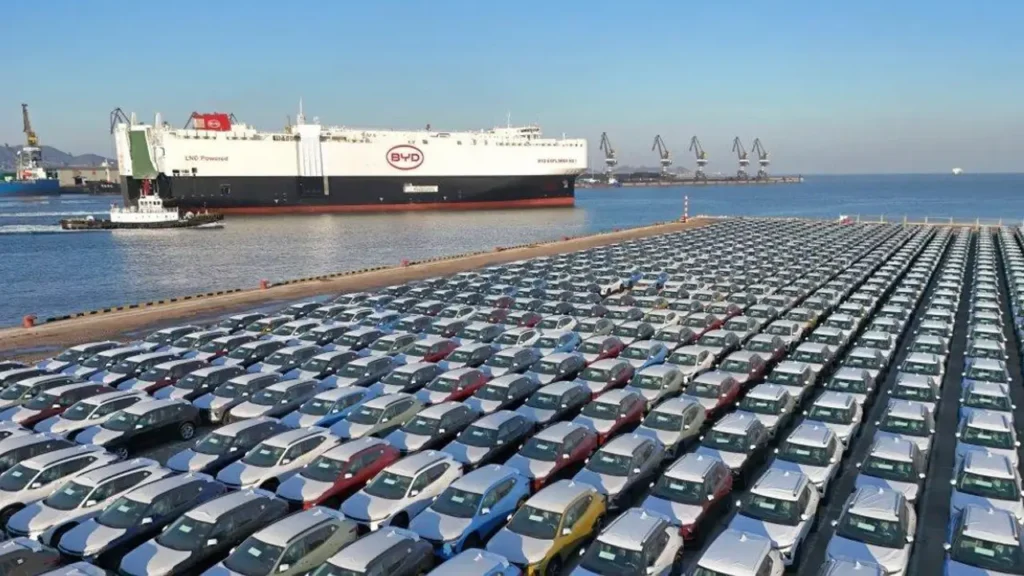
The headline numbers tell a compelling story. In 2025, 19% of EVs sold in Europe were built in China. That figure has already climbed to 22% in the first months of 2026. To put that in perspective, just a few years ago Chinese EVs barely registered in European sales data.
Cars made in China represented seven percent of total EU passenger vehicle sales in 2025, up from five percent the previous year. Meanwhile, the share of Chinese and Chinese-owned brands has grown substantially faster than the share of Chinese-built vehicles, because brands like MG (owned by SAIC) have become firmly embedded in European consumer consciousness.
In January 2026, BYD entered the top three EV brands in Europe by registrations — behind only Volkswagen and BMW. That is a stunning achievement for a brand that was virtually unknown on the continent five years ago. China exported over 922,000 passenger cars to Europe in full-year 2025, up 29% year-on-year. In just the first two months of 2026, exports surged a further 62% compared to the same period in 2025.
The speed of this advance has no modern precedent. It differs sharply from the experience of Japanese and Korean automakers, which entered European markets gradually over decades. Chinese brands are entering simultaneously, at massive scale, and with the full backing of competitive pricing and state industrial policy.
3. Chinese EV Expansion Europe: Key Growth Drivers
Why is this happening so fast? The answer lies in a combination of structural advantages on the Chinese side and powerful demand signals on the European side.
On the supply side, Chinese manufacturers benefit from a significant cost advantage at every level of the value chain. Battery cells cost approximately 30% less to produce in China than in Europe. The International Energy Agency estimates that a small EV costs nearly $10,000 less to manufacture in China than in Germany. Even after EU tariffs, the price gap remains considerable. A standard Tesla Model 3 starts at roughly €41,000 in Europe, while comparable Chinese models such as the BYD Dolphin begin at around €35,500.
China also leapfrogged traditional automotive development stages by focusing on what the industry calls the “three electrics” — battery, electric motor, and electronic control systems — rather than investing in combustion engine technology. This gave Chinese manufacturers a structural head start in the EV era that European incumbents are still scrambling to match.
On the demand side, Europe is electrifying fast. Rising gasoline prices — partly driven by ongoing geopolitical instability in the Middle East — are pushing consumers toward EVs. Government incentive programs across multiple EU member states continue to support EV adoption. And European consumers are increasingly willing to consider unfamiliar brands, particularly when the price-to-feature ratio is compelling.
In April 2026, Europe recorded over 400,000 EV sales — a 27% year-over-year jump. Europe is now described by analysts as “the main engine of growth” for the global EV market. That is exactly the environment Chinese brands have been preparing for.

4. EV Market Europe Forecast 2030: Where China Fits
The European EV market is projected to grow from approximately $119 billion in 2022 to nearly $493 billion by 2030. That extraordinary expansion is creating enormous room for new entrants — and Chinese brands are positioned to capture a disproportionate share of that growth.
JPMorgan forecasts that Chinese cars — combining direct exports and locally manufactured vehicles — could command 20% of the Western European market as early as 2028, up from 10% in 2025. The bank previously forecast 15% by 2030, meaning its projections are accelerating faster than expected. According to JPMorgan’s Asia-Pacific auto research head Nick Lai, “Electrification is accelerating across Europe, creating the precise environment where Chinese OEMs’ product breadth becomes advantageous.”
The International Energy Agency projects that EVs could represent 45% of all new car sales globally by 2030, driven by falling battery costs — from $151 per kWh in 2022 to around $110 per kWh in 2025, with projections falling below $80 by 2030. As batteries get cheaper, so do Chinese EVs, widening the price gap further.
Urban Science research projects that Chinese EV brands could capture 20% of the European battery EV market by 2027. Industry projections suggest Chinese OEMs will peak at around 12% of the Western European BEV market in 2027, coinciding with the full ramp-up of BYD’s Hungarian production facility. The table below summarizes the key forecast milestones:
| Year | Chinese EV Share (Europe/Western Europe) | Source |
|---|---|---|
| 2023 | ~2–3% BEV market | Counterpoint Research |
| 2025 | ~10% of all new car sales (Western Europe) | JPMorgan |
| 2026 | 22% of EVs sold in Europe built in China | Benchmark Mineral Intelligence |
| 2027 | ~12% peak BEV share (Western Europe) | Automotive Logistics Media |
| 2028 | ~20% of Western European market | JPMorgan forecast |
| 2030 | 15–25% (range of analyst projections) | JPMorgan, Urban Science, IEA |
5. Chinese Electric Vehicle Brands Europe: Leaders of the Expansion
It is worth knowing who is actually doing the selling. This is not a monolithic “China Inc.” push — it is a diverse cast of brands with distinct strategies, price points, and target audiences.
BYD (Build Your Dreams) is the undisputed leader. In September 2025, BYD’s EU sales soared 272% year-on-year. In May 2025, BYD registered more battery EVs in Europe than Tesla for the first time — 7,231 units versus Tesla’s 7,165. BYD has set a goal of 10% of Europe’s EV market by 2030, corresponding to roughly 920,000 vehicles annually.
SAIC / MG is the volume leader in terms of total sales. SAIC-owned MG sold nearly 232,000 vehicles in Europe in 2024 and planned more than 300,000 for 2025. MG has successfully positioned itself as an affordable, recognizable brand — benefiting from its British heritage and name recognition. In the first nine months of 2025, SAIC led Chinese brands in EU sales with 226,047 cars, up 21% year-on-year.
XPeng is building rapidly. XPeng signed an agreement with Magna Steyr to assemble vehicles at its Graz, Austria facility — producing the G6, G9, and P7+ models. The company also opened its first European R&D center in Munich and is currently in talks to acquire a Volkswagen plant in Europe. XPeng exported 17,563 vehicles in the first four months of 2026, up 55% year-on-year.
NIO is targeting the premium segment and expanding its dealer network aggressively. BYD plans to showcase presence across 32 European countries with over 1,000 stores by end of 2025, rising to over 2,000 in 2026. NIO has indicated it will consider local European assembly if it reaches 6,000 units per month in sales.
Leapmotor, through its strategic partnership with Stellantis, is taking perhaps the most integrated approach. Stellantis and Leapmotor announced plans to build the Leapmotor B10 electric SUV at a Stellantis plant in Zaragoza, Spain. The brand’s B10 hybrid is priced at just €29,990 in Germany — a figure that puts enormous pressure on European competitors.
Geely’s portfolio — including Polestar, Zeekr, and Lynk & Co — is threading the needle between premium positioning and technological credibility. Polestar plans to begin producing a compact SUV in Europe by 2027, potentially at Volvo’s facilities in Belgium.
| Brand | Segment | European Production | Key Model(s) |
|---|---|---|---|
| BYD | Mass-market & premium | Hungary (Szeged), Turkey | Dolphin, Atto 3, Seal, Tang |
| SAIC / MG | Mass-market | Exports from China | MG4, ZS EV, MG5 |
| XPeng | Mid-premium tech | Austria (Magna Steyr), talks for VW plant | G6, G9, P7+ |
| NIO | Premium | Considering local assembly | ET5, ET7, EL6, Firefly |
| Leapmotor | Budget / mass-market | Spain (Stellantis Zaragoza) | B10, C10, T03 |
| Geely / Polestar / Zeekr | Premium / tech | Belgium (planned 2027) | Polestar 3, Zeekr 001 |
6. EV Import Tariffs Europe China: Barriers and Policy
No discussion of the Chinese EV export strategy in Europe is complete without understanding the tariff landscape. In October 2024, the EU imposed additional countervailing duties on Chinese-made EVs, stacked on top of the standard 10% import duty that applies to all vehicles.
The individual rates reflect findings from the EU’s anti-subsidy investigation: BYD faces an additional 17.0% countervailing duty, Geely 18.8%, and SAIC 35.3% — the highest rate, applied also to non-cooperating manufacturers. XPeng and NIO face 20.7%. Combined with the standard 10% import duty, total tariffs on Chinese EVs can reach up to 45.3%.
However, the tariff story is more nuanced than it first appears. First, plug-in hybrids and internal combustion engine vehicles from China are not subject to these additional duties. This created an immediate workaround: PHEV imports from China to the EU surged an extraordinary 892% in early 2025 compared to the same period in 2024.
Second, the EU and China have been actively negotiating a “price undertaking” system — a framework where Chinese manufacturers commit to selling their EVs above a minimum floor price in Europe, in exchange for tariff relief. In January 2026, Brussels and Beijing reached a preliminary understanding on this mechanism. The European Commission published guidance allowing each manufacturer to submit its own offer, assessed individually under WTO rules. In February 2026, the Commission approved the first such deal — Volkswagen’s Cupra Tavascan SUV, built in China, was freed from import tariffs in exchange for a minimum price and annual quota commitment.
Third, many Chinese automakers are simply building factories in Europe to bypass the tariffs entirely. This is arguably the EU’s biggest unintended consequence: tariffs designed to slow Chinese penetration are instead accelerating the localization of Chinese manufacturing on European soil.
| Manufacturer | Countervailing Duty | Standard Import Duty | Total Maximum Tariff |
|---|---|---|---|
| BYD | 17.0% | 10% | 27.0% |
| Geely | 18.8% | 10% | 28.8% |
| XPeng / NIO | 20.7% | 10% | 30.7% |
| SAIC / Non-cooperating | 35.3% | 10% | 45.3% |
| Tesla (Shanghai) | 7.8% | 10% | 17.8% |
Source: European Commission anti-subsidy investigation findings, October 2024.
7. BYD Europe Strategy as Benchmark Case
If you want to understand the Chinese EV export strategy in Europe, just watch BYD. The Shenzhen-based company is executing the most comprehensive and ambitious European playbook of any Chinese automaker — and it is working.
BYD’s approach combines three pillars: aggressive export volume, deep retail network investment, and rapid localization of manufacturing. The company has already chartered three long-term car carrier vessels for the China-to-Europe route, giving it annual shipping capacity of approximately 100,000 units from China alone. At the same time, it has been building a 150,000-unit-per-year factory in Szeged, Hungary — its European headquarters — which is expected to begin producing the Dolphin Surf (known in China as the Seagull) in 2026. A second plant in Turkey is also advancing.
BYD’s retail ambitions match its production scale. The company aims to have over 1,000 stores across 32 European countries by end of 2025, scaling to over 2,000 by 2026. The strategy is to build consumer familiarity and after-sales trust before the full production ramp-up, not after.
The financial results are validating the strategy. BYD’s EU sales surged 272% year-on-year in September 2025. In May 2025, BYD outsold Tesla in Europe for the first time — and repeated that feat in subsequent months. BYD sold approximately 2.25 million battery EVs globally in 2025, compared to Tesla’s 1.64 million. BYD’s total deliveries, including plug-in hybrids, reached 4.6 million vehicles — more than ten times its volume in 2020.
BYD’s target is clear: 5% of Europe’s EV market in the near term, rising to 10% by 2030. Given the trajectory, those numbers look conservative.
8. Chinese EV Sales Europe Growth: Real Numbers
Let us ground this story in concrete data. Chinese brand passenger car sales in the EU reached 509,700 vehicles in the first nine months of 2025 alone — up 91% from the 266,600 sold in the same period of 2024. SAIC-MG led with 226,047 units. Leapmotor, through its Stellantis partnership, saw sales surge by an extraordinary 8,600%. BYD, Dongfeng, XPeng, and Chery-owned Jaecoo and Omoda brands all posted significant gains.
For full-year 2025, total Chinese passenger car exports to Europe reached 922,000 units, up 29% year-on-year. In the first four months of 2026, China exported approximately 1.4 million EVs globally — more than double the same period in 2025. The EU received a significant share of that surge.
In April 2026 alone, China exported over 400,000 EVs worldwide. The domestic market contributed to this export boom: Chinese domestic EV demand slowed by 17% in early 2026 following changes to subsidies for small vehicles, pushing factories to redirect capacity toward export markets — particularly Europe.
| Period | Chinese Brand EU Sales | YoY Growth |
|---|---|---|
| 2022 | ~58,000 EVs | ~180% |
| 2023 | ~472,000 (all vehicles from China) | ~710% vs 2020 |
| Jan–Sep 2025 | 509,700 (Chinese brands, EU) | +91% |
| Full Year 2025 | 922,000 (passenger car exports) | +29% |
| Jan–Feb 2026 | 214,000 (passenger car exports) | +62% |
Sources: Car Industry Analysis, Rhodium Group, European Commission customs data.
9. Europe EV Competition Tesla vs China: Who Is Winning?
The Tesla-versus-China narrative has become one of the defining storylines of the 2020s auto industry. The answer in 2026 is increasingly clear: in Europe, Chinese brands are gaining the upper hand — while Tesla struggles.
In the first eleven months of 2025, Tesla’s EU sales fell 38.8% year-on-year to just 129,000 vehicles. Its European market share dropped from 2.4% in 2023 to 1.4% in 2025. In traditional strongholds such as Germany, France, and Sweden, the declines were particularly steep — France down 58%, Sweden down 59%, Denmark down 49% in November 2025 alone.
The causes are well-documented. Tesla’s lineup has aged: the Cybertruck is the only new model launched since 2020, and the core Model 3 and Model Y face intense competition they simply did not face in 2021. CEO Elon Musk’s increasingly polarizing political profile caused significant brand damage in European markets, particularly among environmentally conscious buyers who had previously been Tesla’s core constituency.
Meanwhile, BYD outsold Tesla in Europe in May 2025 and again in subsequent months. Volkswagen reclaimed the European EV sales leadership from Tesla in 2025 with a 56% increase. BYD’s global pure-EV sales reached 2.26 million in 2025, compared to Tesla’s 1.64 million — the first time Tesla lost that crown since it established itself as the EV market leader.
The competition is not just about units, though. It is about price. A comparable Chinese model to the Tesla Model 3 typically costs €5,000–8,000 less in Europe, even after tariffs. That gap is decisive for the majority of European buyers who are not paying out of personal choice but responding to incentive schemes, fuel cost comparisons, and total cost of ownership calculations.
The broader picture is that Europe is becoming a three-way competition: Chinese brands (led by BYD), European legacy manufacturers (led by Volkswagen, BMW, and Renault), and Tesla. The race is very much on — and Chinese brands are running fastest.
10. Chinese EV Logistics Europe and Demand Trends
The final piece of the Chinese EV export strategy in Europe is the unglamorous but critical question of logistics — how you get vehicles from Chinese factories to European driveways efficiently and affordably.
In the early phase of the export wave, Chinese automakers faced a serious constraint: a shortage of car-carrying vessels. Charter prices for car carriers skyrocketed by 700% between 2019 and 2023. Chinese manufacturers responded by commissioning new vessels. BYD now operates three dedicated long-term chartered car carriers on the China-to-Europe route, providing capacity for around 100,000 units per year from China alone. XPeng, for its part, has partnered with specialized logistics technology providers to digitize its European distribution network, gaining real-time visibility of vehicles as they move through the continent.
But the most transformative logistics development is the shift to local production. BYD’s Hungary plant, XPeng’s Austrian assembly operations at Magna Steyr, and Leapmotor’s planned Spanish production all represent a fundamental reorientation — from long-distance export logistics to intra-European supply chains. Once a Chinese brand is manufacturing in Europe, the logistics picture looks entirely different: shorter lead times, no ocean freight costs, no tariff exposure, and much easier after-sales support.
On the demand side, structural tailwinds remain powerful. The EU’s 2035 ban on new combustion engine vehicle sales continues to drive fleet electrification across European markets. Corporate fleets — which account for roughly 60% of new car sales in the EU — represent an enormous entry channel for Chinese brands, which have been actively targeting fleet managers with competitive total-cost-of-ownership proposals. Government EV incentive schemes, while not universal across all 27 EU member states, are creating pockets of accelerated demand that Chinese brands are well-positioned to capture with their broader model ranges and lower price points.
Electric vehicle demand in Europe grew 27% year-on-year in April 2026. The European Alternative Fuels Observatory confirmed that the EU started 2026 with a 20% battery EV share of new car registrations — a milestone that would have seemed improbable just three years ago.
The Chinese EV export strategy in Europe is not a single event or a single company’s ambition. It is a systematic, multi-brand, multi-channel, and increasingly multi-country manufacturing effort backed by cost advantages, technology leadership in batteries and software, and an industrial policy framework that has made China the undisputed center of the global EV supply chain.
The roadmap to 15–25% market share in Europe by 2030 is not a projection drawn from optimism. It is a trajectory being built, factory by factory, deal by deal, and sale by sale — right now.
🇬🇧 James Walker
⭐⭐⭐⭐⭐
Absolutely impressive analysis of the Chinese EV export strategy to Europe. The article clearly explains how brands like BYD are scaling fast and targeting up to 25% market share. Clean structure, real insights, no fluff. Highly recommend reading the full post here:
👉 https://autochina.blog/
🇪🇸 Carlos Méndez
⭐⭐⭐⭐⭐
Un artículo muy informativo sobre la expansión de los coches eléctricos chinos en Europa. Explica perfectamente la estrategia, los desafíos y el crecimiento del mercado. Me gustó especialmente la parte sobre BYD. Recomiendo leerlo completo:
👉 https://autochina.blog/
🇸🇦 أحمد القحطاني
⭐⭐⭐⭐⭐
تحليل رائع لاستراتيجية تصدير السيارات الكهربائية الصينية إلى أوروبا. المقال منظم وسهل الفهم ويحتوي على معلومات قوية عن السوق والمنافسة. أنصح بزيارة الموقع وقراءة التفاصيل:
👉 https://autochina.blog/
🇨🇳 李伟 (Li Wei)
⭐⭐⭐⭐⭐
这篇文章对中国电动车进入欧洲市场的战略分析非常到位。内容专业、结构清晰,对未来市场趋势有很好的洞察。值得一读:
👉 https://autochina.blog/
🇫🇷 Thomas Dubois
⭐⭐⭐⭐⭐
Excellente analyse de la stratégie d’exportation des véhicules électriques chinois vers l’Europe. L’article est clair, moderne et très utile pour comprendre le marché. Je recommande vivement:
👉 https://autochina.blog/
🇩🇪 Maximilian Bauer
⭐⭐⭐⭐⭐
Sehr gute Analyse zur Exportstrategie chinesischer Elektroautos in Europa. Klar strukturiert, viele interessante Einblicke und realistische Prognosen. Definitiv lesenswert:
👉 https://autochina.blog/
Discover more from AutoChina
Subscribe to get the latest posts sent to your email.

