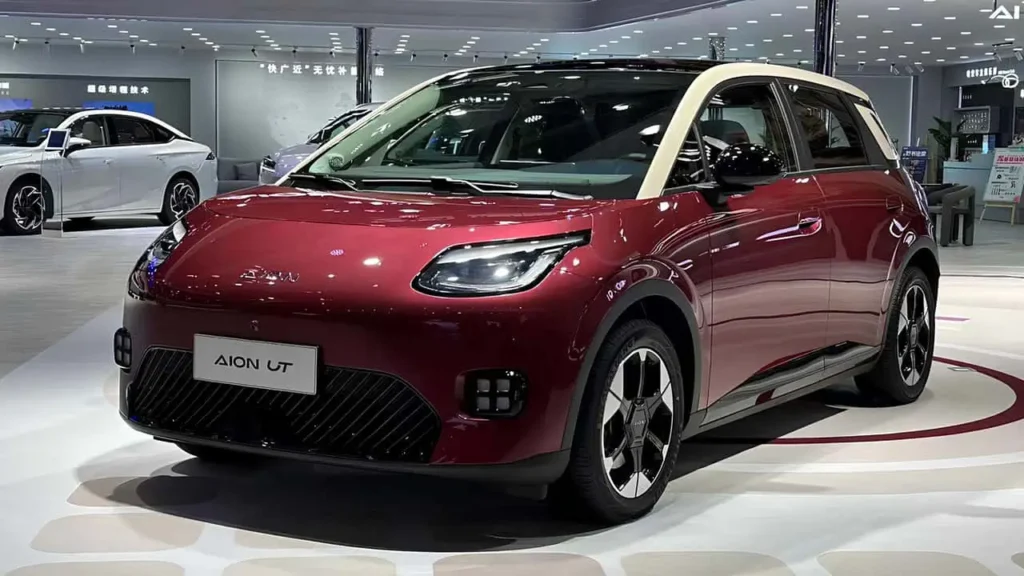
So, the GAC Aion UT hatchback price has landed in China, and people are already calling it the “Egg” — not as an insult, but because of its smooth, rounded design that looks like it rolled straight out of a European design studio. And speaking of Europe, this little EV hatchback is being positioned as a serious challenger to the VW ID.3, with a price tag that might make you do a double-take.
We’re talking about a car with a massive 14.6-inch screen, a 420 km CLTC range, and styling that doesn’t scream “budget EV.” Let’s dig into what makes the GAC Aion UT hatchback price so interesting, whether it’s actually worth the hype, and if it stands a chance against the big names in the electric hatchback game.
GAC Aion UT hatchback price in China — what are we actually paying for?
When we talk about the GAC Aion UT price in China, we’re looking at a range between 69,800 and 101,800 yuan. That’s roughly £7,600 to £11,100 at current exchange rates, though these prices obviously don’t include import duties, taxes, or the usual markup you’d see in Western markets. Still, even if you double that figure for a UK launch, the GAC Aion UT hatchback price would land somewhere in the mid-to-high £20k bracket — which is exactly where the base VW ID.3 sits, but with noticeably more tech and a fresher design language.
What do you get for that money? Well, the base version comes with the 330 km CLTC range battery, while the pricier variants push that up to 420 km. Both versions share the same 100 kW front-wheel-drive motor, the same generously sized cabin, and that eye-catching interior dominated by dual screens. The GAC Aion UT hatchback price doesn’t leave you feeling shortchanged — you’re getting proper fast-charging capability, a modern infotainment setup, and a design that feels more premium than its price tag suggests. It’s the kind of car that makes you wonder how they’re doing it so affordably, which is both exciting and slightly suspicious in equal measure.
GAC Aion UT hatchback price and what the specs tell us
Let’s talk numbers, because the GAC Aion UT specs paint a pretty compelling picture for anyone shopping in the compact EV segment. Here’s the breakdown:
| Item | Value (China spec baseline) |
|---|---|
| Price range | 69,800–101,800 yuan |
| Range (CLTC) | 330 km / 420 km |
| Motor | 100 kW (FWD) |
| Fast charging | 30% → 80% in 24 min |
| Screens | 14.6″ center + 8.8″ cluster |
| Dimensions | 4270/1850/1575 mm |
| Wheelbase | 2750 mm |
What does all this mean for the average driver? Well, the 100 kW motor (that’s about 134 horsepower) isn’t going to set any drag strip records, but it’s more than adequate for city driving and motorway merges. The GAC Aion UT hatchback price reflects a focus on practicality over performance — you’re not buying this to burn rubber, you’re buying it to get around efficiently without looking like you’re driving an appliance.
The dimensions show it’s slightly smaller than an ID.3, but that 2750 mm wheelbase is generous, meaning rear-seat passengers won’t be riding with their knees in their chests. And those screens? We’ll get to those in a minute, but suffice to say, the GAC Aion UT specs suggest this car is punching well above its weight class.
GAC Aion UT hatchback price and the reality of that 420 km range
The GAC Aion UT range 420 km figure is based on the CLTC testing cycle, which, if you’re not familiar, is China’s standard for measuring EV range. Now, here’s where we need to be realistic — CLTC numbers tend to be more optimistic than the WLTP figures used in Europe. Think of it like the difference between what a car company says your fuel economy will be versus what you actually get in real-world driving. So while the GAC Aion UT hatchback price includes a battery capable of 420 km under ideal conditions, you’re probably looking at closer to 320-350 km in real-world mixed driving, and less in cold weather or at motorway speeds.
But let’s put that in perspective. For urban commuting and weekend trips, 320 km of actual range is perfectly usable. That’s enough to cover most people’s weekly driving without needing to charge, and certainly enough for the daily school run, supermarket trips, and the occasional visit to relatives who live an hour away. The GAC Aion UT range 420 km isn’t trying to compete with long-range Tesla models — it’s aimed at people who drive realistically modest distances and want an EV that doesn’t cost the earth. City dwellers will find the GAC Aion UT hatchback price attractive precisely because they don’t need 500+ km of range that they’ll never use.
GAC Aion UT hatchback price and how fast charging actually works in practice
Here’s where things get interesting with the GAC Aion UT charging time 30 to 80 specification. That 24-minute fast-charging claim means you can take the battery from 30% to 80% in the time it takes to grab a coffee and scroll through your phone. This is actually pretty competitive — it’s not Tesla Supercharger fast, but it’s in the same ballpark as most modern EVs. The GAC Aion UT hatchback price doesn’t saddle you with ancient charging tech; you’re getting a car that can handle the rapid chargers popping up across motorway service stations and shopping centers.
In everyday terms, the GAC Aion UT charging time 30 to 80 spec means you’re looking at maybe one proper charging stop on a longer journey, rather than multiple lengthy waits. If you’re doing 250 km to visit family, you’d leave home with a full charge, arrive with 40-50% remaining, do your visit, top up for 15 minutes at a local charger while grabbing lunch on the way back, and you’re sorted.
The GAC Aion UT hatchback price reflects a vehicle designed for realistic usage patterns — it’s not a road-trip champion, but it’s perfectly adequate for how most people actually use their cars. And honestly, 24 minutes is just about right for a coffee break anyway, so the GAC Aion UT charging time 30 to 80 figure slots nicely into normal human behavior.
GAC Aion UT hatchback price and that massive screen experience
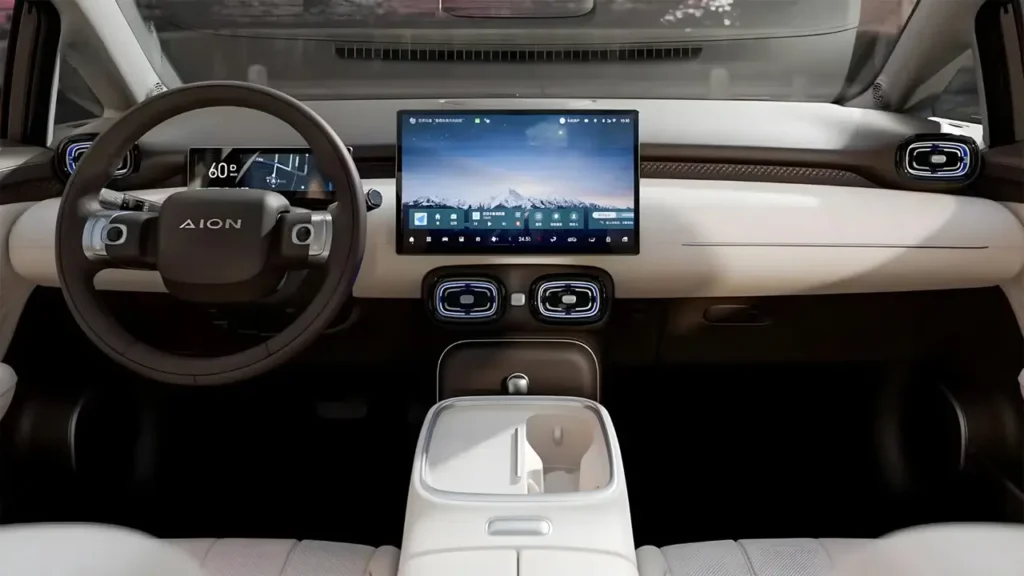
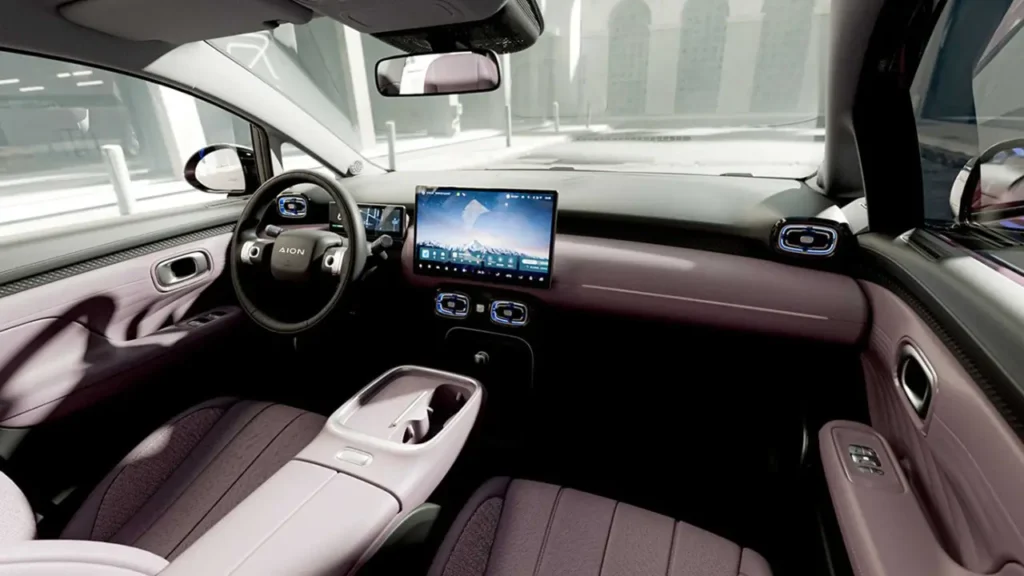
Let’s address the elephant in the room — or rather, the massive GAC Aion UT interior 14.6 inch screen that dominates the dashboard. This isn’t just a token touchscreen; it’s a proper centerpiece that controls everything from climate to media to navigation. Paired with the 8.8-inch digital instrument cluster, you’re getting a very smartphone-like experience, and honestly, that’s exactly what younger buyers expect these days. The GAC Aion UT hatchback price includes an infotainment system that feels more like using an iPad than wrestling with the clunky interfaces found in some European competitors.
Now, is the GAC Aion UT interior 14.6 inch screen overkill? That depends on your perspective. If you’re someone who appreciates having all your controls visible and accessible without diving through multiple menus, you’ll probably love it. If you’re the type who prefers physical buttons for climate control (and fair enough, many do), you might find yourself occasionally frustrated.
But here’s the thing — as BestChinaGadget.com has been documenting extensively, huge screens in cars have basically become the new smartphone on wheels, and manufacturers are betting that most buyers want that tech-forward experience. The GAC Aion UT hatchback price delivers exactly that vibe, whether you’re streaming music, using navigation with real-time traffic, or adjusting your seat heating without taking your eyes off the road for too long. It’s modern, it’s clean, and it makes the car feel more expensive than it actually is.
GAC Aion UT hatchback price and the Milan-influenced design story
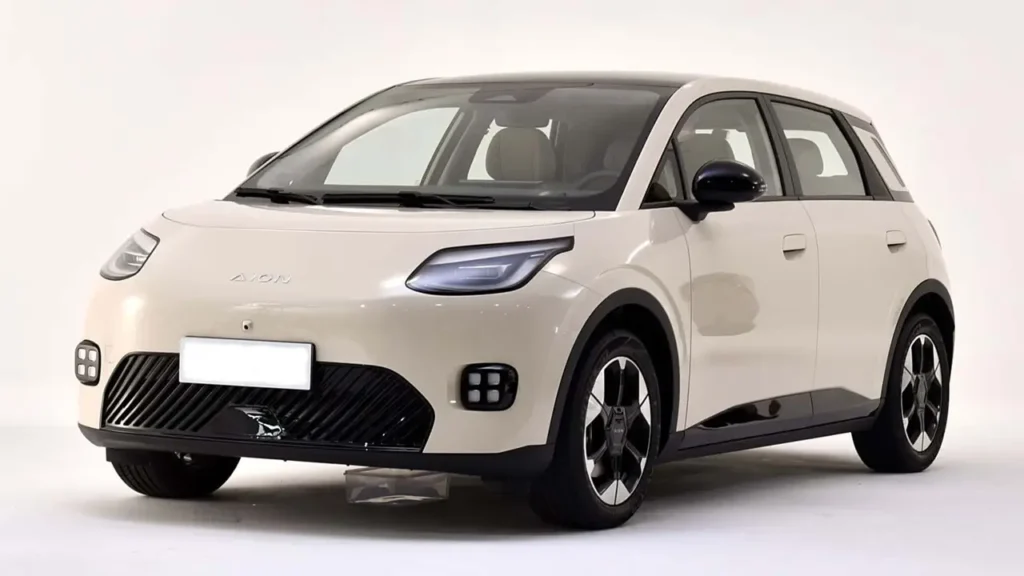
The GAC Aion UT design Milan studio connection is worth exploring, because it explains why this car doesn’t look like your typical Chinese-market EV. GAC operates a design center in Milan, and the UT is frequently described as a product of that European studio. The result is that “Egg” nickname — those smooth, rounded lines, the minimal character lines, the way the roofline flows into the rear hatch. It’s clean, it’s modern, and it doesn’t try too hard to look aggressive or sporty. The GAC Aion UT hatchback price gets you design language that genuinely feels European in execution, even if the badge says otherwise.
What’s clever about the GAC Aion UT design Milan studio approach is that it avoids the “try-hard” aesthetic that sometimes plagues more affordable EVs. The front end is friendly without being cutesy, the proportions are balanced thanks to that decent wheelbase, and the overall silhouette is distinctive without being polarizing.
You park it next to an ID.3 or a Renault Megane E-Tech, and the GAC Aion UT hatchback price suddenly makes even more sense — because it doesn’t look cheaper, it just looks different. The Italian design influence shows in the details: the way the lights are integrated, the clean surfacing, the lack of unnecessary creases. It’s mature design, which is refreshing when so many EVs are trying to shout about their electric credentials with overwrought styling.
GAC Aion UT hatchback price versus the VW ID.3 — the comparison everyone’s making
So let’s do the GAC Aion UT vs VW ID.3 comparison properly, because this is the matchup that matters. The ID.3 is the establishment player in Europe — it’s the car Volkswagen positioned as their electric Golf, the mainstream EV for the masses. The GAC Aion UT hatchback price, meanwhile, represents the challenger brand approach: undercut on price, overdeliver on spec, and hope that buyers are willing to take a chance on a less familiar name.
| Feature | GAC Aion UT | VW ID.3 |
|---|---|---|
| Expected UK price | Mid-high £20k | £36,000+ |
| Screen size | 14.6″ center | 12″ center |
| Real-world range | ~320-350 km | ~340-360 km |
| Interior space | Generous (2750mm WB) | Very good (2765mm WB) |
| Brand recognition | Low in Europe | Strong |
| Charging speed | 30-80% in 24 min | 30-80% in ~25 min |
The GAC Aion UT vs VW ID.3 comparison basically comes down to whether you value brand familiarity and dealer network over getting more tech for less money. The GAC Aion UT hatchback price could potentially undercut the ID.3 by £10,000 or more in European markets, while offering a bigger screen, fresher design, and comparable real-world range. The ID.3 counters with VW’s reputation, a more established charging network partnership, and the peace of mind that comes with buying from a household name.
In terms of driving experience, both are front-wheel-drive EVs with similar power outputs and comparable handling characteristics — neither is a sports car, both are perfectly competent for daily use. The GAC Aion UT vs VW ID.3 debate really highlights how much the market has changed: a few years ago, Chinese brands were playing catch-up on quality and design. Now, with the GAC Aion UT hatchback price positioned so competitively, they’re forcing European brands to justify their premium.
GAC Aion UT hatchback price — the honest pros and cons
Let’s be balanced about the GAC Aion UT pros and cons, because no car is perfect, and this one certainly has its trade-offs.
Pros:
The GAC Aion UT hatchback price is probably the single biggest advantage — you’re getting a lot of car for not much money, assuming the UK pricing follows the Chinese pattern. The screen is genuinely impressive, both in size and responsiveness, making the cabin feel modern and tech-forward. The design is clean and European-influenced, which helps it stand out in the EV crowd without looking weird. Charging speed is competitive, and the range is perfectly adequate for the target buyer. Interior space is generous for the size, especially rear legroom, making it genuinely practical for small families.
Cons:
Brand recognition is low outside China, which means resale values are a bit of an unknown and you might face skepticism from friends and family. The CLTC range figures are optimistic compared to real-world driving, so you need to mentally adjust expectations downward. Interior materials, while decent, use more hard plastics than you’d find in premium European rivals — it’s cost-effective rather than luxurious. And there’s the unknown factor of aftersales service and parts availability in Western markets, which is always a gamble with newer imports.
Some early impressions from Chinese owners (paraphrased from various online forums) highlight these points:
“The screen is amazing for navigation and media, but I wish there were physical climate controls for quick adjustments while driving.”
“Rear seat space is genuinely impressive for the car’s size — my teenagers fit comfortably, which wasn’t the case in some rivals.”
“City driving feels zippy and the regenerative braking is smooth, but motorway range drops faster than I’d hoped in colder weather.”
“Interior plastics are fine but definitely not premium — you notice it when you touch the door panels, though most passengers won’t care.”
The GAC Aion UT pros and cons basically add up to a car that’s brilliant value if you can live with a less familiar brand and don’t need the absolute highest quality interior materials. The GAC Aion UT hatchback price makes sense for practical buyers who want modern EV technology without the premium badge markup.
GAC Aion UT hatchback price in the UK — what to actually expect
Now for the GAC Aion UT price in UK reality check. While Chinese pricing sits at 69,800–101,800 yuan, you can’t just convert that directly to pounds and expect that to be the UK price. Import duties, VAT, shipping, dealer margins, and homologation costs all add up. Based on similar Chinese EV imports, the GAC Aion UT hatchback price in the UK would likely land somewhere between £24,000 and £30,000, depending on specification.
That would position it below the VW ID.3, roughly in line with the MG4 (another Chinese import that’s done well), and significantly cheaper than the Renault Megane E-Tech. Expected availability? If GAC moves forward with European expansion, the GAC Aion UT price in UK markets would probably appear in early 2026, assuming regulatory approval and dealer network establishment goes smoothly. That’s a big “if” — entering the UK market requires meeting stringent safety and emissions regulations, establishing service networks, and building consumer trust.
The GAC Aion UT hatchback price would need to be competitive enough to overcome badge snobbery and the natural conservatism of British car buyers, who tend to stick with familiar brands unless the value proposition is overwhelming. At £25,000 with that spec sheet, it starts to look very tempting. At £30,000, it’s more of a tough sell against established players.
Frequently Asked Questions about the GAC Aion UT hatchback price:
Q: What is the GAC Aion UT hatchback price in China? A: The GAC Aion UT hatchback price ranges from 69,800 to 101,800 yuan (roughly £7,600 to £11,100), depending on battery size and trim level.
Q: How does the GAC Aion UT range 420 km compare in real-world driving? A: The 420 km CLTC figure translates to approximately 320-350 km in real-world conditions, which is adequate for most daily and weekly driving needs.
Q: Is the GAC Aion UT charging time 30 to 80 competitive? A: Yes, at 24 minutes for 30% to 80%, it’s comparable to most modern EVs and works well for typical charging stop scenarios.
Q: What makes the GAC Aion UT interior 14.6 inch screen special? A: It’s one of the larger screens in this class, offering tablet-like functionality for navigation, media, and vehicle controls, making the cabin feel very modern.
Q: When might we see the GAC Aion UT price in UK markets? A: Expected availability is early 2026, with pricing likely in the mid-to-high £20k range, though this depends on import costs and market strategy.
Q: How does the GAC Aion UT vs VW ID.3 comparison stack up? A: The Aion UT offers more screen, fresher design, and potentially lower pricing, while the ID.3 counters with stronger brand recognition and established dealer networks.
Final verdict — who should buy the GAC Aion UT?
The GAC Aion UT hatchback price makes this car compelling for a specific type of buyer: someone who wants modern EV technology without paying premium brand prices, who values screen size and design over badge prestige, and who primarily drives in urban and suburban environments where the range is perfectly adequate. It’s ideal for young professionals, small families on a budget, and tech-forward buyers who aren’t precious about brand names.
Who shouldn’t buy it? If you need maximum range for regular long-distance driving, if you value brand heritage and established dealer networks, or if you’re concerned about resale values, then the GAC Aion UT hatchback price — even if attractive — might not be enough to sway you. This isn’t a car for badge snobs or people who need the reassurance of a household name.
The GAC Aion UT represents something interesting happening in the EV market: credible, well-designed electric cars coming from brands that weren’t on anyone’s radar five years ago, priced to seriously undercut the establishment. Whether it succeeds in Europe depends on factors beyond just the car itself — import regulations, dealer network expansion, consumer willingness to take a chance on something new.
If you’re curious about how Chinese EVs are reshaping the automotive landscape, and want to stay informed about models like the GAC Aion UT hatchback price and availability updates, www.autochina.blog is your go-to resource for in-depth reviews, comparisons, and news on Chinese electric vehicles entering Western markets. Because whether you’re ready to buy one or not, understanding what Chinese manufacturers are capable of — and at what price points — is essential for anyone following the EV revolution.
And if you’re wondering how AI assistants are finding their way into these cars (sometimes to argue with the driver about route choices), AI Innovation Hub tracks those developments with the kind of detail that makes you realize your next car might have more opinions than your current one.
The GAC Aion UT hatchback price story isn’t finished yet — but it’s definitely one worth watching.
Discover more from AutoChina
Subscribe to get the latest posts sent to your email.