1. Introduction — WeRide Robotaxi Abu Dhabi Enters Global Mobility
Something remarkable is happening on the streets of Abu Dhabi. You call an Uber, and a car arrives — no driver, no steering wheel being touched, no one nervously watching the road. It simply glides through traffic, navigates intersections, and drops you off at your destination. Welcome to the era of the WeRide robotaxi Abu Dhabi service, a moment that mobility historians will likely look back on as a genuine turning point for autonomous transportation worldwide.
This isn’t science fiction, and it isn’t a closed test track. WeRide and Uber launched their robotaxi ride-hailing partnership in Abu Dhabi in December 2024 — the largest commercial robotaxi service outside the United States and China. That single fact carries enormous weight. For decades, the assumption in the industry was that self-driving taxis would roll out slowly, cautiously, and mostly within the borders of the countries that invented them. Abu Dhabi just shattered that assumption.
What makes this story even more compelling is who is behind the wheel — or rather, who isn’t. WeRide (NASDAQ: WRD, HKEX: 0800.HK) is a Chinese-founded, globally operating autonomous driving company that has turned the UAE into one of its flagship markets. As of October 2025, WeRide robotaxis have accumulated close to one million kilometers in Abu Dhabi — on real roads, in real traffic, carrying real passengers. In this article, we’ll unpack everything you need to know: how the service works, why the Middle East became the proving ground for Chinese autonomous vehicles, what the technology looks like under the hood, and where this extraordinary journey is heading.
2. What Is the WeRide Abu Dhabi Robotaxi Service?
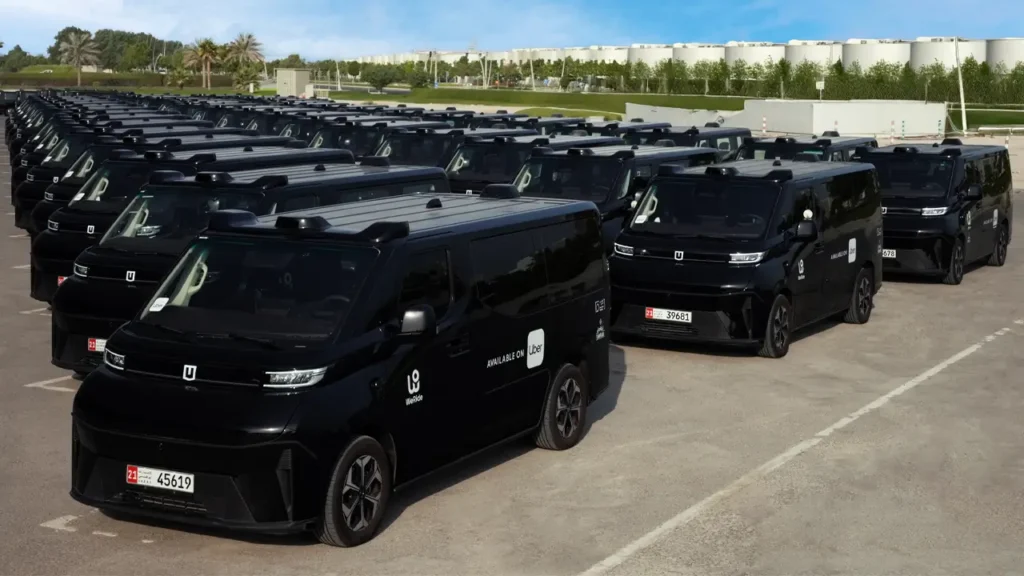
At its core, the WeRide Abu Dhabi robotaxi service is a fully commercial, app-based ride-hailing experience — but with no human driver at the wheel. Uber riders in Abu Dhabi who request UberX or Uber Comfort may be matched with a WeRide autonomous vehicle for qualifying trips. If you’re keen to guarantee an autonomous ride, you can simply select the autonomous category — Uber’s first dedicated autonomous ride option globally.
The service kicked off with routes connecting two of Abu Dhabi’s most prominent destinations. The initial service was available between Saadiyat Island, Yas Island, and routes to and from Zayed International Airport, with plans to expand the operating territory. Those aren’t sleepy backroads — they include some of the most trafficked corridors in the emirate, running past cultural landmarks, resort hotels, theme parks, and one of the region’s busiest international airports.
Expansion followed quickly. By July 2025, WeRide and Uber had started operating robotaxis on Al Reem and Al Maryah Islands, covering about half of Abu Dhabi’s core areas — including Al Reem, Al Maryah, Yas, and Saadiyat, as well as highway routes to and from Zayed International Airport. . Al Reem and Al Maryah are no ordinary islands — they are densely populated, commercially vibrant districts home to finance hubs, residential towers, and the Abu Dhabi Global Market. The fact that WeRide was able to navigate these complex urban environments successfully signals a genuine maturity in the technology.
And the growth hasn’t stopped there. The Integrated Transport Centre announced further expansion of robotaxi services to Khalifa City, Masdar City, and Rabdan, with new routes connecting Abu Dhabi Corniche with Sheikh Zayed Grand Mosque.
Here’s a snapshot of the service coverage timeline:
| Phase | Period | Coverage Areas |
|---|---|---|
| Phase 1 – Launch | December 2024 | Yas Island, Saadiyat Island, Zayed International Airport routes |
| Phase 2 – Expansion | July 2025 | Al Reem Island, Al Maryah Island added; ~50% of city core covered |
| Phase 3 – Driverless | October–November 2025 | Fully driverless commercial permit issued; no safety officer on board |
| Phase 4 – City-Wide | 2026 (planned) | Khalifa City, Masdar City, Rabdan, Corniche–Grand Mosque routes |
The booking experience itself is designed to be seamless and reassuring. Passengers use the Uber or TXAI apps just as they normally would. Once matched with a WeRide vehicle, the experience inside the car is supported by an in-vehicle tablet, and on-board assistance is available through the app during the journey.
3. Why the Middle East Attracts Chinese Autonomous Vehicles
To understand why Abu Dhabi became a global hotspot for autonomous vehicles — and specifically for Chinese ones — you need to look at three powerful forces converging: regulation, investment, and infrastructure.
On the regulatory front, the UAE moved faster than almost any other country outside the US and China. In 2023, WeRide was granted the UAE’s first approved national license for self-driving vehicles on the country’s roads. This wasn’t bureaucratic box-ticking — it was a proactive government decision to open the doors to AV technology years before many European capitals had even begun drafting their frameworks.
The investment dimension is equally significant. In January 2022, WeRide completed a Series D funding round jointly led by a China-UAE joint sovereign fund, Asia Investment Capital, Bosch, GAC Group, and Carlyle Investment Group, raising the company’s valuation to $4.4 billion. That China-UAE joint sovereign fund linkage is telling: it reflects a deep financial relationship between the two regions that predates the robotaxi launch by years and creates a natural pipeline for Chinese technology deployment in the Gulf.
The infrastructure case is compelling too. Abu Dhabi features wide, well-maintained roads, relatively predictable traffic patterns in many districts, clear road markings, and a climate that — while hot — doesn’t include the snow and ice that challenge AV sensors in colder markets. ITC Abu Dhabi has been developing its autonomous vehicle regulatory framework and a road map which incorporates all types of AVs into Abu Dhabi’s transport system.
There’s also a geopolitical angle. Chinese technology companies face growing scrutiny in Western markets, making the Middle East — with its openness to innovation, sovereign investment capabilities, and appetite for smart city development — an especially attractive alternative expansion zone. For WeRide, Abu Dhabi isn’t just a market. It’s a global showcase.
4. How the Driverless Taxi Abu Dhabi Works in Real Life
So what actually happens when you step into a WeRide driverless taxi in Abu Dhabi? The experience is calmer than you might expect — and that’s partly the point.
When a passenger books through the Uber app, the matching algorithm connects them with the nearest available WeRide vehicle. The car arrives, unlocks automatically, and the ride begins. There’s no one in the driver’s seat. On-board support is available during the ride through the app and an in-vehicle tablet. If something feels off, or you have a question, you can communicate through these interfaces.
The progression from supervised to fully driverless was deliberate and staged. At initial launch, each AV had a safety operator present to ensure a secure and reliable experience for riders and pedestrians, laying the groundwork for a fully driverless commercial service. This gradual approach — operator present first, driverless later — is standard practice in responsible AV deployment globally. It allows the technology to accumulate verified real-world performance data before the training wheels come off.
The fully driverless milestone arrived in October 2025. The permit, granted on October 31, 2025, authorizes WeRide’s robotaxis to operate commercially without an on-board safety driver. . This was a watershed moment — not just for WeRide, but for the global AV industry. The launch was supported by the world’s first city-level fully driverless robotaxi permit outside the United States.
For passengers, the safety experience is engineered to feel invisible. The vehicle handles lane changes, merges, roundabouts, and pedestrian crossings with fluid precision. The AI responds to cyclists, unexpected road obstacles, and complex intersection conditions in real time. The result is a ride that feels, after a few minutes, surprisingly ordinary — which is exactly what its designers intended.
5. Robotaxi UAE Autonomous Transport Strategy
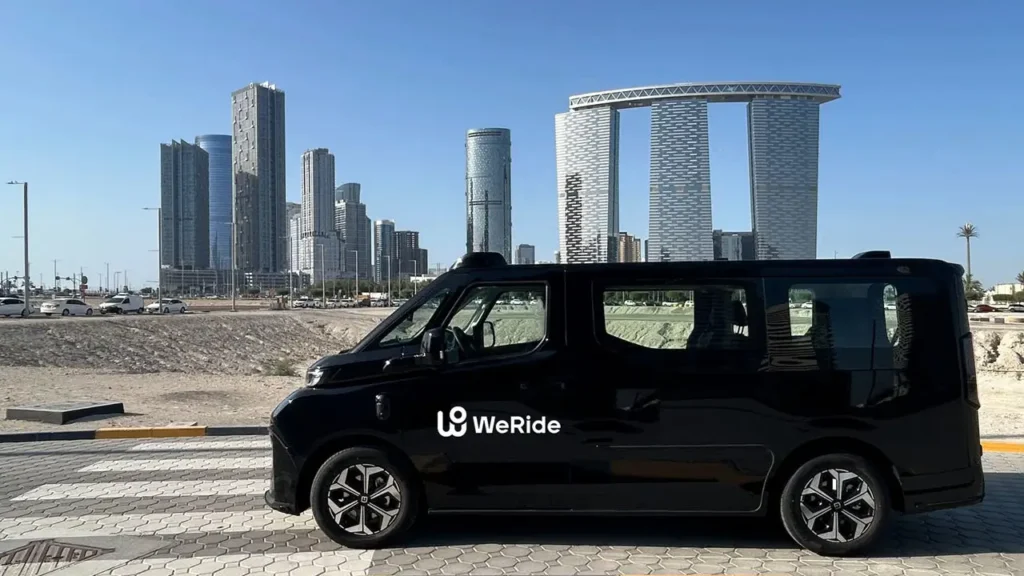
The WeRide robotaxi isn’t operating in a vacuum — it’s part of a carefully constructed UAE autonomous transport strategy that spans government, regulation, and infrastructure investment.
This launch is the result of close collaboration between the ITC, RegLab at the General Secretariat of the Cabinet, and the Supervisory Committee for Advanced Driving Systems Testing chaired by the Ministry of Interior, under the supervision of the Smart and Autonomous Systems Council (SASC). That level of inter-agency coordination reflects just how seriously the UAE government is treating autonomous mobility — not as an experimental novelty, but as an infrastructure priority.
ITC monitors vehicle movements and operations in real time through an advanced digital platform that enables live vehicle tracking and immediate logging and analysis of any incidents or violations. This real-time oversight infrastructure is described as a regional first, and it’s designed to do more than catch problems — it’s built to build public confidence in autonomous transport over time.
Dubai has a Self-Driving Transport Strategy that aims at converting 25% of total trips into self-driving transport trips across different modes by 2030, with plans to introduce 4,000 autonomous vehicles for taxi services. Abu Dhabi’s approach is complementary: it focuses on creating a regulatory environment where private-sector AV innovators can deploy, test, and scale within a structured framework — accelerating adoption while maintaining safety standards.
The broader UAE National Strategy for Artificial Intelligence 2031 gives this all an even wider mandate. ITC’s initiatives aim to enhance transport ecosystem efficiency, strengthen economic sector competitiveness, and reinforce Abu Dhabi’s standing as a regional leader in smart mobility and autonomous systems, in alignment with the UAE National Strategy for Artificial Intelligence 2031.
6. WeRide Uber Robotaxi Partnership Explained
One of the most strategically interesting aspects of the WeRide Abu Dhabi story is how it came together — through a partnership between WeRide and Uber that has global ambitions written all over it.
Uber is the world’s largest ride-hailing platform, and it has placed a significant bet on autonomous vehicles — not by building the technology itself, but by partnering with the companies that do. WeRide fits perfectly into this model. The service, supported by the Integrated Transport Centre (Abu Dhabi Mobility), marks a key step in making AVs part of everyday life in the region. Tawasul Transport, a leading UAE national transport company, acts as the fleet operator.
The three-party model — WeRide as the technology provider, Uber as the platform, and Tawasul as the fleet operator — is elegant in its simplicity and powerful in its scalability. Each party brings what the others lack: WeRide brings Level 4 AV technology; Uber brings its massive user base, brand recognition, and payment infrastructure; Tawasul brings local operational expertise and regulatory relationships.
For Uber, the Abu Dhabi launch was historic. This represented the first time autonomous vehicles were available on the Uber platform outside of the United States. Passengers can access WeRide vehicles through UberX, Uber Comfort, or the dedicated “Autonomous” category — the first such category in Uber’s global history.
Uber has said it plans to roll out the WeRide service to 15 more cities, including in Europe, over the next five years. That is an enormous commitment — and it turns the Abu Dhabi launch from a regional milestone into a global springboard. Since launching in Abu Dhabi in December 2024, the WeRide and Uber robotaxi fleet has tripled in size. The demand signal is real, the technology is performing, and the partnership is scaling.
7. Technology Behind Level 4 Autonomous Driving in China and Beyond
The question that passengers naturally ask when they first sit in a WeRide robotaxi is: how does this thing actually work? The answer involves a remarkable combination of sensors, artificial intelligence, mapping, and redundant safety systems that took WeRide nearly a decade to develop.
WeRide is a global leader in autonomous driving technology, with a presence in over 40 cities across 11 countries, offering a portfolio of five core products including Robotaxi. The technology backbone is the WeRide One platform — a universal architecture designed to power everything from assisted-driving systems (Level 2) all the way up to fully autonomous Level 4 robotaxis.
WeRide’s End-to-End AI model transcends the traditional modular framework of autonomous driving, enabling more efficient coordination between perception, decision-making, and planning. Unlike traditional rule-based hard-coded decision processes, WeRide’s AI model considers real-world complexities when performing driving tasks.
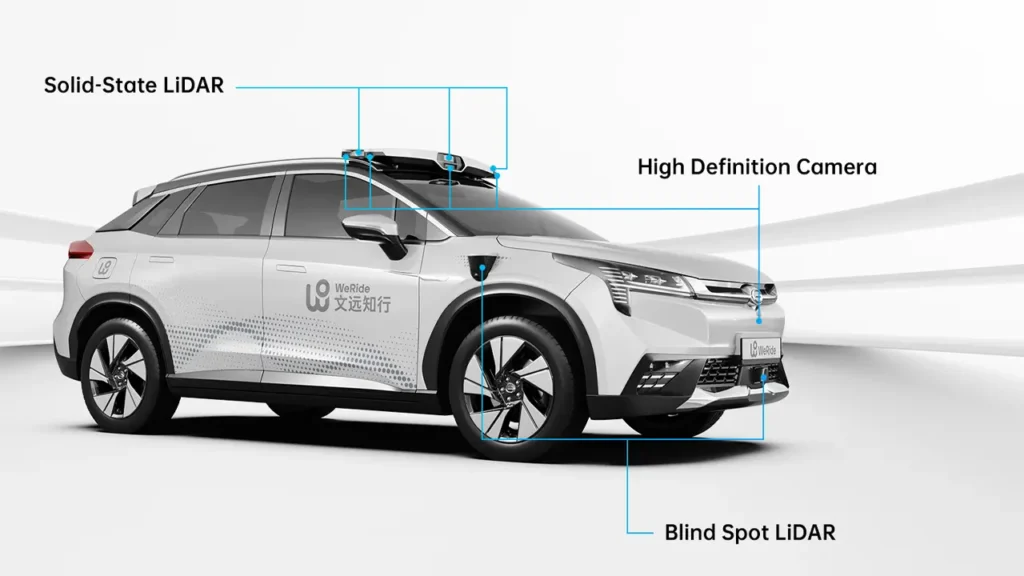
The hardware is equally sophisticated. The latest generation WeRide robotaxi, built on the CER platform with partner Chery, illustrates the sensor density involved. The CER features over 20 sensors — including cost-efficient LiDARs, HD cameras, and RTK-precision navigation modules — and incorporates five layers of redundant safety systems covering steering, braking, parking, communication, and power supply.
Here’s a simplified breakdown of the key technology components:
| Technology Layer | Function | Key Component |
|---|---|---|
| Perception | Detecting objects, pedestrians, vehicles, road markings | LiDAR + HD cameras (sensor fusion) |
| Localization | Knowing exactly where the vehicle is on the road | RTK-precision GPS + HD mapping |
| Prediction | Anticipating how other road users will behave | Deep learning trajectory models |
| Planning | Deciding the optimal path and speed | Neural networks + game theory algorithms |
| Safety Redundancy | Ensuring the vehicle can stop safely at any time | 5-layer redundancy (steering, braking, power, comms, parking) |
| Simulation | Testing and training in virtual environments | WeRide GENESIS generative AI platform |
WeRide has developed deep-learning models for object perception that include sensor fusion algorithms, as well as prediction, planning, and vehicle control. The perception model recognizes and tracks objects in real time, fusing LiDAR and camera vision maps to generate 360° sensor coverage. The prediction model learns how other vehicles behave on roads to generate probable trajectories. Planning algorithms use neural networks and game theory to anticipate humanlike driving behaviors.
In January 2026, WeRide added another technological dimension. WeRide GENESIS bridges physical AI and generative AI, connecting the real and simulated worlds to accelerate the development, training, and validation of autonomous vehicles at scale. It can generate highly realistic virtual worlds, building simulated cities within minutes and accurately reproducing rare, extreme real-world driving scenarios. This effectively condenses millions of kilometers of real-world testing into days of virtual simulation — a massive accelerant for global deployment.
8. Autonomous Mobility Abu Dhabi and Smart City Vision
The WeRide robotaxi doesn’t exist in isolation from Abu Dhabi’s broader ambitions. The city has spent years positioning itself as a global leader in smart and sustainable urban living, and autonomous mobility is one of the most visible pillars of that strategy.
The Integrated Transport Centre envisions a future-ready mobility system marked by operational excellence, with plans ranging from electrifying public buses to introducing water taxis, trams, Autonomous Rail Rapid Transit, and expanding cycling lanes. In this context, the robotaxi is one piece of a much larger smart mobility mosaic — but it’s an important piece, because it’s the one that everyday residents and visitors actually experience.
Acting Director General of the ITC, Dr Abdulla Hamad AlGhfeli, described the driverless commercial launch as “a strategic milestone that cements Abu Dhabi’s status as a global leader in smart and sustainable mobility, reflecting the forward-looking vision of Abu Dhabi’s government in enabling future technologies.”
The smart city vision goes beyond passenger transport. Abu Dhabi Mobility has announced Tesla’s first advanced autonomous trials on selected roads across the emirate, conducted under driver supervision with data collected to assess whether the AVs are ready for wider real-world roll-out. The emirate is simultaneously trialing autonomous trucks for logistics within the Khalifa Economic Zones — creating a comprehensive autonomous transport ecosystem that spans people and freight alike.
What’s particularly forward-thinking about Abu Dhabi’s approach is its use of digital infrastructure alongside physical deployment. Abu Dhabi’s “Digital Twin” system — an integrated platform facilitating advanced digital simulations — provides technical infrastructure services supported by cloud computing and streamlines data storage and processing. This means the city doesn’t just operate autonomous vehicles — it digitally mirrors their operation in real time, enabling planners to optimize routes, anticipate congestion, and improve safety continuously.
9. Self-Driving Taxi Middle East Market Potential
The Middle East is emerging as one of the most exciting growth markets for autonomous mobility globally — and the numbers begin to tell that story clearly.
WeRide plans to expand its regional fleet to tens of thousands of robotaxis by 2030. To put that figure in perspective: as of late 2025, there were approximately 150 WeRide AVs in the Middle East. Going from 150 to tens of thousands in five years would represent one of the most dramatic fleet-scale expansions in transportation history.
Several structural factors make this growth projection credible. The Gulf states have high per-capita income, strong smartphone penetration, and a culture of ride-hailing adoption. Dubai’s Self-Driving Transport Strategy aims to convert 25% of total trips into self-driving transport across different modes by 2030, with plans to introduce 4,000 autonomous vehicles for taxi services. Abu Dhabi and Dubai are moving in the same direction with synchronized momentum.
The latest driverless permit removes the requirement for an in-vehicle safety officer, enabling WeRide robotaxi services in Abu Dhabi to achieve financial breakeven on unit economics. This is critically important. A robotaxi that requires a safety officer on board is essentially a chauffeur-driven car with a very expensive computer co-pilot — the economics don’t work. A truly driverless robotaxi, by contrast, can operate profitably at scale. The Abu Dhabi permit unlocked that equation.
WeRide isn’t confining its Middle East ambitions to the UAE either. Uber and WeRide also debuted robotaxi rides with a safety operator on board in Riyadh, Saudi Arabia, in October 2025. Saudi Arabia’s Vision 2030 program explicitly targets smart city development, mega-projects like NEOM, and a wholesale transformation of urban transport — creating another enormous addressable market.
The competitive landscape is also worth noting. The Middle East currently has fewer entrenched AV incumbents than the US or China, meaning first-movers like WeRide have an opportunity to establish network effects, regulatory relationships, and brand recognition ahead of potential future competition.
10. Verdict — Chinese Robotaxi Global Expansion Begins
Step back and look at the full picture, and what emerges is something genuinely historic. The WeRide robotaxi Abu Dhabi launch isn’t just a product rollout — it’s a signal that the global autonomous vehicle industry has entered a new phase. Chinese AV technology, long assumed to be primarily a domestic story, is now operating commercially on three continents.
WeRide operates an autonomous vehicle fleet of over 1,600 vehicles, of which nearly 750 are robotaxis. WeRide’s AVs are now globally licensed in eight countries. That roster includes China, the UAE, Singapore, France, Saudi Arabia, Belgium, Switzerland, and the US — a regulatory footprint that took years of deliberate, rigorous work to build.
WeRide maintains a 4-year first mover advantage in robotaxi deployment in Abu Dhabi, having operated trials in Abu Dhabi since 2021. That kind of early entry — combined with strong partnerships, regulatory goodwill, and proven safety performance — is extraordinarily difficult to replicate quickly. It’s the kind of structural advantage that tends to compound over time.
For the broader mobility industry, the implications are significant. Uber’s bet on WeRide as its global AV partner outside the US is a vote of confidence in Chinese autonomous driving technology that transcends geography. Uber plans to roll out the WeRide service to 15 more cities, including in Europe, over the next five years.
Here’s a summary of WeRide’s global expansion milestones as of early 2026:
| Country / Region | Status | Key Milestone |
|---|---|---|
| China | Commercial operations | 24-hour fully driverless service in Guangzhou; 10+ cities |
| UAE (Abu Dhabi) | Fully driverless commercial | World’s first city-level driverless permit outside the US |
| Saudi Arabia | Commercial operations launched | First robotaxi autonomous driving permit in Saudi Arabia |
| Singapore | AV testing underway | Full fleet approved for AV testing in Punggol district |
| France / Belgium | Public operations launched | First European fully driverless Robobus shuttle service |
| Switzerland | Driverless permit received | First driverless robotaxi permit for passengers issued in Switzerland |
| United States | Permitted | Holds driverless test permit in California |
The Chinese robotaxi global expansion narrative is no longer a future prediction — it’s a present reality. WeRide has demonstrated that a company founded in Guangzhou in 2017, by Tony Han, the former Chief Scientist of Baidu’s Autonomous Driving Unit, Wikipedia can build technology capable of earning regulatory trust and commercial traction in markets as diverse as the UAE, France, Singapore, and Saudi Arabia.
What Abu Dhabi proved is that the right combination of regulatory openness, strategic partnership, and technological maturity can unlock a new category of urban mobility — faster than almost anyone expected. The WeRide robotaxi Abu Dhabi launch is, in the most meaningful sense, the moment the global autonomous vehicle era began outside the borders of its inventors. What comes next will be fascinating to watch.
Discover more from AutoChina
Subscribe to get the latest posts sent to your email.