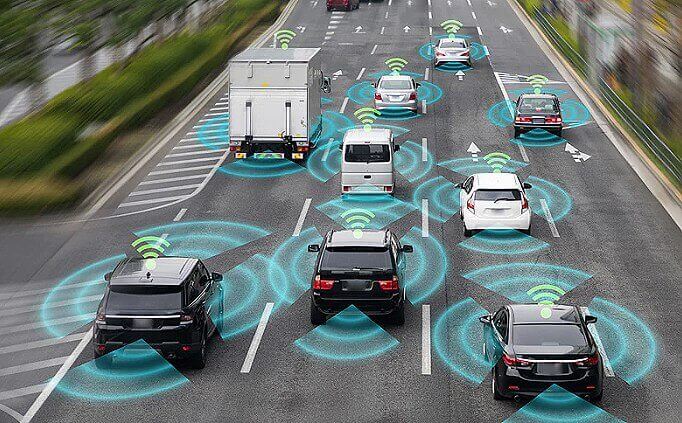
Imagine stepping into your car and instead of pressing buttons or scrolling through menus, the vehicle greets you by name, adjusts the seat temperature based on how you’re feeling, reads the traffic ahead, and begins navigating — all before you say a single word. That’s not science fiction anymore. That’s the promise of the AI cockpit ecosystem, and it is arriving faster than most drivers realize.
In 2026, the smart car user experience has shifted from a novelty feature to the primary battleground for the entire automotive industry. Major technology companies, AI platforms, and automakers are all pouring resources into reimagining what the interior of a connected vehicle can be. The cabin is no longer just a place to sit and steer — it is becoming the most sophisticated personal AI environment most people will ever use on a daily basis. This article takes a friendly, in-depth look at what the AI cockpit ecosystem really means, who is building it, and why it matters to every driver on the planet.

1. Introduction: The AI Cockpit Ecosystem and a New Era of UX
The shift toward a fully integrated AI cockpit ecosystem did not happen overnight. For years, automakers bolted voice assistants and touchscreens onto vehicles without fundamentally changing the underlying architecture. The result was a patchwork of disconnected systems — navigation that did not talk to the climate control, music apps that ignored driver fatigue, and assistants that could answer trivia questions but could not unlock the car door.
That era is now ending. The smart car user experience today is defined by genuine intelligence: systems that perceive driver intent, anticipate needs, and execute complex tasks across every domain of the vehicle simultaneously. At major auto events in 2026, a wave of intelligent agent solutions from companies including Volcengine, Tencent, SenseAuto, and MediaTek all pointed to one conclusion — cars are evolving from passive voice assistants into humanoid agents capable of active perception, autonomous decision-making, and end-to-end task execution.
This transformation is not just about adding a fancier screen. It is a ground-up rethink of how humans and machines communicate inside a moving vehicle, and it has profound implications for safety, comfort, productivity, and even emotional wellbeing. The AI cockpit ecosystem is not a single product — it is an entire philosophy of how technology should serve people in motion.

AndreevWebStudio.com
Professional web development and design services. Custom WordPress sites, landing pages, e-commerce solutions, and 3D printing content creation for businesses and creators.
- • WordPress Development
- • Custom Web Design
- • E-Commerce Solutions
- • 3D Printing Content
2. What Is the AI Cockpit Ecosystem?
At its core, the AI cockpit ecosystem is the integrated network of AI models, software platforms, hardware chips, cloud services, and connected applications that together power the intelligent experience inside a modern vehicle. Think of it as the operating system of your car’s brain — one that keeps learning, adapting, and expanding its capabilities over time.
What makes the current generation genuinely different from everything that came before is the shift from isolated, reactive systems to unified, proactive intelligence. Large AI models are transitioning from add-on features to the foundational core of cockpit systems. This evolution unfolded in three distinct phases: from 2022 to 2023, large models were primarily used for content generation inside vehicles; this was followed by voice agents capable of contextual understanding and memory; and by the second half of 2025, large models began serving as native conversational entry points, deeply integrated into the vehicle’s overall architecture.
The intelligent cockpit technology of today processes inputs from language, behavior, environmental context, driver status, and memory all at once. Large vision models interpret both in-cabin and external conditions, adjusting cockpit settings and delivering proactive, personalized services before the driver even realizes something has changed. The result is a system that feels less like software and more like a thoughtful co-pilot that genuinely understands your preferences, habits, and mood.
This shift also transforms the competitive logic of the automotive industry itself — moving away from a race about the quantity of features toward a much deeper question: how well does this system truly understand its user?
2. The Role of Volcengine AI Cockpit in the Industry
When discussing the AI cockpit ecosystem in 2026, Volcengine — the cloud and AI service platform operated by ByteDance — stands out as one of the most consequential players in the industry. Its scale, reach, and pace of development have made it a central pillar of intelligent cockpit technology for dozens of major automotive brands worldwide.
The numbers speak for themselves. At the 2026 Beijing Auto Show, Volcengine disclosed that over 50 automotive brands and 145 models have integrated its Doubao large model into their cockpit systems. The total installed base has exceeded 7 million vehicles, with the platform completing more than 30 million cabin interactions and service loops every single day. That level of real-world deployment is extraordinary — it means Volcengine’s AI cockpit technology is not a prototype or a concept, but a living system being used by millions of real drivers on real roads right now.
Volcengine’s approach to the Volcengine AI cockpit is built around what the company calls the Agentic AI architecture. Rather than responding passively to user commands, this new generation of the system is designed to upgrade smart cockpits from voice interaction to an autonomous car brain with genuine thinking and execution capabilities. It deeply integrates key functional areas such as vehicle control, navigation, and intelligent driving through a unified AI intelligence layer.
The company’s ecosystem advantage is also significant. By tapping into Volcengine’s diverse content network — spanning social media, short videos, generative content, music, and news — the cockpit can intelligently recommend personalized content based on user behavior. This creates an experience that feels alive and constantly relevant, rather than static and pre-programmed.
Volcengine’s partnerships span the industry’s most recognizable names. Mercedes-Benz signed a memorandum of strategic cooperation with Volcano Engine to collaborate on large models, generative AI, and big data. SAIC Volkswagen achieved in-depth cooperation on intelligent cockpit innovation and in-vehicle content ecosystems. Tesla integrated the Doubao large model for in-car voice services. Dongfeng Motor signed a strategic cooperation agreement focused on intelligent cockpits and enterprise digitalization. These partnerships collectively confirm that the Volcengine AI cockpit has become infrastructure-level technology for the global automotive industry.
Gartner, in its first Magic Quadrant for AI Development Platforms, ranked Volc Engine as the top challenger globally, with the fifth strongest on-premise capabilities in the world and the strongest in China. Its strengths center on a complete loop of models, tools, computing power, and scenarios — exactly the combination needed to power a truly capable AI cockpit ecosystem.
4. The Concept of All-Domain AI 2.0
One of the most exciting developments in the intelligent cockpit technology space is the arrival of All-Domain AI 2.0 — a concept that represents a fundamental leap in how vehicle intelligence is organized and deployed. Rather than treating the cockpit, chassis, safety systems, and driving assistance as separate software silos, All-Domain AI 2.0 brings everything together under a single unified intelligence framework.
Geely Auto Group was among the first major automakers to formally unveil this architecture at CES 2026 in Las Vegas, where the company made its third consecutive appearance at the world’s most influential technology showcase. The company’s Full-Domain AI 2.0 marks a significant evolution from its predecessor, shifting from fragmented, module-based intelligence toward a vehicle-wide AI architecture powered by a central intelligence engine — what Geely describes as a “super AI brain.”
In practical terms, All-Domain AI 2.0 enables different components of the vehicle — the cockpit, chassis, safety systems, and driving functions — to exchange data and interact with each other in real time. Geely achieved this through deep integration of vehicle-level computing power, data, and AI models into a single centralized scheduling layer. The result is a system where cockpit commands can instantly influence driving behavior, safety systems can proactively adjust the cabin environment, and the AI can coordinate complex scenarios across all vehicle domains simultaneously.
The engine of this shift is Geely’s WAM, the World Action Model, built specifically to break a long-standing challenge: siloed data and fragmented models across driving, cockpit, chassis, and power domains. With WAM at the center, automotive intelligence is no longer just a stack of features — for the first time, the car gains an evolving worldview and genuine judgment capability.
Li Chuanhai, Chief Technology Officer of Geely Auto Group, described the long-term vision clearly: “By 2030, cars will evolve into Super Intelligence with emotional awareness, proactive service, and continuous evolution. G-ASD and Full-Domain AI 2.0 are not distant concepts — they are tangible innovations that integrate with cockpits and chassis to deliver highly humanlike, super intelligent, and extremely user-friendly experiences.”
This vision of a unified super brain coordinating every aspect of the vehicle is the definitive direction for the entire AI cockpit ecosystem going forward.
BestChina3DPrinters
Expert Reviews & Rankings
Independent 3D Printer Reviews
Your trusted source for Chinese 3D printer reviews, rankings, and comparisons. We buy, test, and review every printer so you can make informed decisions.
5. How the In-Car AI System Works
Understanding the in-car AI system at a technical level helps explain why this generation of cockpit technology feels so fundamentally different from what came before. Modern in-car AI systems operate through a layered architecture that combines on-device intelligence, edge computing, and cloud connectivity to deliver fast, accurate, and contextually aware responses.
At the hardware level, the latest cockpit chips are purpose-built for AI workloads. MediaTek’s Dimensity Auto Cockpit Platform C-X1, for example, is built on a 3nm process and delivers up to 400 TOPS — tera operations per second — of all-modal AI computing power. ThunderSoft’s RazorDCX Sylvania achieves CPU compute reaching SPECint2017rate of 80 and dense AI compute of 320 TOPS. Geely’s G-ASD system is available in configurations offering between 700 and 1,400 TOPS of computing power. These figures represent genuinely supercomputer-level processing built directly into the vehicle.
At the software level, the in-car AI system processes multimodal inputs simultaneously: voice commands, driver facial expressions, cabin environment data, external road conditions, and behavioral history all feed into the system’s understanding of what the driver needs at any given moment. Intent recognition accuracy in leading platforms has exceeded 95%, with AI features such as multimodal interaction responding within milliseconds.
The architecture that makes this possible combines on-vehicle execution of AI models for real-time responsiveness with cloud-based models that continuously enrich functions and expand usage scenarios. This device-edge-cloud collaborative architecture ensures the system never feels slow or disconnected, even when network conditions are imperfect. For drivers, the practical result is a cockpit that genuinely understands context — it knows the difference between asking for the temperature because you are cold and asking for the temperature as a casual question, and it responds appropriately in both cases.
6. AI Voice Assistant Car: Voice as the Interface
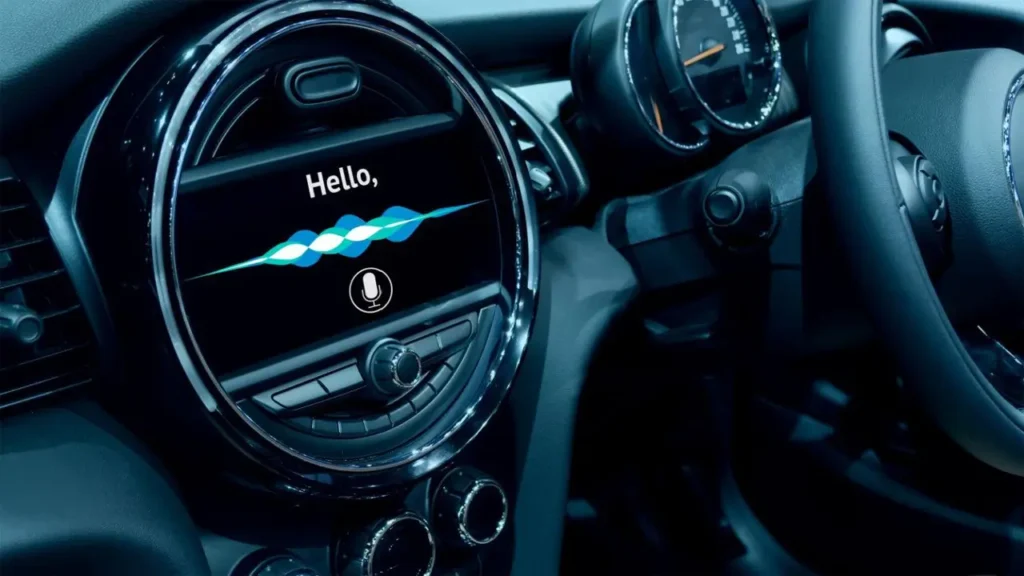
Of all the interaction modalities available in a modern cockpit, voice has emerged as the most natural, safest, and most powerful. The AI voice assistant in today’s smart car is not the rigid command-recognition system of a decade ago — it is a conversational AI capable of nuanced dialogue, contextual memory, and proactive suggestions.
The Doubao Cockpit Assistant developed by Volcengine exemplifies this new generation of AI voice assistant. Powered by the Doubao large language model, the system can engage in multi-turn conversations that span multiple topics and vehicle functions within a single interaction. Rather than forcing drivers to memorize specific commands, the assistant understands natural language in the way a human colleague would.
The evolution of this capability has been rapid and clearly defined. In the early stages, in-car AI large models played the role of a knowledgeable but passive passenger — users asked, it answered; users commanded, it executed. Despite improved voice recognition and more natural dialogue, the underlying logic remained identical to traditional voice control. The current generation changes this entirely. The system can now initiate interactions proactively, remembering preferences from previous journeys and offering suggestions before being asked.
Volcengine’s speech technology has advanced alongside its model capabilities. The company’s Doubao Speech Recognition Model 2.0 and Voice Cloning 2.0 bring multilingual recognition accuracy and personalized voice experiences to the cockpit. For drivers who switch between languages or have strong regional accents, these improvements are practically meaningful — the system understands them correctly the first time, every time.
SAIC Audi’s partnership with Volcengine produced a particularly compelling example of cross-terminal voice continuity. Through the Audi Assistant App built on the Doubao large model, drivers can start a conversation inside the vehicle and then continue that exact conversation on their smartphone after leaving the car. The AI remembers the context, the preferences, and the unfinished threads — creating a seamless companionship experience that crosses the boundary between the vehicle and the rest of daily life.
7. Connected Car Ecosystem and Device Synchronization
The AI cockpit ecosystem does not exist in isolation. It is one node in a much larger connected car ecosystem that links the vehicle to smartphones, smart home devices, cloud services, wearable technology, infrastructure, and the broader digital lives of its users.
The connected car ecosystem enables a level of personalization and continuity that was simply impossible when vehicles were offline machines. When a driver’s smartwatch detects elevated stress levels during a commute, the cockpit AI can automatically lower the lighting, play calming music, and reduce incoming notification alerts — all without a single spoken command. When a driver leaves a meeting on their phone while walking to the parking lot, the car can have the navigation already set for the next appointment by the time they sit down.
Volcengine’s ecosystem advantage in this area is particularly strong, given its parent company ByteDance’s extensive portfolio of consumer applications. The cockpit can intelligently draw on social media content, short video recommendations, music platforms, news, and generative content tools, blending entertainment and information into a coherent, personalized experience for every journey.
The vision of a unified AI ecosystem loop is explicitly articulated by Volcengine’s corporate strategy: with the successive launch of terminal products such as the Doubao phone and AI glasses, ByteDance is building a complete AI ecosystem loop through four pillars — large model, cloud, terminal, and scenario. The connected car is a critical scenario in this loop, and the cockpit is the primary interface through which that ecosystem reaches the driver.
For the automotive industry, the connected car ecosystem also creates new commercial opportunities. OEMs can use the platform to develop brand-specific AI experiences through proprietary knowledge graphs, strengthening user loyalty and creating differentiated identities that go far beyond the sheet metal and powertrain.
| Feature | Traditional Cockpit | AI Cockpit Ecosystem |
|---|---|---|
| Interaction Model | Command-and-response only | Proactive, contextual, multimodal |
| System Architecture | Siloed modules, no cross-domain link | Unified AI brain, real-time integration |
| Personalization | Manual user profiles, static settings | Behavioral learning, adaptive experience |
| Device Connectivity | Basic smartphone mirroring | Full ecosystem sync across all devices |
| Voice Assistant | Keyword recognition only | Natural language, multi-turn dialogue |
| Content Experience | Pre-loaded apps, limited updates | Dynamic, cloud-powered content ecosystem |
| Safety Awareness | Passive alerts, no behavioral reading | Driver monitoring, proactive intervention |
| OTA Updates | Rare firmware patches | Continuous AI model improvement |
8. Autonomous Driving AI Cockpit and Safety
The relationship between the autonomous driving AI cockpit and vehicle safety is one of the most important — and most carefully managed — aspects of this entire technology revolution. As AI systems take on more driving responsibilities, the cockpit must evolve in parallel to ensure that the transition from human control to machine control is safe, transparent, and trustworthy.
Geely’s G-ASD intelligent driving system provides a clear blueprint for how this is being approached. The system combines advanced AI with large-scale real-world driving data and high-performance sensing hardware. G-ASD’s cloud-side multimodal large model plus World Model reaches the 100-billion-class parameter range, significantly boosting perception and reasoning capabilities. The system uses 31 sensors and integrates lidar, enabling it to handle complex traffic scenarios with a level of situational awareness that exceeds human capability in many conditions.
The roadmap for autonomous capability is structured and disciplined. Geely plans to launch highway Level 3 autonomy and low-speed Level 4 city capabilities in 2026, subject to regulatory approval. Level 3 means the vehicle can handle all driving tasks in defined conditions, with the human ready to take over if requested. Level 4 means the vehicle can complete journeys without human intervention in specific operational domains, enabling applications such as robotaxi services.
Critically, the role of the AI assistant within the autonomous driving AI cockpit is clearly defined and respected. As Volcengine officials stated at the 2026 Beijing Auto Show, the AI assistant is responsible for understanding intentions and issuing commands, but the final authority over driving decisions remains within a safe, controlled framework. User data within the vehicle will never be used for training large models — a firm commitment to privacy that addresses one of the most significant concerns drivers have about AI-powered cockpits.
ThunderSoft’s approach to safety in its RazorDCX Sylvania platform reinforces this principle. Through a device-edge-cloud collaborative architecture, AI features including multimodal interaction respond within milliseconds, with intent recognition accuracy consistently above 95%. The system’s full development framework allows OEMs to customize quickly while building on production-grade algorithms proven in real-world use cases.
The industry’s convergence on the concept of a unified agent subject — a single AI brain coordinating both cabin intelligence and driving intelligence — is the endgame that makes safety even more achievable. As Qiu Xiaoxin, CEO of Aixin Yuanzhi, noted at Auto China 2026: “The interior of future cars will no longer see the cockpit and assisted driving operating independently. Instead, a unified Agent Subject will emerge to coordinate different intelligent capabilities within the car, creating a more complete, integrated experience.”

9. Next-Gen Vehicle UX: Personalization and Emotion
Perhaps the most human dimension of the AI cockpit ecosystem is its growing ability to recognize, respond to, and even shape the emotional state of the people inside the vehicle. Next-gen vehicle UX is moving beyond functionality into genuine emotional intelligence — and that shift is one of the most compelling developments in the entire smart mobility space.
The aspiration is articulated most powerfully in Geely CTO Li Chuanhai’s vision: “By 2030, cars will evolve into Super Intelligence with emotional awareness, proactive service, and continuous evolution.” This is not marketing language — it reflects a real technical direction that multiple companies are now pursuing simultaneously.
The Volcengine-Visteon joint cockpit solution demonstrated at Auto Shanghai 2025 offers a concrete example of how emotional and behavioral intelligence manifests in practice. Large vision models within the system interpret both in-cabin and external user states, adjusting cockpit settings and delivering proactive, personalized services. The system integrates inputs from language, behavior, environmental context, status, and memory to enable more intuitive and human-like communication between driver and vehicle.
The Eva personal agent unveiled alongside Geely’s All-Domain AI 2.0 at CES 2026 represents the interface layer of this emotional intelligence. If Full-Domain AI 2.0 represents the car’s cognitive architecture, Eva embodies the car’s IQ and EQ — the personality and emotional responsiveness that makes the interaction feel genuinely personal rather than mechanical.
For everyday drivers, the practical manifestation of next-gen vehicle UX includes: seats that adjust to your posture before you ask, cabin lighting that shifts with the time of day and your mood, music that matches the energy of your journey, and an assistant that remembers the name of the restaurant you were trying to remember last Tuesday. The system learns from every interaction, building a richer and more accurate model of each individual user over time.
The personalization extends to brand identity as well. OEM manufacturers can use Volcengine’s platform to develop brand-specific AI experiences leveraging proprietary knowledge graphs, allowing them to create cockpit personalities that reflect their brand values and strengthen user loyalty. A premium luxury brand might build an assistant that is calm, precise, and understated. A performance brand might favor something more energetic and immediate. The underlying AI cockpit ecosystem enables both, from the same platform infrastructure.
| AI Cockpit Capability | Current Status (2026) | Near-Future Direction (2030) |
|---|---|---|
| Voice Interaction | Multi-turn natural language dialogue, 95%+ accuracy | Emotionally adaptive, zero-friction conversation |
| Autonomous Driving | L2+ standardized, L3/L4 launching in 2026 | Full urban L4, broad robotaxi deployment |
| Personalization | Behavioral learning, content recommendations | Emotional awareness, proactive life integration |
| Cross-Device Sync | Phone-to-car conversation continuity live | Full seamless sync across all personal devices |
| Domain Integration | All-Domain AI 2.0 architecture deployed | Single unified super-intelligence across entire vehicle |
| Safety Systems | Proactive driver monitoring, real-time alerting | Predictive safety across full driving lifecycle |
10. Pros, Cons, and Final Verdict on the AI Cockpit Ecosystem
No technology revolution arrives without trade-offs, and the AI automotive interface is no exception. A balanced assessment requires looking honestly at both the genuine strengths of the current AI cockpit ecosystem and the real challenges that still need to be addressed.
The strengths are substantial and well-documented. The scale of deployment is already remarkable — over 7 million vehicles running Volcengine’s Doubao large model, completing more than 30 million daily interactions, across 50 brands and 145 models. This is not a laboratory experiment. The AI cockpit ecosystem is a functioning, scaled, real-world technology that millions of drivers use every day. The improvements in voice accuracy, multimodal interaction, personalization, and cross-domain integration are measurable and meaningful.
The safety case for the AI automotive interface is also strengthening with every generation. Unified architectures like All-Domain AI 2.0 create the technical foundation for safer autonomous driving by eliminating the dangerous gaps between previously siloed systems. Intent recognition accuracy above 95%, millisecond response times, and 100-billion-parameter reasoning models represent a qualitative leap in what in-car AI can actually do in real driving conditions.
The connected car ecosystem dimension adds value that compounds over time. Unlike traditional vehicle features that are fixed at purchase, the AI cockpit ecosystem improves continuously through over-the-air model updates. The car you buy today will be meaningfully smarter in one year, and significantly more capable in three years — without any hardware changes.
The challenges are equally real and deserve honest acknowledgment. Homogenization is a growing concern. As the 2026 industry analysis noted, mainstream intelligent cockpit interfaces are becoming highly similar in UI design, voice assistant personas, and app ecosystems. If every cockpit uses the same underlying AI platforms, differentiating the user experience becomes extremely difficult. The risk is a race to the bottom where all smart cars feel generically similar despite their brand identities.
Data privacy remains a genuine concern for many drivers. The AI cockpit ecosystem is, by definition, a system that collects and processes extremely detailed behavioral data about how people live, where they go, what they talk about, and how they feel. While Volcengine and others have made explicit public commitments that vehicle user data will never be used to train large models, consumer trust in these commitments will need to be earned through transparency and consistent behavior over time.
The computing power gap between premium and entry-level vehicles creates a two-tier experience that could deepen inequalities in the driving population. Mainstream chips currently support only sub-billion-parameter small models, while leading platforms run 7 to 100 billion parameters. Bridging this gap without dramatically increasing vehicle costs is one of the industry’s most important technical and commercial challenges.
Traditional automakers also face significant organizational and engineering challenges in this transition. Building deep AI expertise, managing the pace of software iteration, and integrating new AI architectures into complex global vehicle programs requires capabilities that are genuinely difficult to acquire quickly.
The final verdict is optimistic, grounded, and clear. The AI cockpit ecosystem is not a trend or a buzzword — it is the defining technology direction of the automotive industry for the next decade. The convergence of powerful large language models, unified vehicle architectures like All-Domain AI 2.0, mature cloud platforms like Volcengine, and genuinely intelligent voice assistants has created an inflection point that is already producing real value for millions of drivers.
The AI automotive interface of 2026 is smarter, safer, more personal, and more capable than anything that existed just two years ago. The direction of travel — toward emotional awareness, proactive service, unified super-intelligence, and seamless ecosystem integration — is compelling and technically credible. The challenges of homogenization, privacy, and democratization are real, but they are engineering and policy problems that the industry has both the motivation and the capability to solve.
For drivers, the message is simple: the car you sit in is becoming the most sophisticated AI device in your life. The AI cockpit ecosystem is not just changing how you interact with your vehicle — it is changing what a vehicle fundamentally is. And the most exciting part is that this revolution has barely begun.
🇺🇸 James Carter ⭐⭐⭐⭐⭐
This article about the AI cockpit ecosystem is next level. Clear, informative, and actually useful. I’ve been researching smart car UX for a while, and this is one of the best breakdowns I’ve seen. The site is clean and easy to navigate.
👉 https://www.autochina.blog
🇪🇸 Carlos Méndez ⭐⭐⭐⭐⭐
Excelente artículo sobre el AI cockpit ecosystem. Explica muy bien cómo Volcengine y la inteligencia artificial están cambiando la experiencia en los coches. El sitio es rápido y profesional.
👉 https://www.autochina.blog
🇸🇦 Ahmed Al-Farsi ⭐⭐⭐⭐⭐
مقال رائع عن AI cockpit ecosystem. المعلومات واضحة ومفيدة جداً، خاصة حول الذكاء الاصطناعي داخل السيارات. الموقع منظم وسهل الاستخدام.
👉 https://www.autochina.blog
🇨🇳 Li Wei ⭐⭐⭐⭐⭐
这篇关于AI cockpit ecosystem的文章非常专业,内容清晰,解释了车载人工智能系统的未来发展。我很喜欢这个网站,信息很有价值。
👉 https://www.autochina.blog
🇫🇷 Sophie Laurent ⭐⭐⭐⭐⭐
Article très intéressant sur le AI cockpit ecosystem. J’ai particulièrement apprécié les explications sur l’expérience utilisateur dans les voitures intelligentes. Le site est moderne et agréable.
👉 https://www.autochina.blog
🇩🇪 Lukas Schneider ⭐⭐⭐⭐⭐
https://www.autochina.blogSehr guter Artikel über das AI cockpit ecosystem. Die Inhalte sind verständlich und gut strukturiert. Perfekt für alle, die sich für moderne Fahrzeugtechnologie interessieren.
👉 https://www.autochina.blog
Discover more from AutoChina
Subscribe to get the latest posts sent to your email.