Introduction to BYD Great Han
There is a new name in the world of luxury electric sedans, and it is making quite an impression even before its official launch. Meet the BYD Great Han — a full-size flagship sedan that combines stunning range figures, cutting-edge battery technology, and a level of premium refinement that puts it squarely in competition with the best executive cars money can buy.
The BYD Great Han, known in Chinese as “Dahan” (大汉), is the next major evolution of BYD’s celebrated Han sedan lineup. It sits above the Han and Han L in the Dynasty series hierarchy and represents the brand’s most ambitious push into the upper luxury segment to date. The Great Han is a full-size sedan measuring 5,256 mm in length, 1,999 mm in width, and 1,510 mm in height, with a wheelbase of 3,130 mm. To put that in perspective, that makes it longer than a standard Mercedes-Benz S-Class — a bold statement of intent from a brand that is clearly playing for the very top.
What makes the Great Han particularly exciting right now is that it arrives at a moment when the global premium EV market is fiercely competitive, yet still wide open for well-equipped challengers. BYD clearly believes it has the right product at the right time, and the early signals are very encouraging indeed.
Why BYD Great Han Is Making Headlines
Before the car even received its official name, BYD did something refreshingly unusual — it asked the public to choose. On June 4, 2026, BYD Dynasty Network General Manager Lu Tian posted on Weibo, inviting users to vote for the name of the brand’s upcoming flagship sedan. This was not simply a marketing exercise; it reflected a genuine desire to bring customers along for the ride when building a car of this significance.
After several rounds of internal selection, six name candidates were put to the public: Great Han (Dahan), Han 9, Han Ultra, Han Tianxia (All-Under-Heaven), Xiaohan (Heaven Han), and Han Chitu (Han Red Rabbit). The result was decisive. The Great Han variant led the poll with 1,727 votes, while the runner-up, Han Tianxia, gathered just 254 votes. The name resonated deeply, and it is easy to see why — it carries cultural weight, connecting the car to one of the most celebrated dynasties in Chinese history.
This naming campaign is part of a broader brand strategy. BYD is actively positioning itself as a global bearer of Chinese cultural identity through its products, and the Dynasty lineup — which includes the Han, Song, Tang, and Yuan models — is central to that narrative. The Great Han fits perfectly into this story as the most prestigious sedan in the family.
The car’s arrival also follows the enormous commercial success of its sibling, the Great Tang SUV. The Great Tang received over 100,000 pre-orders in less than two weeks after pre-sales opened, which was so overwhelming that BYD was forced to delay its launch to ensure production capacity could meet demand. With that kind of momentum behind the Dynasty flagship lineup, expectations for the Great Han are naturally very high.
BYD Great Han Range: The 1,008 km Claim
Let’s talk about the headline figure, because 1,008 km of range on a single charge is genuinely extraordinary. To be clear about the context: this figure is measured under China’s CLTC (China Light-duty Vehicle Test Cycle) standard, which tends to produce more optimistic results than the European WLTP or American EPA cycles. Even so, the number represents a meaningful leap forward in what is technically achievable in a mass-produced electric sedan.
The Great Han will be offered in two main pure electric configurations. The rear-wheel-drive (RWD) LiDAR Exclusive Edition achieves the flagship 1,008 km range figure. The all-wheel-drive (AWD) LiDAR Flagship Edition delivers an impressive 880 km of range — still a class-leading number by any standard. Both variants are equipped with BYD’s second-generation Blade Battery and the Flash Charging system built on the 1000V Super e-Platform architecture.
A plug-in hybrid (PHEV) version is also available. The PHEV variant uses a 1.5-litre turbocharged engine producing 115 kW, paired with a 200 kW electric motor, and carries a 54.489 kWh LFP battery pack providing up to 370 km of pure electric range, with fuel consumption of just 4.6 litres per 100 km on a depleted battery.
For the pure electric variants, the powertrain options are equally impressive. The single rear-mounted motor in the RWD configuration delivers 370 kW (496 hp), while the AWD dual-motor setup combines a rear motor with a 200 kW front motor for a total output of 570 kW — that is 764 hp from a production luxury sedan. These are genuinely performance-car numbers dressed up in executive clothing.

AndreevWebStudio.com
Professional web development and design services. Custom WordPress sites, landing pages, e-commerce solutions, and 3D printing content creation for businesses and creators.
- • WordPress Development
- • Custom Web Design
- • E-Commerce Solutions
- • 3D Printing Content
How the 1,008 km Range EV Changes the Market
Range anxiety has long been one of the primary objections raised by consumers considering a switch to electric vehicles. A car that can travel over 1,000 km on a single charge does not just address that concern — it eliminates it entirely for the overwhelming majority of drivers and use cases.
For context, 1,008 km is roughly the distance from London to Rome, or from New York to Charlotte, North Carolina. It means that for most users, a weekly or even bi-weekly charging routine would be perfectly sufficient, regardless of daily driving patterns.
The Great Han is not the first EV to claim four-digit range figures, but it achieves this milestone in a full-size, premium sedan package that also happens to offer megawatt-level flash charging. That combination — extreme range plus extreme charging speed — is what makes this car genuinely different. Previous ultra-long-range EVs often sacrificed charging speed, requiring many hours to refill. The Great Han, as we will discuss shortly, does not make that trade-off.
From a competitive positioning standpoint, the Great Han enters a segment where traditional German luxury brands are currently vulnerable. Audi has confirmed that the successor to the current A8L will not arrive until 2029 at the earliest, leaving a significant gap in the D-class executive sedan market from 2026 to 2029. The Great Han steps directly into that space, offering an executive-oriented product with a body length exceeding 5.3 metres and a wheelbase of over 3.1 metres — dimensions that match and in some cases exceed what European rivals offer.
BYD Blade Battery 2.0 Technology Explained
The heart of the Great Han’s remarkable capabilities is its second-generation Blade Battery, often referred to as Blade Battery 2.0. This is an evolution of the original Blade Battery technology that BYD introduced with the first-generation Han EV, which was notable for being the world’s first mass-produced vehicle to use a blade-format lithium iron phosphate (LFP) cell arrangement.
The original Blade Battery was already widely praised for its thermal stability and safety characteristics. The LFP chemistry is inherently more thermally stable than nickel-manganese-cobalt (NMC) alternatives, and the blade cell geometry allowed BYD to pack more energy into less space while reducing the risk of thermal runaway — the dangerous condition that can cause EV batteries to catch fire. Blade Battery 2.0 builds on these foundations while introducing significant performance improvements.
One of the most remarkable claims associated with Blade Battery 2.0 is its charging capability. The battery supports charging from 10% to 97% in just 9 minutes when connected to a compatible Megawatt Flash Charging station. This is a dramatic improvement over conventional fast-charging systems and represents a fundamental shift in how owners will think about recharging their vehicles.
The new battery also introduces ultra-fast ion channels that reduce internal resistance by 50% compared to the previous generation. This reduction in internal resistance is what makes the extreme charging rates physically possible without generating excessive heat or degrading the cells. The battery achieves a world-record charging rate of 10C — meaning it can theoretically absorb ten times its capacity in electrical charge per hour — and supports a charging current of 1,000 amperes.
LFP chemistry also offers a practical longevity advantage: LFP batteries are generally capable of more charge-discharge cycles before degradation compared to NMC alternatives, making them a strong long-term ownership proposition.
BYD Flash Charging and Charging Speed
BYD’s Flash Charging technology, underpinned by the Super e-Platform, is arguably as impressive as the range figures themselves — and in daily use, it may actually matter more. After all, even with 1,008 km of range, drivers will eventually need to charge, and how quickly they can do so is a critical quality-of-life factor.
BYD’s Super e-Platform is the world’s first full-domain 1000V high-voltage architecture for mass-produced passenger vehicles. Unlike standard EV platforms that operate at 400V or 800V, the Super e-Platform integrates ultra-high voltage (1000V) and ultra-high current (1000A) across all key components — battery, motor, power supply, and even the air conditioning system — into a unified 1000V ecosystem.
The results are remarkable. BYD’s Megawatt Flash Charging technology achieves a peak charging speed described as “1 second for 2 kilometres,” which translates to 400 km of added range in just 5 minutes. For comparison, most current 800V fast-charging systems add roughly 100 to 160 km in the same five-minute window. BYD’s system is effectively two to four times faster than existing premium fast-charging technology.
In practical terms: the Han L, which shares the same Super e-Platform as the Great Han, can charge from 10% to 70% in just 6 minutes, and from 0% to 100% in approximately 20 minutes. The Blade Battery 2.0 version in the Great Han further improves on this, supporting the 10%-to-97% charge in 9 minutes as mentioned above.
To support this infrastructure, BYD has announced plans to deploy over 4,000 Megawatt Flash Charging stations across China. The company has also developed an all-liquid-cooled charging terminal system capable of delivering up to 1,360 kW of power. Additionally, dual-gun charging and intelligent voltage boost technologies ensure backward compatibility with existing public fast-charging networks, which is an important practical consideration for owners.
Wang Chuanfu, BYD’s Chairman and President, has stated clearly that the company’s goal is to make EV charging as fast as refuelling a conventional petrol car. With 5 minutes delivering 400 km of range, that goal has effectively been achieved.
Luxury Electric Sedan Features
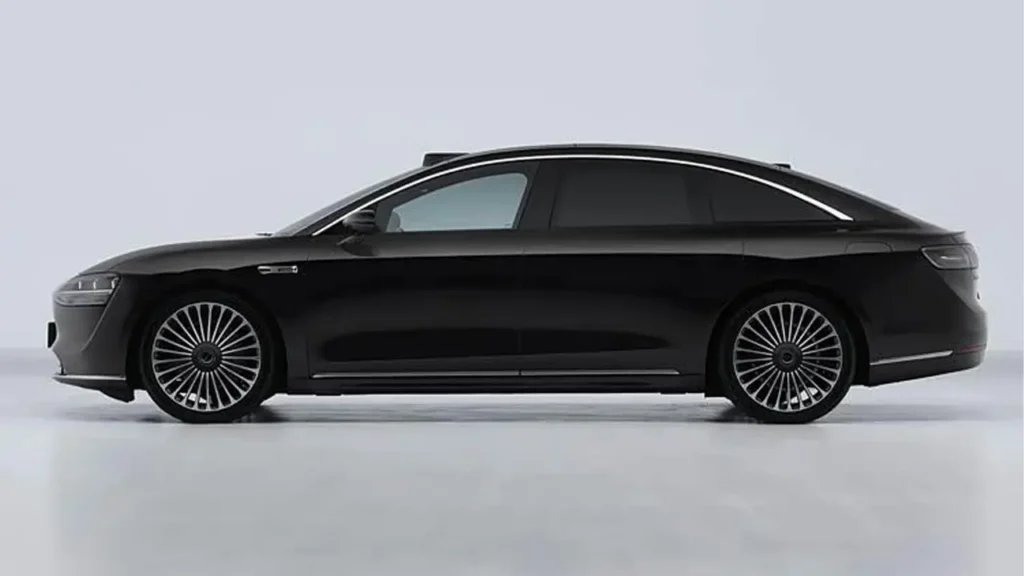
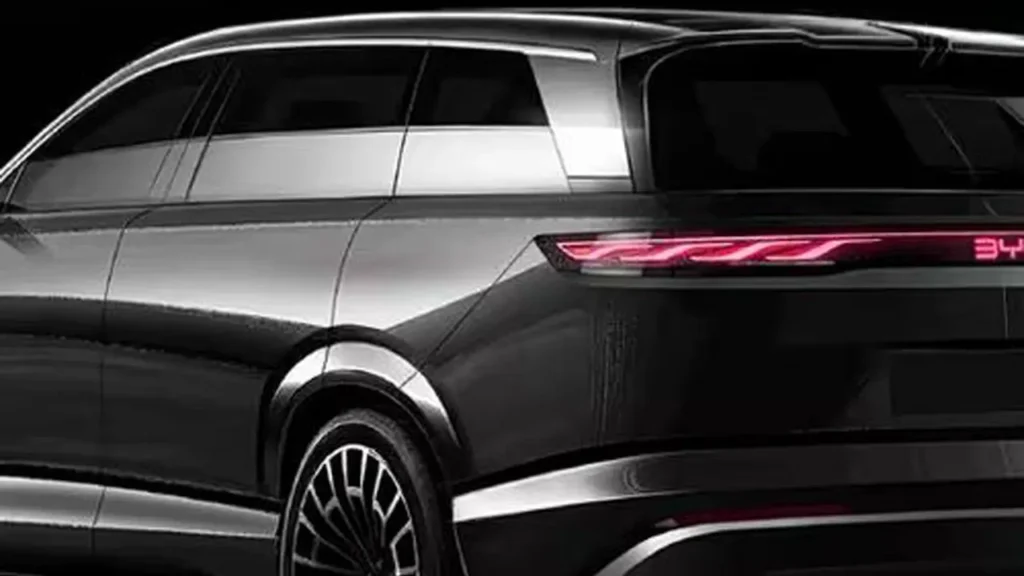
Beyond the powertrain and battery innovations, the BYD Great Han makes a strong case as a genuinely luxurious executive sedan. The exterior design follows BYD’s “Loong Face” (Dragon Face) design language, featuring thin headlights joined by a chrome-plated panel, an active air intake in the front bumper, semi-hidden door handles, and multi-spoke rims. The rear is defined by a single full-width taillight unit with a distinctive Chinese knot pattern. Blackened pillars and a sloping roofline give the car a sleek, modern silhouette, and a LiDAR sensor is mounted on the roof as a visual indicator of the car’s advanced driver assistance capabilities.
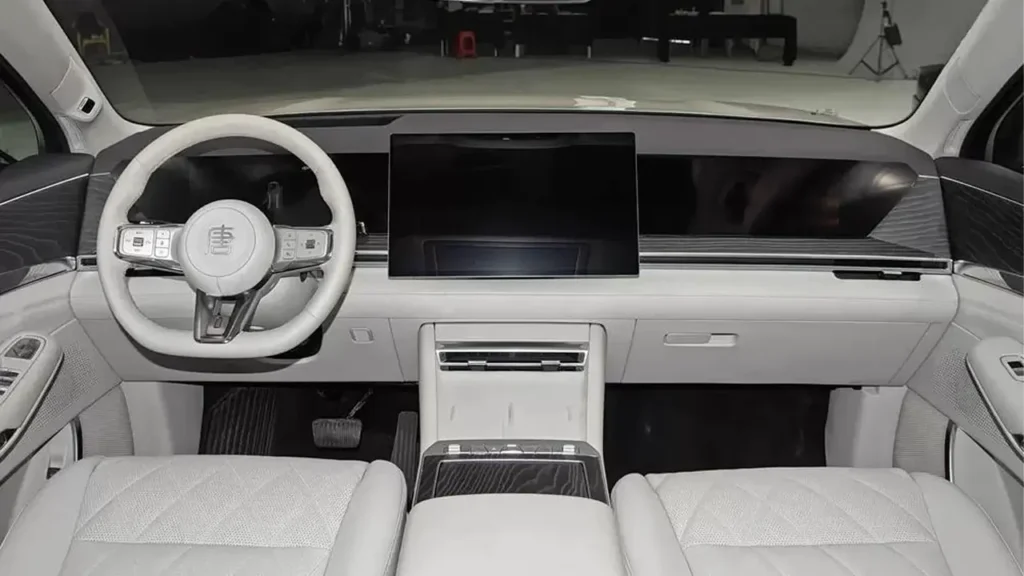
The interior takes strong inspiration from the Great Tang SUV, which means a thoroughly screen-focused, premium environment. The cabin features three displays covering the instrument panel, the central infotainment screen, and a separate passenger display. The gear shifter has been moved to the steering column, freeing up the centre console for wireless charging pads and hidden storage compartments. A three-spoke steering wheel with the Han badge sits at the centre of the driving experience.
In terms of chassis technology, the Great Han is expected to carry the same level of equipment as the Great Tang SUV, which includes the DiSus-A suspension system featuring dual-chamber air suspension with adjustable ride height, as well as rear-wheel steering for improved manoeuvrability at low speeds and high-speed stability. These are features typically associated with cars costing significantly more.
For intelligent driving, the Great Han carries the DiPilot system in LiDAR-enabled specification. Based on a reinforcement-learning end-to-end large model, the DiPilot 5.0 solution promises a driving experience that more closely mirrors human decision-making logic. The roof-mounted LiDAR provides the core hardware support for high-level driver assistance across both urban and highway environments.
The result is a car that does not ask owners to compromise between technology and comfort. It offers both in abundance.
Specification Table
| Specification | BYD Great Han |
|---|---|
| Range (CLTC) — RWD | 1,008 km (626 miles) |
| Range (CLTC) — AWD | 880 km (547 miles) |
| Battery | Blade Battery 2.0 (LFP) |
| Charging Technology | Megawatt Flash Charging |
| Charging Speed | 400 km in 5 min; 10%–97% in 9 min |
| Platform | Super e-Platform (1000V Architecture) |
| Drive Options | RWD / AWD |
| Peak Power (AWD) | 570 kW (764 hp) |
| Peak Power (RWD) | 370 kW (496 hp) |
| Body Length | 5,256 mm |
| Wheelbase | 3,130 mm |
| LiDAR | Yes (roof-mounted) |
| Intelligent Driving | DiPilot 5.0 (God’s Eye B) |
| Suspension | DiSus-A dual-chamber air suspension |
| Powertrain Options | BEV / PHEV |
| Estimated Price | ~300,000 yuan (~$41,500 USD) |
| Expected Launch | Q3 2026 |
Tesla Model S Competitor or Something More?
It is tempting to frame the BYD Great Han purely as a Tesla Model S competitor, and on paper the comparison makes obvious sense. Both are large, premium electric sedans with performance powertrain options and advanced driver assistance systems. But in several key respects, the Great Han goes further.
The Great Han is physically larger than the Tesla Model S. At 5,256 mm long with a 3,130 mm wheelbase, it is closer in size to a long-wheelbase Mercedes S-Class than to the Model S, which measures approximately 5,021 mm in length. The Great Han also surpasses the Lucid Air in exterior dimensions — and the Lucid Air has long been the range benchmark for premium EVs in international markets.
On charging speed, the gap is even more pronounced. While Tesla’s Supercharger network delivers up to around 250 kW on V3 chargers, BYD’s Megawatt Flash Charging platform peaks at 1,000 kW — effectively four times the power delivery. That translates directly into dramatically shorter charging stops.
Range-wise, the Great Han’s 1,008 km CLTC figure compares with the Tesla Model S Long Range’s EPA-rated figure of approximately 652 km (405 miles). It is important to acknowledge that CLTC and EPA figures are not directly comparable — EPA testing is generally more conservative — but even accounting for that difference, the Great Han’s real-world range is expected to be class-leading.
Where Tesla still holds a meaningful advantage is in its global Supercharger network and its mature, internationally available software ecosystem. BYD’s Flash Charging infrastructure is currently expanding rapidly in China, with over 4,000 stations planned, but international coverage remains more limited at this stage.
Beyond Tesla, the Great Han also competes with domestic Chinese rivals including the NIO ET7, the Stelato S9, and various traditional German luxury sedans in the 300,000 yuan price bracket. Each of these represents a serious competitor, but the Great Han’s combination of range, charging speed, size, and technology is genuinely difficult to match at its expected price point.
Why Chinese Luxury EV Brands Are Growing Fast
The rise of the BYD Great Han does not happen in isolation. It reflects a broader and accelerating trend: Chinese automotive brands are no longer competing only on price. They are increasingly winning on technology, features, and — in more markets every year — on prestige.
BYD sold 4.27 million vehicles globally in 2024, representing a year-on-year increase of 41.26%. In 2025, the company sold 4.6 million vehicles in China alone, cementing its position as the top automaker in the country by volume. Overseas sales have also been rising significantly, with BYD expanding into Europe, Southeast Asia, Australia, and Latin America.
The broader Chinese luxury EV sector is following a similar trajectory. Brands such as NIO, Li Auto, Xiaomi Auto, and Huawei-backed Stelato are all pushing into the premium segment with products that feature genuinely world-class technology. The competitive intensity of the Chinese domestic market — arguably the most technologically demanding automotive market in the world today — has served as an enormous accelerator of innovation.
One structural factor particularly favours the Great Han right now. Traditional European luxury brands are navigating a difficult transition to electrification. As noted earlier, Audi will have no successor to the A8L until 2029 at the earliest, leaving a significant gap in the D-class executive sedan market. BYD and other Chinese brands are well-positioned to fill that gap, both domestically and increasingly in international markets where consumer awareness of Chinese EV quality is steadily growing.
The Great Han’s timing is therefore strategic as much as it is technological. BYD is not just launching a flagship car — it is staking its claim to a segment that will define perceptions of the brand for years to come.
Final Verdict on the BYD Premium Sedan
The BYD Great Han is shaping up to be one of the most significant luxury electric vehicles of 2026. It combines a genuinely record-breaking range figure with the fastest mass-produced charging technology on the planet, wrapped in a full-size executive body that is larger than most of its European and American rivals. At an estimated price of around 300,000 yuan, it enters the market at a price point that makes its technology package extraordinary value.
There are, of course, questions that remain to be answered. Real-world range under WLTP or EPA conditions will inevitably differ from the CLTC figures. International availability timelines are not yet confirmed. And while the Great Han’s technology story is compelling, the premium automotive market also values brand heritage, dealer experience, and long-term reliability — areas where BYD is still building its reputation outside China.
But none of that changes the fundamental story: BYD has engineered a flagship sedan that, on every measurable technical specification, belongs in the very top tier of global luxury electric vehicles. If the Great Han delivers on its promises when it reaches customers in Q3 2026, it will be a genuinely landmark product — not just for BYD, but for the entire electric vehicle industry.
Frequently Asked Questions
What is the BYD Great Han?
The BYD Great Han (Dahan) is BYD’s full-size flagship sedan from the Dynasty lineup. It is the largest and most premium sedan in BYD’s passenger car range, measuring 5,256 mm in length with a 3,130 mm wheelbase. It is available in both pure electric (BEV) and plug-in hybrid (PHEV) variants, and sits above the Han L in the lineup.
How far can the BYD Great Han travel?
The pure electric rear-wheel-drive version of the BYD Great Han achieves up to 1,008 km of range on a single charge under CLTC test conditions. The all-wheel-drive variant delivers up to 880 km. The PHEV version offers 370 km of pure electric range, with a combined range extending well beyond 1,000 km when including the fuel tank.
What is BYD Blade Battery 2.0?
Blade Battery 2.0 is BYD’s second-generation blade-format lithium iron phosphate (LFP) battery. It features ultra-fast ion channels that reduce internal resistance by 50% compared to the first generation, enabling a world-record 10C charging rate and a charging current of 1,000 amperes. It supports charging from 10% to 97% in just 9 minutes when connected to a Megawatt Flash Charging station. The LFP chemistry also provides excellent thermal stability and long-term durability.
How fast is BYD Flash Charging?
BYD’s Megawatt Flash Charging technology, built on the Super e-Platform with a full-domain 1000V high-voltage architecture, delivers a peak charging power of 1 megawatt (1,000 kW). This enables the addition of 400 km of range in just 5 minutes — a charging speed comparable to refuelling a petrol car. By comparison, most current 800V fast-charging systems add 100 to 160 km in the same timeframe.
Is the BYD Great Han a Tesla Model S competitor?
The BYD Great Han competes directly with the Tesla Model S and other premium electric sedans including the Lucid Air and NIO ET7. However, the Great Han is physically larger, offers a greater claimed range, and features significantly faster charging technology. Tesla maintains advantages in its mature global Supercharger network and international software ecosystem. The two cars represent different strengths, but the Great Han closes the gap on virtually every hardware metric.
When will the BYD flagship sedan launch?
The BYD Great Han is expected to launch in the Chinese domestic market in Q3 2026. Based on the launch timeline of its sibling model, the Great Tang SUV, pre-sales are anticipated in August 2026 with a formal market launch expected in September 2026, timed to coincide with the traditional “Golden October” peak sales period in China. International availability timelines have not yet been officially confirmed.
🇬🇧 Michael Johnson — ⭐⭐⭐⭐⭐
“Excellent article about the new BYD flagship sedan! The information is well-organized, easy to understand, and includes details that I couldn’t find elsewhere. AutoChina has quickly become one of my favorite sources for Chinese EV news. Highly recommended!”
🇪🇸 Carlos Martínez — ⭐⭐⭐⭐⭐
“Excelente artículo sobre el nuevo sedán insignia de BYD. La información es clara, actualizada y muy útil para quienes seguimos la evolución de los coches eléctricos chinos. Sin duda volveré a visitar AutoChina para leer más análisis.”
🇸🇦 أحمد الشمري — ⭐⭐⭐⭐⭐
“مقال رائع ومفصل عن سيارة BYD الجديدة. أعجبني أسلوب الشرح وسهولة القراءة، كما أن الموقع يقدم أحدث أخبار السيارات الكهربائية الصينية بشكل احترافي. أنصح الجميع بزيارة AutoChina.”
🇨🇳 王伟 (Wang Wei) — ⭐⭐⭐⭐⭐
“这篇关于比亚迪旗舰轿车的文章非常专业,内容详细,图片精美,分析客观。我经常关注中国新能源汽车新闻,AutoChina 已经成为我最喜欢的网站之一。强烈推荐!”
🇫🇷 Julien Moreau — ⭐⭐⭐⭐⭐
“Très bon article sur la nouvelle berline haut de gamme de BYD. Les informations sont précises, les explications sont faciles à comprendre et le site est agréable à parcourir. AutoChina est devenu une excellente référence pour suivre les voitures chinoises.”
🇩🇪 Thomas Schneider — ⭐⭐⭐⭐⭐
“Fantastischer Beitrag über die neue BYD-Limousine! Sehr gut recherchiert, modern präsentiert und mit vielen interessanten Details. AutoChina gehört inzwischen zu meinen bevorzugten Webseiten für Nachrichten über chinesische Elektrofahrzeuge.”
Discover more from AutoChina
Subscribe to get the latest posts sent to your email.