Electronic Mechanical Braking System EV — The Safety Reset
There is a moment in every industry when the technology that everyone took for granted suddenly starts to look like a relic. For the automotive world, that moment may be arriving faster than most people expected — and it is arriving on four wheels, powered by electricity, and equipped with a braking system that has almost nothing in common with what your parents drove.
The electronic mechanical braking system EV is not just a brake upgrade. It is a fundamental rethinking of how a vehicle stops, how safety is managed at the hardware level, and how the next generation of electric vehicles will be engineered to communicate with regulators, road surfaces, and the vehicles around them.
At the centre of this shift is a Chinese automaker that many Western consumers are only beginning to discover: Chery. Through its premium EV sub-brand Exlantix and its Exeed lineup, Chery has placed a bold bet — that Chery Exeed EX7 brake technology and the systems integrated into the Exlantix MX will not just satisfy existing safety standards, but help rewrite them.
This article walks you through everything you need to know: what this technology actually is, how it works, why it matters to regulators like Euro NCAP and NHTSA, and why the future of EV braking systems may look very different from anything we have seen before.
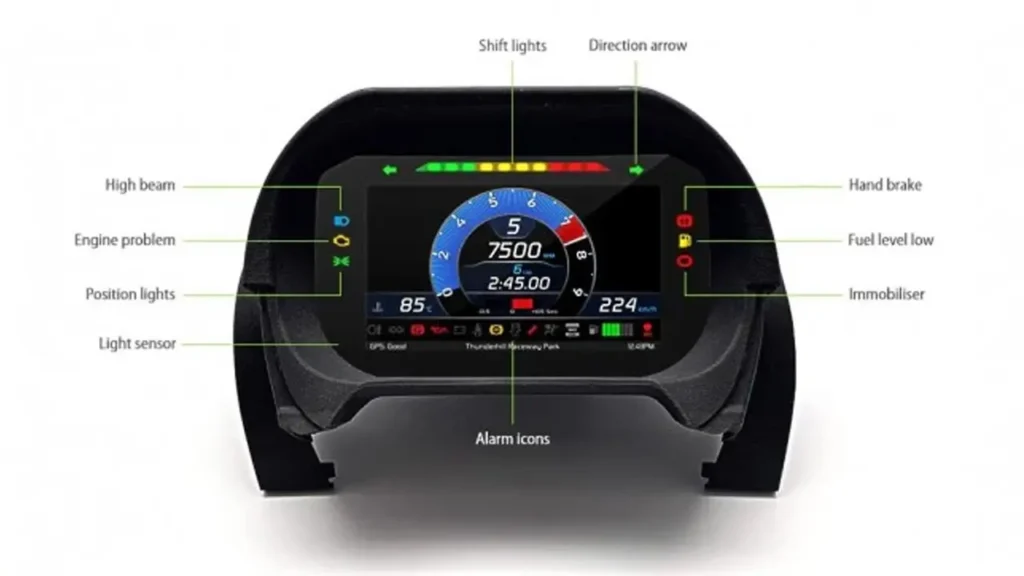
What Is an Electronic Mechanical Braking System EV?
To understand the electronic mechanical braking system EV, it helps to start with what it replaces.
Traditional braking systems in passenger cars rely on hydraulic pressure. When you press the brake pedal, you push fluid through a network of pipes and cylinders. That fluid pressure clamps brake pads against rotors, slowing the vehicle. The system is mechanical, physical, and has been refined over more than a century of engineering. It works well. But it has limits.
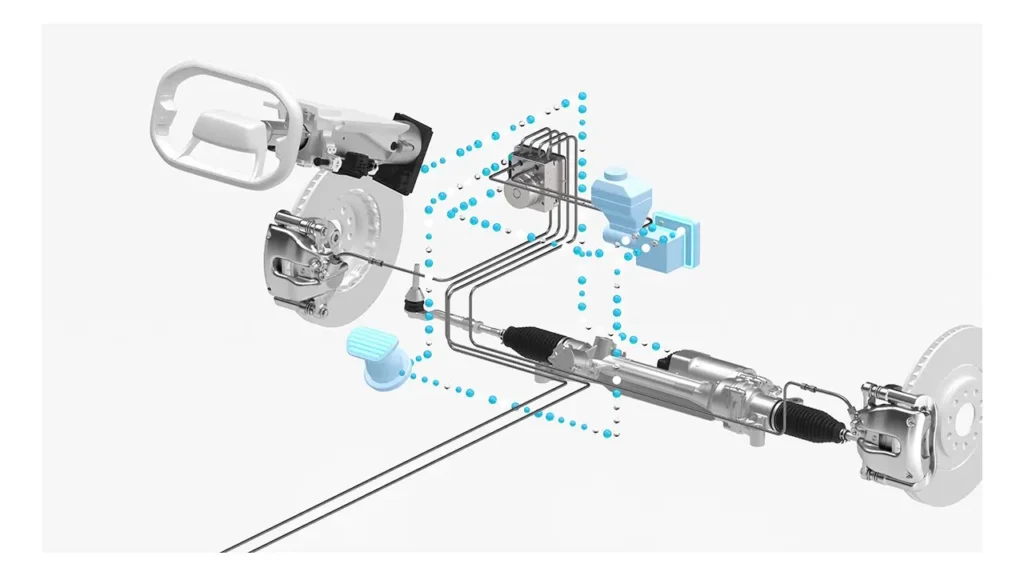
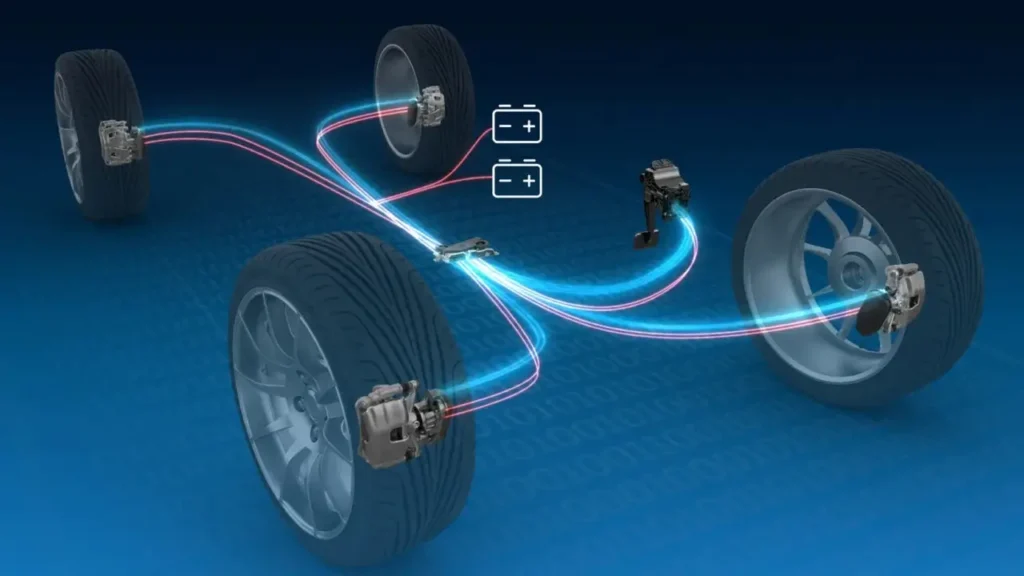
An electro mechanical brake system removes hydraulic fluid from the equation almost entirely. Instead of converting pedal pressure into fluid pressure, it converts pedal input into an electronic signal. That signal travels — at the speed of electricity — to actuators mounted directly at each wheel. Those actuators generate the clamping force mechanically, but they are commanded and controlled electronically.
This is the core idea behind brake by wire electric vehicle technology: the physical link between the driver’s foot and the braking mechanism is replaced by a digital command channel. The driver still has a pedal. The sensation of braking is still there. But behind that sensation, the system is entirely different.
The implications are significant. Because the signal is electronic, it can be processed, filtered, and adjusted by software in milliseconds. It can be integrated with ADAS (Advanced Driver Assistance Systems), regenerative braking, stability control, and autonomous driving stacks in ways that a hydraulic system simply cannot match. It can respond faster, adapt in real time, and be updated over-the-air as software improves.
For electric vehicles specifically, this integration is particularly natural. EVs already rely heavily on electronic control systems. The powertrain, the battery management, the thermal systems — all of these are software-controlled. Adding an EMB braking system EV to that architecture is a logical and technically coherent next step.
How Electronic Mechanical Braking System EV Works Inside Exlantix MX
The Exlantix MX safety technology represents one of the most publicly discussed implementations of this approach in a production-ready Chinese EV platform. While full technical specifications are subject to regulatory filings and official disclosures, the architectural principles are well-established in engineering literature and Chery’s own product communications.
At its core, the system consists of several key components:
Electronic Control Units (ECUs): The brain of the system. Multiple ECUs monitor input from the brake pedal sensor, vehicle speed sensors, wheel speed sensors, and the overall vehicle dynamics system. Redundant ECUs ensure that if one fails, another takes over instantly.
Electromechanical Actuators: Mounted at each wheel, these devices receive the electronic command and apply mechanical clamping force to the brake disc. They use electric motors — often combined with gearbox reduction stages — to generate the required braking torque with precision.
Redundancy Architecture: This is perhaps the most critical engineering challenge. In a traditional hydraulic system, redundancy is built into the fluid circuit itself. In an electronic mechanical braking system EV, redundancy must be built into the electronics. The Exlantix approach, consistent with industry standards for brake-by-wire systems, uses dual power supply channels and multiple independent signal paths to ensure the system can operate safely even in the event of a component failure.
Integration with Regenerative Braking: In EVs, braking is not only about stopping — it is also about energy recovery. The electronic architecture of an EMB braking system EV allows seamless blending between regenerative braking (where the electric motor acts as a generator to recover kinetic energy) and friction braking (where the pads physically contact the rotors). This blending is essentially invisible to the driver but has a meaningful impact on range and efficiency.
Software-Defined Calibration: Because the system is digitally controlled, braking feel, response curves, and pedal mapping can be adjusted through software. This means the manufacturer can tune the braking experience without physically changing hardware — and can push improvements to existing vehicles through software updates.
Electronic Mechanical Braking System EV vs Hydraulic Brakes
The comparison below summarises the key differences between conventional hydraulic brakes and an electronic mechanical braking system EV, formatted for easy reading on any device:
| Feature | Hydraulic Brakes | Electronic Mechanical Braking System EV |
|---|---|---|
| Response Time | Mechanical delay via fluid circuit | Near-instant electronic signal |
| Maintenance | Regular fluid replacement, line inspection | Minimal — no fluid, fewer wear points |
| ADAS Integration | Limited, requires additional modules | Native — fully software-integrated |
| Safety Redundancy | Mechanical dual-circuit | Dual electronic layers + failsafe ECUs |
| Energy Recovery | Not applicable | Seamless regen blending |
| Software Updates | Not possible | OTA-capable calibration |
| Weight | Heavier (fluid, master cylinder, lines) | Lighter overall system architecture |
| Environmental Impact | Brake fluid is hazardous waste | No fluid disposal required |
Why Electronic Mechanical Braking System EV Matters for Euro NCAP
Euro NCAP brake safety standards are among the most respected and widely referenced vehicle safety benchmarks in the world. Since its founding in 1997, Euro NCAP has progressively raised the bar for what a safe car must be able to do — and its protocols have directly influenced how vehicles are designed, not just how they are marketed.
For 2025 and beyond, Euro NCAP has placed increasing emphasis on Autonomous Emergency Braking (AEB), pedestrian detection, and the integration of braking systems with active safety software. These are precisely the areas where an electronic mechanical braking system EV has a structural advantage over hydraulic alternatives.
Because the system is electronically controlled from the ground up, it can receive and act on inputs from cameras, radar, and LiDAR sensors with zero hydraulic lag. In a scenario where a pedestrian steps into a road unexpectedly, the difference between a hydraulic system and a fully integrated EMB braking system EV may be measured in centimetres of stopping distance — which in safety testing translates directly into star ratings.
Euro NCAP’s testing protocols for AEB and lane-keeping assistance already reward vehicles whose braking systems respond quickly and accurately to sensor inputs. As these protocols evolve — and Euro NCAP has publicly communicated its roadmap toward more demanding assessments of automated driving functions — vehicles equipped with electronic mechanical braking system EV architecture will be structurally better positioned to perform.
There is also a longer-term regulatory conversation happening within Euro NCAP’s technical working groups about how braking standards should evolve for vehicles that have no conventional hydraulic system at all. This is a genuine open question, and the answers will partly be shaped by the performance data that vehicles like the Exlantix MX generate in real-world and controlled testing environments.
Can Electronic Mechanical Braking System EV Pass US Regulations?
On the other side of the Atlantic, NHTSA brake regulations EV present a different but equally important set of requirements. The National Highway Traffic Safety Administration (NHTSA) governs vehicle safety standards in the United States through Federal Motor Vehicle Safety Standards (FMVSS), and FMVSS 135 specifically covers light vehicle brake systems.
FMVSS 135 was written primarily with hydraulic systems in mind. It specifies stopping distance requirements, pedal force limits, and performance under conditions including partial system failure. For an electronic mechanical braking system EV to receive NHTSA certification, it must demonstrate compliance with these performance benchmarks — but the standard does not prescribe the technology used to achieve them. It prescribes the outcome.
This is actually an important distinction. NHTSA’s approach to vehicle safety standards is generally performance-based rather than prescriptive-technology-based. In principle, a brake-by-wire system that meets or exceeds the stopping distance and failure-mode requirements of FMVSS 135 should be certifiable — regardless of whether it uses fluid or not.
The certification path, however, is not simple. NHTSA will require extensive validation data, including performance across temperature extremes, failure mode analysis, and cybersecurity assessment. This last point — cybersecurity — is increasingly important. An electronic mechanical braking system EV is, by definition, a software-driven safety-critical system. NHTSA’s emerging framework for software-defined vehicles, informed by its 2023 and 2024 guidance documents on AV safety, is beginning to address how safety-critical electronic systems must be validated and monitored over a vehicle’s lifetime.
For Chery and Exlantix to enter the US market with this technology, the regulatory journey will be substantial. But the regulatory framework, at least in principle, does not prohibit it — and the direction of NHTSA’s own rulemaking is toward greater accommodation of software-defined vehicle architectures.
Chery Exeed EX7 Brake Technology — Strategic Leap
The Chery Exeed EX7 brake technology represents something broader than a single product decision. It is part of a deliberate strategic positioning by one of China’s largest and most export-focused automakers.
Chery has been producing vehicles since 1997 and has grown into one of China’s top five passenger car manufacturers by volume. Its Exeed sub-brand targets the premium segment and has been explicit about its ambition to compete not just on price but on technology and safety credentials. The EX7, as a flagship SUV positioned for both domestic and international markets, carries the brand’s most advanced engineering.
The decision to integrate an electronic mechanical braking system EV into this platform is consistent with a broader Chinese automotive industry strategy that has become visible since approximately 2022: move up the value chain in safety technology, not just in battery range or infotainment. Chinese EV manufacturers have observed that Western and Japanese brands built their global reputations partly on safety leadership. The new generation of Chinese EVs is pursuing the same path.
This connects directly to next generation EV safety systems as a concept. Safety, in the context of these vehicles, is no longer just about passive protection (crumple zones, airbags) or even basic active safety (ABS, stability control). It encompasses how the entire vehicle system — braking, steering, sensing, computing — works as an integrated unit. The Chery Exeed EX7 brake technology is designed from the outset to be part of that integrated architecture, not bolted on as a compliance feature.
Advantages and Risks of Electronic Mechanical Braking System EV
No technology that challenges a century-old engineering paradigm arrives without trade-offs. Here is a balanced look at both sides.
Advantages:
The most immediately obvious advantage is response speed. Because the signal from pedal to actuator is electronic, there is no hydraulic lag. In safety-critical situations — particularly at highway speeds or in automated driving scenarios — this can translate into measurably shorter stopping distances.
Software-driven calibration is another significant benefit. Manufacturers can tune the brake feel, the regenerative-to-friction blending ratio, and the response curves without changing hardware. This also means that safety improvements can be delivered to existing vehicles through software updates, something that is simply not possible with a hydraulic system.
Lower mechanical complexity reduces maintenance requirements. Without brake fluid, master cylinders, and the associated plumbing, there are fewer components to inspect, replace, and dispose of. This is relevant both for the vehicle owner and for environmental compliance, particularly as regulations around hazardous waste tighten.
Integration with Exlantix MX safety technology and ADAS platforms is architecturally cleaner. A digitally-commanded brake system can share data with cameras, radar, and AI decision-making modules in real time, enabling faster and more precise automated interventions.
Risks:
Regulatory inertia is real. Standards written for hydraulic systems require adaptation, and adaptation takes time, lobbying, testing, and political will. Even a technically superior system can face years of delay if the regulatory framework has not caught up.
Software validation at the level required for safety-critical systems is enormously demanding. Every line of code that contributes to a braking decision must be validated to standards like ISO 26262 (Functional Safety) and SOTIF (Safety of the Intended Functionality). This is not a barrier that cannot be overcome, but it is a genuine engineering and documentation challenge.
Market trust takes time to build. Consumers and fleet buyers who have relied on hydraulic braking their entire lives may be skeptical of a system they cannot see or intuitively understand. Transparency, education, and demonstrated safety records will be essential for adoption.
Is Electronic Mechanical Braking System EV the Future of EV Braking Systems?
The trajectory of the future of EV braking systems points, fairly clearly, in one direction. Hydraulic systems are not going to disappear overnight — the installed base is enormous, the supply chain is mature, and the regulatory frameworks are calibrated for them. But the structural advantages of electronic mechanical architecture are significant enough that the direction of travel is not really in question.
What is in question is the timeline. Several factors will shape how quickly EMB braking system EV technology becomes the norm:
Regulatory adaptation is probably the most important variable. As Euro NCAP updates its protocols to reward faster, more integrated braking responses, and as NHTSA develops clearer frameworks for software-defined safety systems, the regulatory environment will become progressively more favourable.
Cost reduction will follow scale. Early implementations of any sophisticated electronic system are expensive. As more manufacturers adopt the architecture and the supply chain matures, costs will fall — just as they did with ABS, ESC, and camera-based ADAS.
Consumer experience will drive normalisation. Once drivers experience the response characteristics of a well-implemented brake by wire electric vehicle system, the comparison with hydraulic alternatives becomes viscerally clear. Driving impressions matter enormously in automotive purchasing decisions.
Autonomous and semi-autonomous driving may ultimately be the decisive force. As vehicles take on more of the driving task, the braking system needs to respond to machine instructions, not just human inputs. An electronic mechanical braking system EV is structurally designed for exactly this — and hydraulic systems, however refined, are not.
The question of when hydraulic brakes become legacy technology is genuinely open. A reasonable projection, based on current regulatory roadmaps and industry development cycles, would suggest that by the early 2030s, electronic mechanical braking system EV architecture will be standard on premium EVs globally, with mid-range adoption following within the decade.
Final Verdict: Electronic Mechanical Braking System EV — Game Changer?
The honest answer is: yes, but with patience required.
The electronic mechanical braking system EV is not a concept or a prototype curiosity. It is a production technology, being integrated into real vehicles, designed for real roads, and being evaluated against real regulatory standards. The engineering case for it is strong — faster response, cleaner integration, better ADAS compatibility, and lower long-term maintenance costs.
The market is not uniformly ready. Consumers in many markets have limited awareness of brake-by-wire technology, and trust in novel safety systems requires demonstrated real-world performance data accumulated over time. This is not a criticism — it is how safety-critical technology adoption has always worked, from seatbelts to ABS to electronic stability control.
The regulators are moving, but moving deliberately. Euro NCAP’s evolving protocols and NHTSA’s emerging frameworks for software-defined vehicles are both trending in a direction that will reward exactly the kind of integrated, electronic safety architecture that Chery Exeed EX7 brake technology and Exlantix MX safety technology represent. But regulatory processes have their own timelines, and those timelines are measured in years, not months.
What is clear is that the brands and engineers who are building and validating this technology now — accumulating data, refining software, navigating certification processes — will be the ones who define the next generation EV safety systems that the rest of the industry eventually follows.
Chery’s decision to make this a flagship feature of its Exlantix and Exeed platforms is a calculated bet on being early. In technology markets, being early and being right is how leadership is established. Whether Chery achieves that leadership will depend on execution — on the safety records these systems build, the regulatory approvals they earn, and the trust they generate with drivers around the world.
The future of EV braking systems is electronic, software-defined, and deeply integrated with everything else the vehicle does. The technology exists. The engineering is sound. The regulatory path, while demanding, is navigable. What comes next is the patient, rigorous work of proving it — one test, one certification, one kilometre at a time.
If you want to follow the development of Chinese EV technology and understand where the global automotive industry is actually heading — not just where the headlines say it is going — this is exactly the kind of platform evolution worth watching closely. The braking system is, after all, the last line of defence between the road and the driver. The companies that get it right will earn something that no marketing budget can buy: genuine safety credibility.
Professional Web Development and SEO Services
Discover more from AutoChina
Subscribe to get the latest posts sent to your email.