Imagine pulling up in a car with a drag coefficient lower than a Porsche Taycan, a 15.6-inch infotainment screen, semi-autonomous highway driving, and a trunk large enough for five suitcases — all for around $16,500. Sounds like a fantasy from 2035? Welcome to the Xpeng Mona M03 budget EV test, happening right now in 2025. This is the affordable Chinese electric car 2026 buyers are going to be talking about for years. The Mona M03 doesn’t just punch above its weight — it obliterates the entire weight class. Let’s dig in.
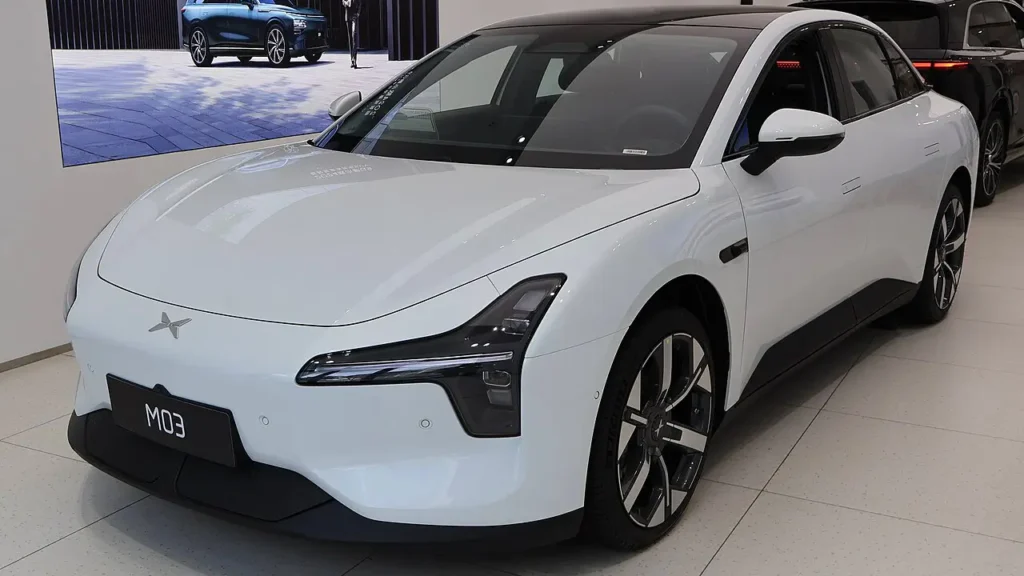
Xpeng Mona M03 Price — How Is It Only $16K?
The very first question anyone asks after learning about the Xpeng Mona M03 is: how? How can a car with this level of technology cost this little?
According to XPeng’s official press release from August 28, 2024, the Mona M03 launched in China at prices ranging from RMB 119,800 to RMB 155,800, which translates to approximately $16,450 to $21,400 USD at current exchange rates. The base 515 km variant starts at roughly $16,450, the 620 km long-range trim sits around $17,830, and the flagship 580 Max with full urban autonomous driving comes in at approximately $21,400.
So how does XPeng do it? A few key reasons. First, the Mona M03 was originally developed by DiDi — China’s ride-hailing giant — before XPeng acquired the project in August 2023. Much of the R&D cost was already absorbed. Second, XPeng’s vertically integrated supply chain keeps component costs low. Third, fierce competition in China’s EV market forces every manufacturer to sharpen pricing to a razor’s edge.
The result is arguably the best EV under $20,000 on the planet in terms of the technology-to-price ratio. No other manufacturer at this price point offers standard L2 driver assistance, a 15.6-inch central display, 360-degree camera system, and over 500 km of real-world range. That combination simply doesn’t exist anywhere else at this cost.
The Mona M03 budget EV test confirms: this price is real, and the car behind it is equally real.
Xpeng Mona M03 Specs Breakdown
Numbers don’t lie. Here’s a full look at what the Xpeng Mona M03 offers on paper, sourced from XPeng’s official specifications and CarNewsChina’s verified database:
| Specification | Xpeng Mona M03 (2024/2025) |
|---|---|
| Body Type | Electric Liftback / Compact Sedan |
| Motor Power (base / top) | 140 kW (188 hp) / 160 kW (218 hp) |
| Torque | 225 Nm (base) / 250 Nm (top trims) |
| Battery Options | 51.8 kWh / 62.2 kWh (LFP) |
| Range (CLTC) | 515 km / 580 km / 620 km |
| Estimated Real-World Range | ~420–500 km |
| 0–100 km/h | 7.4 sec (top trims) / 7.8 sec (base) |
| Top Speed | 155 km/h (2024) / 170 km/h (2025 Max) |
| Drag Coefficient | Cd 0.194 (world record for mass-produced electric liftback) |
| Drive Type | Front-Wheel Drive (FWD) |
| Dimensions (L/W/H) | 4,780 / 1,896 / 1,445 mm |
| Wheelbase | 2,815 mm |
| Trunk Volume | 621 L |
| DC Fast Charging (30–80%) | ~24 minutes |
| AI / ADAS System | XPILOT (standard) / XNGP (Max variant) |
| Infotainment Screen | 15.6-inch floating display |
| Seats | 5 |
| Starting Price (China) | RMB 119,800 (~$16,450 USD) |
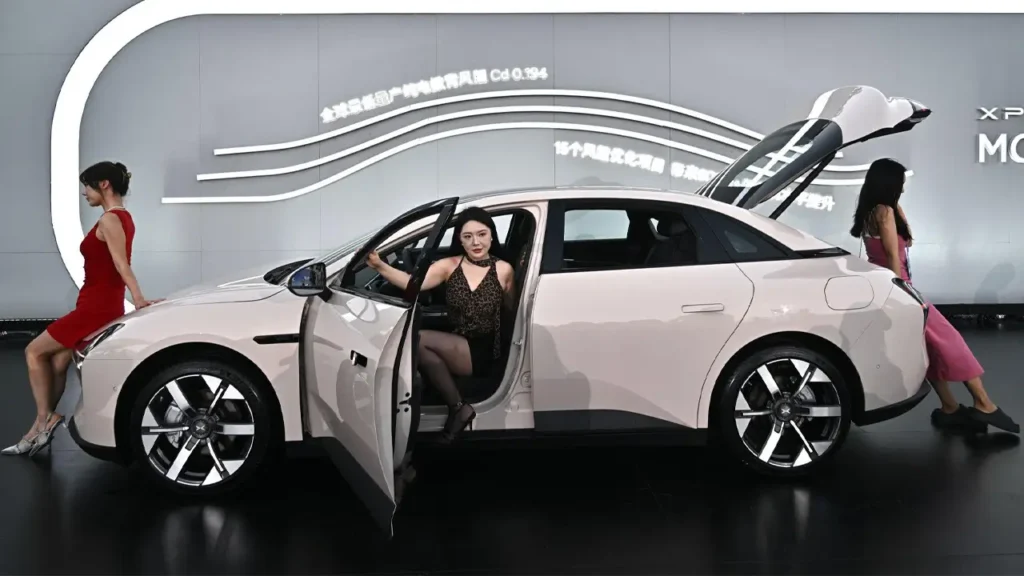
When it comes to the Xpeng Mona M03 specs, the standout figure is that Cd 0.194 drag coefficient. XPeng conducted over 1,000 hours of wind tunnel testing across 10 separate sessions, making 15 major aerodynamic optimizations. The payoff? About 60 additional kilometers of range compared to rivals of the same size. For the Xpeng Mona M03 range, real-world estimates sit around 420–500 km depending on speed and conditions — genuinely competitive with cars costing twice the price.
Xpeng Mona M03 Autonomous Driving — Real AI or Marketing?
This is the question at the heart of every Xpeng Mona M03 budget EV test: can a $16,000 car actually deliver meaningful autonomous driving, or is it just a badge on the brochure?
The honest answer is: it depends on which trim you choose — and both options are impressive for the price.
Standard models come equipped with XPilot L2, an ADAS suite that includes 2 millimeter-wave radars, 7 cameras, and 12 ultrasonic sensors. This covers adaptive cruise control, lane-keeping assistance, automatic emergency braking, blind-spot monitoring, and a 360-degree camera view. Critically, according to XPeng’s official launch materials, L2 ADAS is standard across every single trim — not reserved for expensive configurations, as is common with rival brands.
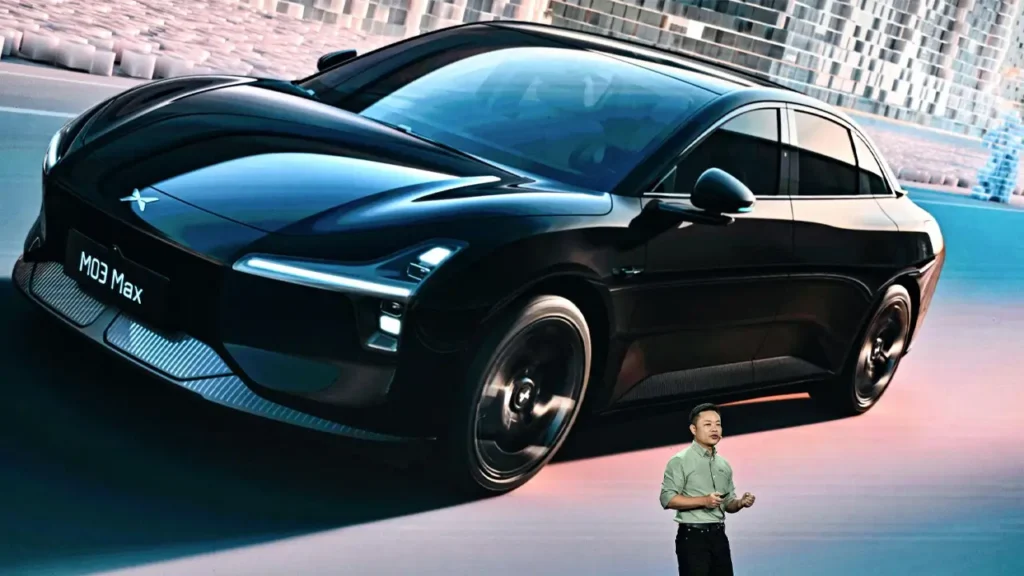
The Max variant takes things dramatically further. Launched in May 2025, the M03 Max runs XPeng’s XNGP — the company’s full urban supervised autonomous driving system. This version is powered by two NVIDIA Orin X chips delivering a combined 508 TOPS of compute power and uses 12 cameras plus additional radar. According to XPeng, the M03 Max can handle supervised autonomous driving on all public roads in China, making it — at approximately $21,400 — the cheapest car in the world with full urban AI driving capability.
The Xpeng Mona M03 autonomous driving story in any Xpeng Mona M03 review 2026 context is one of democratization. Features that once demanded a $50,000 to $100,000 budget are now available in a compact liftback costing a fraction of that. That’s not marketing. That’s a genuine technological shift.
For comparison: Tesla’s Full Self-Driving subscription alone costs $8,000–$12,000 in the US. XPeng bundles competitive urban autonomy into a car that costs less than many gasoline sedans.
Xpeng Mona M03 Interior — Budget or Premium Feel?
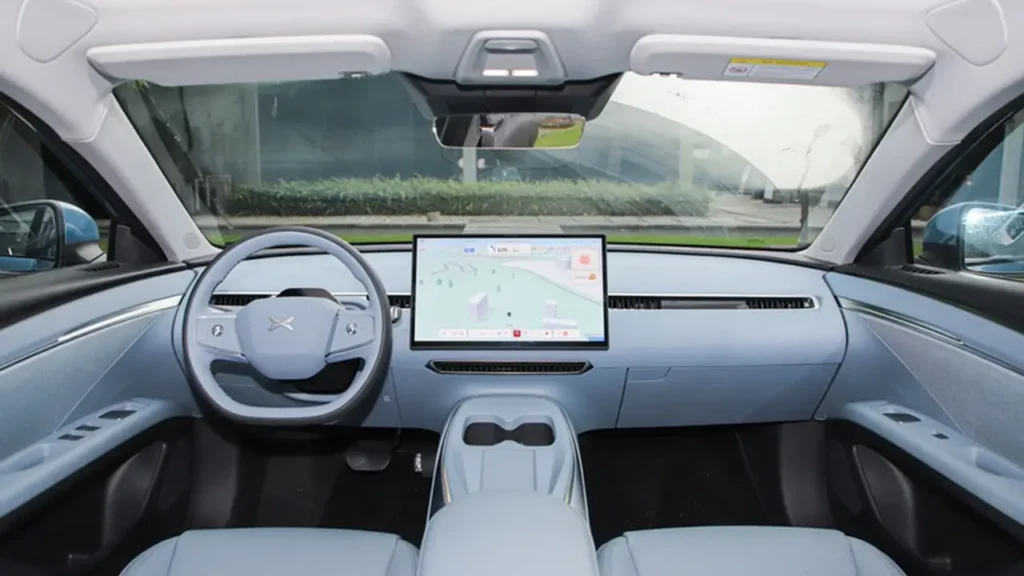
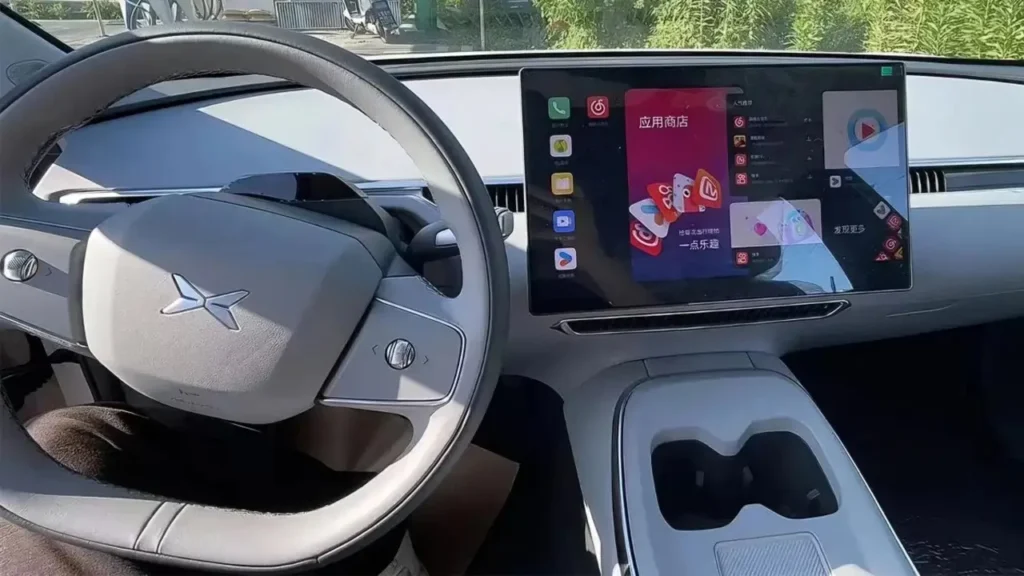
Step inside the Mona M03 and the first thing you notice is what’s missing: clutter. The Xpeng Mona M03 interior is a masterclass in intentional minimalism.
There is no traditional instrument cluster. No physical buttons cluttering the dashboard. Instead, everything revolves around a massive 15.6-inch floating central display powered by a Qualcomm Snapdragon 8155 chip. Reviewers who drove the car at the Chengdu Auto Show noted the screen is “surprisingly snappy” — no lag, no hesitation, intuitive layout.
The panoramic glass roof spans 1.22 square meters, flooding the cabin with light and creating a sense of airiness that belies the car’s compact footprint. XPeng used Low-E laminated glass to reduce heat and glare in summer — a thoughtful touch that shows this car wasn’t designed purely on paper.
Seat quality is comfortable and supportive for everyday use. The interior color palette is restrained: Morning Fog Grey or Night Grey for standard models, with an exclusive Dawn Purple option for the Star Twilight Purple exterior. It’s mature, calm, and clean — not the kind of fussy, button-heavy interior that budget cars often default to.
Trunk space at 621 liters is genuinely practical. XPeng claims it can accommodate one 28-inch suitcase plus four 20-inch suitcases simultaneously — handy for family trips or rideshare duty.
Is it a Rolls-Royce inside? Of course not. But it competes directly with cars costing $10,000–$15,000 more. The Mona M03 budget EV test shows that “affordable” and “thoughtfully designed” are not mutually exclusive terms.
Why Xpeng Mona M03 Is a Student Car Icon
Here’s a stat that says everything: at the launch of the Mona M03 Max in May 2025, XPeng revealed that 90% of M03 customers are under the age of 35. That’s not coincidence — it’s a design decision baked into every part of this car.
The Xpeng Mona M03 student car appeal starts with the price. At around $16,500 for the base model, it sits within reach of young professionals, recent graduates, and first-time car buyers in China. Monthly financing payments are comparable to renting a decent apartment in a second-tier city. For a generation that has grown up with smartphones and AI assistants, the M03’s technology-first philosophy feels natural rather than gimmicky.
The name itself is a clue. XPeng says “Mona” stands for “Made Of New AI.” CEO He Xiaopeng even confirmed that the “M03” designation is a deliberate nod to the Tesla Model 3 — essentially telling younger buyers: here’s your Model 3, without the Model 3 price tag.
The design language matters too. Hidden door handles, a sweeping liftback silhouette, six available exterior colors including Star Twilight Purple and Star Rain Green, and frameless side mirrors on the Max variant with teal autonomous driving indicator lights — this car is designed to be noticed and admired, which counts for a lot when you’re 24 years old.
Charging infrastructure in China is now mature enough that range anxiety is largely obsolete. A 515 km CLTC-rated range combined with 24-minute fast charging removes the last practical objection. For students commuting between home, campus, and internships, the M03 delivers everything needed without compromise.
Taxi Drivers and Xpeng Mona M03 Budget EV Test Results
While students make up the core demographic, there’s another user base quietly validating the Mona M03’s durability and economy: rideshare and taxi drivers.
China’s massive DiDi platform — the very company that originally developed the Mona project — was acutely aware of fleet economics when designing this vehicle. Low operating costs were built into the brief from day one.
The energy consumption figure of 11.5 kWh per 100 km (2024 model) is excellent for a car of this size and weight. At average Chinese commercial electricity rates, that translates to roughly 4–6 RMB per 100 km — a fraction of gasoline costs. For a driver covering 300–400 km per day, the monthly fuel savings versus a petrol equivalent can reach 2,000–3,000 RMB ($275–$415 USD).
The LFP (lithium iron phosphate) battery chemistry is another professional-grade feature. LFP batteries are chemically stable, have very long cycle lives (typically 2,000–3,000 full charge cycles before significant degradation), and don’t suffer from the thermal runaway risks associated with NMC batteries. For a vehicle running 100,000+ km per year in commercial service, this matters enormously.
The 621-liter trunk is practical for carrying goods. The low floor and wide hatch opening make loading and unloading easy. And the XPILOT L2 system, with its highway driving assistance, reduces fatigue on long runs.
In the Xpeng Mona M03 budget EV test for commercial use, the numbers are compelling: high mileage capability, low running costs, durable battery chemistry, and enough technology to make the job easier. It’s no surprise that fleet buyers and rideshare drivers have taken notice.
Pros and Cons of Xpeng Mona M03 Budget EV Test
Every car has trade-offs. Here’s an honest, balanced assessment based on official data and verified test drive reports.
Pros:
- World-record low drag coefficient of Cd 0.194 — genuinely improves real-world range
- XPILOT L2 ADAS is standard on every trim — no need to pay extra for safety
- 15.6-inch infotainment screen with fast Snapdragon 8155 chip at this price is remarkable
- 621-liter trunk is class-leading for a compact liftback
- LFP battery chemistry means long-term durability and low degradation risk
- 90% of buyers are under 35 — the market has spoken with its wallet
- Max variant with XNGP urban autonomous driving at ~$21,400 has no equivalent globally
- 24-minute DC fast charge (30–80%) keeps downtime minimal
- Six exterior colors, including genuinely striking options for younger buyers
Cons:
- Top speed limited to 155 km/h on 2024 models (170 km/h on 2025 Max) — adequate but not exciting
- 0–100 km/h in 7.4–7.8 seconds is competitive but not sporty
- Suspension tuning prioritizes comfort over driver engagement — not for enthusiasts
- No all-wheel drive option currently available
- Urban XNGP is only available on the most expensive Max trim
- Currently primarily available in China; global availability is limited
- Physical button fans will feel uncomfortable with the all-screen interface
FAQ — Xpeng Mona M03 Budget EV Test
Q1: What is the Xpeng Mona M03 price in USD?
Based on official XPeng pricing at launch and current exchange rates, the Mona M03 starts at approximately $16,450 USD for the base 515 km variant, rising to around $21,400 USD for the Max autonomous driving model. This makes it one of the strongest contenders for the title of best EV under $20,000 in the global market.
Q2: What are the official Xpeng Mona M03 specs for battery and motor?
The Xpeng Mona M03 specs include two battery options: 51.8 kWh (base) and 62.2 kWh (upper trims), both using LFP chemistry. Motor output ranges from 140 kW (188 hp) on the base to 160 kW (218 hp) on higher trims. All variants are front-wheel drive with a maximum torque of 225–250 Nm depending on configuration.
Q3: What is the real-world Xpeng Mona M03 range?
The Xpeng Mona M03 range under CLTC conditions is rated at 515 km, 580 km, or 620 km depending on the variant. Real-world driving estimates from reviewers who tested the 620 km model put practical range at approximately 420–500 km in mixed conditions — competitive with vehicles costing significantly more.
Q4: How good is Xpeng Mona M03 autonomous driving compared to Tesla?
The Xpeng Mona M03 autonomous driving capability is genuinely impressive at this price. Standard models include L2 ADAS with highway assistance, cameras, radar, and ultrasonic sensors. The Max variant runs XNGP — a full urban supervised autonomous system using two NVIDIA Orin X chips and 12 cameras. As a point of comparison, Tesla’s equivalent Full Self-Driving package is sold as an $8,000+ add-on in the US. XPeng includes urban autonomy in a car that starts under $22,000.
Q5: What is the Xpeng Mona M03 interior like?
The Xpeng Mona M03 interior is minimalist and technology-focused. There is no traditional instrument cluster — the entire interface centers on a 15.6-inch Snapdragon 8155-powered touchscreen. A 1.22 m² panoramic roof, Low-E glass, five-seat layout, and 621-liter trunk round out the cabin. Reviewers have praised build quality as punching well above the car’s price point.
Q6: Why is the Xpeng Mona M03 so popular as a student car?
The Xpeng Mona M03 student car reputation is well-earned. XPeng confirmed at the May 2025 Max launch that 90% of all M03 buyers are under 35. The combination of a manageable purchase price (~$16,500 base), zero fuel costs, standard AI driving technology, bold design options, and low maintenance requirements makes it uniquely suited to younger first-time EV buyers. It’s essentially a smartphone on wheels — which is exactly how Gen Z thinks about cars.
Final Verdict — Is Xpeng Mona M03 the Smartest Budget EV?
After this deep-dive Xpeng Mona M03 budget EV test, the answer is almost certainly yes — at least within its home market of China, and potentially on a global scale as XPeng continues to expand internationally.
What XPeng has achieved with the Mona M03 is something the Western automotive industry has been promising for a decade and consistently failed to deliver: a genuinely affordable, genuinely capable, genuinely modern electric car. Not a stripped-down commuter appliance. Not a compliance vehicle with a checkbox feature list. An actual car you’d be proud to own and excited to drive.
The world-record Cd 0.194 aerodynamics, 620 km CLTC range, L2 ADAS standard across all trims, 15.6-inch display, LFP battery, 621-liter trunk, and sub-$17,000 starting price would be extraordinary if any one of these features existed at this cost. The Mona M03 delivers all of them simultaneously.
The Max variant with XNGP urban autonomous driving at $21,400 is potentially the most disruptive product in the entire EV industry right now. There is nothing else anywhere near that price offering comparable AI driving capability powered by dual NVIDIA Orin X hardware.
Is it perfect? No. The suspension is tuned for comfort over dynamics, the top speed is modest, and FWD-only limits its all-weather appeal in some markets. But for the vast majority of real-world use cases — commuting, city driving, occasional road trips, rideshare duty — the Mona M03 executes brilliantly.
The Mona M03 budget EV test verdict: this is what the future of affordable transportation looks like. And the future arrived a lot sooner than most people expected.
All specifications and pricing data sourced from XPeng’s official press releases, XPeng.com, and verified automotive databases including CarNewsChina and Wikipedia. Prices in USD are approximate conversions from CNY and may vary based on exchange rates and regional market conditions.Share
If you’re into smart tech that actually survives real life, not just office desks, you’ll want to see this. The Amazfit T-Rex 3 is built for adventure, durability, and serious performance. Check the full rugged smartwatch breakdown here:
https://bestchinagadget.com/amazfit-t-rex-3-rugged-smartwatch/
Discover more from AutoChina
Subscribe to get the latest posts sent to your email.