If you’ve ever navigated a packed city street, circled endlessly looking for a parking spot, or squeezed through a narrow lane while other drivers honked, you already understand exactly why the Smart #2 EV exists. This is not just another electric car. It’s a bold, thoughtful, and surprisingly tech-loaded answer to the everyday frustrations of urban life — and it’s arriving at precisely the right moment.
The Smart #2 EV is the official successor to the legendary Smart ForTwo, a tiny two-seater that became a cultural icon in cities across Europe, Asia, and beyond. First revealed as the Concept #2 at Auto Beijing 2026 on April 22, 2026, the Smart #2 EV signals the brand’s proud return to its roots: pure, unapologetic urban mobility. Built on a brand-new dedicated platform, powered entirely by electricity, and designed by the Mercedes-Benz Global Design Team, this compact city car is engineered to redefine what urban driving can feel like in 2026 and beyond.
In this review, we’ll walk through everything you need to know — from the design philosophy and technical specs to expected pricing, range figures, charging performance, interior technology, and Smart’s bold global expansion strategy. Whether you’re a city dweller, an EV enthusiast, or simply curious about what the future of compact urban electric mobility looks like, you’re in exactly the right place. Let’s dive in.
Design and Concept of the Smart #2 EV: Function Becomes Fashion
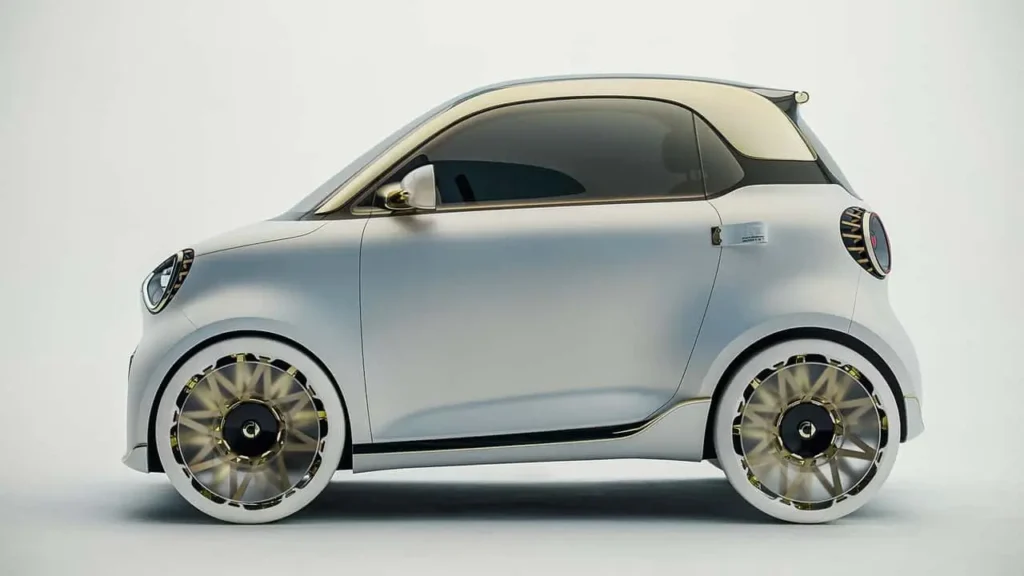
At first glance, the Smart #2 EV feels instantly familiar — and intentionally so. The new Smart #2 marks a return to form, successfully reviving the spirit of the original ForTwo in both its styling and compact footprint. That tiny silhouette, those dramatically short overhangs, and the upright cabin design — it all echoes three decades of Smart DNA while looking unmistakably fresh and contemporary.
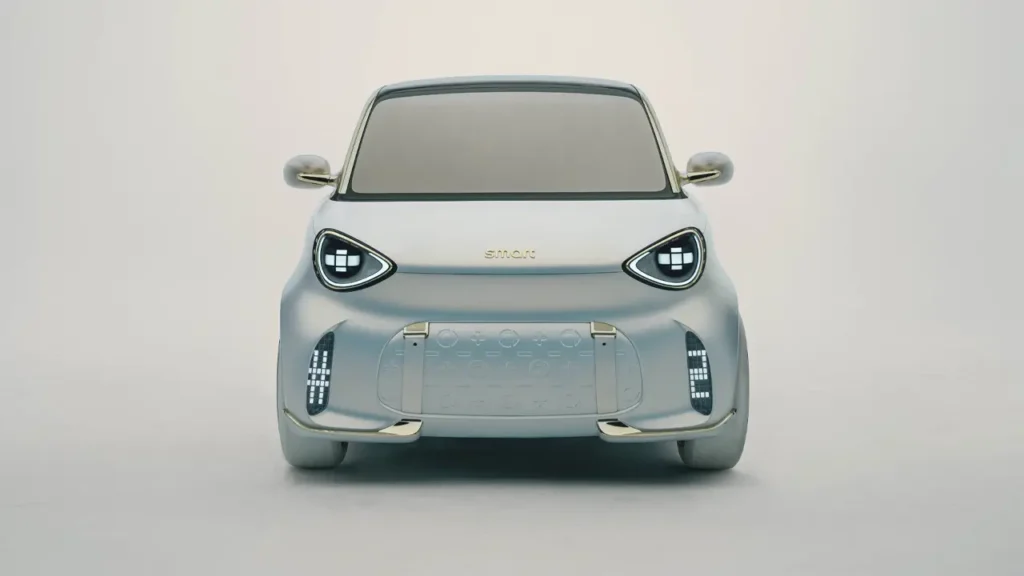
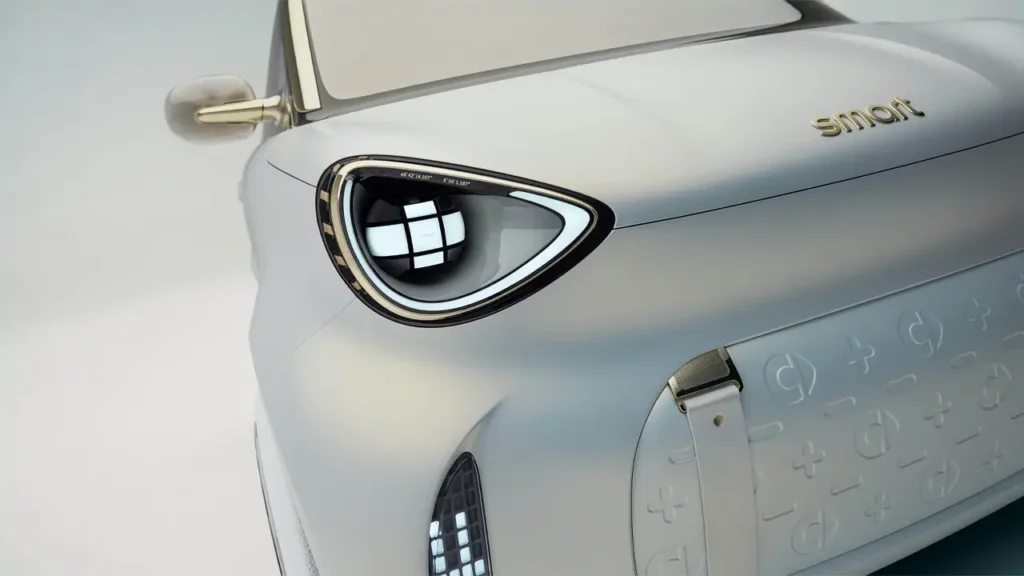
This smart compact electric car is guided by the design philosophy “Love, Pure, Unexpected.” The Concept #2 adopts what Smart describes as a “Function becomes Fashion” approach — a statement that perfectly captures what makes this car special. Its minimalist silhouette is enhanced by a striking matte white and warm gold two-tone finish, combining everyday practicality with genuinely expressive personal style. Hidden design details and translucent body surfaces add a layer of visual intrigue, positioning the vehicle as far more than just a utilitarian city commuter.
The entire exterior was crafted by the Mercedes-Benz Global Design Team, which operates both a main studio in Europe and a design center in Shanghai. The result is a car that blends the iconic shape of the original ForTwo with modern Smart family design elements — including the brand’s signature triangular headlamps, already seen on the Smart #1 and #3 models. This visual continuity gives the Smart #2 EV a clear family identity while still feeling bold, fresh, and future-forward.
What makes the design concept truly clever, however, is not just aesthetics. The entire body structure is built around a core functional principle: push the wheels as far to the corners of the car as possible to maximize interior space while keeping the overall footprint ultra-compact. This “wheels-at-the-corners” philosophy isn’t just visually distinctive — it’s the engineering foundation that makes this smart compact electric car genuinely usable for two adults despite its famously tiny dimensions.
The Smart #2 EV is, at its heart, a car that refuses to apologize for being small. Instead, it celebrates its compactness as a feature — and in the congested, parking-scarce cities of 2026, that’s a genuinely revolutionary attitude.
Smart #2 Specs: Technical Characteristics
When it comes to Smart #2 specs, the technical story starts with the most important ingredient: the platform. The Smart #2 is engineered on the brand’s all-new, self-developed Electric Compact Architecture — known officially as ECA. This is a bespoke, purpose-built EV platform designed from the ground up specifically for ultra-compact city cars. Smart did not adapt an existing platform or borrow architecture from a larger model. The ECA was created entirely for the needs of a next-generation urban electric two-seater.
What does that mean in practice? It means every millimeter of the car’s engineering is optimized for city life — tight spaces, stop-and-go traffic, rapid charging needs, and maximum interior efficiency within the smallest possible footprint.
Here are the confirmed and anticipated Smart #2 specs based on official announcements from Smart at Auto Beijing 2026:
| Specification | Detail |
|---|---|
| Platform | Electric Compact Architecture (ECA) |
| Body Style | Two-door, two-seat hatchback |
| Overall Length | 2.79 meters (2,792 mm) |
| Drive Layout | Rear-wheel drive (expected) |
| Turning Diameter | 6.95 meters |
| Powertrain | 100% Battery Electric (BEV only) |
| Design Team | Mercedes-Benz Global Design Team |
| Production Location | China |
| Concept Reveal | Auto Beijing 2026, April 22, 2026 |
| Production Premiere | Paris Motor Show, October 2026 |
One of the most impressive Smart #2 specs is its turning diameter. At just 6.95 meters, the Smart #2 EV can navigate congested urban streets, multi-storey car parks, and tight residential roads with a level of agility that larger electric city cars simply cannot match. For any driver who’s ever struggled to turn around on a narrow European side street, this number alone is reason to pay attention.
The ECA platform also incorporates next-generation safety systems, advanced driver assistance technology, and a software architecture built for over-the-air updates — meaning the car improves and evolves throughout its ownership life, just like a smartphone.
Smart #2 Range km: Real-World Performance
One of the biggest criticisms of the original Smart ForTwo EV — the EQ ForTwo — was its limited range. With a real-world range of only around 120–145 km, the previous generation was frustrating even by city car standards. Smart has heard that criticism loud and clearly, and the Smart #2 range km figures represent a dramatic step forward.
According to official Smart announcements at Auto Beijing 2026, the Smart #2 EV targets a WLTP range of nearly 300 km. Some configurations, depending on final battery specification, could potentially reach 300–400 km of WLTP range. This is an enormous improvement over the previous generation and makes the Smart #2 genuinely viable not just for daily city commuting, but for occasional suburban and even regional trips as well.
To put this in perspective: a typical European urban commuter drives fewer than 50 km per day. A 300 km Smart #2 range means most drivers could realistically charge once or twice per week — a fundamentally different ownership experience compared to the old EQ ForTwo, which required much more frequent charging to stay practical.
It’s important to note that Smart explicitly stated at the concept reveal stage that the range figure of nearly 300 km is a concept-stage target and not a final certified WLTP value. Final official Smart #2 range km figures will be confirmed at the production premiere at the Paris Motor Show in October 2026. Nevertheless, the direction of travel is unmistakably positive, and the ECA platform’s architecture is genuinely capable of supporting these ambitions.

Battery and Charging: Smart #2 Battery Capacity and Smart #2 Charging Time
Two of the most exciting aspects of the Smart #2 EV are its Smart #2 battery capacity and Smart #2 charging time — and both represent a significant generational leap.
While Smart has not yet released the exact Smart #2 battery capacity figures (full specification disclosure is expected at the Paris Motor Show in October 2026), industry analysis based on the ECA platform’s architecture and the targeted WLTP range suggests the battery pack will likely be in the 30–45 kWh range. This is carefully calibrated to balance energy density, weight, and cost — keeping the car genuinely compact and affordable while delivering real-world usability.
What Smart has confirmed officially, however, is the Smart #2 charging time performance — and it’s genuinely impressive for a car of this size. The Smart #2 EV supports DC fast charging from 10% to 80% state of charge in under 20 minutes. This places the Smart #2 among the fastest-charging cars relative to battery size in the entire EV segment — a remarkable achievement for an A-segment city car.
| Charging Type | Performance |
|---|---|
| DC Fast Charging (10–80%) | Under 20 minutes |
| Estimated Battery Capacity | ~30–45 kWh (to be confirmed) |
| Target WLTP Range | ~300 km (concept target) |
| Vehicle-to-Load (V2L) | Yes — confirmed feature |
| AC Home Charging | Supported (specs TBC) |
Perhaps the most forward-thinking charging feature of the Smart #2 EV is its Vehicle-to-Load (V2L) capability. V2L allows the car to export electrical energy from its main battery to power external devices — laptops, cameras, electric bicycles, small appliances, and more. This is a rare feature in the A-segment, typically found only in larger, more expensive EVs. Its inclusion in the Smart #2 EV signals that Smart is positioning this car as a genuinely premium, full-featured product — not a budget city runabout.
Think about what V2L means in practice: you park your Smart #2 EV at the beach, the park, or a camping site, and use the car to power a portable speaker, charge your devices, or even run a small electric cooler. For urban millennials and Gen Z buyers who live active, spontaneous lifestyles, this is a genuinely compelling and distinctive feature.
Interior and Technology: Smart #2 Interior Features
Smart has not yet released official photographs of the Smart #2 interior — full interior details will be unveiled at the Paris Motor Show production premiere in October 2026. However, based on official statements from Smart and the design philosophy embedded in the Concept #2, we can paint a very clear picture of what to expect from the Smart #2 interior features.
The cabin is designed around the same “wheels-at-the-corners” principle that defines the ECA platform. By pushing the wheels to the extreme corners of the car’s footprint, Smart creates significantly more usable interior space than the overall 2.79-meter body length would suggest. The ECA platform also enables a completely flat floor — a feature that greatly enhances the sense of openness and comfort inside such a compact vehicle.
Two adult occupants will sit in genuine, comfortable ergonomic seating with adequate headroom and thoughtfully designed storage solutions. Despite the car’s tiny external dimensions, Smart has clearly prioritized making the interior feel spacious, premium, and functional rather than cramped or compromised.
From a technology standpoint, the Smart #2 interior features are expected to be thoroughly modern. Based on Smart’s current product lineup (the #1, #3, and #5 models), the production Smart #2 is anticipated to feature a digital instrument cluster paired with a large central infotainment touchscreen. The interface will offer seamless smartphone connectivity, over-the-air software updates, and Smart’s evolving digital ecosystem — the same kind of connected, intuitive user experience that defines the broader smart brand today.
Smart has consistently described the #2 as a “contemporary premium” product, which in interior terms translates to quality materials, a clean minimalist aesthetic, smart storage integration, and a digital-first approach to controls and information display. The goal, in Smart’s own words, is not luxury in the traditional sense — it is to make a very small car feel fresh, desirable, and thoroughly modern to live with every single day.
Smart #2 Price Europe: Positioning and Value
One of the most eagerly anticipated questions surrounding the Smart #2 EV is, of course, its price. Smart has not yet released official final pricing — that announcement is expected alongside the production debut at the Paris Motor Show in October 2026. However, Smart’s own CEO has provided strong directional guidance on Smart #2 price Europe positioning.
Smart CEO Dirk Adelmann has confirmed that the Smart #2 is being engineered to achieve an entry price of approximately €20,000 in Europe — and UK pricing could potentially start from around £20,000. For a purpose-built, fully electric, premium-branded city car with rapid charging capability, a Mercedes-designed interior, and V2L technology, this is a remarkably competitive target price point.
| Market | Expected Entry Price | Status |
|---|---|---|
| Europe (EUR) | From ~€20,000 | CEO target — not final |
| United Kingdom (GBP) | From ~£20,000 | CEO target — not final |
| China (RMB) | To be confirmed | TBC at Paris 2026 |
In the context of the European small EV market, the Smart #2 price Europe positioning is strategically intelligent. The car is deliberately not competing purely on price — it is competing on premium brand value, Mercedes-Benz design quality, and a specific urban lifestyle proposition that brands like Dacia, Citroën, and Volkswagen’s budget EV offerings simply cannot replicate.
Smart’s target audience for the Smart #2 EV in Europe is clear: urban professionals, city commuters, and lifestyle-conscious buyers who want a genuinely premium EV experience in a car perfectly sized for dense city life. For this audience, the combination of Smart’s heritage, Mercedes design quality, modern technology, and a sub-€25,000 price point represents a compelling and differentiated value proposition in an increasingly competitive small EV market.
Smart Geely Electric Car: Brand Strategy and Partnership
To fully appreciate the Smart #2 EV, you need to understand the fascinating corporate story behind it. The Smart Geely electric car partnership is one of the most unusual and strategically interesting joint ventures in the modern automotive industry.
Since 2019, Smart has operated as a 50:50 joint venture between two automotive giants: Mercedes-Benz AG, the legendary German premium automaker, and Geely Holding Group, the Chinese automotive powerhouse that also owns Volvo, Polestar, and Lotus. This partnership combines Mercedes-Benz’s world-class design heritage, safety engineering, and premium brand positioning with Geely’s electrification expertise, manufacturing efficiency, and deep knowledge of the Chinese and Asian EV markets.
The result of this Smart Geely electric car collaboration is a brand that is uniquely positioned: globally premium in brand identity, efficiently manufactured in China, designed in Europe, and sold across 40 markets worldwide. The Smart #2 EV is perhaps the purest expression of this dual heritage — a car that carries the DNA of the original German-born Smart ForTwo but is engineered, manufactured, and launched as a truly global, China-developed electric vehicle.
At Auto Beijing 2026, Smart’s Global CEO Mr. Tong Xiangbei summarized the brand’s ambition clearly: “There is a smart for everyone.” The lineup now spans from the compact Smart #1 and #3 crossovers to the larger Smart #5 SUV, the new #6 EHD premium fastback sedan, and now the iconic two-seater Smart #2. This is a brand that has decisively expanded beyond its roots as a niche city car maker — and the Smart #2 EV represents its confident return to where it all began.
The “smart care” customer service initiative, set to launch across Europe from mid-2026, further underlines Smart’s commitment to building a complete, premium ownership ecosystem — not just selling cars, but supporting customers throughout their entire ownership journey.
Smart #2 Release Date and Global Expansion
The Smart #2 release date timeline is now clearly established and moving forward on schedule. Here is the confirmed roadmap directly from Smart’s official announcements:
April 22, 2026 — Smart Concept #2 world debut at Auto Beijing 2026 (Global Brand Event, Beijing, China). First physical preview of the production Smart #2, confirming design direction, platform details, and performance targets.
October 2026 — Production Smart #2 world premiere at the Paris Motor Show. Full official specification release, final pricing announcement for European markets, and the beginning of pre-order programs.
Early 2027 — Market launch and deliveries begin in Europe and other key markets worldwide.
Smart has been remarkably consistent and transparent about this Smart #2 release date schedule, having first hinted at the model’s return as early as April 2024, officially confirming it in September 2025, and now following through with the Concept #2 reveal at Beijing 2026 — exactly as promised.
| Milestone | Date | Event |
|---|---|---|
| Concept Reveal | April 22, 2026 | Auto Beijing 2026 |
| Production Premiere | October 2026 | Paris Motor Show 2026 |
| European Market Launch | Early 2027 | Deliveries begin |
| Smart Care Europe Launch | Mid-2026 | Customer service rollout |
The primary focus market for the Smart #2 EV is clearly Europe, where the Smart brand has its deepest heritage, strongest brand recognition, and most natural audience among urban dwellers. However, given Smart’s presence in 40 markets worldwide and the car’s obvious appeal in Asia’s densely populated mega-cities, China and other Asian markets are also expected to receive the Smart #2 following the European launch.
Smart CEO Wolfgang Ufer, who leads Smart Europe, described the Paris Motor Show reveal as “a strong peak in Europe this autumn” — underlining just how central the European market is to the Smart #2 EV’s commercial strategy.
Pros and Cons of the Smart #2 Urban EV: Final Analysis
After covering every aspect of the Smart #2 urban EV — from its design and platform to its range, charging, interior, pricing, and brand strategy — it’s time for the honest final verdict. Like every car ever made, the Smart #2 urban EV has genuine strengths and some limitations worth acknowledging.
| Pros | Cons |
|---|---|
| Ultra-compact 2.79m body — perfect for city parking and maneuvering | Only two seats — not suitable for families or group travel |
| Class-leading 6.95m turning circle for unmatched urban agility | ~300 km range is good for cities but modest for long highway trips |
| Rapid DC charging — 10% to 80% in under 20 minutes | Final battery capacity and motor specs not yet confirmed |
| Mercedes-Benz designed exterior and interior quality | Limited cargo space typical of A-segment two-seaters |
| V2L capability — rare feature in this segment | Starting from ~€20,000 is competitive but above budget EV rivals |
| Purpose-built ECA platform — optimized for urban EV performance | Production in China — some buyers may prefer European manufacturing |
| Strong brand heritage — successor to the iconic ForTwo | Full specs and final pricing confirmed only at Paris Motor Show Oct 2026 |
| Available in 40 markets worldwide — broad global reach | Not confirmed for North American market |
The Smart #2 urban EV is not trying to be everything to everyone — and that is precisely what makes it compelling. In a market increasingly dominated by bloated crossovers and SUVs, the Smart #2 urban EV is a confident, principled, and genuinely useful alternative for the millions of city dwellers who simply don’t need a large car and would rather have one that’s perfectly sized for where they actually live and drive.
The combination of dramatically improved range (from the 145 km of the old EQ ForTwo to a targeted 300 km), rapid 20-minute charging, V2L capability, Mercedes design quality, and a purpose-built ECA platform makes the Smart #2 urban EV one of the most technically interesting small EVs announced in recent years.
Smart has clearly learned from the limitations of its previous electric city car. The new platform, the new technology stack, and the new pricing strategy all reflect a brand that has genuinely listened to its customers and critics, and responded with a product that addresses their concerns directly and confidently.
Conclusion
The Smart #2 EV is more than a car — it’s a statement. A statement that small can be smart (in every sense of the word), that urban mobility doesn’t require compromise on technology or quality, and that the iconic two-seater city car concept, invented nearly 30 years ago, is not just relevant in 2026 — it is more necessary than ever.
With its world premiere at the Paris Motor Show in October 2026 and European market deliveries expected from early 2027, the Smart #2 EV is just around the corner. If the production model delivers on the promises made by the Concept #2 in Beijing, Smart will have genuinely created something special: a modern, premium, fun, and practical urban EV that honors its legendary heritage while boldly embracing the electric future.
Keep an eye on the Paris Motor Show this October. The Smart #2 EV is coming — and it’s going to make city driving fun again.
Discover more from AutoChina
Subscribe to get the latest posts sent to your email.