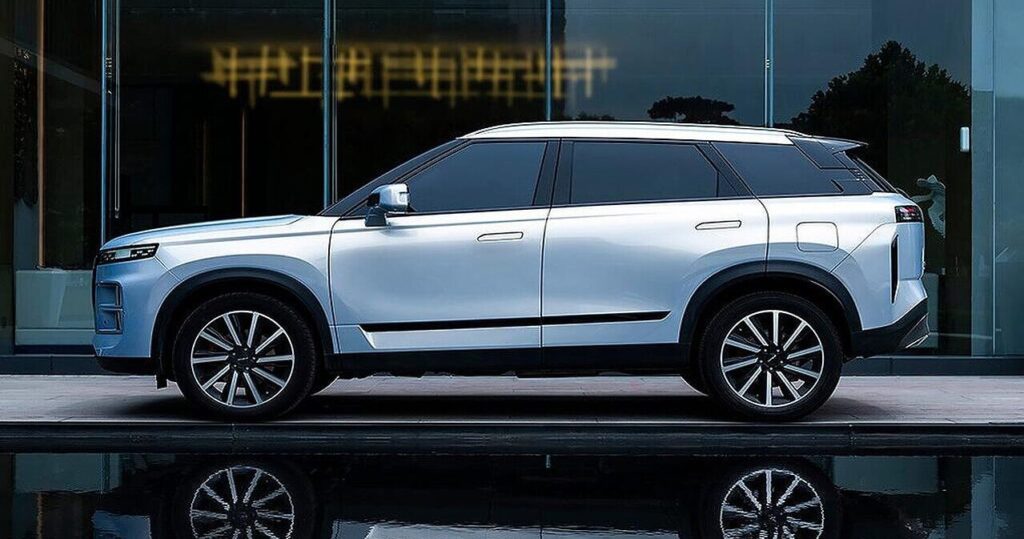
1. Introduction: Xiaomi YU7 SUV review and Xiaomi YU7 launch 2025
The automotive industry in 2025 is undergoing a seismic shift, catalyzed by the aggressive expansion of tech giants into the mobility sector. The most striking example of this transformation is the Xiaomi YU7 SUV review, which showcases not just a new product, but a full ecosystem integration. Following the stunning success of the SU7 sedan, Xiaomi has officially entered the market’s most competitive segment—mid-size electric SUVs—throwing a direct gauntlet at the Tesla Model Y’s hegemony. The Xiaomi YU7 launch 2025 is not a standard premiere; it is a strategic move aimed at reshaping the premium EV market in China and beyond.
In this detailed Xiaomi YU7 SUV review, we analyze how the Chinese tech giant has reimagined the concept of a family vehicle. While the SU7 was a statement of intent regarding dynamics and handling, the YU7 is positioned as the ultimate solution for the “elite,” seeking a balance between supercar performance and family shuttle functionality. Analysis shows that the Xiaomi YU7 launch 2025 arrives at a critical moment: while traditional automakers are just beginning to adapt to software-defined vehicles (SDVs), Xiaomi is launching a product designed from the ground up as part of a user’s smart home and digital life.
The market context for the Xiaomi YU7 SUV review is crucial. The crossover enters the market with an aggressive pricing strategy, starting at RMB 253,500, making it a direct competitor not only to Tesla but also to premium German brands and local players like Li Auto and XPeng. Unlike many competitors, Xiaomi bets on the mass accessibility of high technology. Pre-order statistics mentioned in this Xiaomi YU7 SUV review confirm the validity of this strategy: 240,000 orders in the first 18 hours is a historic record, demonstrating incredible brand trust.
A key aspect highlighting the Xiaomi YU7 SUV review is the engineering of the Modena platform. The car doesn’t just look like a Ferrari Purosangue; it utilizes a cutting-edge 800-volt architecture across all trims, ensuring outstanding Xiaomi YU7 Max performance and record-breaking charging efficiency. While many manufacturers limit advanced tech to top-tier versions, Xiaomi democratizes it, offering a Xiaomi YU7 range 835 km even in the base rear-wheel-drive version. This changes the game, eliminating range anxiety as a barrier to mass EV adoption.
However, the Xiaomi YU7 launch 2025 faces significant challenges. One cannot ignore logistics and production capacity issues in this Xiaomi YU7 SUV review. Massive demand has already led to delivery queues stretching for months, causing some frustration among early adopters. Xiaomi’s ability to scale production at the Beijing F2 plant will determine the model’s long-term success. Yet, judging by initial impressions and technical data, the YU7 has the potential to not just compete, but to become the new benchmark in its class.
If you’re curious how the same AI that powers smart EV assistants is changing everything from office work to creative jobs, check out our main hub for future tech insights at https://aiinovationhub.com/ — deep guides, tools, and real use cases on AI in business, life, and productivity for everyone worldwide.
2. Design & Aesthetics: Xiaomi YU7 electric SUV China
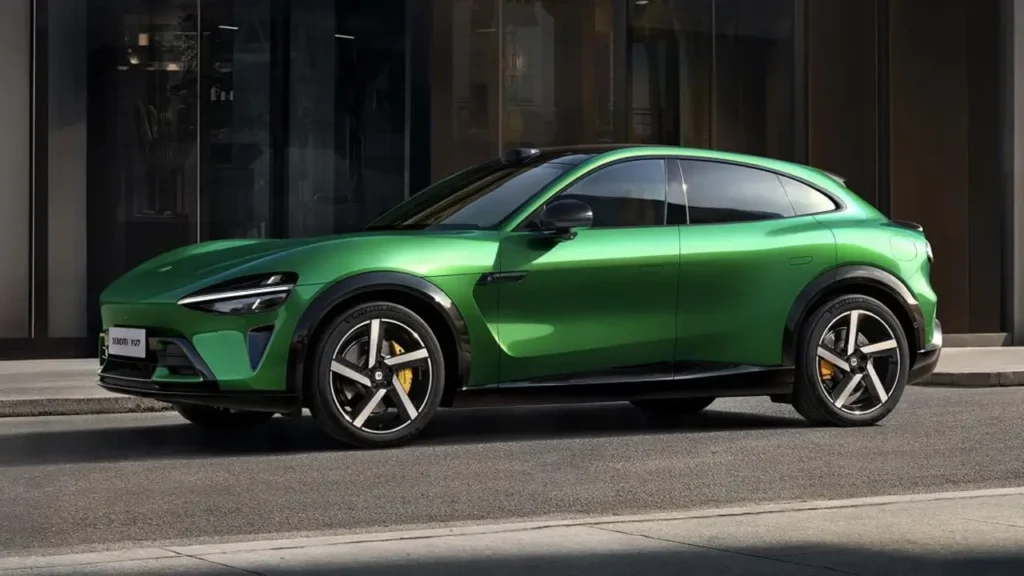
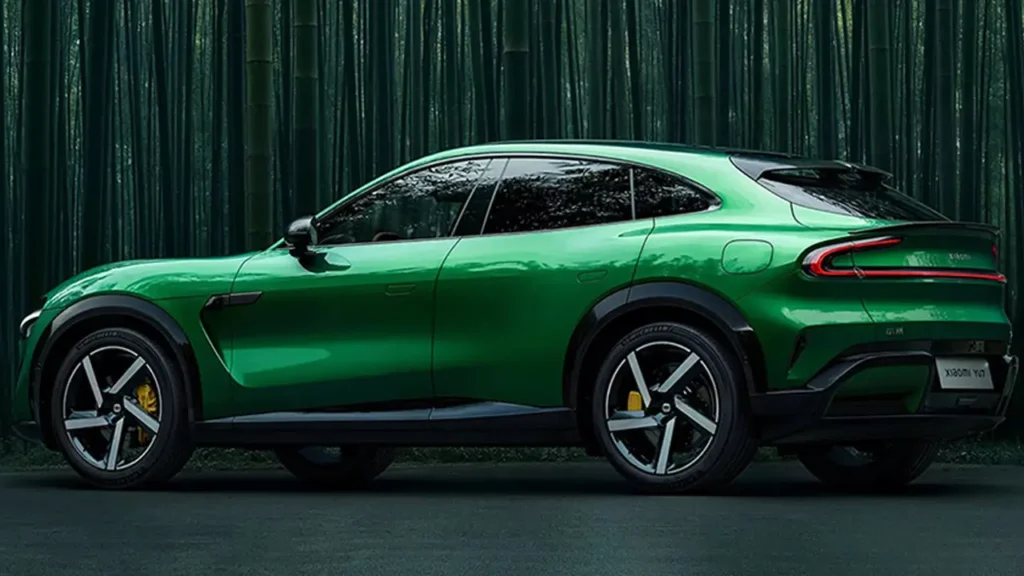
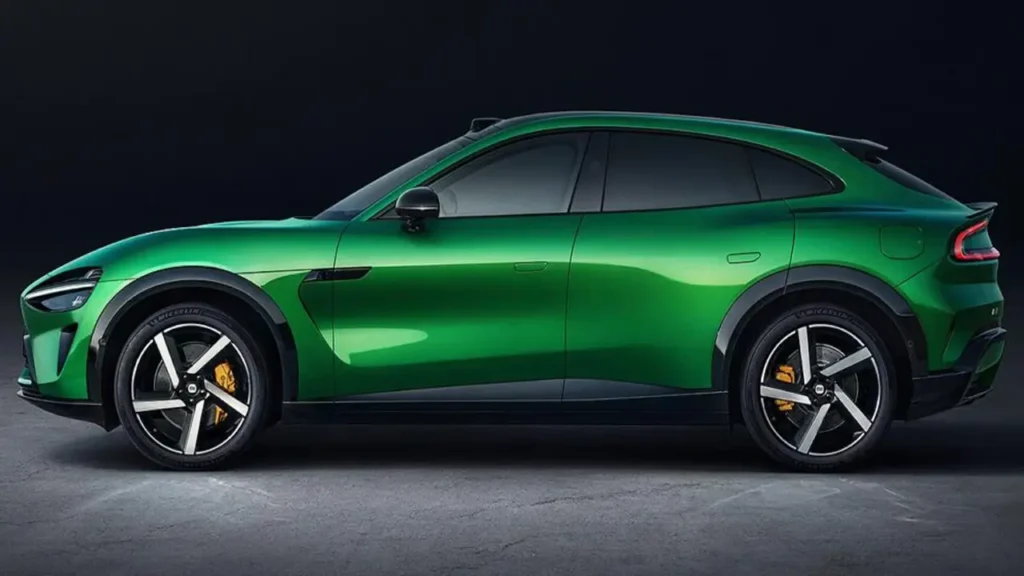
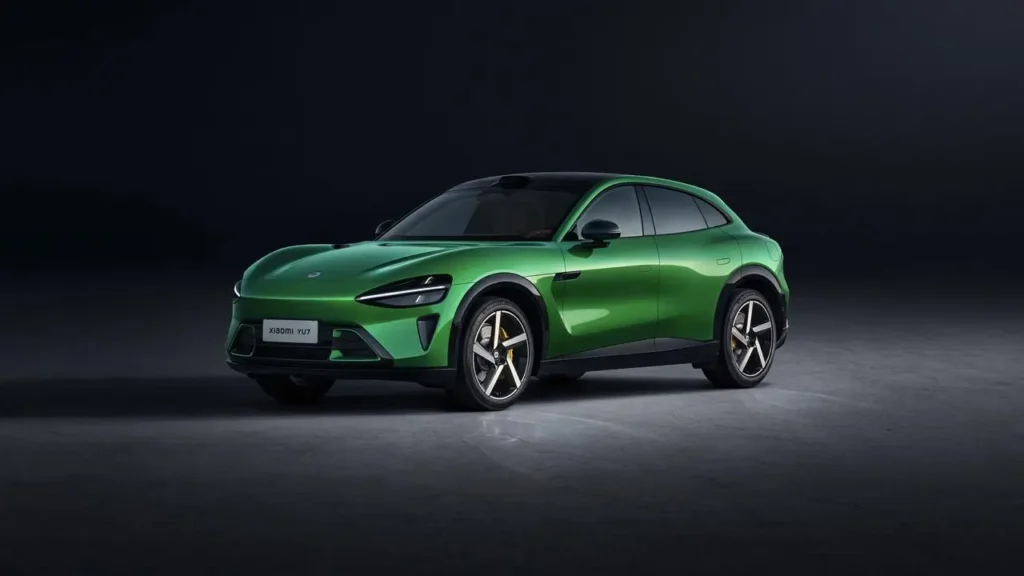
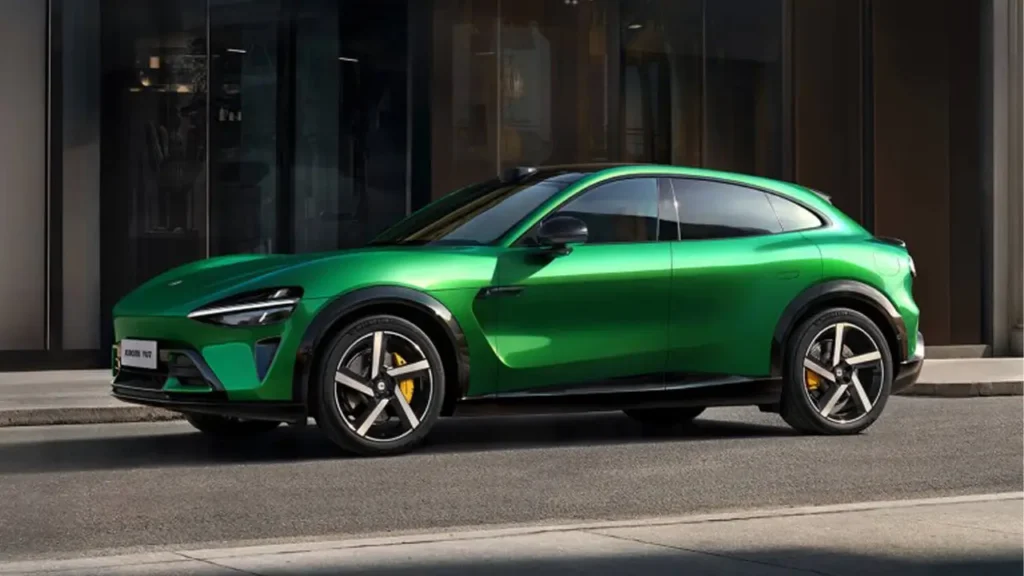
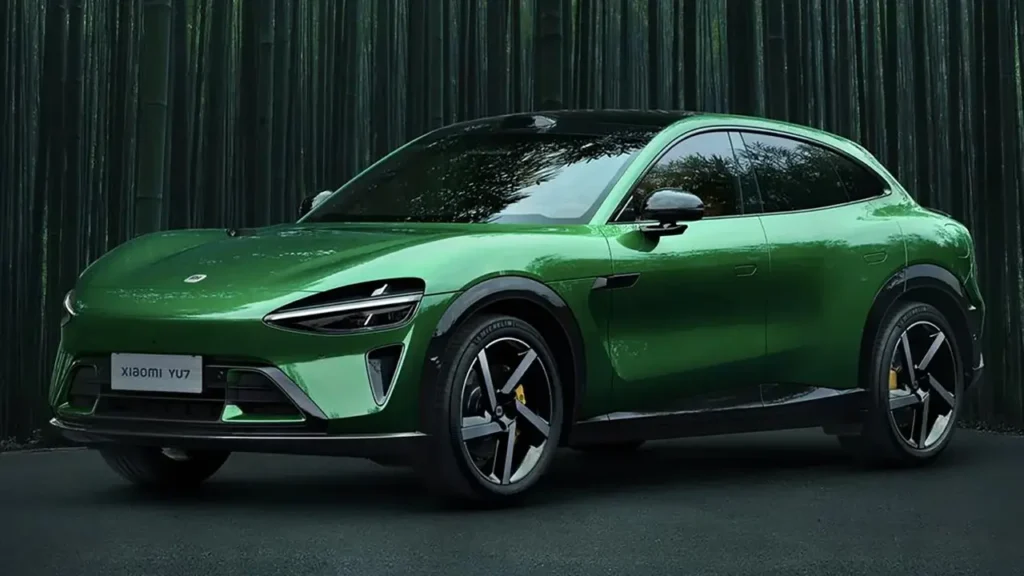
The visual component of the Xiaomi YU7 electric SUV China deserves a deep dive in this Xiaomi YU7 SUV review. Xiaomi designers, led by Li Tianyuan, consciously moved away from the utilitarian shapes common to most modern electric SUVs, opting instead for an emotional and dynamic silhouette. The result is a vehicle that resembles a lifted grand tourer or shooting brake rather than a classic crossover. The Xiaomi YU7 SUV review frequently draws parallels with the Ferrari Purosangue, and this is no accident: a long hood, a cabin shifted rearward, and muscular rear arches create proportions typical of high-power internal combustion cars [],.
The dimensions of the Xiaomi YU7 electric SUV China are imposing: length is 4999 mm, width 1996 mm, and height just 1600 mm. This length-to-height ratio (roughly 3:1) gives the car a squat, sporty look rarely seen in this class. The 3000 mm wheelbase not only ensures interior space but also pushes the wheels to the corners, minimizing overhangs to improve geometric capability and visual stability. This Xiaomi YU7 SUV review notes an L113 coefficient (distance from front wheel center to brake pedal) of 680 mm, a benchmark for premium cars that underscores a “noble posture”.
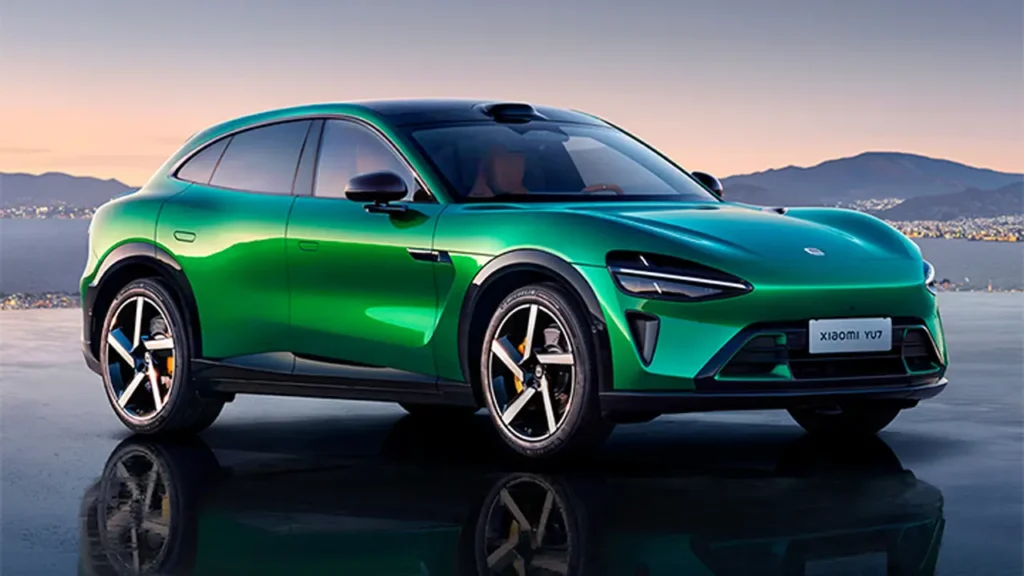
The front preserves the family traits of the SU7, including the characteristic “water droplet” headlights, which the Xiaomi YU7 SUV review describes as a key brand identifier. However, unlike the sedan, the optics here are vertically oriented to match the increased front height. Active aerodynamic elements, such as grille shutters and Air Curtains, play a vital role in reducing drag, crucial for achieving the stated Xiaomi YU7 range 835 km. The LiDAR, integrated into the roof in a “watchtower” configuration, ensures optimal visibility for autonomous driving systems, with designers managing to blend it organically into the silhouette to minimize aerodynamic losses ,.
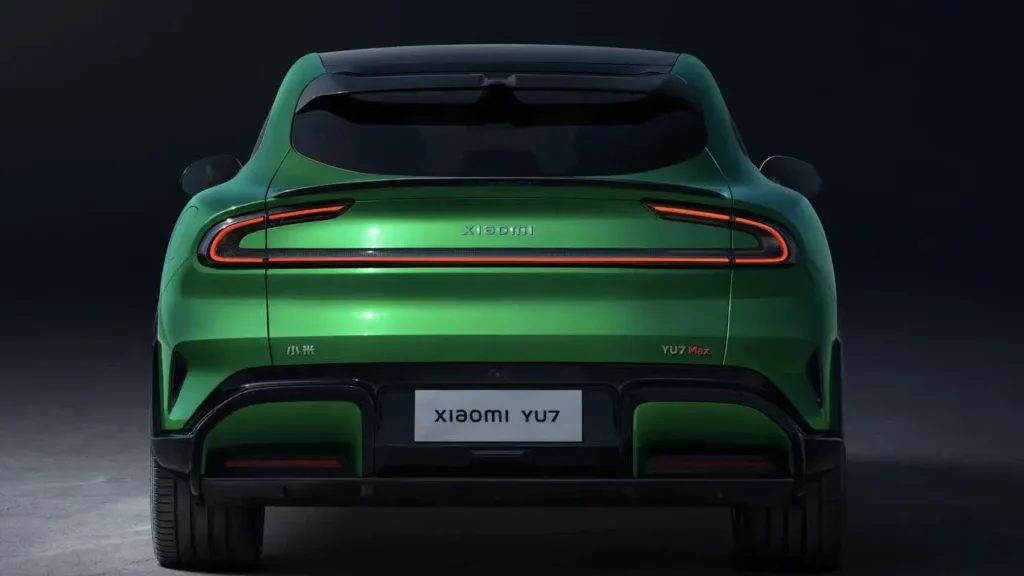
The side profile of the Xiaomi YU7 electric SUV China is devoid of superfluous lines, relying on light and shadow play across complex surfaces. Frameless doors, hidden handles, and stalk-mounted mirrors all work to reduce noise and improve aerodynamics. In the Xiaomi YU7 SUV review, special attention is paid to the rear, where an active spoiler and diffuser not only complete the sporty look but generate real downforce at high speeds. The taillights, a single light bar with U-shaped elements, echo the SU7 design, creating a unified visual code for the Xiaomi Auto lineup.
The color palette of the Xiaomi YU7 electric SUV China also demonstrates premium ambitions. The Xiaomi YU7 SUV review highlights the special “Crystal Purple” Challenger Edition, which uses complex multi-layer painting technology to create a deep, rich color that shifts with lighting. Customization options, including yellow Brembo calipers and wheel designs up to 21 inches, allow owners to create a unique vehicle. Build quality, evaluated in this Xiaomi YU7 SUV review, is high: panel gaps are even, and assembly precision rivals German competitors, testifying to the high production culture at Xiaomi’s factory.
If you want to see how another Chinese brand is going straight after Tesla in Europe, read our NIO Onvo L60 breakdown here: https://autochina.blog/nio-onvo-l60-tesla-model-y-competitor-europe/ — compact SUV format, sharp pricing, and a very clear message: Model Y, move over and make space for European buyers watching this EV battle unfold.
3. Powertrain & Dynamics: Xiaomi YU7 Max performance
The technical excellence of the Xiaomi YU7 Max performance is a primary argument for this new arrival. At the heart of the powertrain are the proprietary HyperEngine V6s Plus motors, showcasing outstanding power density and efficiency. The top-tier YU7 Max features a dual-motor setup delivering a combined 508 kW (691 hp) and a staggering 866 Nm of torque. This Xiaomi YU7 SUV review confirms that these specs allow the heavy crossover to sprint from 0 to 100 km/h in just 3.23 seconds, placing it alongside supercars and outpacing the Tesla Model Y Performance [],.
However, the Xiaomi YU7 SUV review emphasizes that acceleration is only part of the equation. Xiaomi engineers focused heavily on chassis tuning to ensure handling worthy of the car’s looks. The Modena platform utilizes double-wishbone front suspension and a five-link rear, the gold standard for sports cars. In Pro and Max versions, this layout is enhanced by dual-chamber air suspension and CDC (Continuous Damping Control) adaptive shocks, []. This gives the Xiaomi YU7 SUV review a dual character: in “Comfort,” it absorbs bumps smoothly, while in “Sport+,” the suspension stiffens to minimize body roll and sharpen steering response [],.
The base version of Xiaomi YU7 Max performance, equipped with a single rear motor, is no slouch. Power of 235 kW (315 hp) and 528 Nm of torque ensure a 0-100 km/h time of 5.88 seconds [],. For a family crossover, this is more than adequate, allowing confident merging and overtaking. The Xiaomi YU7 SUV review notes that the RWD layout gives the car a classic driver’s feel that enthusiasts will appreciate.
The AWD system in Pro and Max versions features intelligent torque distribution. Electronics query sensors thousands of times per second, instantly shifting power to wheels with grip. This ensures not just phenomenal launch dynamics but high safety on slippery surfaces—crucial for Xiaomi YU7 SUV review winter testing. The top speed is capped at 253 km/h, significantly higher than most rivals, indicating the powertrain’s durability and cooling efficiency [],.
Braking also matches the high status of Xiaomi YU7 Max performance. Multi-piston Brembo calipers and large ventilated discs ensure stable deceleration even during aggressive driving ,. Regenerative braking is integrated seamlessly, with the transition from electric to hydraulic braking virtually imperceptible. The Xiaomi YU7 SUV review notes flexible regen settings, allowing for one-pedal driving, which enhances comfort in traffic and boosts real-world range.
4. Battery Tech & Efficiency: Xiaomi YU7 range 835 km
In the EV world, range remains a top criterion, and the Xiaomi YU7 range 835 km sets a new industry bar. Achieving such a figure was possible through a combination of advanced battery tech and fanatical efficiency. The base RWD YU7 Standard comes with a 96.3 kWh Lithium Iron Phosphate (LFP) battery from BYD (FinDreams) or CATL, []. This combination of a large battery and efficient rear drive enables a record 835 km (CLTC), making the YU7 a leader in the mid-size electric SUV class.
In this Xiaomi YU7 SUV review, we dissect the battery hierarchy. The Pro AWD version uses the same 96.3 kWh LFP pack, but due to the second motor and weight, range drops to 770 km—still an outstanding result, []. The flagship Max version gets a cutting-edge Ternary (NMC) Qilin battery from CATL with 101.7 kWh capacity. Despite the larger size, the high-power motors and performance focus result in a 760 km range, []. Using different chemistries (LFP for volume, NMC for performance) allows Xiaomi to manage cost and specs effectively.
Real-world usage, covered in the Xiaomi YU7 SUV review, adjusts these lab figures. Independent highway tests showed the YU7 Max capable of about 492 km at an average speed of 99.6 km/h until full stop. The CLTC achievement rate was 65.5%, typical for high-speed EV driving where drag grows quadratically. Nevertheless, covering nearly 500 km on the highway on a single charge makes the Xiaomi YU7 range 835 km claim a practical tool for long-distance travel, not just marketing fluff.
A vital efficiency component noted in the Xiaomi YU7 SUV review is the standard heat pump across all trims. This system efficiently moves heat between the battery, motors, and cabin, minimizing winter energy loss. Combined with a low drag coefficient (0.245 Cd), achieved via a coupe-like silhouette and active aero, the YU7 maintains low consumption even in adverse conditions [],.
The intelligent Battery Management System (BMS) in the Xiaomi YU7 SUV review deserves mention. It monitors every cell, optimizing charge/discharge to extend life. Integration with navigation allows the car to pre-condition the battery for fast charging, ensuring maximum speed immediately upon plug-in—critical for user convenience.
Table 1: Xiaomi YU7 Battery and Range Comparison
EV Range and Battery Comparison (LFP vs. NMC)
| Version | Drive | Battery Type | Capacity (kWh) | Range CLTC (km) | Real Highway Test* |
|---|---|---|---|---|---|
| Standard | RWD | LFP (Blade) | 96.3 | 835 | N/A |
| Pro | AWD | LFP (Blade) | 96.3 | 770 | N/A |
| Max | AWD | NMC (Qilin) | 101.7 | 760 | ~492 km (Shows significant real-world range drop vs CLTC) |
*Independent test data for Max version at ~100 km/h average speed.
5. Cabin & Features: Xiaomi YU7 interior review
The Xiaomi YU7 interior review reveals a philosophy of "smart luxury," blending minimalism with advanced digital tech and premium materials. The cabin is designed around the "Human x Car x Home" concept, ensuring seamless integration with the Xiaomi ecosystem. Dominating the dash is a 16.1-inch 3K central display running HyperOS. The interface is intuitive, resembling a modern tablet with instant response thanks to the Snapdragon 8295 chip.
A unique feature noted in the Xiaomi YU7 interior review is the driver information display. Instead of a traditional cluster, the YU7 uses a "Skyline" display spanning the width of the dashboard near the windshield, complemented by a massive Head-Up Display (HUD), [. This keeps key data like navigation and ADAS in the driver's line of sight. For tactile lovers, a magnetic panel with physical buttons and knobs can attach below the central screen—an elegant bridge between digital and analog.
Passenger comfort in the Xiaomi YU7 interior review is absolute. Front "zero-gravity" seats recline 123 degrees with 10-point massage, turning the car into a lounge while charging. The rear row is equally impressive: electrically adjustable backrests recline up to 135 degrees. Legroom is generous thanks to the long wheelbase and flat floor. A panoramic roof with double silver plating blocks UV and heat, protecting the cabin from overheating.
The Xiaomi YU7 SUV review highlights attention to detail: a built-in 4.6L fridge capable of both cooling and heating. A scent system with replaceable cartridges personalizes the atmosphere. Nappa leather upholstery is durable and soft. Practicality is ensured by 36 storage spaces throughout the cabin.
Cargo space in the Xiaomi YU7 interior review is praiseworthy. The rear trunk holds 678 liters, fitting three 24-inch suitcases. With seats folded, it expands to 1758 liters, creating a 1.8-meter flat bed. The 141-liter front trunk (frunk) is class-leading, easily swallowing charging cables or a small carry-on. This sets the YU7 apart from competitors with missing or tiny frunks.
Multimedia extends to rear passengers via Xiaomi Pad mounts on front seatbacks, integrating tablets into vehicle control for climate and media. A 25-speaker Dolby Atmos system creates a concert hall effect,. Noise insulation is high, with acoustic glass ensuring silence even at speed.
6. Charging Ecosystem: Xiaomi YU7 charging speed
In the EV ecosystem, charging speed is critical, and Xiaomi YU7 charging speed demonstrates technological dominance. All YU7 versions, including the base model, are built on a full 800-volt Silicon Carbide (SiC) architecture. This is pivotal, as many rivals offer 800V only on top trims. Consequently, peak charging power reaches 5.2C, charging from 10% to 80% in just 12 minutes for the Max and ~21 minutes for LFP versions.
In the context of the Xiaomi YU7 SUV review, a coffee stop adds up to 620 km of range. This speed brings the EV experience closer to ICE refueling. To support such Xiaomi YU7 charging speed, Xiaomi is rolling out its own 600kW liquid-cooled superchargers. However, engineers optimized for third-party compatibility. The YU7 is tested compatible with 99% of China's 1.4 million public chargers.
The Xiaomi YU7 SUV review notes that 800V benefits even lower-power stations. Higher voltage means lower current for the same power, reducing cable/battery heat and sustaining high charging speeds longer than 400V cars. This makes the YU7 efficient in real-world scenarios where ultra-fast chargers might be scarce.
For home charging, Xiaomi offers 7kW and 11kW smart wallboxes integrated into the smart home system. Users can schedule charging via app to utilize off-peak rates. Plug & Charge and OTA updates make operation simple. The Xiaomi YU7 SUV review emphasizes this comprehensive ecosystem approach as a major competitive advantage.
7. Value Proposition: Xiaomi YU7 price and specs
The Xiaomi YU7 price and specs strategy is an aggressive assault on market leaders. Starting at RMB 253,500 (~$35k) for the Standard RWD, the value is undeniable. This price includes an 800V platform, 96.3 kWh battery (835 km range), NVIDIA Orin-X/Thor chip, and LiDAR. The Xiaomi YU7 SUV review stresses that rivals often gate these specs behind expensive trims.
The Xiaomi YU7 Pro AWD costs RMB 279,900, adding AWD, air suspension, and better dynamics [],. It’s the "goldilocks" trim for those needing traction without Max's excess power. The flagship Xiaomi YU7 Max AWD is RMB 329,900, offering 3.23s acceleration, Qilin 101.7 kWh battery, and max luxury [],.
Analyzing Xiaomi YU7 price and specs, it's clear Xiaomi is applying its smartphone strategy: "high specs, accessible price." The company sacrifices initial margin for market share and future software/service revenue. The Xiaomi YU7 SUV review notes this pressures Tesla and premium brands like Porsche, whose EVs cost multiples more for similar specs.
Standard equipment includes Xiaomi Pilot, using LiDAR, HD cameras, and millimeter-wave radar. The compute platform (NVIDIA Drive Orin or Thor) provides immense headroom (up to 700 TOPS) for future L3/L4 autonomy updates. Buying a YU7 is an investment in future-proof tech.
8. The Middle Child: Xiaomi YU7 Pro AWD
In model lineups, the middle trim is often the smartest buy, and the Xiaomi YU7 Pro AWD proves this. In this Xiaomi YU7 SUV review, it stands out for balancing price, performance, and utility. For an extra RMB 26,400 over the base, you get a second motor, AWD, and air suspension.
The Xiaomi YU7 Pro AWD uses the same 96.3 kWh LFP battery as the base, yielding 770 km CLTC. This is slightly less than the RWD but offers all-weather confidence. Combined power is 365 kW (489 hp) with 690 Nm torque, hitting 100 km/h in 4.27 seconds [],. The Xiaomi YU7 SUV review concludes: this is more than enough speed for any road situation, beating most ICE performance SUVs.
A key benefit of the Xiaomi YU7 Pro AWD is the LFP battery. Compared to the Max's NMC, LFP offers longer cycle life and thermal stability, making it a safer long-term choice. The 800V architecture mitigates LFP's traditional cold-weather charging slowness (assuming pre-conditioning).
Dual-chamber air suspension allows ride height adjustment, transforming the Pro from a highway cruiser to a light off-roader capable of clearing snow [. The Xiaomi YU7 SUV review deems the Pro the rational choice for buyers wanting tech and comfort without paying for the Max's "bragging rights" power.
9. Competitive Analysis: Xiaomi YU7 vs Tesla Model Y
The Xiaomi YU7 vs Tesla Model Y battle is central to any discussion. The Model Y has been the global benchmark, but the Xiaomi YU7 SUV review shows the challenger is prepared. The YU7 is larger, offering more interior space and a more premium design. If Tesla is minimalism, Xiaomi is tech-luxury.
Technically, Xiaomi YU7 vs Tesla Model Y favors the newcomer. YU7 uses 800V vs Tesla's 400V, charging faster. The base YU7 battery is ~60% larger than the base Model Y (96.3 kWh vs ~60 kWh), translating to a massive range lead: 835 km vs 554 km (CLTC). Even adjusting for cycle optimism, the real-world gap is huge.
Regarding autonomy, philosophies diverge. Tesla bets on Vision (cameras only). Xiaomi uses Fusion (LiDAR + Radar + Cameras) powered by NVIDIA. The Xiaomi YU7 SUV review notes that in chaotic Chinese traffic, LiDAR adds a safety layer Tesla lacks.
Interior Xiaomi YU7 vs Tesla Model Y is a clash of worlds. Xiaomi offers a cozy, high-tech cabin with better materials, optional buttons, instrument cluster, and HUD—features the Model Y lacks. Amenities like the fridge and massage seats elevate the YU7. However, Tesla still wins on software maturity and global Supercharger network (though opening up), and resale value.
Sales data in the Xiaomi YU7 SUV review speaks volumes: in October 2025, YU7 sold over 33,000 units, outselling the Model Y domestically. A new king may have arrived.
10. Conclusion: Can the Xiaomi YU7 SUV review confirm it as the new benchmark?
Summing up this Xiaomi YU7 SUV review, Xiaomi has created a product that matches and often exceeds world leaders. The YU7 demonstrates the power of Chinese auto manufacturing, blending tech, design, and scale. The Xiaomi YU7 launch 2025 marks the shift from "electrification" to "intelligence."
The model's aces are the record Xiaomi YU7 range 835 km, ultra-fast Xiaomi YU7 charging speed, and disruptive Xiaomi YU7 price and specs. It blurs the line between gadget and car.
Risks exist: Xiaomi's auto division is young. Long-term reliability and service scale are unproven. Delivery delays are a "growing pain". But per this Xiaomi YU7 SUV review, the product is so compelling buyers are willing to wait. The Xiaomi YU7 is truly a "brutal rival" to the Model Y, forcing the industry to accelerate.
Table 2: Xiaomi YU7 Summary Specs
Xiaomi YU7 Electric Vehicle Model Comparison
| Feature | Xiaomi YU7 Standard | Xiaomi YU7 Pro | Xiaomi YU7 Max |
|---|---|---|---|
| Drivetrain | RWD | AWD | AWD |
| Battery | 96.3 kWh LFP [Image of LFP battery architecture] | 96.3 kWh LFP | 101.7 kWh NMC [Image of NMC battery architecture] |
| Range (CLTC) | 835 km (Highest) | 770 km | 760 km |
| 0-100 km/h | 5.88 s | 4.27 s | 3.23 s (Fastest) |
| Power | 235 kW (315 hp) | 365 kW (489 hp) | 508 kW (681 hp) |
| Charging (10-80%) | ~21 min | ~21 min | 12 min (Fastest) |
| Price (RMB) | ¥253,500 (Lowest) | ¥279,900 | ¥329,900 (Highest) |
Discover more from AutoChina
Subscribe to get the latest posts sent to your email.