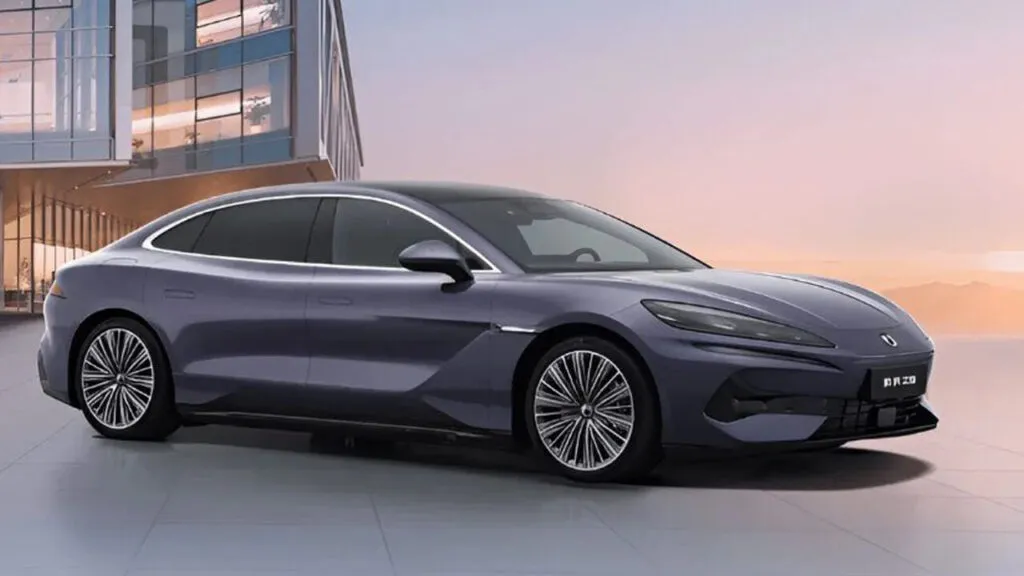
Why Xiaomi SU7 Ultra Is Exploding Online
There are cars that make headlines, and then there is the Xiaomi SU7 Ultra — a machine that has genuinely shaken the automotive world and forced some of the biggest names in the industry to sit up and pay attention. If you have been anywhere near a car forum, an EV community, or even a general tech discussion in 2025, chances are you have heard the name. But what exactly is all the fuss about?
Here is the short answer: a Chinese smartphone company just built one of the fastest road-legal sedans on the planet, priced it at around $73,000, and then went ahead and broke lap records at some of the most prestigious racing circuits in the world. When you put it like that, the internet hype makes perfect sense.
Xiaomi, best known globally for its affordable smartphones and smart home gadgets, officially announced its automotive ambitions back in September 2021 with a clear mission statement: benchmark against Porsche and Tesla and create a pure electric high-performance car. The regular SU7, launched in late 2023, was already a serious machine that quickly outsold the Tesla Model 3 in China. But the Xiaomi SU7 Ultra? That is a completely different animal. It is Xiaomi’s statement to the world that Chinese engineering is no longer playing catch-up — it is setting the pace.
The Xiaomi electric car story is one of the most compelling in recent automotive history, and the SU7 Ultra is its most dramatic chapter yet. In this full review we break down everything you need to know — from specs and performance to interior tech, range, pricing, and the legendary Nürburgring lap that sent shockwaves through the industry.
Xiaomi SU7 Ultra Specs and Power Numbers
Let us start with the numbers, because they are genuinely jaw-dropping even by hypercar standards.
The Xiaomi SU7 Ultra uses a tri-motor all-wheel-drive system. At the rear sit two HyperEngine V8s motors, while a V6s motor handles the front axle. The combined maximum output reaches 1,548 horsepower with a maximum torque of 1,135 Nm. To put that in context, that is more power than a Bugatti Chiron Sport and significantly more than a Ferrari SF90 Stradale — but packaged inside a four-door family sedan.
The battery is a CATL-made 93.7 kWh ternary NMC unit running on an 800-volt architecture. The charging system operates at 5.2C, which means a 10–80% charge takes just 11 minutes on a compatible DC fast charger. That is class-leading performance that embarrasses most of the competition.
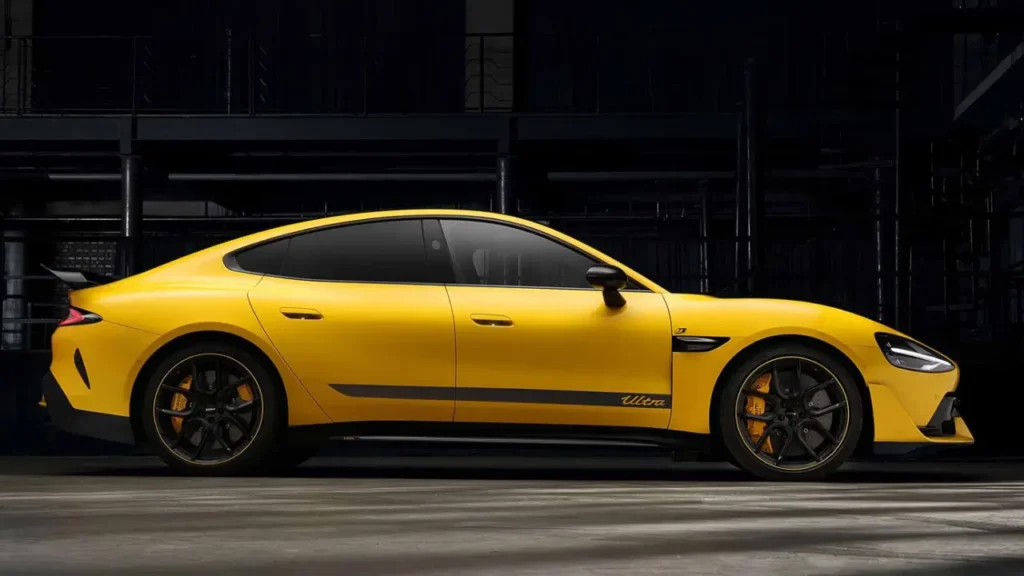
The car itself measures 5,115 mm in length, 1,970 mm in width, and 1,465 mm in height, with a 3,000 mm wheelbase. Its curb weight sits at 2,360 kg — heavy by sports car standards, but 150 kg lighter than a BMW M5 G90 sedan.
Here is the full official specs breakdown:
| Specification | Value |
|---|---|
| Powertrain | Tri-motor AWD (2× V8s rear + 1× V6s front) |
| Max Horsepower | 1,548 hp (1,138 kW) |
| Max Torque | 1,770 Nm (combined system) |
| 0–100 km/h | 1.98 seconds |
| 0–200 km/h | 5.96 seconds |
| 0–300 km/h | 15 seconds |
| Top Speed | 350 km/h (217 mph) |
| Quarter Mile (0–400 m) | 9.23 seconds |
| Battery Capacity | 93.7 kWh (CATL Qilin 2.0) |
| Charging Speed | 10–80% in 11 minutes |
| CLTC Range | 620 km |
| Curb Weight | 2,360 kg |
| Downforce | 285 kg |
| Braking 100–0 km/h | 30.8 metres |
| Body Length | 5,115 mm |
| Wheelbase | 3,000 mm |
| Architecture | 800V platform |
The Xiaomi SU7 Ultra horsepower figure of 1,548 hp is not a theoretical peak designed to impress in a brochure — it is the real, usable number. After some early controversy where a software update temporarily capped output at around 900 hp, Xiaomi responded to owner feedback and restored the full power figure via an OTA update. That response tells you a lot about how seriously Xiaomi takes its community.
Xiaomi SU7 Ultra Performance on Road and Track
The Xiaomi SU7 Ultra performance credentials go far beyond straight-line speed, though the straight-line numbers are extraordinary enough on their own. Getting from 0 to 100 km/h in 1.98 seconds in a car with four proper seats is a genuinely surreal experience. For reference, that is faster than a Porsche 918 Spyder hypercar.
But Xiaomi did not build the SU7 Ultra just to win drag races. The chassis has been engineered for serious circuit work. The suspension uses dual-chamber air springs paired with high-performance adaptive dampers that can be tuned for both comfortable daily driving and aggressive track sessions. Akebono carbon-ceramic brake discs with 6-piston front calipers and 4-piston rear calipers handle the stopping duties, and they are rated to withstand temperatures over 1,300 degrees Celsius.
The SU7 Ultra top speed of 350 km/h is impressive on paper, but the prototype actually hit 359.71 km/h at the CATARC Yan Cheng Automotive Proving Grounds — a figure that CEO Lei Jun himself noted was limited by the test facility, not the car.
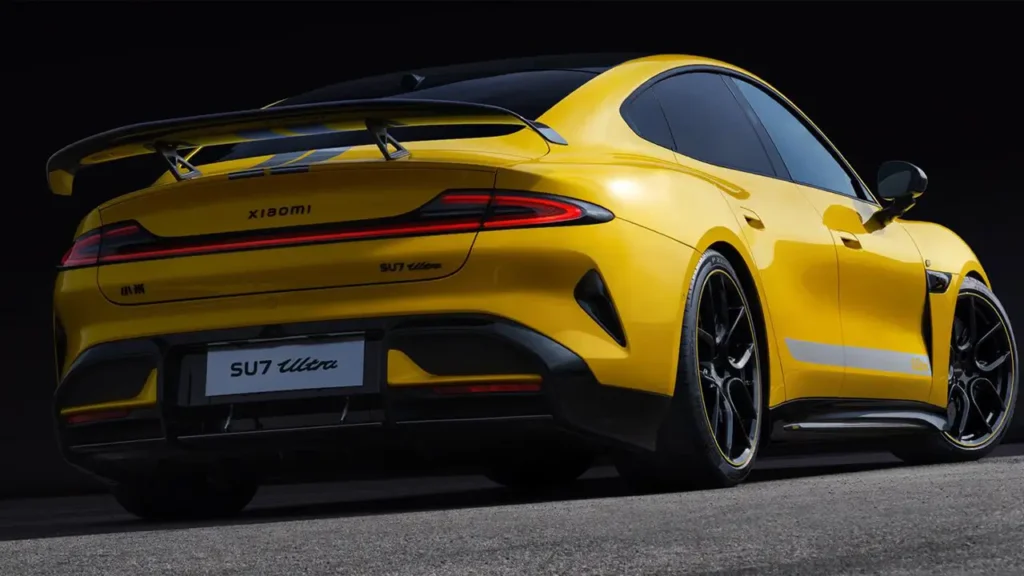
The aerodynamic package plays a huge role in all of this. The body features 17 carbon fibre components, a massive 1,560 mm wide rear wing with a 240 mm chord, a front splitter with large vertical endplates, and an active diffuser at the rear. Together, these generate 285 kg of downforce at high speed — the kind of numbers that would not embarrass a dedicated track car.
Xiaomi also introduced a Track Mode that must be unlocked through specific qualification certifications — a responsible touch for a car with this kind of power. There is also a Beginner Mode for drivers who want to explore performance in a more measured way.
The three-motor torque vectoring system is another highlight. By independently controlling power delivery to each wheel, the car can rotate precisely through corners in ways that its weight would otherwise prevent. Reviewers who have driven it on circuit note the understeer is more present than in a Porsche Taycan Turbo GT — the car prioritises stability and safety — but the sheer pace it carries through corners is remarkable.

AndreevWebStudio.com
Professional web development and design services. Custom WordPress sites, landing pages, e-commerce solutions, and 3D printing content creation for businesses and creators.
- • WordPress Development
- • Custom Web Design
- • E-Commerce Solutions
- • 3D Printing Content
Xiaomi SU7 Ultra Nürburgring Record Explained
This is the chapter that truly changed everything. The Nürburgring Nordschleife is widely considered the most demanding race track in the world — 20.8 km of sweeping mountain roads, blind crests, and unforgiving barriers. If you can go fast there, you can go fast anywhere.
On 1 April 2025, driven by professional racing driver Vincent Radermecker, the Xiaomi SU7 Ultra set a certified lap time of 7 minutes 04.957 seconds on the Nürburgring Nordschleife. This made it the fastest production electric vehicle ever to lap the circuit, and the fastest road-legal four-door car in the track’s history. It beat the Porsche Taycan Turbo GT Weissach and the Rimac Nevera — two cars that cost significantly more and were specifically engineered for this kind of performance.
The conditions were cold — between 2 and 9 degrees Celsius — and the lap was set on the car’s second attempt. Xiaomi brought two SU7 Ultras to the track. The cars were fitted with safety equipment including a full roll cage and racing seats with a six-point harness, with some interior trim removed to compensate for the additional weight, at the request of track officials. Critically, the powertrain and tyres remained standard — this was a production car doing production car things.
In June 2025, when the record was officially announced, Xiaomi confirmed they would remain at the circuit to attempt to improve on the time. Shortly after, a production SU7 Ultra lapped the circuit in just under 7 minutes 5 seconds in an unmodified configuration with its full 1,527 hp output, reconfirming the result.
Xiaomi also holds the production car record at the Shanghai International Circuit, with a certified lap time of 2 minutes 09.944, set on 13 February 2025 — the fastest mass-produced vehicle at that venue, beating even the time set by a Porsche Taycan Turbo GT.
For those who want an even more extreme version, Xiaomi released the Nürburgring Limited Edition to commemorate the record. Just 100 units will be produced in its lifetime, with 10 built in 2025. It features an aerodynamic floor, a half roll cage, Sparco carbon fibre racing bucket seats with 6-point harnesses, removed rear seats to save 30 kg, and custom racing suits.
Xiaomi SU7 Ultra Interior and Smart Technology
Performance cars do not always prioritise the interior experience. The Xiaomi SU7 Ultra does — and it does so in a way that reflects the company’s deep roots in consumer technology.
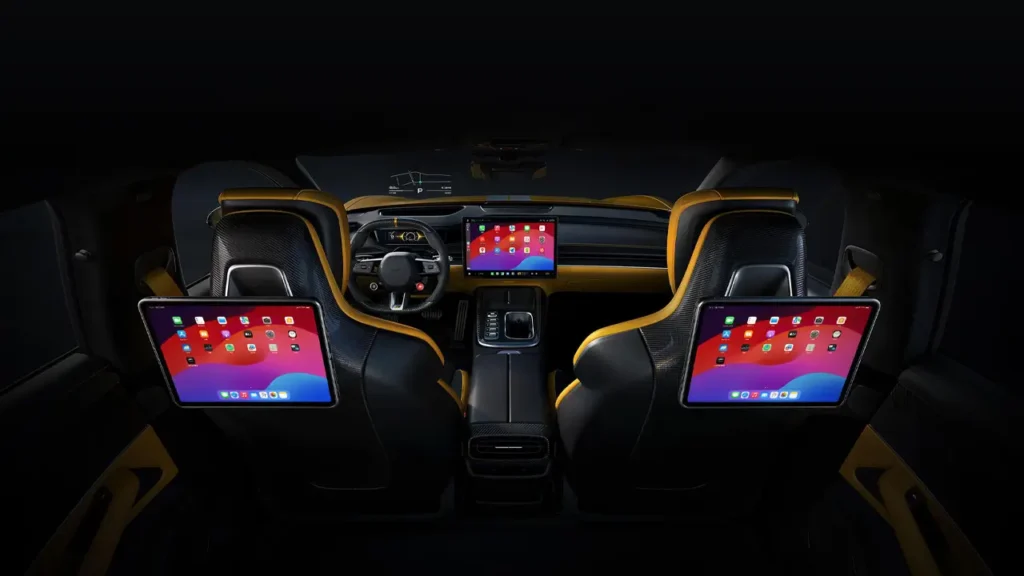
Step inside and you are greeted by Alcantara upholstery with carbon fibre accents throughout the cabin. The seats are distinctively trimmed and designed to hold you firmly in place whether you are cruising or attacking a corner. Up front, the technology stack is genuinely impressive.
The centrepiece of the dashboard is a 16.1-inch 3K resolution central touchscreen powered by Xiaomi’s HyperOS — the same operating system that runs across Xiaomi’s smartphones and smart home ecosystem. This is not just a big screen with a map app — it is a genuinely intelligent hub. The system is driven by a Qualcomm Snapdragon 8295 in-car chip with AI processing power of up to 30 TOPS, making it one of the most capable infotainment processors in any production vehicle.
The HyperVision panoramic display stretches 1.10 metres across, creating an immersive visual experience for the driver and front passenger. There is also a 56-inch head-up display that projects key driving data directly onto the windscreen — speed, navigation, and performance data visible without taking your eyes off the road.
Rear passengers are catered for too, with two seat-back extension mounts that allow tablets to be safely stowed and used during journeys. For audio, the system includes a 25-speaker Dolby Atmos setup — the kind of system you would expect in a luxury limousine, not a performance sedan.
Driver assistance technology includes LiDAR sensors paired with dual Nvidia Orin X chips for the intelligent driving suite. The highway autonomous driving capability is described as mature, with decisive and confident automatic lane changes. Urban navigation on autopilot is more conservative but functional, and Xiaomi continues to update the system over the air.
The Smart Cabin philosophy ties everything together. Thanks to HyperOS, the car connects seamlessly with Xiaomi smartphones, wearables, and smart home devices. You can monitor vehicle status remotely, control certain functions from your phone, and receive OTA updates that genuinely improve the car over time. Ford CEO Jim Farley, after six months of testing a Xiaomi vehicle, was quoted saying the software integration was well above what Ford offers today. That is a remarkable endorsement from one of the industry’s most experienced executives.
Xiaomi SU7 Ultra Range, Charging, and Daily Driving
One of the most common questions about any high-performance EV is whether it can actually be lived with day to day. The SU7 Ultra’s answer is a confident yes — with some nuance.
Under CLTC testing conditions, the Xiaomi SU7 Ultra range is rated at 620 km. Real-world range will vary depending on driving style and conditions, and performance driving will naturally reduce that figure considerably. But for normal urban commuting and motorway driving, the range is genuinely usable and removes range anxiety from most daily scenarios.
The 93.7 kWh CATL Qilin 2.0 battery features an upgraded cooling system designed to maintain full performance under sustained high-load conditions — critically important for a car that is expected to perform on track. The battery architecture runs at 800 volts, which enables the extraordinary 490 kW peak charging power and the 11-minute 10–80% charge time on a compatible DC fast charger.
The suspension system offers real versatility. The dual-chamber air springs and adaptive dampers can be configured for a comfortable daily setting that absorbs road imperfections well, or tightened dramatically for track use. It is a genuinely different car depending on which mode you select, and that flexibility is one of its most appealing qualities.
Xiaomi has also thought carefully about driver experience for those who may be intimidated by 1,548 hp. The Beginner Mode limits the available power and sharpens the safety systems, making the car accessible even for drivers who are not professional racers. The Track Mode, as mentioned, requires certification — a safety measure that other manufacturers would do well to consider for cars of this capability.
Xiaomi SU7 Ultra Price vs Porsche Taycan and Tesla Model S
This is where the Xiaomi SU7 Ultra story becomes almost unbelievable. The car was officially launched on 27 February 2025 at a price of 529,900 yuan — approximately $73,000 USD at launch. For context, earlier presale pricing had been set at 814,900 yuan (approximately $114,000), so the final launch price was a significant and very welcome reduction.
Now compare that to the competition it has decisively beaten on track:
| Model | Power | 0–100 km/h | Top Speed | Nürburgring | Price (approx.) |
|---|---|---|---|---|---|
| Xiaomi SU7 Ultra | 1,548 hp | 1.98 s | 350 km/h | 7:04.957 | ~$73,000 |
| Porsche Taycan Turbo GT Weissach | 1,108 hp | 2.2 s | 305 km/h | 7:07.55 | ~$230,000 |
| Tesla Model S Plaid | 1,020 hp | 2.1 s | 322 km/h | No official time | ~$90,000 |
| Rimac Nevera | 1,914 hp | 1.97 s | 412 km/h | 7:05.30 | ~$2,100,000 |
| Lucid Air Sapphire | 1,234 hp | 1.89 s | 330 km/h | No official time | ~$249,000 |
The value proposition here is staggering. The Xiaomi SU7 Ultra beat the Porsche Taycan Turbo GT Weissach at the Nürburgring — a car that costs over three times as much. It beat the Rimac Nevera — a car that costs roughly 28 times as much. Those are not cherry-picked comparisons; those are certified, official lap times on the same circuit under comparable conditions.
Currently, the SU7 Ultra is available only in China. Xiaomi has confirmed that European sales will not begin before 2027 at the earliest. International buyers are watching closely.
Pros and Cons of Xiaomi SU7 Ultra
No car is perfect, and the SU7 Ultra has genuine strengths alongside a few areas worth knowing about before making a decision.
| Pros | Cons |
|---|---|
| 1,548 hp from a tri-motor AWD system — genuinely world-class power output | Currently available only in China; no confirmed international launch before 2027 |
| Certified Nürburgring production EV lap record — 7:04.957 | 2,360 kg curb weight affects dynamic agility compared to lighter sports cars |
| Extraordinary value at approximately $73,000 for this level of performance | Urban NOA autonomous driving still conservative and in development |
| 11-minute 10–80% charge time — among the fastest in any production EV | More understeer than track-focused competitors like the Porsche Taycan GT |
| 620 km CLTC range — practical for everyday use | HUD clarity can be reduced in strong direct sunlight |
| World-class interior tech — HyperOS, 16.1-inch 3K screen, 25-speaker Dolby Atmos | Full 1,548 hp was initially software-limited after launch, causing owner backlash (later restored) |
| Active aerodynamics — 285 kg of downforce from a production sedan | Long waiting lists expected due to very high demand |
| Full Xiaomi smart ecosystem integration — seamless with phones and smart home | Track Mode requires qualification certification — not accessible for all buyers immediately |
Real User Reactions and Community Opinions
The Xiaomi SU7 Ultra review from the wider community has been overwhelmingly enthusiastic, though with some nuanced criticism mixed in.
When Xiaomi announced the launch price of 529,900 yuan, the internet reaction was one of genuine disbelief. The original presale price had been set at 814,900 yuan, so the final reveal was a massive and very public surprise that generated enormous goodwill. Within ten minutes of the original presale opening at the higher price, the car had received 3,680 orders — a remarkable figure for a vehicle in this category.
The performance demonstration that truly went viral was the drag race footage of the SU7 Ultra against a Tesla Model S Plaid — one of the previous kings of the quarter mile. The Xiaomi won cleanly, and that video circulated far beyond the usual EV enthusiast communities, reaching mainstream automotive audiences globally.
On track, independent reviewers and racing professionals who have driven the car note that it prioritises safety and stability over pure driving involvement. The torque vectoring system is conservative — it would rather add understeer than risk a spin — and this reflects Xiaomi’s design philosophy of a car that is fast for everyone, not just experienced drivers. Some reviewers compare this unfavourably to the Porsche Taycan Turbo GT, which has a more precise and playful character. But at less than a third of the price, most enthusiasts consider that an entirely reasonable trade-off.
The software controversy was the most significant community flashpoint. After launch, a software update quietly reduced the accessible power to around 900 hp in normal driving conditions. The reaction from owners and online communities was immediate and intense. Xiaomi acknowledged the issue, issued a public statement committing to better transparency, and restored the full 1,548 hp via an OTA update. The episode highlighted both the challenges of software-defined vehicles and Xiaomi’s willingness to listen and respond quickly to its customer base.
Long-term reliability data is still limited given the car’s relatively recent launch, but durability confidence in the broader Xiaomi SU7 line is growing. One Chinese owner of the standard SU7 documented driving 265,000 km in 18 months with a battery state of health still at 94.5% — data that went viral and suggested the underlying engineering is genuinely robust.
AutoChina.blog
Your trusted guide to Chinese automotive technology. Expert reviews, comparisons, and insights on electric vehicles, hybrids, and innovative automotive solutions from China’s leading manufacturers.
- • EV & Hybrid Reviews
- • Tech Comparisons
- • Industry News & Trends
- • Buying Guides
Final Verdict — Should You Buy Xiaomi SU7 Ultra?
After going through everything — the specs, the performance, the interior, the record-breaking, the price — the conclusion is surprisingly straightforward: the Xiaomi SU7 Ultra is one of the most remarkable cars ever built, and its price-to-performance ratio is completely without precedent in automotive history.
There is no other way to frame it. A four-door production sedan that holds the Nürburgring production EV lap record, accelerates to 100 km/h in under 2 seconds, tops 350 km/h, charges to 80% in 11 minutes, seats five adults, offers 620 km of range, and costs $73,000 simply should not exist. And yet it does.
For performance car enthusiasts in China who can buy it right now, this is an extraordinary moment. You are getting a car that beats the Porsche Taycan Turbo GT Weissach around the most demanding race track in the world — at less than a third of the price. You are getting a technology experience that is genuinely ahead of what European and American manufacturers currently offer. And you are getting a daily driver that is comfortable, spacious, and deeply integrated with the digital ecosystem most people already live in.
The caveats are real but manageable. The car is heavy, and that weight is felt in certain cornering situations. The autonomous driving stack is good but not class-leading in urban environments. And if you are outside of China, you are going to have to wait — possibly until 2027 or later — before official sales reach your market.
But none of those caveats change the fundamental reality: Xiaomi entered the car industry less than four years ago, and its flagship vehicle is now the fastest production electric four-door car on the Nürburgring. That is not a marketing claim. That is a certified official lap time.
The Xiaomi SU7 Ultra is not just a great Chinese car. It is a great car, full stop — and a genuine turning point in the story of electric vehicles.
If you want to explore more in-depth reviews of the latest Chinese electric vehicles and performance EVs from around the world, head over to autochina.blog where we cover the full landscape of next-generation electric cars, from flagship hypercars to everyday commuters reshaping the market.
🇬🇧 “Probably the best Xiaomi SU7 Ultra article I’ve read so far. Simple language, awesome details, and the photos look absolutely insane. Finally a car site that feels modern and not boring.”
👉 https://autochina.blog/
🇪🇸 “Excelente artículo sobre el Xiaomi SU7 Ultra. Me gustó mucho la comparación con Porsche y Tesla. El sitio se ve profesional y muy fácil de leer.”
👉 https://autochina.blog/
🇸🇦 “مراجعة رائعة جدًا لسيارة Xiaomi SU7 Ultra. التصميم والمعلومات كانت ممتازة، والموقع يبدو احترافي وحديث. سأتابع الموقع بالتأكيد للمزيد من أخبار السيارات الصينية.”
👉 https://autochina.blog/
🇨🇳 “这篇关于 Xiaomi SU7 Ultra 的文章真的很棒。内容简单清晰,图片非常酷。我现在每天都会访问 autochina.blog 查看中国汽车新闻。”
👉 https://autochina.blog/
🇫🇷 “Super article sur la Xiaomi SU7 Ultra. Les informations sont faciles à comprendre et le style est dynamique. Franchement, autochina.blog devient une référence pour les voitures chinoises.”
👉 https://autochina.blog/
🇩🇪 “Sehr starker Beitrag über den Xiaomi SU7 Ultra. Gute Details, modernes Design der Website und interessante Vergleiche. autochina.blog gehört jetzt zu meinen Favoriten.”
👉 https://autochina.blog/
Discover more from AutoChina
Subscribe to get the latest posts sent to your email.