Introduction: Too Cheap to Be True?
When a mid-size sedan rolls out with a starting price under $14,000, the natural reaction is skepticism. Is it a stripped-down economy box with plastic seats and a lawnmower engine? Is it a compliance car nobody really wants? Or is it something genuinely different — a car that rewrites what “affordable” means in 2025 and 2026?
The Geely Galaxy A7 is that car. Launched officially on August 8, 2025, by Geely’s Galaxy sub-brand, the A7 is a mid-size plug-in hybrid sedan built on the same Global Intelligent New Energy Architecture (GEA) that underpins Geely’s most advanced new energy vehicles. It is not a budget compromise. It is a deliberate market assault — packed with hybrid technology, a spacious cabin, advanced driver assistance, and a price that makes its nearest rivals look overpriced.
This review covers everything you need to know: specs, pricing, powertrain options including the PHEV and BEV variants, interior features, real-world range, and a final honest verdict. Whether you are a buyer, a car enthusiast, or simply curious about where the automotive market is heading, the Geely Galaxy A7 is worth every minute of your attention.
Geely Galaxy A7 Specs — Key Technical Characteristics
The Geely Galaxy A7 is built on the GEA platform — the Global Intelligent New Energy Architecture — making it the first plug-in hybrid sedan in the Galaxy lineup to use this advanced foundation. Here is what the platform delivers in practical terms.
Body and Dimensions
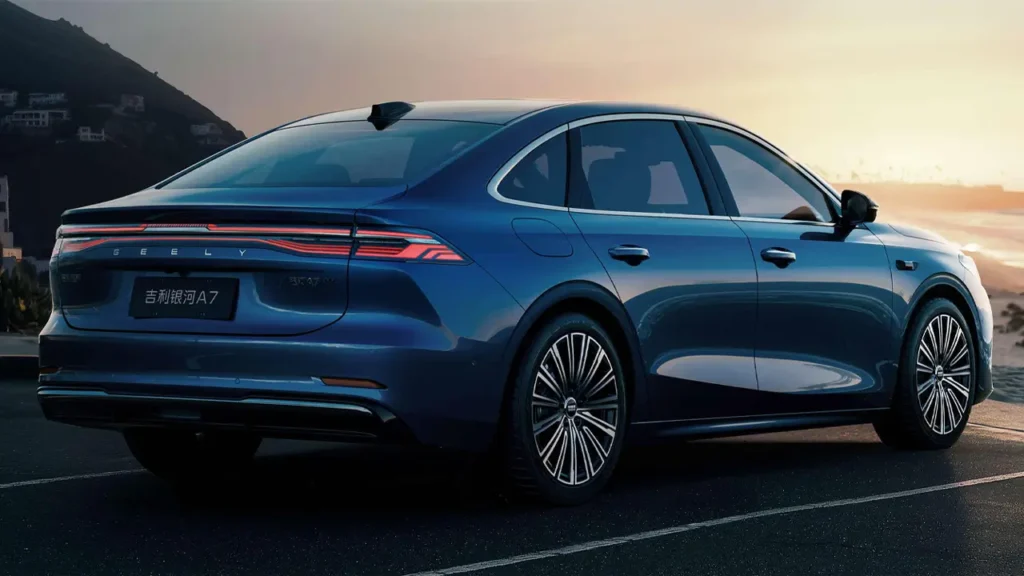
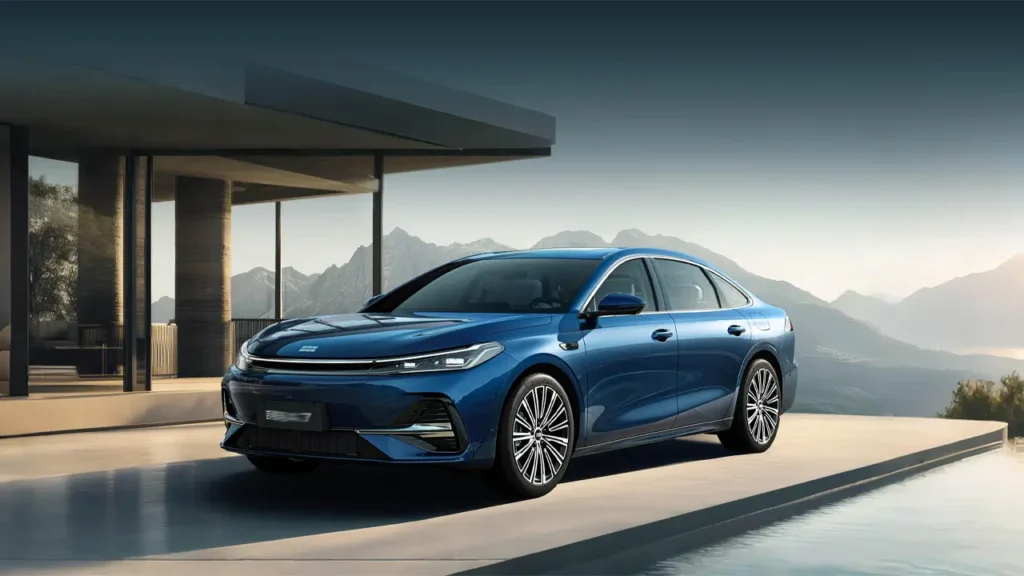
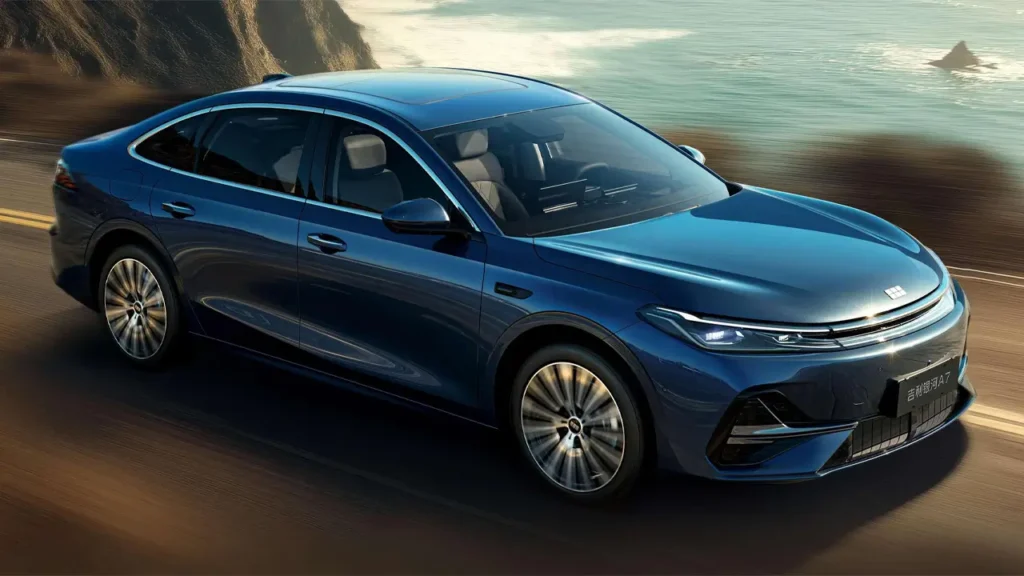
The A7 is a proper mid-size sedan. It measures 4,918 mm in length, 1,905 mm in width, and 1,495 mm in height, with a wheelbase of 2,845 mm. To put that in perspective, it is larger than the BYD Qin L DM-i and the BYD Seal 06 DM-i — both major rivals in China’s crowded hybrid sedan market. The EV variant is slightly longer at 4,935 mm and slightly taller at 1,500 mm, sharing the same 2,845 mm wheelbase.
The aerodynamic design achieves a drag coefficient of 0.229, thanks to 21 optimized aerodynamic points, an active grille shutter, and a fastback-style roofline with a subtle trunk lip. Continental tires are fitted on 19-inch turbine-style rims on higher trims.
Powertrain — PHEV
The PHEV version uses the Thor EM-i Super Hybrid System (also branded as Geely EM AI Super Hybrid 2.0), combining:
- A 1.5-liter naturally aspirated engine producing 82 kW (110 hp) with a thermal efficiency of 47.26% — one of the highest in any production car
- An electric motor delivering 175 kW (235 hp) and 262 Nm of torque
- Combined system output of up to 257 kW (approximately 350 hp in higher trims)
- 0–100 km/h acceleration in 7.1 seconds
Two battery sizes are available: 8.5 kWh (CALB) for 70 km CLTC electric range, and 18.4 kWh for 150 km CLTC electric range. A larger 28.3 kWh option extends pure electric range to 235 km on updated trims.
Powertrain — BEV
The pure electric Galaxy A7, confirmed in February 2026, uses a single 160 kW (215 hp) front-mounted electric motor with a 58 kWh lithium iron phosphate battery, delivering a CLTC range of 550 km (342 miles). Energy consumption is rated at 11.4 kWh per 100 km.
| Spec | PHEV (70km) | PHEV (150km) | BEV |
|---|---|---|---|
| Engine | 1.5L + EM | 1.5L + EM | Electric only |
| Battery | 8.5 kWh | 18.4 kWh | 58 kWh |
| EV Range (CLTC) | 70 km | 150 km | 550 km |
| Motor Power | 175 kW | 175 kW | 160 kW |
| 0–100 km/h | 7.1 sec | 7.1 sec | 7.4 sec |
| Fuel (depleted) | 2.67 L/100km | 2.8 L/100km | N/A |
Geely Galaxy A7 Price — Why the Numbers Shock the Market
Let’s talk money, because this is where the Geely Galaxy A7 genuinely surprises. The PHEV version launched on August 8, 2025, with a starting guide price of RMB 89,800 — approximately $12,300–$12,500 USD at launch exchange rates. That is a mid-size sedan with a 47% thermal efficiency hybrid engine, 19-inch Continental tires, a large touchscreen, and Level 2+ driver assistance for less than most economy hatchbacks cost in Western Europe.
An early-buyer promotion brought the entry price down further to RMB 81,800, or roughly $11,200, for customers who purchased before September 30, 2025.
Seven PHEV variants are available, and the updated 2026 lineup extends further:
| Variant | Price (RMB) | Price (USD approx.) |
|---|---|---|
| A7 EM 150 Enjoy (entry PHEV) | 97,800 | ~$14,300 |
| A7 EM 235 Starship (top PHEV) | 131,800 | ~$19,300 |
| A7 EV 550 Premium (entry BEV) | 112,800 | ~$16,500 |
| A7 EV 550 Excellence (top BEV) | 119,800 | ~$17,500 |
Competitor price comparison:
| Model | Starting Price (USD approx.) | Powertrain |
|---|---|---|
| Geely Galaxy A7 PHEV | ~$12,300 | PHEV |
| BYD Seal 06 DM-i | ~$13,500 | PHEV |
| BYD Qin L DM-i | ~$12,800 | PHEV |
| Toyota Camry (China) | ~$19,000+ | Hybrid |
The math is hard to argue with. At entry-level pricing, the Galaxy A7 is competing with cars that offer far less tech and smaller cabins.
Geely Galaxy A7 Sedan — Positioning in the Segment
The Galaxy A7 is positioned in the mainstream mid-size sedan segment — the most contested category in China’s booming new energy vehicle market. Geely’s primary target is the BYD Seal 06 DM-i, one of China’s best-selling plug-in hybrid sedans. The A7 slots in the Galaxy lineup between the Starshine 6 and Starshine 7 models.
What makes the A7 stand out in this crowded space is its combination of size, efficiency, and value. At 4,918 mm long with a 2,845 mm wheelbase, it is physically larger than both the BYD Qin L and Seal 06 DM-i — yet it undercuts or matches them on price. Against a Toyota Camry or Honda Accord in China, the A7 offers comparable or greater cabin space, a more advanced infotainment system, and dramatically more efficient hybrid technology at a price roughly $5,000–$7,000 lower.
Geely Galaxy has grown rapidly. It is reportedly the second best-selling NEV brand in China after BYD, which means the A7 benefits from an existing customer base that trusts the Galaxy sub-brand. The sedan is designed for urban families who need range flexibility, daily electric driving, and the reassurance of a petrol backup on longer trips.

Geely Galaxy A7 Hybrid and PHEV Technologies
The heart of the Geely Galaxy A7 PHEV is the Thor EM-i Super Hybrid System, also called Geely EM AI Super Hybrid 2.0. This is not a simple mild hybrid. It is a sophisticated series-parallel hybrid architecture that deserves a closer look.
How the system works:
The 1.5-liter naturally aspirated engine achieves a thermal efficiency of 47.26% — a headline figure that rivals or exceeds the best systems from Toyota and Honda. In practice, this means the engine extracts more energy from each liter of fuel than almost any other production engine in existence. In depleted-battery mode, the CLTC fuel consumption figure is 2.67 liters per 100 km for the 70 km variant, and 2.8 liters per 100 km for the 150 km variant.
The engine is paired with an 11-in-1 electric drive system — a compact unit that integrates the motor, inverter, transmission, and supporting electronics into a single package. The front electric motor delivers 175 kW and 262 Nm of torque, enabling brisk acceleration and responsive city driving.
Battery options and charging:
- 8.5 kWh battery: 70 km CLTC electric range, from CALB
- 18.4 kWh battery: 150 km CLTC electric range, supports 37 kW DC fast charging (30% to 80% in approximately 18 minutes)
- 28.3 kWh battery: 235 km CLTC electric range (higher trims)
For most urban commuters, the 150 km electric range is enough to go days without touching the fuel tank. When you do need to travel further, the petrol engine seamlessly takes over. With a full battery and a full tank, the combined CLTC range exceeds 2,100 km — equivalent to driving from London to Rome and back with fuel to spare.
Geely Galaxy A7 Electric Version — The BEV
Alongside the PHEV, Geely has developed a pure electric version of the Galaxy A7. The BEV variant was officially filed with China’s Ministry of Industry and Information Technology (MIIT) on February 7, 2026, and official images were subsequently released by Geely.
BEV specifications:
- Electric motor: 160 kW (215 hp), front-mounted
- Battery: 58 kWh lithium iron phosphate (LFP)
- CLTC range: 550 km (342 miles)
- Energy consumption: 11.4 kWh per 100 km
- Fast charging: 10% to 80% in approximately 28 minutes
- 0–100 km/h: 7.4 seconds
The BEV version has slightly different exterior dimensions — 4,935 mm long and 1,500 mm tall — with a closed grille at the front, vertical decorations in the fog lamp areas, and a refined full-width taillight at the rear. The charging port is positioned on the right front fender.
Inside, the BEV shares the same cabin architecture as the PHEV, including the 10.2-inch digital instrument cluster and either a 14.6-inch or 15.4-inch central touchscreen running Geely’s Flyme Auto system. The BEV entry price opens at approximately $16,500 for the 550 Premium trim — competitive against BYD Seal 07 EV and domestically-positioned against the Tesla Model 3.
Geely Galaxy A7 Range — Real-World Numbers
Range anxiety is real. CLTC figures are generated under controlled conditions and typically outperform real-world results. Here is an honest breakdown of what you can realistically expect from the Galaxy A7:
| Scenario | PHEV (70km battery) | PHEV (150km battery) | BEV |
|---|---|---|---|
| CLTC EV Range | 70 km | 150 km | 550 km |
| Real-world EV est. | 55–60 km | 120–135 km | 430–490 km |
| Combined total range | 2,100+ km | 2,100+ km | 550 km (CLTC) |
| Fuel consumption (depleted) | 2.67 L/100km | 2.8 L/100km | N/A |
| DC fast charge (30–80%) | N/A | ~18 min (37kW) | ~28 min (10–80%) |
For urban drivers who charge overnight, the PHEV’s 150 km electric range is genuinely useful. Most commuters in China and Asia-Pacific travel well under 80 km per day, meaning many Galaxy A7 PHEV owners would rarely need to burn petrol at all. On longer highway trips, the engine’s 47.26% thermal efficiency keeps running costs remarkably low.
The BEV’s 550 km CLTC range is competitive for the class, and the 28-minute 10–80% fast charge time makes road trips practical rather than stressful.
Geely Galaxy A7 Interior — Cabin and Technology
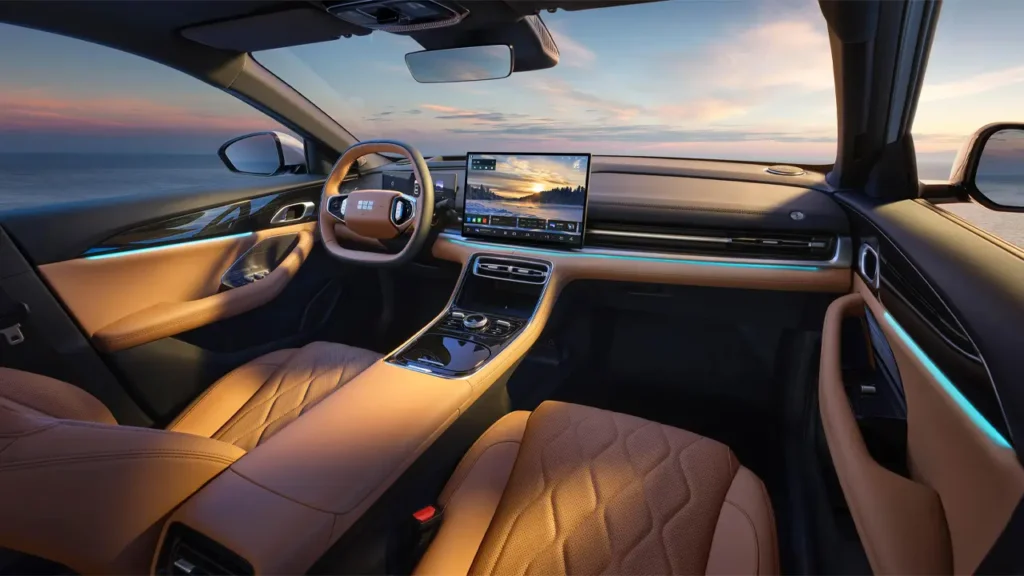
Step inside the Galaxy A7 and the budget stigma disappears quickly. Geely’s designers drew inspiration from the concept of a traditional Chinese courtyard — a space defined by balance, elegance, and careful proportion. The result is a wraparound cockpit that feels genuinely premium for the price point.
Screens and infotainment:
- 10.2-inch digital instrument cluster (standard across trims)
- 14.6-inch or 15.4-inch central touchscreen depending on trim level
- Flyme Auto infotainment with Widget card mode
- AI voice interaction across four zones with “visible-to-speak” functionality and continuous dialogue support
- Smartphone connectivity: HiCar, Flyme Link, ICCOA, and Apple CarPlay (via OTA update)
- 50W wireless phone charging
Audio:
Higher trims include a 16-speaker Flyme Sound audio system with headrest speakers for the driver — a feature more commonly found in executive cars costing twice the price.
Comfort features:
- 950 mm of rear legroom
- 132 mm of knee clearance
- 535 liters of trunk capacity, expandable to 988 liters with rear seats folded
- Dual-zone automatic climate control
- 256-color ambient lighting
- Panoramic sunroof (standard or limited-time gift depending on trim)
- Top trims: ventilated, heated, and massaging front seats
Driver assistance:
Entry variants come with an L2 suite using five cameras and two millimeter-wave radars. Higher trims use Geely’s G-Pilot H3 system, featuring 11 cameras, three radars, 12 ultrasonic sensors, and a Journey 6 chip. This enables highway navigation assist (NOA), full-scene automated parking, and future OTA upgrades for city NOA and emergency evasive steering. In practical terms, the top-trim Galaxy A7 can navigate highway lanes, maintain following distance, and park itself — features that cost a significant premium in most markets.
The suspension uses front MacPherson struts and a rear multi-link arrangement, with CST 2.0 braking to reduce pitch during hard stops. Six airbags are standard across the range.
Pros and Cons of the Geely Galaxy A7
Pros:
Price. The Galaxy A7 PHEV starts at approximately $12,300 in China — a price point that makes mid-size hybrid sedans accessible to a genuinely mass-market audience. The BEV version from $16,500 is similarly aggressive against rivals with smaller batteries and shorter range.
Technology. The 47.26% thermal efficiency engine, Flyme Auto cockpit with AI voice, G-Pilot H3 driver assistance, OTA update capability, and 16-speaker audio are features that belong in a much more expensive car. Geely has clearly decided to compete on specification rather than margin.
Versatility. With PHEV options covering 70 km, 150 km, and 235 km of electric range, and a BEV with 550 km, there is a Galaxy A7 configuration for almost every driving pattern — daily urban commuter, occasional long-distance driver, or pure EV adopter.
Size and space. At 4,918 mm long with 950 mm of rear legroom and a 535-liter trunk, the A7 is a genuinely spacious family car — larger than its main Chinese rivals at launch.
Cons:
Brand recognition outside China. Geely Galaxy is a relatively new sub-brand. While Geely itself owns Volvo and Polestar, the Galaxy name carries limited recognition in markets outside China. International buyers may need time to build confidence in the brand.
Long-term reliability is unproven. The GEA platform and the Thor EM-i hybrid system are new. No long-term reliability data exists yet. For buyers who prioritize proven dependability over leading-edge technology, the Galaxy A7 asks for a degree of trust that some will find difficult to give a new entrant.
Primarily a China-market model (for now). As of writing, the Galaxy A7 is sold primarily in China. International availability timelines have not been officially confirmed, meaning buyers in Europe, Southeast Asia, or the Middle East may have to wait.
Final Verdict — Is the Geely Galaxy A7 Worth Buying?
The Geely Galaxy A7 is not just a good car for the price. It is a genuinely impressive car by any standard, and the price makes it extraordinary.
A starting price of around $12,300 for a 4.9-meter PHEV sedan with a 47% thermal efficiency hybrid engine, 2,100 km of combined range, a 15.4-inch touchscreen, Level 2+ driver assistance, and Continental tires on 19-inch rims would be remarkable from any manufacturer. From a Chinese brand that most Western consumers have never heard of, it is a statement of intent about where the automotive industry is heading.
Is it perfect? No. Long-term reliability remains an open question. The Flyme Auto ecosystem, while impressive on paper, needs real-world road testing by independent reviewers over time. And international availability is still limited.
But for buyers in China and markets where the Galaxy A7 is available, the value proposition is almost impossible to match. You are getting more car, more technology, more range, and more interior space than the competition — at a price that undercuts them all.
The BEV variant, priced from approximately $16,500 with 550 km of range, extends the argument into pure electric territory with similar conviction. A 28-minute fast charge, 215 hp, a flat LFP battery, and Geely’s Flyme AI cockpit for less than most mainstream EVs cost in Europe — it is a compelling offer.
If you are curious about the Galaxy A7, want to follow its global rollout, or explore the wider world of Chinese new energy vehicles, visit autochina.blog for ongoing coverage, reviews, and market analysis. The Chinese automotive industry is moving fast, and the Galaxy A7 is one of the clearest signs of where it is going.
Discover more from AutoChina
Subscribe to get the latest posts sent to your email.