MG4 Anxin Edition and the New Battery Era
The MG4 Anxin Edition has just done something the automotive world has been waiting years to see: it brought next generation EV battery technology to a genuinely affordable, mass-market car. When deliveries officially kicked off in China in December 2025, this compact electric hatchback quietly rewrote the rulebook. Not because it offers outrageous range numbers or supercar performance, but because it is the first mass-produced passenger vehicle in the world to feature a semi-solid-state battery — and it does so at a price that ordinary buyers can actually consider.
For context, semi-solid-state battery technology had previously appeared only in expensive premium EVs. The idea that you could get this kind of forward-thinking chemistry in a compact hatchback, priced at around 102,800 yuan (approximately $14,600 USD), is genuinely remarkable. The MG4 Anxin Edition is not just a new trim level — it is a signal that the future of EV batteries is already here, available at your local dealership (at least if you live in China), and it is called the Anxin Edition.
MG4 Anxin Edition Overview
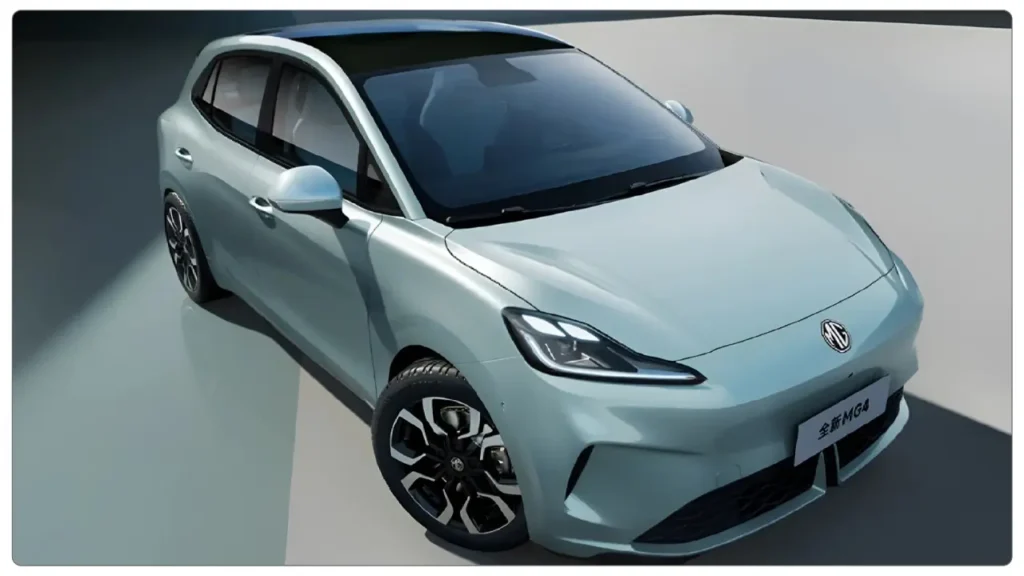
The MG4 Anxin Edition sits at the top of the second-generation MG4 lineup, which was officially launched at the Chengdu Motor Show in August 2025. SAIC, MG’s parent company, introduced the new MG4 in five trim levels, with the Anxin Edition as the flagship, carrying the most advanced powertrain technology in the range.
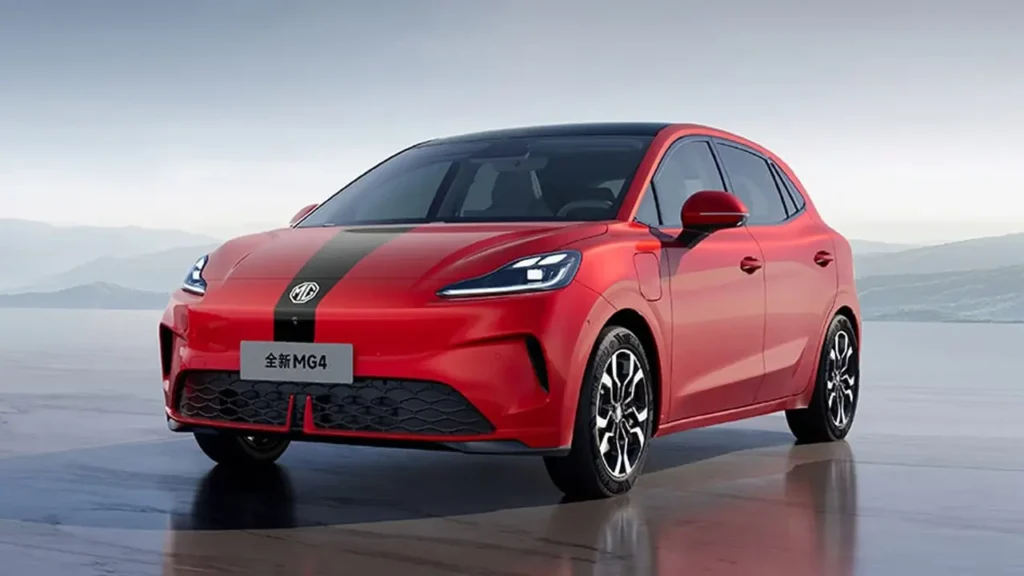
This Chinese electric hatchback is built on SAIC’s Nebula platform — a dedicated battery-electric architecture designed from the ground up to prioritise space efficiency, range, and performance. The MG4 measures 4,395 mm in length, 1,842 mm in width, and 1,551 mm in height, with a generous 2,750 mm wheelbase that punches well above its segment in terms of interior space.
The name “Anxin” translates roughly to “peace of mind” in Mandarin — a deliberate message from SAIC about the safety credentials of the new battery technology underpinning the car. For buyers in China, the Anxin Edition represents a tangible leap forward: not just an updated version of an existing car, but a window into what mass-market EVs will routinely offer within the next few years.
What makes this model particularly interesting is its price positioning. Entry-level MG4 trims start at just 68,800 yuan (approximately $9,800 USD), while the Anxin Edition commands 102,800 yuan. That is still considerably less than many conventional petrol cars in Western markets, and it delivers technology that even premium EV brands have struggled to commercialise at scale.
MG4 Anxin Edition Battery Technology
This is the heart of the story. The MG4 Anxin Edition battery is a manganese-based lithium-ion semi-solid-state pack, jointly developed by SAIC and Suzhou QingTao Power Technology — a startup in which SAIC invested several years ago. The cells are supplied exclusively by QingTao Energy, and the partnership represents years of quiet, behind-the-scenes development finally reaching production.
So what exactly is a semi solid state battery EV, and why does it matter?
A conventional lithium-ion battery uses a liquid electrolyte to move ions between the anode and cathode. This liquid is efficient at conducting ions, but it is also flammable, sensitive to temperature extremes, and prone to degradation over time. A fully solid-state battery replaces that liquid entirely with a solid electrolyte — delivering higher safety, better temperature resilience, and potentially much higher energy density. However, full solid-state batteries remain extremely difficult and expensive to manufacture at scale.
The semi-solid-state battery is an intelligent middle ground. It retains a small proportion of liquid electrolyte — in the case of the MG4 Anxin Edition, approximately 5% less liquid than a conventional pack — while the bulk of the electrolyte structure is solid or gel-like. This dramatically reduces the flammability risk while keeping the manufacturing process close enough to existing production lines that it can actually be built affordably.
SAIC has been particularly vocal about the safety results from cell-level testing. During perforation tests — where a nail is driven through a live battery cell — the MG4 Anxin’s semi-solid cells reportedly produced no smoke, no fire, and no explosion, even hours after the test. This is a meaningful improvement over conventional lithium-ion cells, which can undergo thermal runaway in similar conditions.
The battery is also expected to perform significantly better in cold weather compared to standard LFP packs, which are known to suffer range loss at low temperatures. The reduced liquid content in the semi-solid design means the electrolyte is less affected by freezing, making the chemistry more stable across a wider range of temperatures.
Before the MG4 Anxin Edition, the only mass-produced semi-solid-state battery EV was the Nio ET7, supplied by WeLion — a car that costs four to five times as much. That is what makes the MG4 Anxin Edition such an important milestone.
MG4 Anxin Edition Range and Efficiency
The MG4 Anxin Edition range is rated at 530 km on the CLTC (China Light-Duty Vehicle Test Cycle) standard — a figure confirmed in official regulatory filings and repeated across SAIC’s own product documentation. For international context, CLTC figures tend to be somewhat optimistic compared to WLTP or EPA testing standards, but 530 km CLTC EV testing still translates into a very usable real-world range for most daily driving patterns.
What is particularly interesting about this range figure is that it matches the 530 km offered by the standard LFP-equipped MG4 variant with a similar 53.9 kWh battery. The semi-solid pack does not add range — it adds confidence. The focus here is on consistent performance across temperatures, improved safety, and laying the groundwork for future generations that will offer genuine energy density improvements.
Energy consumption is rated at 11.9 kWh per 100 km, which is impressively efficient for a car with a 1,500 kg kerb weight. For comparison, that is in line with or better than many lightweight competitors using more conventional battery chemistry.
Charging performance is equally competitive. The MG4 Anxin Edition supports 2C fast charging, allowing the battery to go from 30% to 80% charge in approximately 21 minutes. This is a significant practical benefit for longer journeys, and it demonstrates that the semi-solid chemistry does not compromise the vehicle’s charging capabilities — a concern that had been raised by some analysts when the technology was first announced.
MG4 Anxin Edition Specs Table
| Category | Specification |
|---|---|
| Battery Type | Semi-solid manganese lithium-ion (QingTao Energy) |
| Battery Capacity | 53.95 kWh |
| Range (CLTC) | 530 km |
| Motor Power | 120 kW (161 hp) — Front permanent magnet synchronous |
| Peak Torque | 250 Nm |
| 0–50 km/h | Approximately 3 seconds |
| Top Speed | 160 km/h |
| Fast Charging (30–80%) | Approximately 21 minutes (2C) |
| Energy Consumption | 11.9 kWh / 100 km |
| Kerb Weight | 1,500 kg |
| Dimensions (L×W×H) | 4,395 × 1,842 × 1,551 mm |
| Wheelbase | 2,750 mm |
| Boot Volume | 471 L (standard) / 1,362 L (seats folded) |
| Price in China | 102,800 yuan (~$14,600 USD) |
Performance and Acceleration
The MG4 Anxin Edition might be a technology showcase, but it is not slow. The SAIC MG electric car is powered by a single front-mounted permanent magnet synchronous motor delivering 120 kW of power and 250 Nm of torque. For an everyday compact hatchback, those numbers translate into genuinely spirited performance off the line.
The claimed 0–50 km/h acceleration time of approximately 3 seconds is particularly impressive and reflects the instant torque delivery that makes electric cars so enjoyable in urban and suburban driving conditions. Whether you are pulling away from traffic lights or joining a motorway, the Anxin Edition responds with immediate, linear thrust.
Top speed is electronically limited to 160 km/h, which is entirely appropriate for a car of this type and more than adequate for highway cruising anywhere in the world. It is worth noting that this performance profile — smooth, responsive, and efficient — is characteristic of modern Chinese electric hatchbacks that prioritise usability over outright headline statistics.
The MG4 Anxin Edition rides on the SAIC Nebula platform, which features a long wheelbase and short overhangs. This layout contributes to stable, composed handling, with a lower centre of gravity thanks to the floor-mounted battery pack. The suspension tuning prioritises comfort for daily driving while remaining composed during faster cornering.
The slightly heavier kerb weight of 1,500 kg — around 15 kg more than equivalent standard trims — is the only performance concession made to accommodate the new battery technology. In real-world driving, this difference is imperceptible.
Interior and Smart Technology
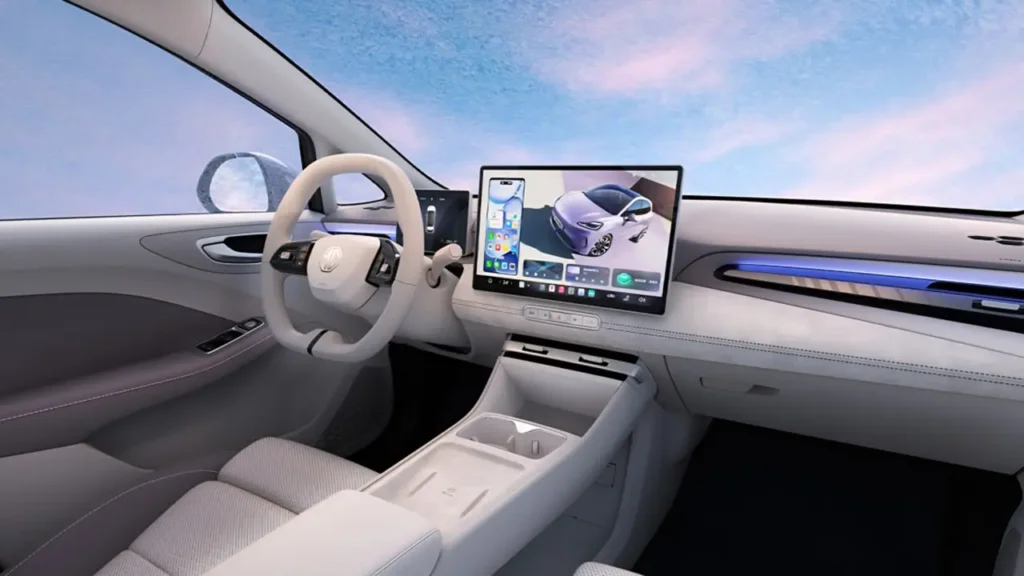
Step inside the MG4 Anxin Edition and the modernity of the package becomes immediately apparent. This is one area where the car genuinely surprises people who are unfamiliar with the latest generation of Chinese electric hatchbacks.
The centrepiece of the cabin is a 15.6-inch central control screen with 2.5K resolution, powered by a Qualcomm Snapdragon 8155 chip. This is the same processor found in a range of high-end Android smartphones and delivers fast, responsive performance whether you are navigating, streaming music, or adjusting vehicle settings. Critically, MG has replaced the previous generation’s mechanical buttons beneath the screen with a cleaner, touch-based interface, while also swapping the rotary gear selector for a column-mounted unit.
Behind the two-spoke flat-bottom steering wheel sits a digital instrument cluster displaying all essential driving information in a clean, readable format. A 50-watt wireless charging pad in the lower console keeps your smartphone topped up throughout the day.
The MG–Oppo intelligent cockpit system brings smartphone-like connectivity and over-the-air update capability to the infotainment platform, ensuring the car’s software can improve over time just as you would expect from a modern mobile device.
For driver assistance, the MG4 Anxin Edition features 5 cameras and 12 ultrasonic sensors, processed by a Horizon Robotics Journey J6e chip capable of 80 TOPS (Tera Operations Per Second) of computing power. This enables Highway NOA (Navigate on Autopilot) functionality and advanced parking assistance — technologies that were rare even in premium segments just a few years ago.
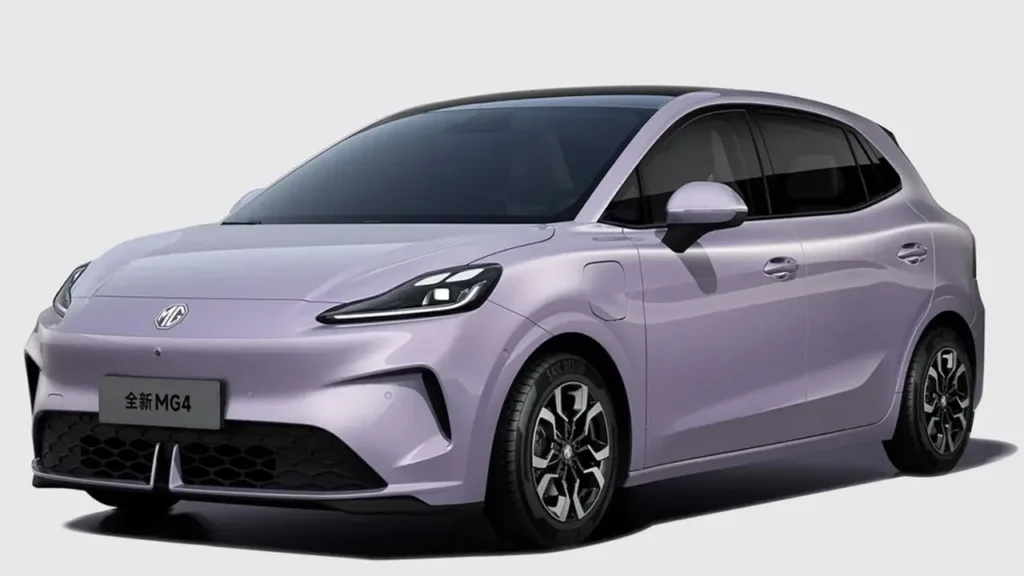
Practical storage is a strong point: the boot offers 471 litres of luggage space as standard, expanding to a very family-friendly 1,362 litres when the rear seats are folded. Six exterior colour options — purple, green, white, red, grey, and blue — give buyers a degree of personalisation that brings some fun to the ownership experience.
Pros and Cons of MG4 Anxin Edition
Every car has trade-offs, and the MG4 Anxin Edition is no exception. Here is an honest look at what it does brilliantly — and where it is still finding its feet.
Pros
The MG semi solid state battery is the headline achievement, and for good reason. The safety improvements over conventional lithium-ion packs are real and documented, particularly around thermal runaway resistance. For buyers who have concerns about EV battery safety, this is a genuinely meaningful upgrade.
Fast charging is excellent. The ability to add significant range in under 25 minutes from a DC fast charger makes the Anxin Edition highly practical for longer journeys, not just urban commuting.
The price is extraordinary. At around 102,800 yuan in China, the MG4 Anxin Edition is the most affordable car in the world to offer semi-solid-state battery technology. Comparable innovation from other manufacturers has typically appeared in vehicles costing three to five times as much.
The interior and technology package punches well above the car’s price point. The Snapdragon-powered infotainment, Highway NOA, and generous boot space are features that buyers of much more expensive EVs often pay a premium for.
Cons
The semi-solid-state battery technology is first-generation. While the safety credentials are impressive, the energy density of this inaugural pack is not yet superior to the best LFP batteries — a limitation that is expected to improve significantly in future iterations.
Availability is currently restricted to China. There is no confirmed timeline for the MG4 Anxin Edition to reach European or other international markets, meaning most global buyers will have to wait. When (and if) the Anxin Edition reaches Europe, import duties and export costs will significantly increase the retail price.
The 15 kg weight penalty compared to LFP variants is minor but worth noting, particularly as it indicates that the energy density of this first-generation semi-solid pack has room to improve.
User Impressions and Early Reviews
Deliveries of the MG4 Anxin Edition commenced officially in China on 18 December 2025, making early ownership feedback still quite limited. However, initial responses from automotive journalists and early adopters have been largely positive, with enthusiasm concentrated around three main themes: safety confidence, charging speed, and the significance of the technology milestone.
Industry analysts have been careful to frame the MG4 Anxin Edition correctly. This is not a car that immediately outperforms all conventional EVs on every metric — the SAIC MG electric car with semi-solid chemistry offers comparable range and similar power output to its LFP-equipped siblings. What it represents is a production proof of concept: evidence that semi-solid batteries can be manufactured at scale, integrated into an affordable platform, and delivered to customers reliably.
Automotive commentators have also highlighted the competitive pressure that the MG4 Anxin Edition creates across the industry. Toyota, Nissan, Honda, BMW, Mercedes, Hyundai, and others are all developing solid-state and semi-solid-state battery programmes, but none has yet managed to deliver this technology in a high-volume, affordable production car. MG and SAIC have beaten them all to market.
The pricing signal is arguably the most important takeaway for the wider industry. If a semi-solid-state battery car can be sold for approximately $14,600 USD in China today — with all the cost implications of being a first-generation technology — the price curve for subsequent generations looks very encouraging indeed.
Final Verdict — Is MG4 Anxin Edition the Future EV?
The MG4 Anxin Edition will not be the last word in semi-solid-state battery vehicles — it is the first. And that is precisely what makes it so important.
This car does not dazzle with record-breaking range figures or face-melting acceleration statistics. What it does is something arguably more valuable: it makes next generation EV battery technology real, accessible, and affordable. It demonstrates that the technical and manufacturing challenges of semi-solid-state chemistry can be solved well enough to put a car on the road and in the hands of everyday buyers.
The 530 km CLTC range is competitive and practical. The 21-minute 30–80% fast charging is class-leading. The safety improvements over conventional lithium-ion — particularly the resistance to thermal runaway demonstrated in cell perforation tests — are genuinely meaningful for consumer confidence in EV technology. And the price, at around $14,600 USD in China, is remarkable for what is on offer.
Where the MG4 Anxin Edition falls short today, future generations will improve. Battery chemistry at this stage of development typically follows a steep improvement curve: energy density, weight, and cost all improve dramatically with each successive generation. The second and third iterations of QingTao’s semi-solid cells — and of competing products from other manufacturers inspired by this milestone — will almost certainly offer superior energy density, lighter weight, and even faster charging than what is available today.
For the broader EV market, the MG4 Anxin Edition represents a fork in the road. The era of conventional liquid electrolyte batteries is not ending tomorrow — LFP and NMC packs will continue to power the majority of electric vehicles for years to come. But the direction of travel is now unmistakable. Semi-solid-state batteries are no longer laboratory curiosities or features reserved for six-figure luxury cars. They are in a 14,000-dollar hatchback, being driven by real customers on real roads.
That is a genuinely big deal. The MG4 Anxin Edition is not the future of EVs — it is the beginning of it.
1️⃣ James Carter – EV enthusiast
I’ve been following Chinese electric cars for a while, and this article about the MG4 Anxin Edition was actually one of the clearest explanations I’ve seen. The battery technology part was especially interesting. Many websites just copy specs, but here it really explains why the semi-solid battery matters for the future of EVs.
Also, the photos and structure of the post made it easy to read. If you’re interested in new Chinese electric vehicles, www.autochina.blog is definitely worth checking regularly.
2️⃣ Michael Torres – automotive blogger
Great post about the MG4 Anxin Edition. I liked how the article quickly explains the main specs and the 530 km range without drowning the reader in unnecessary technical details. The writing style feels more like a YouTube review than a boring spec sheet.
Honestly, websites focused on Chinese EVs are still rare, so www.autochina.blog is becoming a useful place to track what’s happening in this fast-moving market.
3️⃣ Daniel Wright – EV buyer
I was actually researching affordable electric hatchbacks and found the article about the MG4 Anxin Edition. The post answered most of my questions about range, battery technology, and performance. The comparison table helped a lot.
What I like most is that www.autochina.blog focuses specifically on Chinese EVs, which are becoming very competitive globally. Definitely bookmarking the site for future updates.
BestChina3DPrinters
Expert Reviews & Rankings
Independent 3D Printer Reviews
Your trusted source for Chinese 3D printer reviews, rankings, and comparisons. We buy, test, and review every printer so you can make informed decisions.
Discover more from AutoChina
Subscribe to get the latest posts sent to your email.