BYD Linghui M9 e9 Review – Full Breakdown & First Impressions
If you've been following the global electric vehicle scene lately, you've probably noticed that BYD just can't stop making moves. In this BYD Linghui M9 e9 review, we're taking a close look at two of the most strategically interesting new models to emerge from Shenzhen in 2026: the Linghui e9, a long-range all-electric sedan built for ride-hailing fleets, and the Linghui M9, a plug-in hybrid MPV designed to dominate the commercial mobility space. These two vehicles sit at the heart of BYD's freshest sub-brand — Linghui — and together they tell a compelling story about where the Chinese EV industry is heading.
Whether you're a fleet manager evaluating your next acquisition, a mobility industry enthusiast, or simply someone curious about what BYD is building next, this deep-dive is for you. Let's get into it.
Introduction: What Makes BYD Linghui Special
To understand Linghui, you first have to understand what gap it's designed to fill. BYD already has a well-established portfolio of sub-brands. Denza targets the premium segment. Yangwang chases the ultra-luxury and off-road enthusiast market. FangChengBao aims at adventure-oriented buyers. But none of those brands are built for the professional, day-in-day-out commercial driver.
That's exactly where the new Linghui auto brand steps in.
BYD officially unveiled the Linghui brand in China, targeting the ride-hailing business. The brand was launched on February 2, 2026, with an official presence on the Weibo Chinese social media platform. Its stated mission is to "redefine mobility through technological innovation," and its core audience is explicitly commercial: taxis, ride-hailing services, leasing companies, and government vehicles.
What makes Linghui particularly fascinating as a brand concept is how deliberately it bridges a gap in the market. Linghui is designed to fill the gap between higher-end luxury vehicles and mass-market models that often lack the software, tech, features, and performance that buyers are increasingly looking for. In other words, it's not a stripped-down budget play. It's a commercially-focused brand that still brings genuine technology and refinement to the table.
Following Denza, Yangwang, and FangChengBao, Linghui is BYD's fourth sub-brand as it expands into new segments. The initial lineup — Linghui e5, e7, e9, and M9 — spans battery electric sedans and a plug-in hybrid minivan. The e-series are all-electric, while the M9 is the lone PHEV in the range, making the lineup incredibly well-rounded for professional use.
One key advantage underpinning the entire brand is scale. In 2025, BYD delivered results that secured its position as the world's top-selling NEV maker, with annual vehicle sales reaching 4.6024 million units. That kind of volume translates into the supply chain leverage and cost efficiency that allows Linghui to price competitively without compromising on core technology.
Linghui e9 – Range and Performance Details
Let's start with the model that's generating the most buzz: the Linghui e9. This is the flagship of the e-series lineup, and it's a properly substantial electric sedan.
In terms of Linghui e9 range, BYD has done something smart. Rather than offering just one configuration, the e9 comes in two distinct battery options to suit different operational requirements. The Linghui e9 features 60.5 kWh and 64.315 kWh Blade battery packs, corresponding to cruising ranges of 535 km and 605 km (CLTC), respectively.
For context: a 605 km CLTC range on a sedan intended for commercial use is genuinely impressive. Most professional ride-hailing drivers cover between 200 and 400 km per shift. With the larger pack, an e9 could theoretically complete two full shifts on a single charge under normal city driving conditions — dramatically reducing charging downtime and operational costs.
On the power side, the Linghui e9 is powered by a single front electric motor with 135 kW (181 hp) or 150 kW (201 hp), depending on the chosen variant. This isn't a performance car — it's not designed to be. It's engineered for efficiency, consistency, and durability over hundreds of thousands of kilometers of commercial use. For that mission, a smooth, reliable front-wheel drive powertrain with well-calibrated torque delivery makes perfect sense.
The battery technology deserves a closer look. BYD's Blade battery is a lithium iron phosphate (LFP) design that has been engineered for safety, longevity, and density. BYD's second-generation Blade Battery achieves an energy density of up to 220 Wh/kg and supports 10C ultra-fast charging, which significantly reduces charging downtime — an essential advantage for high-utilization commercial vehicles. This matters enormously for taxi and ride-hailing operations, where a car sitting idle at a charger is a car not earning revenue.
Design & Features of the Linghui Electric Sedan
The Linghui e9 isn't trying to look like a sci-fi concept. It's a professional sedan with a clean, confident presence that clearly communicates premium intent without being showy.
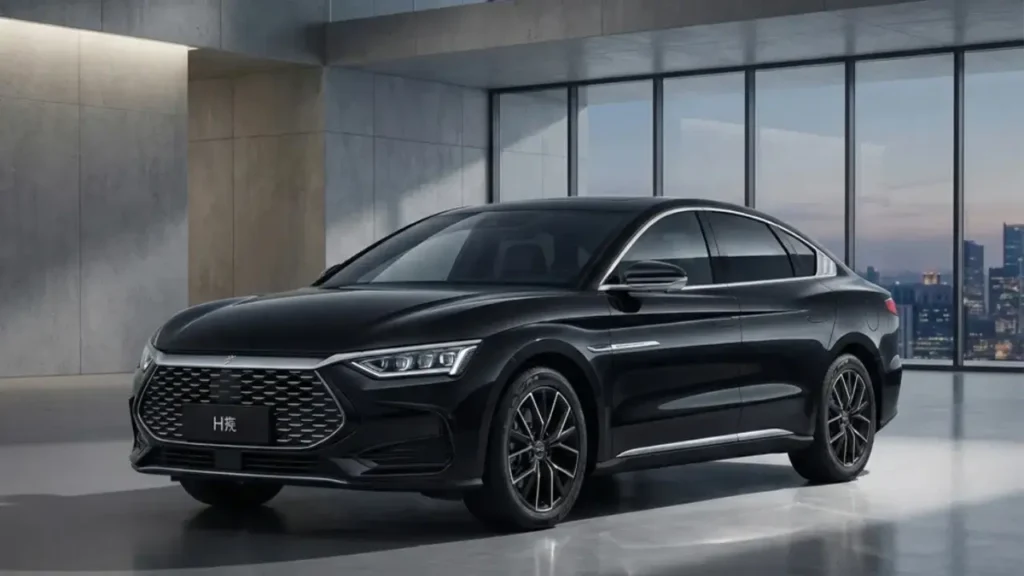
The Linghui e9 adopts the design style of the BYD Han model, featuring a large grille with a chrome-plated dot-matrix mesh layout, flanked by sharp, split headlights at the front. The Linghui brand logo sits prominently above the chrome trim on the nose, making it clear that this isn't a Han — it's something new. Conventional door handles keep things practical and accessible, and the side profile is finished with black-finished alloy rims. Tire specifications are 245/50 R18 and 245/45 R19, depending on the trim.
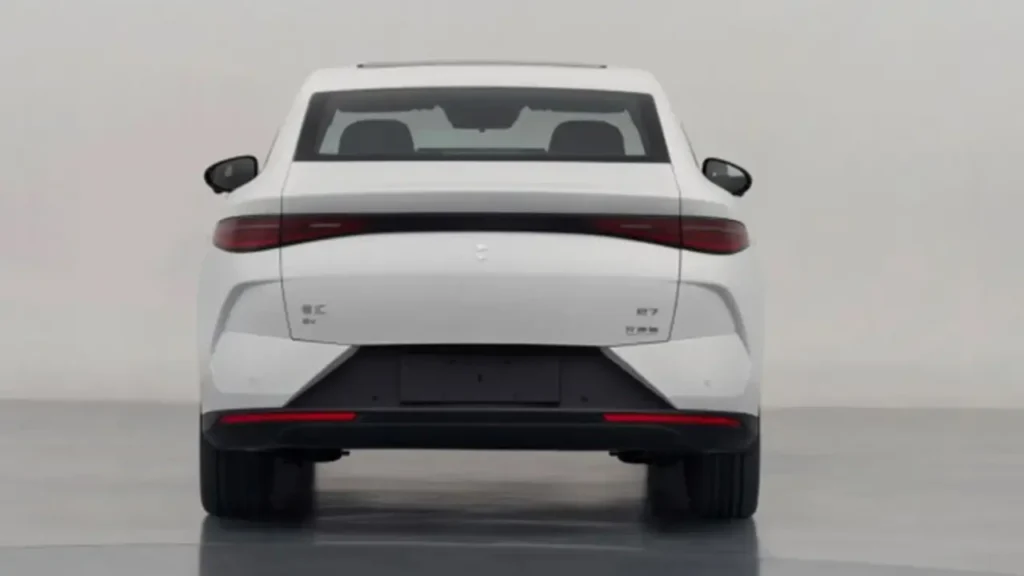
At the rear, the Linghui e9 adopts a continuous taillight design with red reflectors on both sides of the bumper, with the "Linghui EV" and "e9" logos visible at the tailgate.
Dimensionally, this is a big car. The Linghui e9 measures 4,995 mm in length, 1,940 mm in width, and 1,495 mm in height, with a wheelbase of 2,920 mm.That long wheelbase means excellent rear passenger legroom — a critical selling point for a vehicle whose paying customers sit in the back seat. It is genuinely large-sedan territory, which is exactly what professional operators need.
In terms of technology and connectivity, BYD is expected to integrate its established intelligent systems into the Linghui lineup. BYD plans to integrate its DiLink intelligent connectivity system and full-stack DiSus intelligent body control into the Linghui vehicles. DiLink is BYD's in-car connectivity and infotainment platform that has already been deployed across its consumer lineup, offering large-screen navigation, voice control, over-the-air software updates, and smart integration with external services. DiSus, meanwhile, handles adaptive ride comfort and body stability management — important for long shifts on varied road surfaces.
Linghui M9 Specifications – Hybrid MPV Breakdown
Now let's talk about the Linghui M9 — arguably the more unique of the two vehicles and one that opens up an entirely different set of commercial use cases.
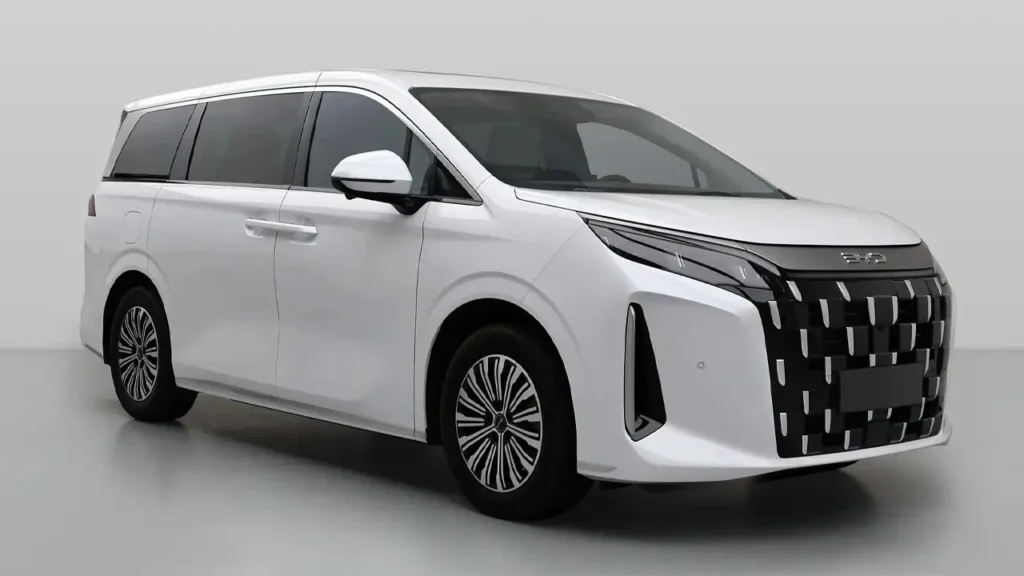
While the e9 is a pure electric sedan, the Linghui M9 takes a different approach. It's a large MPV built on a plug-in hybrid platform, targeting airport transfers, premium ride-hailing services, corporate mobility, and family taxi operators who need maximum flexibility and range without range anxiety.
The Linghui M9 measures 5,200 mm in length, 1,970 mm in width, and 1,805 mm in height, with a wheelbase of 3,045 mm. That makes it a genuinely large vehicle — more than half a meter longer than the e9 — with interior proportions that will appeal to operators carrying multiple passengers or luggage.
The powertrain setup reflects BYD's mature fifth-generation DM (Dual Mode) plug-in hybrid technology. Power comes from a plug-in hybrid system consisting of a 1.5T turbocharged engine (model BYD472ZQB), a permanent magnet synchronous motor (model TZ210XYD), and a Blade battery. The engine produces a maximum power of 115 kW (154 hp) and the electric motor delivers 200 kW (268 hp).
These are the same specifications as the BYD Xia DM-i, which is the consumer model this vehicle is based on. The combined system output is therefore substantial — the 200 kW electric motor alone produces 268 hp, providing excellent torque for smooth, quiet acceleration even when fully loaded with passengers.
The fifth-generation DM technology delivers fuel consumption as low as 2.6 liters per 100 kilometers in charge-sustaining mode and a combined range exceeding 2,100 kilometers. For fleet operators, that last number is the headline. Over 2,100 km of combined range means the M9 can run entire working weeks without a significant refuel or recharge event — an operational efficiency advantage that's difficult to overstate.
The pure electric range reference is equally useful. The BYD M9 DM-i, which the Linghui M9 is based on, is equipped with a 20.39 kWh Blade battery pack that provides a CLTC pure electric range of 100 km. In city use, most of the M9's daily kilometers could be covered on electric power alone — keeping fuel costs low for urban fleet operators.
Practical Interior & Seating for Ride-Hailing Fleets
If there's one area where the Linghui M9 really earns its place in a professional mobility fleet, it's the interior.
The M9 is configured as a seven-seater MPV, with the layout designed to maximize passenger comfort across all rows. That 3,045 mm wheelbase gives the second and third rows genuine, usable space — not the cramped occasional seating you sometimes find in smaller MPVs. For airport transfers, corporate shuttle operations, or premium ride-hailing services where passengers are paying for comfort, this is a serious advantage.
Optional configurations include a small sunroof, two sunroofs, non-privacy glass, a rearview mirror base with integrated camera, and rear cameras. The availability of privacy glass options is notable — many premium ride-hailing operators offer glass privacy as a service differentiator, and having this as a factory option rather than an aftermarket retrofit makes configuration straightforward for fleet purchasers.
The overall interior design follows the BYD Xia DM-i quite closely, which is a smart move given that the Xia has been well-received in the Chinese market. The Linghui M9's cabin is expected to feature large-format seating, with seat materials and layouts optimized for passenger ingress and egress — particularly relevant for elderly passengers or those with luggage.
The rear passenger area is designed with ride-hailing ergonomics in mind. This means practical features like easy-clean seat surfaces, ample headroom in all rows, and thoughtful placement of charging points and storage pockets for passenger convenience.
Technology Highlights – Blade Battery Performance & Connectivity
At the heart of both the Linghui e9 and the Linghui M9 is BYD's proprietary Blade battery technology. It's one of the defining technological advantages that sets BYD-based vehicles apart from many competitors, and it's worth spending a moment to understand what makes it special.
Blade battery performance begins with the cell-to-pack design philosophy. Traditional battery packs have cells grouped into modules, which are then assembled into a pack. BYD's Blade design eliminates the intermediate module layer entirely, placing individual prismatic cells directly into the structural pack. This increases space efficiency, reduces weight, and removes potential failure points between module boundaries.
The safety implications are equally important. LFP chemistry is inherently more thermally stable than the nickel-manganese-cobalt (NMC) cells used in many competitor vehicles. BYD has run extensive nail penetration and crush tests on its Blade cells, with results showing no fire or explosion — a critical property for commercial vehicles that operate in high-mileage, varied-condition environments.
The second-generation Blade Battery achieves an energy density of up to 220 Wh/kg and supports 10C ultra-fast charging. The 10C charging capability means, in principle, that a battery can accept charge at up to ten times its rated capacity in current — enabling extremely fast charging sessions for vehicles that need to turn around quickly between shifts. This is the kind of technology that can genuinely transform fleet operations by making charging stops shorter and less frequent.
On the software and connectivity side, BYD's DiLink platform brings smartphone-level responsiveness to the in-car experience. The system supports over-the-air updates, meaning the vehicle can receive new features and security patches without visiting a service center. For fleet operators managing dozens or hundreds of vehicles, this centralized software management capability can significantly reduce maintenance overhead.
BYD's investment in these technologies is ongoing and substantial. In the first half of 2025 alone, BYD's R&D spending reached 30.9 billion yuan, up 53% year-on-year, bringing cumulative investment to more than 210 billion yuan. That level of R&D investment ensures that the technology flowing into Linghui vehicles represents genuine cutting-edge capability, not recycled older-generation systems.
How BYD Linghui Fits Into Ride-Hailing & Commercial Use
The BYD ride-hailing EV proposition is becoming more compelling by the year, but Linghui represents the most focused expression of this strategy yet. Where BYD's mainstream Dynasty and Ocean models are designed for individual consumers who might also use their cars for ride-hailing, Linghui is built entirely around commercial operational requirements from the ground up.
What does that mean in practice? It starts with durability. Commercial ride-hailing vehicles routinely cover 200,000 to 400,000 km over their working lives — multiples of what a typical private car faces. Every component in a Linghui vehicle needs to be specced for this intensity of use, from the seat fabric to the suspension bushings to the battery management system.
It also means thinking carefully about total cost of ownership rather than just purchase price. An EV like the Linghui e9 may have a higher sticker price than an equivalent ICE taxi, but when you factor in the dramatically lower per-kilometer fuel cost, reduced maintenance requirements (no oil changes, fewer brake replacements due to regenerative braking, fewer transmission service intervals), and government subsidies for commercial EV adoption in China, the economics often favor the electric option strongly.
The hybrid M9 occupies a slightly different economic position. For operators in regions with limited fast-charging infrastructure, or those running longer intercity routes, the M9's ability to run on petrol when needed eliminates range anxiety entirely. The fifth-generation DM system's fuel consumption of as low as 2.6 liters per 100 km in charge-sustaining mode means that even when running on petrol, the M9 is extremely efficient by the standards of a large MPV.
From a fleet management perspective, the standardization inherent in Linghui's platform-sharing approach is also an advantage. With the e5, e7, and e9 all drawing on BYD's established EV platforms, and the M9 sharing its powertrain with the Xia DM-i, operators can benefit from consistent parts compatibility, shared service procedures, and driver familiarity across the fleet.
Pros & Cons – Quick Takeaways
Here's a comparative overview of both models to help fleet managers and buyers make informed decisions:
| Category | Linghui e9 (EV Sedan) | Linghui M9 (PHEV MPV) |
|---|---|---|
| Powertrain | Pure electric (135 kW or 150 kW) | PHEV (115 kW engine + 200 kW motor) |
| Range | Up to 605 km CLTC (electric only) | ~100 km EV + 2,100+ km combined |
| Battery | 60.5 kWh or 64.315 kWh Blade | ~20.39 kWh Blade (ref. Xia DM-i) |
| Body Style | Large sedan (4,995 mm) | Large MPV, 7-seat (5,200 mm) |
| Wheelbase | 2,920 mm | 3,045 mm |
| Best For | City taxis, urban ride-hailing | Airport transfers, intercity, premium fleets |
| Fuel Cost | Lowest (electricity only) | Very low (2.6 L/100 km on petrol mode) |
| Charging Dependency | High (requires charging infrastructure) | Low (can run on petrol as backup) |
| Passenger Capacity | 4–5 passengers | 7 passengers (multi-row seating) |
| Environmental Impact | Zero emissions in operation | Low emissions (EV-first operation) |
| Limitation | Needs robust charging infrastructure | Higher purchase complexity vs. pure EV |
Conclusion BYD Linghui M9 e9 review
So what's the final verdict on BYD's Linghui duo?
The BYD Linghui M9 e9 review picture that emerges is one of a brand that has been built with unusual clarity of purpose. Where other manufacturers have sometimes applied ride-hailing or commercial EV strategies as an afterthought — adapting consumer models with minimal changes — BYD has created an entirely new brand identity around the commercial mobility use case. That distinction matters, both for operators who need vehicles engineered for the rigors of professional use, and for passengers who increasingly expect a higher standard of experience even in a taxi or shared ride.
The Linghui e9 is a compelling proposition for urban fleet operators. With up to 605 km of CLTC range, two power outputs to suit different operational needs, and BYD's proven Blade battery technology at its core, it addresses the core concerns that have historically held back EV adoption in commercial fleets — range, reliability, and durability. Its Han-derived design gives it a premium visual presence that passengers will appreciate, while its fleet-focused engineering ensures it can go the distance, shift after shift.
The Linghui M9 covers a different but equally important part of the commercial mobility market. Its PHEV powertrain makes it ideal for operators who can't guarantee access to charging infrastructure, or who run longer routes that benefit from the security of a petrol backup. Its seven-seat MPV format, long wheelbase, and configurable interior options make it genuinely versatile — from airport VIP transfers to school runs and corporate shuttles.
Looking ahead, the Linghui lineup is clearly just getting started. With the e5 and e7 also filed with Chinese regulators alongside the e9 and M9, there's a full spectrum of commercial EV and PHEV options being built out under this brand. As BYD continues to invest heavily in next-generation battery technology and DM hybrid systems, the vehicles that follow will only improve.
For fleet managers evaluating their next acquisition cycle, the message is clear: Linghui represents a mature, technologically advanced, and commercially focused product line that deserves serious consideration. BYD's scale advantages mean parts availability and service network support will be robust from launch. And as EV infrastructure continues to expand across China and key export markets, the economic case for the e9 in particular will only strengthen.
Whether you're running a small taxi operation or managing a large mobility fleet, the new Linghui auto brand has built something worth your attention. And given BYD's track record of rapid iteration and improvement, the best may genuinely still be to come.
If you're exploring smart Chinese innovation beyond electric vehicles, you should also check how advanced 3D printing software is shaping the future of manufacturing and design. From slicing tools to professional modeling platforms, the right software makes all the difference. Discover the most powerful tools and practical recommendations here:
https://bestchina3dprinters.com/3d-printer-software-tools/
Discover more from AutoChina
Subscribe to get the latest posts sent to your email.