Skip to content
1. IM Motors L6 – SAIC IM Motors L6 Brand History and Market Position
The launch of the IM Motors L6 signals a major move in the global premium electric vehicle (EV) market, serving as the new technological flagship for IM Motors. To understand its importance, one must first look at its parent company: SAIC Motor. As one of China’s “Big Four” state-owned automotive manufacturers, SAIC possesses immense resources and manufacturing prowess.
SAIC established the IM Motors (Intelligent Mobility) brand specifically to compete in the high-end, intelligent EV segment, a niche previously dominated by international luxury brands and newer Chinese rivals like NIO and XPeng. IM Motors is positioned as SAIC Motor’s most high-end new energy vehicle brand, representing the company’s number one project in the new energy field, signaling a commitment to advanced technology and luxury execution.
The SAIC IM Motors L6 is designed to enter the competitive arena of premium mid-to-large electric sedans, a space currently defined by models like the Tesla Model 3 and BYD Seal, but the L6 targets a slightly more upmarket positioning. The L6 is the evolution of the brand’s previous models, such as the LS6 SUV, and aims to consolidate IM Motors’ image as a tech-forward luxury brand. The media buzz surrounding the IM Motors L6 is exceptionally high primarily due to two groundbreaking features: the introduction of a semi-solid-state battery option and its 900V ultra-fast-charging architecture.
These technologies are set to redefine market expectations for range and charging speed. By integrating cutting-edge features like the 900V system and high-energy-density batteries, the L6 is not just another EV; it’s a statement of technological capability by SAIC, aiming to capture the attention of tech-savvy early adopters and global media, solidifying IM Motors’ role as a true competitor in the premium international EV landscape.
If you care about IM Motors L6 and Chinese tech, you’ll probably love what’s happening with AI PCs too. Check how Lenovo, Huawei and other brands use Snapdragon X Elite chips in real Copilot+ laptops here: https://laptopchina.tech/snapdragon-x-elite-ai-laptop-chinese-brands/ and compare cars’ brains with laptops’ power. Smart, simple, and very, very fast.
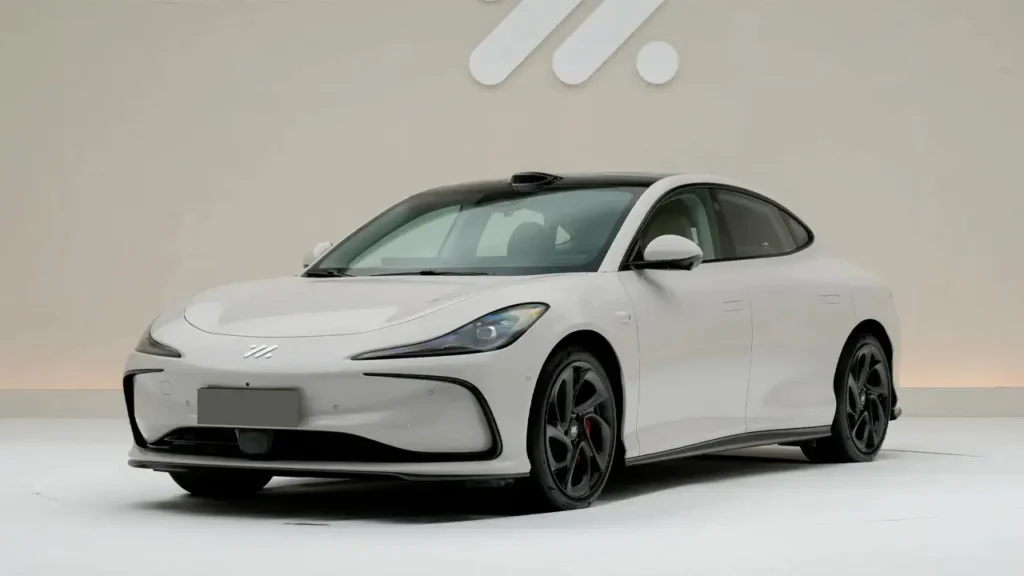
2. IM Motors L6 – Design and Format IM L6 electric sedan for City and Highway
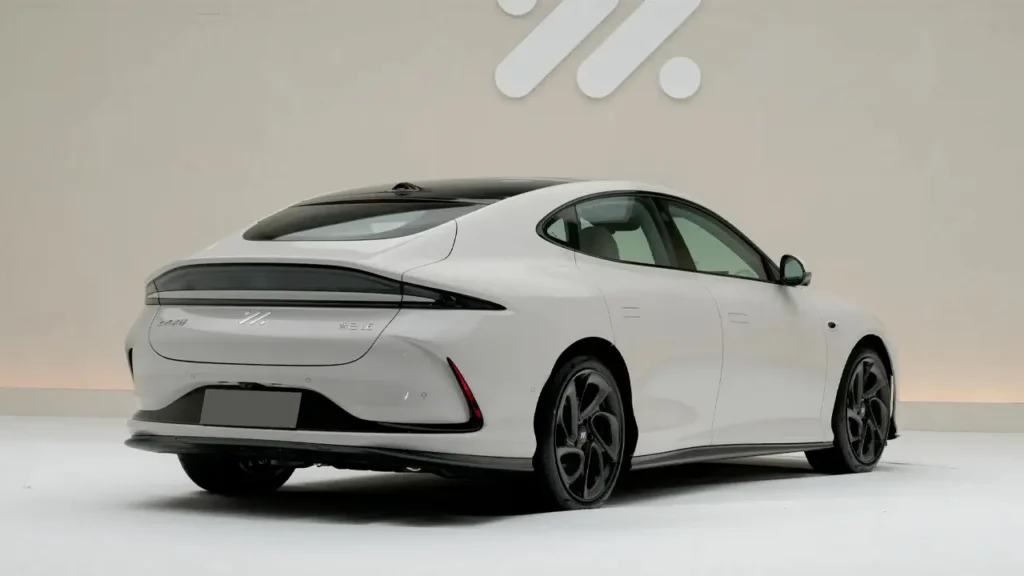
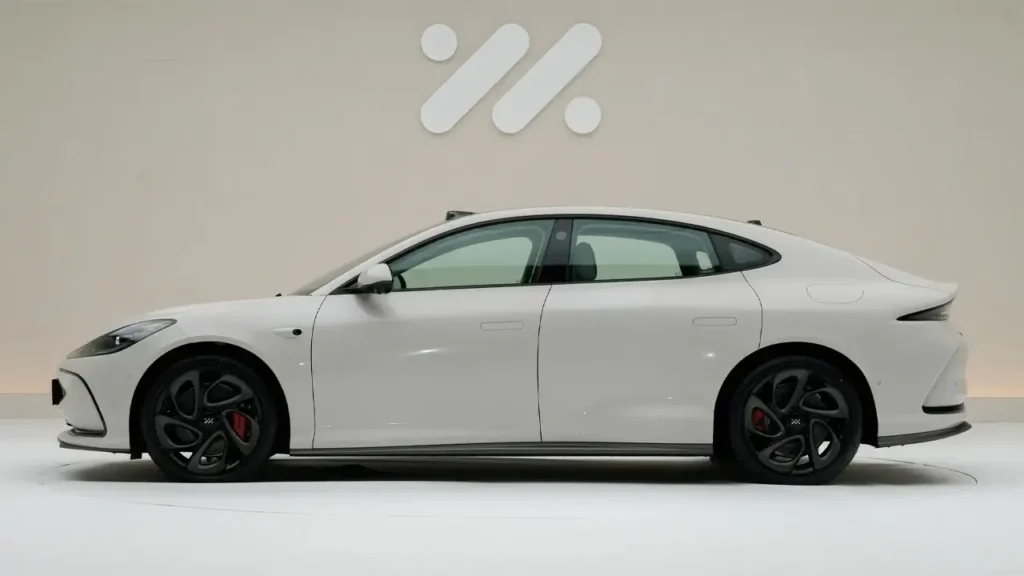
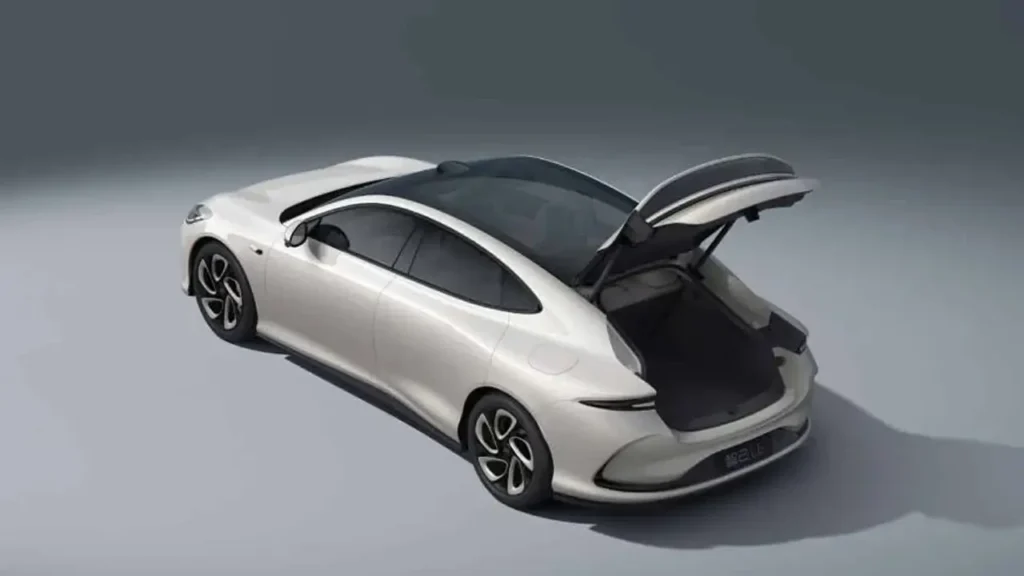
The IM Motors L6 is an elegantly proportioned IM L6 electric sedan, blending the sleek lines of a fastback with the commanding presence of a mid-to-large luxury vehicle. Measuring 4937mm in length, 1960mm in width, and 1474mm in height, with a 2950mm wheelbase, it is dimensionally similar to established luxury EV rivals, confirming its status in the premium segment. The exterior design emphasizes aerodynamic efficiency, crucial for maximizing the electric range, with a clean, minimalist front end and a flowing roofline that contributes to its sporty, yet sophisticated profile.
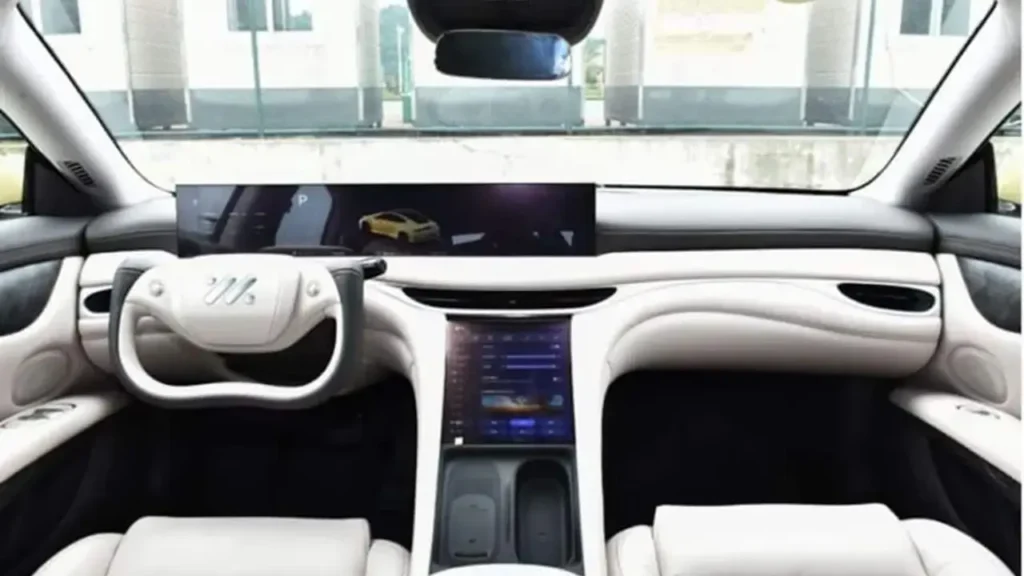
Inside, the L6 embraces a minimalist and highly intelligent cockpit concept. The cabin is dominated by a panoramic digital display interface, often featuring a triple-screen setup: a large center screen, a separate passenger display, and a lower control panel. This setup, powered by the intuitive IMOS 4.0 smart cockpit system and high-performance chips like the NVIDIA Orin-X and Qualcomm Snapdragon 8295, redefines human-machine interaction. The interior materials and finish are aimed at conveying a “premium from China” feel, with new accents, metallic speaker grilles, and advanced seating technology.
The seats are engineered for comfort, featuring pressure-relief technology and multi-level adjustments, including heating and massage functions, enhancing the driving experience for both city commutes and long highway journeys. Rear-seat passengers benefit from ample legroom and electric adjustment options, adding to the luxury quotient. The practical design is completed by a useful boot space, making the IM L6 electric sedan a viable and comfortable choice for a variety of drivers and usages.
If you like what IM Motors L6 is doing for Chinese EV sedans, you should also check how Geely responds with its sleek Galaxy E8 electric flagship. Read our full breakdown, range, tech and Tesla comparisons here: https://autochina.blog/geely-galaxy-e8-review-electric-sedan/ and decide which future-ready sedan wins for your garage in the 2025s.
3. IM Motors L6 – IM L6 solid state battery Potential on Paper and in Reality
The optional 133 kWh pack in the IM Motors L6 has generated immense excitement because it incorporates a IM L6 solid state battery—or, more accurately, a semi-solid-state battery (SSB) technology. Traditional lithium-ion batteries use a liquid electrolyte, which is a key component in their operation but also a potential safety risk and a limiting factor for energy density.
Solid-state batteries (SSBs) replace this liquid with a solid electrolyte, theoretically offering several monumental advantages. On paper, the manufacturer boasts of a significantly higher energy density, meaning more power can be stored in the same physical space and weight. The 133 kWh pack, for instance, is claimed to achieve a sensational range of up to 1,000 km under the lenient CLTC protocol.
The primary advantage touted for the IM L6 solid state battery technology is enhanced safety. By eliminating the flammable liquid electrolyte, the risk of thermal runaway and fire is drastically reduced, with IM Motors claiming “no thermal runaway or fire for the entire battery pack,” exceeding national safety standards.
Furthermore, the use of advanced materials, such as a patented nano-scale solid electrolyte coating on ultra-high nickel materials for the positive electrode and a new generation of high-energy-density composite silicon-carbon materials for the negative 1electrode, allows for greater energy storage. While the term “solid-state” can be confusing as it is a semi-solid design, the technology in the L6 represents a significant step towards commercializing higher-density and safer battery packs, setting a new benchmark for what is possible in mass-produced EVs.
4. IM Motors L6 – How IM L6 semi solid state battery Works and its Differences from Ordinary Li-ion
The technology in the L6 is specifically referred to as a IM L6 semi solid state battery, which distinguishes it from a theoretical “pure” solid-state battery (SSB) that would use an entirely solid electrolyte. The “semi-solid” designation implies a compromise or transitional phase where the battery still contains some liquid or gel-like electrolyte components, but the proportion and function of the solid material are substantially increased compared to traditional liquid Li-ion cells. This approach allows manufacturers to mitigate the significant engineering challenges of a pure SSB, such as poor ionic conductivity at room temperature and managing the volumetric change of electrode materials during cycling.
The key difference lies in the electrolyte. Traditional Li-ion batteries use a wholly liquid organic electrolyte, which is highly efficient for ion transport but poses flammability risks and limits energy density improvements. The IM L6 semi solid state battery employs a mix, often utilizing self-developed solid electrolytes with high ionic conductivity and a high-temperature-resistant composition, alongside the remaining liquid/gel. This combination aims to deliver the best of both worlds: the high energy density and enhanced safety of the solid component, while the liquid portion ensures rapid ion movement, especially during fast charging and discharge cycles.
This design is crucial for achieving the claimed ultra-fast charging capability and mitigating the high expansion issue of silicon-based materials. While a pure SSB might offer ultimate density and lifespan, the semi-solid state technology provides a viable, mass-producible solution that significantly pushes the boundaries of current Li-ion capabilities regarding energy density, cycle performance, and thermal stability in a real-world vehicle.
5. IM Motors L6 – Real IM L6 1000 km range: Cycles, Speed, and Climate
The headline-grabbing figure for the IM L6 is its IM L6 1000 km range, claimed for the top-tier 133 kWh semi-solid-state battery variant. It is critical to understand the test cycle used: the China Light-Duty Test Cycle (CLTC). The CLTC is known to be a relatively lenient standard compared to global equivalents like the European WLTP or the American EPA. CLTC tests typically yield range figures that are 15-20% higher than WLTP and 30-35% higher than EPA estimates.
This means the celebrated 1,000 km CLTC range is likely to translate to a real-world WLTP-equivalent range of approximately 800 km (or 500 miles), making it comparable to the longest-range EVs currently available, such as the Nio ET7 (150 kWh) or the Lucid Air Grand Touring.
However, even an 800 km WLTP-equivalent range is a phenomenal achievement and significantly surpasses the typical 500–600 km range offered by most competitors. In real-world driving, factors like speed, climate, and driving style will significantly impact the actual distance covered. On a highway at a steady speed of 120 km/h, the range will inevitably be lower than the tested figures due to increased aerodynamic drag and energy consumption.
Similarly, extremely cold or hot climates require the battery to use energy for thermal management, reducing the available range for driving. The IM L6 1000 km range should therefore be viewed as a technological peak achievable under optimal laboratory conditions, but it signifies a genuine breakthrough in energy efficiency and battery capacity that sets the L6 apart from the majority of the current EV market, providing a comfortable buffer against typical range anxiety.
6. IM Motors L6 – Electronics and IM L6 900V architecture for Fast Charging
The IM Motors L6 is built on a high-voltage platform that supports its next-generation charging capabilities, leveraging a IM L6 900V architecture (often simplified from a nearly 900V system). This voltage level represents a significant leap from the industry standard 400V architecture, and even surpasses the 800V systems adopted by some premium Chinese and Korean rivals like BYD and Geely/Zeekr
. The fundamental advantage of a higher voltage system is the ability to transmit the same amount of power (P) with lower current (I), as power is defined by the formula $P = V \times I$ (where $V$ is voltage). Lower current results in less heat generation, which not only improves efficiency but also allows for the use of thinner, lighter wiring and, most critically, enables ultra-fast charging speeds.
The 900V architecture is claimed to enable peak charging speeds that push beyond the 396 kW mark, potentially allowing the L6 to replenish a significant portion of its colossal battery pack in remarkably short times. For example, some claims suggest the ability to add around 400 km (249 miles) of range in just 12 minutes, or charge from 10% to 80% in as little as 16-17 minutes on compatible charging infrastructure. While this requires a high-power charging station (like those in China’s rapidly developing network), the L6 is future-proofed for the fastest available charging speeds.
This capability is a core differentiator, directly addressing a primary concern for long-distance EV travel. By adopting the IM L6 900V architecture, IM Motors positions the L6 as a leader in charging technology, offering a practical solution that minimizes downtime and maximizes usability compared to standard 400V vehicles, which typically take 30–40 minutes for the same 10-80% charge window.
7. IM Motors L6 – IM L6 price on the Domestic Market and Trim Levels
The IM Motors L6 price on the Chinese domestic market is highly competitive and structured across multiple trim levels, making the cutting-edge technology accessible to a broader premium audience. Upon its launch, the L6 was offered in several variants, typically ranging from a base model up to the flagship high-performance or ultra-long-range version. Initial pricing for the entry-level models—often equipped with a standard lithium iron phosphate (LFP) battery (around 74 kWh) and a 400V or lower-spec 800V platform—started at a highly aggressive price point, potentially around RMB 204,900 to RMB 219,900 (approximately €26,500 to €28,500).
As customers move up the configuration ladder, the IM L6 price increases significantly. Mid-to-high-end trims often feature larger ternary lithium batteries (NMC, e.g., 100 kWh), and, crucially, the full 800V/900V architecture. The top-of-the-line variant, featuring the 133 kWh semi-solid-state battery and max performance, commands the highest price, potentially starting in the range of RMB 279,900 to over RMB 345,900 (roughly €36,200 to €44,800).
What is included “from the base” is a key selling point: IM Motors often bundles advanced features as standard, such as a sophisticated driver assistance suite (IM AD 3.0 with lidar and NVIDIA chips), premium acoustics, and high-quality interior materials, which would typically be costly options on comparable European models. These aggressive price points for the domestic market, when converted to approximate Euros, provide a powerful orientation for the global consumer on the value proposition the IM L6 price brings to the table.
8. IM Motors L6 – Expected IM L6 price in Europe and Budget Competitors
The potential entry of the IM Motors L6 into Europe presents an exciting opportunity for consumers, but also introduces market complexities that will inevitably affect the final IM L6 price in Europe. When a Chinese-manufactured EV enters the European market, the original domestic price is subject to substantial upward revision due to a combination of import tariffs, shipping costs, Value Added Tax (VAT) which varies by country, and the necessity of re-engineering and certifying the vehicle to meet stringent EU safety and emission standards. Early market speculation suggests the starting price for the L6 in Europe could be in the range of €55,000 to €60,000 for well-equipped variants.
This potential price bracket immediately pits the IM L6 price in Europe against established and highly popular electric vehicles, most notably the Tesla Model 3 (especially the Performance and Long Range versions), the BYD Seal, and premium offerings such as the Hyundai IONIQ 6 and even lower-spec models of the BMW i4 and Mercedes-Benz EQE. The L6’s competitive advantage in this price range will be its unparalleled technology: the semi-solid-state battery offering superior range and the 900V ultra-fast charging capability.
The high-end tech must justify the price premium over rivals like the BYD Seal, which benefits from lower entry costs. If the IM Motors L6 can deliver its headline features at this price point, it will present a compelling, high-tech alternative to the dominance of Tesla and other long-established brands, forcing them to accelerate their own adoption of high-voltage and advanced battery technologies to keep pace.
9. IM Motors L6 – Honest Comparison IM L6 vs Tesla Model 3 and Other EVs
The electric vehicle world loves a good head-to-head, and the IM L6 vs Tesla Model 3 is the inevitable battle in the premium mid-size sedan segment. While the Model 3 is the long-established benchmark for performance, efficiency, and software integration, the IM L6 brings formidable new technology to the fight. In terms of design, the L6 offers a slightly larger, more luxurious, and technologically complex interior with its multi-screen dashboard, contrasting with the Model 3’s famously minimalist cabin. For dynamics, the top-spec L6 boasts a 0-100 km/h acceleration time as low as 2.74 seconds, making it one of the quickest sedans, even potentially faster than the Model 3 Performance.
The most significant battleground, however, is range and charging. The L6’s 133 kWh semi-solid-state battery promises a far greater range (up to 1,000 km CLTC) than the Model 3’s best offerings, which typically peak around 600-650 km WLTP-equivalent. Coupled with its 900V architecture, the L6 can achieve significantly faster peak charging speeds than the Model 3’s 400V system and proprietary Supercharger network. Where the Model 3 retains an edge is in its mature software ecosystem, global Supercharger network (though third-party access is growing), and proven long-term service and support.
Other rivals, like the BYD Seal, offer a strong value proposition with competitive dynamics and Blade Battery safety, but generally lack the L6’s headline range and 900V charging. Ultimately, the IM L6 vs Tesla Model 3 choice boils down to a preference between Tesla’s proven ecosystem and performance versus the L6’s cutting-edge battery and charging technology, making the L6 the superior choice for the true techno-geek prioritizing maximum range and charging speed.
Here is a comparative table of key specifications:
| Feature | IM Motors L6 (Top Spec) | Tesla Model 3 Performance (Example) |
|---|---|---|
| Battery Type | 133 kWh Semi Solid State | ~80 kWh Li-ion (NCA/NMC) |
| Max Range (Claimed) | 1000 km (CLTC) | ~528 km (EPA) / ~629 km (WLTP) |
| Architecture Voltage | 900V Class | ~400V |
| 0-100 km/h | 2.74 seconds | ~3.3 seconds |
| Smart Cockpit Chip | Qualcomm Snapdragon 8295 | Tesla Custom Chip |
| Autonomous Hardware | Lidar + NVIDIA Orin-X | Cameras (Tesla Vision) |
10. IM Motors L6 – Target Audience and Why to Follow Reviews on autochina.blog
The IM Motors L6 is not an electric car for everyone; it is a meticulously engineered machine aimed at a discerning and technologically forward-thinking audience. It is ideal for the techno-geek who demands the absolute latest in automotive innovation, particularly those fascinated by the promise of SSB technology and the tangible benefits of a 900V architecture. It is also a perfect fit for the long-distance driver who views the 1,000 km (CLTC) range claim as a solution to range anxiety, even if the real-world figure is lower. For the urban commuter, it offers unparalleled luxury and high-tech convenience.
Potential owners must, however, be aware of the inherent risks associated with a new brand and technology, such as the yet-to-be-fully-established European service network and the long-term degradation and performance of the semi-solid-state battery in varied climates.
To stay ahead of the curve and fully understand the real-world implications of these breakthroughs, following dedicated, expert coverage is essential. autochina.blog is your definitive source for these updates. We track the latest news, provide detailed reviews of both the performance and practical usability of Chinese EVs, and offer clear, comparative tables that cut through the marketing hype. We will be providing early driving impressions, long-term battery tests on the semi-solid-state pack, and honest comparisons that delve deeper than the manufacturer’s claims. By keeping a close eye on autochina.blog, you can make a fully informed decision about whether the IM Motors L6—or any of its innovative rivals—is the right electric vehicle for your future.
Would you like me to find the latest official WLTP range figures for the IM Motors L6 or comparable real-world driving reviews for the semi-solid state battery?
Discover more from AutoChina
Subscribe to get the latest posts sent to your email.