Skip to content
1. Executive Introduction: The Redefinition of the Tier 1 Relationship
Huawei HIMA automotive alliance. The global automotive industry is currently navigating a period of turbulence unparalleled since the introduction of the assembly line. This transformation is driven by the convergence of electrification, connectivity, and artificial intelligence—a triad often summarized in China as the “New Four Modernizations.” At the epicenter of this seismic shift stands Huawei Technologies Co., Ltd. Despite repeated public assertions that “Huawei does not make cars,” the telecommunications giant has effectively become one of the most consequential automakers in the world through a novel business architecture: the Harmony Intelligent Mobility Alliance (HIMA).
The HIMA model represents a fundamental restructuring of the traditional Original Equipment Manufacturer (OEM) and supplier relationship. Historically, Tier 1 suppliers like Bosch or Continental provided components or “black box” subsystems to automakers who retained full control over product definition and integration. HIMA, however, operates on a “Tier 0.5” or “Co-Creator” model. Under this framework, Huawei provides the “digital soul” of the vehicle—comprising the Qiankun Advanced Driving System (ADS), the HarmonyOS Intelligent Cockpit, and the Tuling Intelligent Chassis—while partner OEMs provide the “mechanical body” and manufacturing infrastructure. Crucially, Huawei also takes the helm of quality control, user experience design, brand marketing, and retail distribution through its vast consumer electronics network.
This report provides an exhaustive analysis of the HIMA ecosystem as of late 2025. It dissects the strategic logic behind the alliance, evaluates the technological supremacy of the ADS 3.0 and upcoming 4.0 architectures, and offers a granular examination of the five core sub-brands: AITO, Luxeed, Stelato, Maextro, and Shangjie. Furthermore, it analyzes the market performance that led to the delivery of one million vehicles within 43 months—a velocity exceeding that of Tesla and dominant Chinese startups in their nascent stages—and forecasts the trajectory of this alliance as it challenges legacy luxury incumbents and new challengers like Xiaomi.
If you’re curious how Huawei’s HIMA rivals stack up against pure-blood EV players, you should also check Xiaomi’s new crossover star. Our in-depth Xiaomi YU7 SUV review breaks down design, range, tech and real-world value versus Model Y here: https://autochina.blog/xiaomi-yu7-suv-review-model-y-rival-2025/ — seriously worth saving for your next smart EV decision.
2. Strategic Architecture: From “Huawei Inside” to HIMA
2.1 The Evolution of Huawei’s Automotive Ambitions
Huawei’s entry into the automotive sector was not a singular event but an iterative process of finding the optimal point of leverage. The company’s initial forays were traditional, supplying connectivity modules and inverters. This evolved into the “Huawei Inside” (HI) model, a full-stack solution where Huawei supplied the complete smart vehicle architecture to partners like Arcfox (BAIC) and Avatr (Changan).
However, the HI model exposed significant friction points. Traditional OEMs, unaccustomed to the rapid iteration cycles of consumer electronics software, struggled to integrate Huawei’s advanced systems effectively. Marketing alignment was often poor, and the vehicles lacked a cohesive brand identity that resonated with tech-savvy consumers. The “Smart Selection” model, which eventually rebranded as HIMA, was Huawei’s strategic pivot to resolve these inefficiencies. By taking control of the “soft” aspects of the car—product definition, design, and retail—Huawei could ensure that the technology was presented in a vessel that maximized its appeal.
2.2 The “Four Worlds” and the Expansion to Five
The HIMA portfolio is meticulously structured to cover the entire spectrum of the premium vehicle market without causing internecine warfare among its partners. This structure, often referred to internally as the “Four Worlds,” has recently expanded to include a fifth partner, SAIC, creating a constellation of brands that target specific demographics and price points.
AITOS Automotive Brand Strategy and Positioning (Huawei Alliance)
| Brand | Partner OEM | Market Positioning | Key Competitors | "Fighter" Designation |
|---|---|---|---|---|
| AITO | Seres Group | Premium Family & SUV | Li Auto, Tesla Model Y | The Volume Driver |
| Luxeed | Chery Auto | Sport/Performance | Tesla Model 3, BMW 3/5 Series | The BMW Fighter |
| Stelato | BAIC BluePark | Executive Luxury | Mercedes E/S-Class, Audi A6/A8 | The Benz Fighter |
| Maextro | JAC Motors | Ultra-Luxury [Image of Luxury Sedan Interior Design] | Maybach, Rolls-Royce, Bentley | The Halo Brand |
| Shangjie | SAIC Motor | Mass Market/Entry | BYD, VW ID. Series | The Democratizer |
This segmentation allows Huawei to amortize the massive R&D costs of its Qiankun and HarmonyOS platforms across a diverse fleet. A feature developed for the ultra-luxury Maextro S800, such as the ADS 4.0 architecture, effectively trickles down to the mass-market Shangjie H5, giving the entry-level vehicle a technological edge that competitors in its price class cannot match.
If you care about the AI brains behind smart cars, don’t stop at hardware. Dive into fresh guides, tool reviews and real-world AI workflows on our sister project AI Innovation Hub here: https://aiinovationhub.com/ — your shortcut to understanding how modern AI powers business, content and everyday productivity for you today.
3. The Technological Core: The "Digital Soul"
The primary differentiator of HIMA vehicles is the vertical integration of Huawei's technology stack. Unlike legacy automakers that must cobble together disparate systems—integrating a Mobileye vision system with a Qualcomm cockpit chip and a Bosch braking system—HIMA vehicles run on a unified digital architecture. This integration allows for features that require deep cross-domain communication, such as the vehicle's suspension adjusting in real-time based on LiDAR data (HUAWEI xMotion).
3.1 Huawei Qiankun ADS: The Path to Autonomy
The Qiankun Advanced Driving System (ADS) is the central nervous system of HIMA vehicles. As of late 2025, the system is transitioning from the widely deployed ADS 3.0 to the next-generation ADS 4.0.
3.1.1 ADS 3.0: The GOD Network and Mapless Driving
ADS 3.0 represented a paradigm shift away from the traditional Bird's Eye View (BEV) networks used by many competitors.
- GOD (General Obstacle Detection) Network: Traditional autonomous systems rely on "whitelists"—databases of known objects (cars, trucks, pedestrians). If the system encounters an object not in its database (e.g., an overturned cart or a fallen rock), it may fail to recognize it as an obstacle. ADS 3.0 utilizes a voxel-based GOD network that perceives the environment as occupied 3D space. If a voxel is occupied, the car knows it cannot drive there, regardless of whether it "knows" what the object is.
- PDP (Prediction-Decision-Planning) Network: This end-to-end network integrates perception and planning. Instead of a rule-based "if-then" logic structure, the PDP network learns from human driving data to make fluid decisions in complex scenarios, such as navigating roundabouts or unprotected left turns, significantly reducing the "jerky" behavior associated with robot drivers.
- Hardware Suite: The standard ADS 3.0 suite includes a 192-line LiDAR (providing a 250m detection range), multiple millimeter-wave radars, and high-definition cameras. This multi-modal sensor fusion provides redundancy that pure-vision systems (like Tesla's) lack, particularly in China's complex weather and lighting conditions.
3.1.2 The Leap to ADS 4.0: The WEWA Architecture
Scheduled for wide release in 2025, ADS 4.0 introduces the WEWA architecture, moving further toward unsupervised learning and AI-driven decision-making.
- WEWA Architecture: This new framework is designed to handle "infinite" scenarios through AI generation rather than manual rule-writing. It enables a "data-driven" approach where the system improves autonomously based on the fleet's driving data.
- Sensor Upgrades: ADS 4.0 introduces solid-state LiDARs for side and rear coverage, eliminating blind spots entirely. It also features a new in-cabin laser vision sensor ("Limera") to detect small targets at long distances and a distributed millimeter-wave radar system that improves detection in extreme weather.
- L3 Commercialization: The flagship "ADS Ultra" version is designed to support Level 3 autonomous driving on highways, allowing for "eyes-off" operation at speeds up to 120 km/h, pending regulatory approval.
- CAS 4.0 (Collision Avoidance System): The safety envelope is expanded significantly. The system can now initiate Automatic Emergency Braking (AEB) at speeds up to 150 km/h and covers "all-direction" threats, including crossing traffic and rear-end collision mitigation.
3.2 HarmonyOS Intelligent Cockpit: The User Experience
The HarmonyOS Cockpit is designed to integrate the vehicle seamlessly into the user's digital life, leveraging Huawei's "1+8+N" ecosystem strategy.
3.2.1 Super Desktop and Interconnectivity
The "Super Desktop" feature allows users to run smartphone applications natively on the car's infotainment screen without the need for intermediaries like CarPlay or Android Auto. The processing is shared, and the transition is seamless—a navigation route started on a phone continues instantly on the car screen upon entry.
- MagLink: A unique feature in AITO and other HIMA models is the MagLink interface on the back of the front seats. This magnetic pogo-pin connector allows Huawei tablets to attach and instantly integrate into the car's system. They can be controlled from the front screen (allowing parents to manage content for children) or act as independent entertainment units.
3.2.2 Celia (Xiaoyi) and Large Models
The cockpit is powered by the Celia voice assistant, which is integrated with Huawei's Pangu large model. This allows for vague, natural language commands. A user can say "I'm tired," and the car will interpret this intent: it might locate a rest stop, turn on the massaging seats, play calming music, and adjust the ambient lighting and climate control to a "nap mode". This moves beyond "command and control" to "intent understanding."
3.2.3 Privacy and Security
Recognizing the premium nature of its clientele (especially for Stelato and Maextro), the cockpit features advanced privacy modes. "One-touch privacy" can mask GPS location, mute microphones, and disable cameras. The system also uses acoustic shielding technology to ensure that phone calls taken via the hands-free system cannot be heard by passengers in other seats.
3.3 The Tuling Intelligent Chassis
The Tuling platform represents the digitization of the vehicle's mechanical underpinnings.
- HUAWEI DATS (Dynamic Adaptive Torque System): By adjusting the torque output of the motors in milliseconds, DATS can reduce the pitch and heave of the vehicle over bumps, smoothing out the ride and reducing motion sickness—a common issue in high-torque EVs.
- HUAWEI xMotion: This system coordinates the motor, braking, steering, and suspension systems. It can individually brake wheels to help the car rotate around a corner (torque vectoring) or stabilize the vehicle in a skid, offering a level of control that traditional ESC (Electronic Stability Control) systems cannot match due to the latency of hydraulic systems.
4. Brand-by-Brand Deep Dive: The HIMA Constellation
4.1 AITO (Huawei x Seres): The Volume Leader
AITO (Adding Intelligence to Auto) is the foundational pillar of HIMA. It validated the business model and continues to drive the majority of the alliance's volume.
4.1.1 AITO M9: The Technology Flagship
The AITO M9 is a full-size luxury SUV that has become a cultural phenomenon in China, delivering over 100,000 units shortly after launch and crossing 250,000 deliveries in 21 months.
- Dimensions: 5,230mm length, 1,999mm width, 3,110mm wheelbase.
- The "Cinema" Experience: The M9 features an industry-first 32-inch roll-up projection screen for rear passengers. Furthermore, its intelligent headlights contain millions of pixels and can project a 100-inch display onto a wall or the road surface, turning the car into an outdoor cinema for camping.
- "Double Beach Chair" Mode: A specific configuration where the front and second-row seats fold flat to create a continuous sleeping or lounging surface, integrated with the projector system for a "private mobile theater" experience.
- Chassis: It utilizes a fully aluminum alloy chassis with integrated die-casting, similar to Tesla's "Gigacasting," to reduce weight and increase stiffness.
4.1.2 AITO M7 and M5
- M7 Ultra: A substantial refresh of the M7, featuring the new "interstellar" front face design and standard 192-line LiDAR. It targets the 5-seat family SUV market, competing directly with the Li Auto L7.
- M8 (Upcoming 2025): Leaked plans indicate a new model, the M8, to bridge the gap between the M7 and M9. It is expected to debut in mid-2025 with the M9's advanced powertrain (EREV and EV) and a slightly smaller footprint (5,190mm length).
4.2 Luxeed (Huawei x Chery): The Performance Challenger
Luxeed is tasked with capturing the "driver's car" market, targeting younger demographics who prioritize handling and aesthetics.
4.2.1 Luxeed S7: The Electric Sport Sedan
- One-Box Design: The S7 utilizes a unique cab-forward design to maximize interior space, achieving a cabin utilization rate of 88%.
- Performance: The dual-motor version accelerates from 0-100 km/h in 3.3 seconds. It features the "Giant Whale" 800V high-voltage platform, allowing it to add 215 km of range in just 5 minutes of charging.
- Quirks: The passenger dashboard features a flat "desk" area that can be used as a workstation or makeup table. It also includes a hidden "beauty mirror" compartment, catering to female buyers.
- Market Position: It competes directly with the Tesla Model 3 and Xiaomi SU7. While initial sales were hampered by production ramp-up issues at Chery's factory, the "Ultra" refresh has stabilized its market presence.
4.2.2 Luxeed R7 and R9
- Luxeed R7: A coupe SUV (fastback) designed to challenge the Tesla Model Y. It brings the S7's performance metrics into a crossover form factor.
- Luxeed R9 (Upcoming): Expected in late 2025, this full-size SUV coupe will target the BMW X6 and Porsche Cayenne Coupe segment, offering high-performance capabilities to distinguish it from the family-oriented AITO M9.
4.3 Stelato (Huawei x BAIC): The Executive Standard
Stelato (derived from "Stellar" and "Auto") is the alliance's answer to the traditional German executive sedans.
4.3.1 Stelato S9: The Administrative Sedan
- Design Philosophy: The S9 avoids the aggressive styling of the Luxeed in favor of "Galaxy Aesthetics"—understated, elegant, and imposing.
- Rear Seat Priority: The focus is entirely on the rear passenger (the "boss"). It features "Zero Gravity" seats that can recline fully, massive legroom, and dedicated privacy controls.
- Market Strategy: Initially launched as a pure EV, the S9 faced challenges due to the preference of executive buyers for the unlimited range of gasoline cars. Consequently, an EREV (Extended Range Electric Vehicle) version is scheduled for April 2025. This version will use a 1.5T generator (likely adapted from BAIC's off-road division) to provide a combined range exceeding 1,300 km, removing range anxiety for cross-province business trips.
4.4 Maextro (Huawei x JAC): The Ultra-Luxury Pinnacle
Maextro is the most ambitious project within HIMA, aiming to breach the "glass ceiling" of the Chinese automotive industry by competing in the 1 million RMB ($140,000+) segment.
4.4.1 Maextro S800: The Halo Car
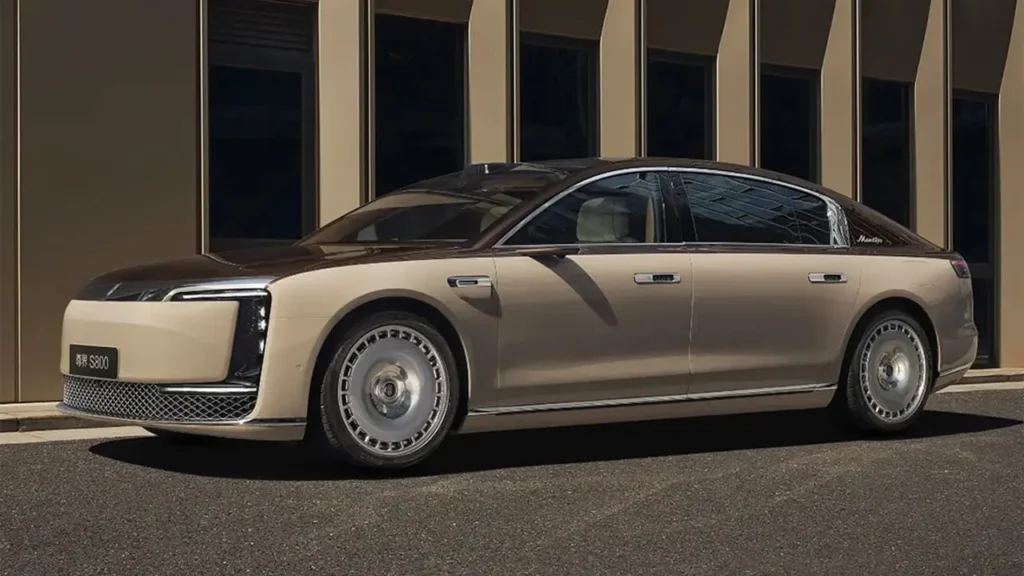
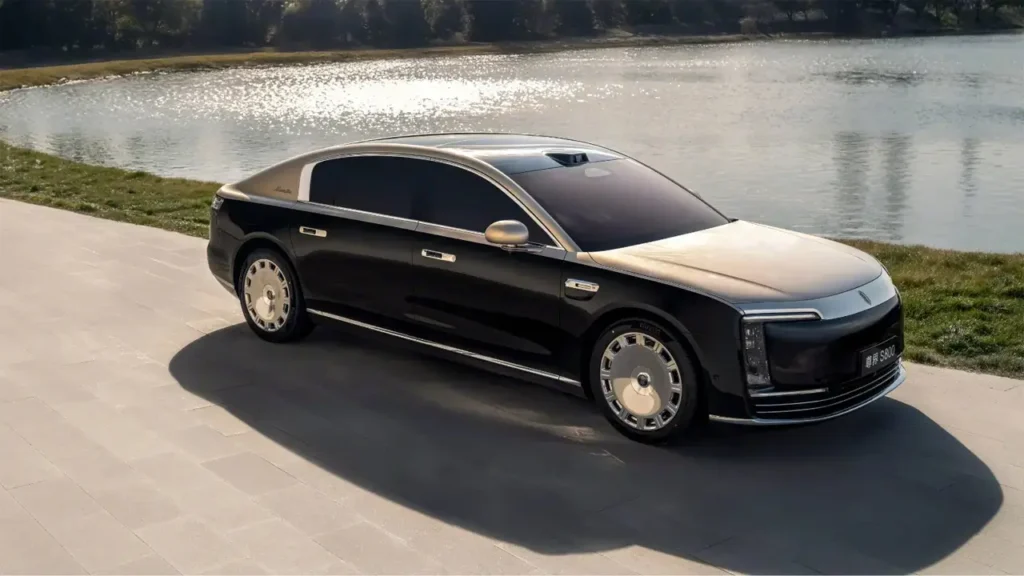
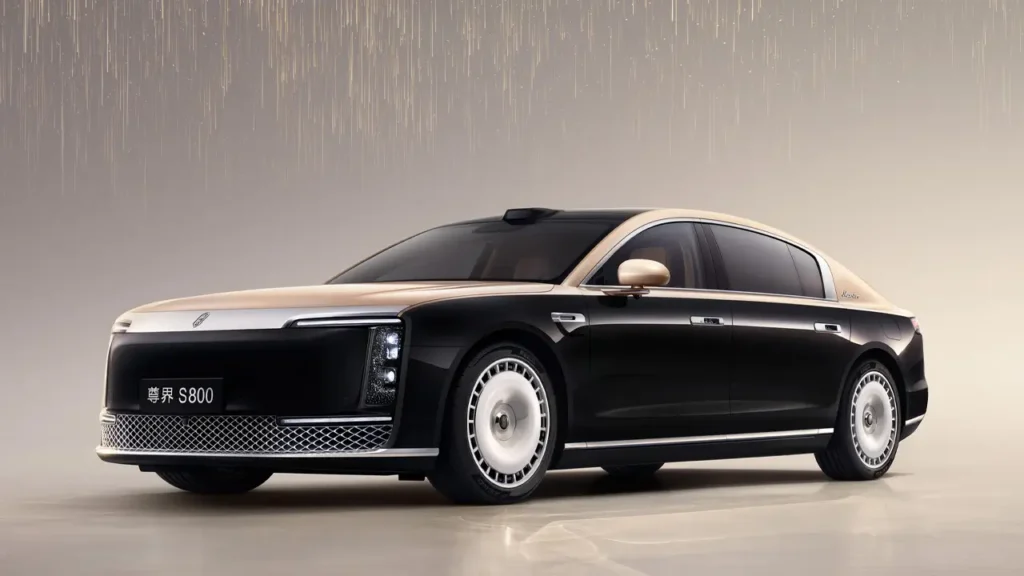
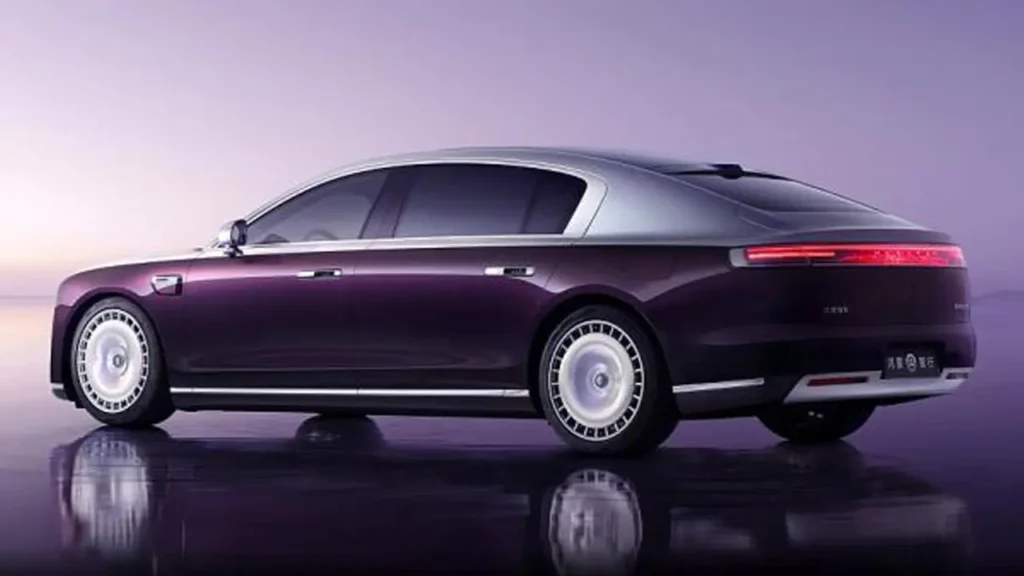
- Dimensions: A true behemoth, measuring 5,480mm in length, 2,000mm in width, and 1,536mm in height, with a wheelbase of 3,370mm. This makes it larger than the Mercedes-Benz S-Class Long Wheelbase and comparable to a Rolls-Royce Ghost.
- Design: Features a "Galaxy Scroll" taillight design and a two-tone paint scheme reminiscent of Maybach.
- Powertrain: Available as both EV and EREV. The EV version features a tri-motor setup producing 635 kW (852 hp). The EREV combines a 1.5T engine with this massive electric output, ensuring performance does not degrade with battery levels.
- Robotic Charging: A key innovation for the S800 is the integration of unmanned robotic charging. The vehicle can autonomously navigate to a charging station, where a robotic arm identifies the port and plugs in the cable without any human intervention—a feature designed to signal ultimate luxury and convenience.
- Pricing: Estimated to start at roughly 1 million RMB, positioning it as the most expensive mass-produced Chinese sedan in history.
4.5 Shangjie (Huawei x SAIC): The Mass Market Disruptor
The inclusion of SAIC, China's largest state-owned automaker, into HIMA via the Shangjie brand is a strategic watershed. It signals that even the industry giants are turning to Huawei for software competence.
4.5.1 Shangjie H5: The Entry Point
- Positioning: The H5 is the most affordable entry into the HIMA ecosystem, with prices starting around 159,800 RMB (~$22,500).
- Technology Democratization: Despite its price, it comes standard with the Qiankun ADS system (likely a "Lite" or vision-heavy version of ADS 3.0/4.0), bringing advanced autonomy to the mass market.
- Specs: It is available as a BEV and an EREV. The EREV version boasts a combined range of over 1,300 km and a pure electric range of 230 km, addressing the primary needs of cost-conscious families who need one car to do everything.
- Strategic Impact: By entering the <200,000 RMB segment, Shangjie threatens the volume dominance of BYD and the Volkswagen ID. series, leveraging Huawei's software advantage to differentiate in a commoditized market.
5. Sales Performance and Market Dynamics
5.1 The Velocity of One Million
In October 2025, HIMA announced it had surpassed one million cumulative deliveries, achieved in just 43 months. This trajectory is significantly steeper than that of Tesla or Chinese startups like Nio, Li Auto, and Xpeng during their respective growth phases.
- Average Transaction Price (ATP): Perhaps more impressive than the volume is the value. The ATP of HIMA vehicles hovers around 390,000 RMB ($55,000). This places HIMA firmly in the premium luxury category, well above the industry average and comparable to the transaction prices of BMW and Audi in China.
- Model Mix: While AITO currently accounts for the lion's share of this volume (specifically the M7 and M9), the ramp-up of Luxeed and the introduction of Shangjie are expected to diversify the sales mix in 2026.
5.2 Comparative Analysis: The "War of Gods"
5.2.1 HIMA vs. Tesla
- Autonomy: While Tesla's FSD (Full Self-Driving) is a pioneering vision-only system, its rollout in China has been hampered by regulatory and data security hurdles. HIMA's ADS 3.0 is fully operational nationwide now. The addition of LiDAR in HIMA vehicles provides a perception redundancy that many Chinese consumers trust more than Tesla's camera-only approach.
- Interior Luxury: HIMA vehicles offer a level of interior opulence (Nappa leather, massaging seats, fridges, projectors) that Tesla's minimalist "spartan" interiors do not attempt to match.
- Model Cycle: Tesla relies on the aging Model 3 and Y platforms. HIMA, through its multiple partners, launches 3-4 new or refreshed models per year, maintaining a "freshness" advantage.
5.2.2 HIMA vs. BYD
- Market Segmentation: BYD dominates the mass market (100k-300k RMB) through vertical integration and cost leadership. HIMA dominates the premium intelligence market (300k+ RMB). However, the Shangjie H5 represents HIMA's first direct assault on BYD's volume territory (Song and Yuan families).
- Intelligence Gap: While BYD is catching up with its "Xuanji" architecture, Huawei is widely considered to be 12-18 months ahead in terms of autonomous driving capability and cockpit software integration.
5.2.3 HIMA vs. The "BBA" (Benz, BMW, Audi)
- Market Share Erosion: HIMA models like the AITO M9 and Stelato S9 are directly cannibalizing the sales of the BMW X5/X7 and Mercedes E/S-Class. For wealthy Chinese consumers, "technological luxury" (smart driving, connectivity) is replacing "mechanical luxury" (engine pedigree, badge heritage) as the primary status symbol.
- Resale Value: A critical challenge for HIMA (and all EVs) remains resale value compared to the established German brands, though the gap is narrowing as software updates keep older HIMA vehicles relevant.
6. Manufacturing and Supply Chain
6.1 The "Super Factory" Model
To support the HIMA volume, partners have built dedicated facilities.
- Seres Super Factory: Located in Chongqing, this plant utilizes massive 9,000-ton die-casting machines (similar to Tesla's Giga Press) to manufacture the AITO M9. It features extremely high levels of automation, with robots handling the majority of assembly tasks.
- JAC Maextro Plant: JAC has invested heavily in a new flexible manufacturing base specifically for the Maextro brand, capable of handling the large dimensions and complex assembly requirements of the S800.
6.2 Supply Chain Sovereignty
Huawei's involvement ensures a robust supply chain, particularly for semiconductors. Despite US sanctions, Huawei has localized much of its automotive chip supply.
- Batteries: HIMA works closely with CATL. The Maextro S800 and other flagships utilize the "Whale Battery 2.0," a customized high-energy-density pack designed for ultra-fast charging (up to 6C rates) and high safety.
7. Future Outlook: The Road to 2026
7.1 Product Roadmap
The years 2025 and 2026 will see a product blitz aimed at filling every niche of the market.
- Q1-Q2 2025: Launch of the Maextro S800 (Halo Sedan) and the Stelato S9 EREV (Executive Long-Range).
- Q3 2025: Expected debut of the AITO M8 (The "Mini M9") and the Shangjie H5 (Mass Market Volume).
- Late 2025/Early 2026: Launch of the Luxeed R9 (Flagship Coupe SUV) and potentially a shooting brake variant of the Stelato S9.
7.2 The Challenge of Export
While HIMA is dominant in China, its global footprint is minimal. Exporting presents significant challenges:
- Geopolitics: Trade tariffs on Chinese EVs in Europe and North America, combined with specific sanctions against Huawei, make direct entry into Western markets difficult.
- Data Privacy: Exporting ADS 4.0, which relies on data collection for training, requires navigating complex GDPR and local data sovereignty laws.
- Branding: In export markets, the partner OEMs (Seres, Chery) often sell the vehicles under their own export brands, sometimes stripping the "Huawei" branding to avoid political friction, which dilutes the HIMA value proposition.
8. Conclusion
The Harmony Intelligent Mobility Alliance is more than just a successful automotive business unit; it is a structural revolution in the automotive value chain. By effectively outsourcing the "brain" of the car to a technology giant, partners like Seres and JAC have leapfrogged legacy competitors in product capability.
For the global automotive industry, HIMA serves as a stark warning. It demonstrates that in the era of the software-defined vehicle, value capture has shifted decisively away from the chassis and engine toward the algorithms and the user interface. As Huawei pushes toward Level 3 autonomy with ADS 4.0 and expands into the ultra-luxury segment with Maextro, it is not merely participating in the auto industry; it is establishing the operating system upon which the future of Chinese mobility will run.
AITOS Flagship Vehicle Comparison (Huawei ADS Models)
| Model | Partner | Segment | Length (mm) | Wheelbase (mm) | Powertrain | Max Power | Range (CLTC) | ADS Version | Key Feature | Price (Est.) |
|---|---|---|---|---|---|---|---|---|---|---|
| AITO M9 | Seres | Full-size SUV | 5,230 | 3,110 | EREV / EV | 390 kW (523 hp) | 1,400+ km (EREV) | ADS 3.0 (4.0 Ready) | Projector/Bed Mode | 469k - 569k RMB |
| Stelato S9 | BAIC | Executive Sedan | 5,160 | 3,050 | EV (EREV coming) | 385 kW (516 hp) | 721 km (EV) | ADS 3.0 (4.0 Ready) | Zero Gravity Seats | 399k - 459k RMB |
| Maextro S800 | JAC | Ultra-Luxury Sedan | 5,480 | 3,370 | EV / EREV | 635 kW (852 hp) (Highest) | 1,300+ km (EREV) | ADS 4.0 Native | Robotic Charging | 1M - 1.5M RMB |
| Shangjie H5 | SAIC | Compact SUV | 4,785 | 2,840 | EREV / EV | ~365 kW | 1,300+ km (EREV) | ADS Lite/Standard | Value/Price | 160k - 200k RMB |
Discover more from AutoChina
Subscribe to get the latest posts sent to your email.