Executive Summary
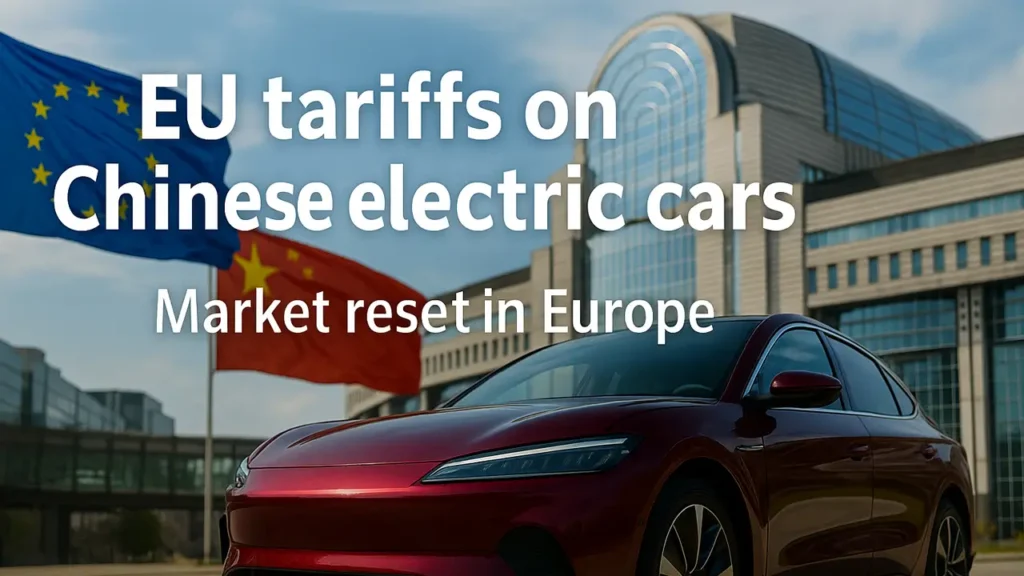
EU tariffs on Chinese electric cars: tough reset. The European Union’s imposition of definitive countervailing duties (CVDs) on battery electric vehicles (BEVs) originating from the People’s Republic of China represents a seismic shift in the architecture of global trade. Formalized in late October 2024 through Commission Implementing Regulation (EU) 2024/2754, this policy intervention is not merely a tariff adjustment but a fundamental restructuring of the competitive landscape for the European automotive sector. The regulation, which mandates duties ranging from 7.8% to 35.3% on top of the standard 10% import duty, is the culmination of a politically charged investigation that exposed deep fissures within the EU bloc and triggered a retaliatory trade defense spiral with Beijing.
This report provides an exhaustive, multi-dimensional analysis of the tariff regime, extending beyond the immediate fiscal implications to explore the second and third-order effects on industrial strategy, consumer economics, and geopolitical stability. The analysis reveals that while the tariffs were designed to shield the EU’s domestic industry from “unfairly subsidized” competition, the market response has been characterized by rapid, asymmetrical adaptation. Chinese Original Equipment Manufacturers (OEMs) are not retreating; they are mutating. We observe a decisive pivot toward localizing production within the EU’s periphery (Hungary, Turkey) and a tactical shift toward Plug-in Hybrid Electric Vehicles (PHEVs) to exploit regulatory loopholes.
Furthermore, the policy has catalyzed a fracturing of the European single market’s political unity, with member states like Germany and Hungary opposing the measures due to fears of retaliation against their own export industries—fears that have materialized in China’s targeted probes into pork, brandy, and large-displacement engines. This report argues that the tariffs, while intended as a protective moat, are functioning instead as an accelerant for the “transnationalization” of Chinese automotive capital, forcing these firms to embed themselves physically and politically within the European economy to survive.
If you care how EU tariffs reshape car tech supply chains, you’ll also like seeing what’s happening in laptops. Chinese homegrown CPUs are finally reaching consumers. Check my breakdown of Loongson/LoongArch performance, software limits and AI options here: https://bestchinagadget.com/ — same no-nonsense vibe for tech nerds who love brave experiments.
1. Context and Regulatory Genesis
1.1 The Strategic Backdrop: “Fit for 55” Meets Industrial Reality
The European Union’s “Fit for 55” legislative package sets ambitious targets for reducing net greenhouse gas emissions by at least 55% by 2030 compared to 1990 levels. Central to this strategy is the decarbonization of road transport, effectively mandating a transition to zero-emission vehicles. However, this regulatory push created a market vacuum that European legacy automakers, burdened by the high costs of transitioning from internal combustion engines (ICE), struggled to fill with affordable options. Into this vacuum stepped Chinese OEMs, leveraging a decade of state-directed industrial policy, massive economies of scale, and vertical integration in battery supply chains to offer technologically advanced EVs at prices significantly lower than their European counterparts.
By 2023, the market share of Chinese-made EVs in Europe had surged to approximately 8%, with projections suggesting it could reach 15% by 2025. This rapid penetration raised alarm bells in Brussels, not just regarding market share, but regarding the structural integrity of the European industrial base, which employs millions and accounts for a significant portion of the bloc’s R&D spending.
1.2 The Investigation: Ex Officio and the Burden of Proof
In a rare move, the European Commission initiated the anti-subsidy investigation ex officio (on its own initiative) on October 4, 2023, rather than waiting for a formal complaint from the industry. This signaled the Commission’s perception of the issue as a systemic threat to the EU’s economic security. The investigation covered the period from October 1, 2023, to September 30, 2024, examining whether the value chain of BEVs in China benefited from countervailable subsidies.
The Commission’s findings were categorical. The investigation concluded that the BEV value chain in China benefits from unfair subsidization, including:
- Direct Transfer of Funds: Grants and preferential loans from state-owned banks.
- Government Revenue Foregone: Tax exemptions and rebates.
- Provision of Goods/Services: Supply of lithium, batteries, and land at below-market rates.
These subsidies allowed Chinese producers to undercut EU industry prices, causing “material injury” or a threat thereof to the established Union industry.
1.3 The Tariff Structure: A Tiered Punitive Mechanism
The definitive duties, adopted on October 29, 2024, and effective from October 30, are valid for five years. Crucially, the Commission employed a sampling methodology, selecting three major Chinese groups—BYD, Geely, and SAIC—to determine representative duty rates. Other cooperating companies received a weighted average rate, while non-cooperating entities were hit with the maximum penalty.
Table 1: Definitive Countervailing Duty Structure (Effective Oct 30, 2024)
EU Anti-Subsidy Tariffs on Chinese EVs (Proposed)
| Manufacturer / Group | Subsidy Margin / Duty | Total Import Burden (Incl. 10% Standard) | Rationale for Rate |
|---|---|---|---|
| Tesla (Shanghai) | 7.8% | 17.8% | Granted individual examination. Proven lower subsidy receipt compared to domestic Chinese giants. |
| BYD Group | 17.0% | 27.0% | Cooperated with investigation. Moderate subsidy findings relative to SAIC. |
| Geely Group | 18.8% | 28.8% | Cooperated. Owners of Volvo, Polestar, Zeekr. Includes Lynk & Co. |
| Other Cooperating | 20.7% | 30.7% | Weighted average for non-sampled cooperators (e.g., Nio, Xpeng, Leapmotor). |
| SAIC Group | 35.3% | 45.3% | Sampled but deemed **non-cooperative** regarding transparency on subsidies. Includes MG and Maxus. |
| Non-Cooperating | 35.3% | 45.3% | Residual rate for all other companies that did not participate in the investigation. |
It is imperative to note the distinction in the treatment of provisional versus definitive duties. While provisional duties were introduced in July 2024, the regulation stipulates that the amounts secured under the provisional framework are not to be collected; only the definitive duties apply moving forward. This nuance provided a brief reprieve for importers who had secured potential liabilities via bank guarantees during the July-October window.
As EU tariffs push Chinese brands to rethink strategy, the next big question is how AI will reshape mobility, work and business. For deep dives into AI tools, automation trends and real-world use cases, explore my main hub: https://aiinovationhub.com/ — your shortcut to staying ahead in the AI game today.
2. Economic Impact Analysis: The OEM Landscape
The imposition of tariffs has forced every major player in the Eurasia automotive trade corridor to re-evaluate their pricing models, supply chains, and market entry strategies. The response is not uniform; it varies wildly based on corporate structure, profit margins, and brand positioning.
2.1 SAIC (MG): The Primary Casualty
SAIC Motor, the state-owned giant and parent company of the British heritage brand MG, faces the most severe punitive measures. With a combined tariff burden of 45.3%, SAIC’s business model—predicated on selling high volumes of value-oriented EVs like the MG4—is under existential pressure.
- Market Erosion: The impact was immediate. In the lead-up to the provisional tariffs, SAIC engaged in aggressive "self-registration" and dealer stock dumping to clear inventory before the duty hit. By August 2024, MG’s share of the EU BEV market had collapsed to 2.4%, down from 4.1% a year prior—a relative decline of 41%.
- Pricing Dilemma: The MG4, a bestseller in markets like Germany and France, faces a stark choice. Absorbing a 35.3% cost increase is financially unsustainable for a budget vehicle with thin margins. Passing it on renders the car uncompetitive against European rivals like the Volkswagen ID.3 or the Renault Megane E-Tech.
- Strategic Pivot: SAIC is aggressively pivoting away from pure BEVs toward hybrids. In the first half of 2025, while BEV registrations plummeted, MG saw a surge in registrations for the MG HS (PHEV) and the MG3 Hybrid. This substitution effect allows SAIC to bypass the countervailing duties entirely, as PHEVs attract only the standard 10% tariff.
2.2 BYD: The Vertical Integrator
BYD stands in stark contrast to SAIC. With a duty rate of 17.0%, BYD faces a hurdle, not a wall. The company's unique vertical integration—manufacturing its own batteries (Blade Battery), semiconductors, and even owning its own shipping fleet (the BYD Explorer No. 1)—grants it a cost structure that is unrivaled globally.
- Cost Absorption: Analysis suggests BYD’s profit margins on European exports are robust enough to absorb the 17% duty while maintaining profitability. The "export premium"—the difference between the domestic Chinese price and the European list price—is often substantial. For example, the BYD Atto 3 sells for significantly more in Germany (€37,990) than in China, creating a buffer.
- Aggressive Expansion: Rather than retreating, BYD is doubling down. Executives have stated intentions to capture significant market share in Germany within six months, regardless of tariffs. The launch of newer, cheaper models like the Seagull (expected to be priced competitively even with tariffs) and the Seal U DM-i (PHEV) demonstrates a multi-pronged assault on the market.
2.3 Geely and the "Trojan Horse" Brands
Geely occupies a complex position due to its ownership of European heritage brands Volvo and Polestar. The 18.8% tariff applies to its exports, complicating the business case for models like the Volvo EX30, which is manufactured in China.
- Volvo EX30: This model was poised to be a volume seller. The tariff directly impacts its profitability. Volvo has responded by accelerating plans to shift production of the EX30 to its plant in Ghent, Belgium, to avoid the duties entirely. Until that transition is complete, Volvo must either absorb the cost or raise prices, potentially dampening the launch momentum of one of its most critical vehicles.
- Polestar: As a brand explicitly targeting the premium segment, Polestar may have more elasticity to pass on costs, but it faces stiff competition from Tesla and German premiums. The tariffs add friction to its asset-light, China-heavy production model.
2.4 Tesla: The Strategic Winner
Perhaps the greatest irony of the anti-subsidy investigation is that its most clear-cut beneficiary is an American company. Tesla requested and received an individual examination, resulting in a duty rate of just 7.8%.
- Competitive Advantage: This rate is less than half of that applied to its direct competitors like BYD (17%) and Geely (18.8%), and a fraction of SAIC’s rate (35.3%). This allows Tesla to import its Model 3 from the Shanghai Gigafactory with a minimal price adjustment, effectively improving its relative price position against Chinese rivals.
- Market Stability: While Chinese OEMs scramble to reconfigure supply chains or re-price inventory, Tesla can offer stability. This regulatory windfall reinforces Tesla's dominance in the European EV sector, insulating it from the worst effects of the trade war.
2.5 Nio and Xpeng: The "Wait and See" Cohort
Niche premium players like Nio and Xpeng fall under the "Other Cooperating" category with a 20.7% tariff. Their lower volumes and higher price points make them less sensitive to tariffs than budget brands, but they lack the scale of BYD to absorb costs easily. Both have indicated they will maintain current pricing for now, absorbing the hit to margins to establish brand presence, while actively exploring local manufacturing options.
As EU tariffs on Chinese electric cars keep shifting the rules, you might want a single place to track every new model, price move and policy twist across brands. Bookmark https://autochina.blog/ — your go-to hub for Chinese EVs, hybrids and market insights tailored for European drivers today, tomorrow and the future.
3. The "Loophole" Economy: The Rise of PHEVs
A critical and unintended consequence of the definitive duties is the distortion of the powertrain mix in the European market. The countervailing duties are specifically targeted at Battery Electric Vehicles (BEVs). Plug-in Hybrid Electric Vehicles (PHEVs) remain subject only to the standard 10% import duty.
This regulatory asymmetry has created a massive arbitrage opportunity that Chinese OEMs are exploiting with ruthless efficiency.
3.1 The PHEV Pivot
Data from the first half of 2025 indicates a dramatic surge in Chinese PHEV registrations.
- BYD's Shift: BYD registered approximately 20,000 PHEVs in the EU in H1 2025, a rise of 17,000% from a near-zero base. The introduction of the Seal U DM-i was timed perfectly to capitalize on this loophole. For a vehicle priced at €40,000, the difference between a 10% duty (PHEV) and a 27% duty (BEV) is roughly €6,800 per unit—a massive commercial advantage.
- MG's Lifeline: As noted, MG has pivoted marketing resources toward the MG HS Plug-in and the MG3 Hybrid. This strategy allows them to keep dealer lots full and maintain brand visibility while they navigate the crisis facing their electric lineup.
3.2 Environmental Implications
This trend arguably undermines the EU's "Fit for 55" goals. By incentivizing the import of PHEVs—which still rely on internal combustion engines and are often criticized for real-world emissions that exceed test cycle data—the trade defense measure is inadvertently slowing the transition to pure zero-emission transport. The market is being flooded with transitional technology rather than the definitive BEV technology the EU seeks to foster.
4. Industrial Reconfiguration: "Fortress Europe" and Localization
The tariffs have catalyzed a new phase of industrial globalization: the physical localization of Chinese automotive production within Europe. To permanently circumvent the duties, Chinese OEMs are moving from an "export" model to a "build where you sell" model.
4.1 Hungary: The New Center of Gravity
Hungary, under Prime Minister Viktor Orbán, has positioned itself as the primary gateway for Chinese industrial capital into the EU, opposing the tariffs and courting investment aggressively.
- BYD Szeged Plant: BYD is constructing a massive passenger car plant in Szeged, southern Hungary. Construction is advancing rapidly, with production potentially commencing as early as late 2025.
- Strategic Value: Vehicles produced in Szeged will be "Made in EU" and thus exempt from the 17% countervailing duty. This plant will have an initial capacity of 150,000 units, scaling to 300,000, effectively replacing BYD's Chinese exports to the region.
4.2 Spain: The Joint Venture Hub
Spain has emerged as a critical secondary hub, leveraging existing industrial capacity (often from departing legacy manufacturers) to attract Chinese partners.
- Chery & Ebro: Chery Automobile has signed a joint venture with Ebro-EV Motors to revitalize the former Nissan plant in Barcelona. Production of the Omoda 5 is set to begin, utilizing a DKD (Disassembled Knock Down) kit approach initially, moving to full manufacturing later. The target is 150,000 vehicles by 2029.
- Leapmotor: In a dramatic turn of events, Stellantis—which owns a 20% stake in Leapmotor—halted trial production of the Leapmotor T03 in Poland in mid-2025. Reports indicate this decision was influenced by geopolitical pressure: Poland voted in favor of the tariffs, while Spain abstained. Consequently, production plans were rerouted to Stellantis's Zaragoza plant in Spain. This incident highlights how Chinese industrial investment is being weaponized to punish or reward EU member states based on their voting behavior.
4.3 Turkey: The Customs Union Backdoor
Turkey, while not an EU member, is part of the EU Customs Union. Vehicles manufactured in Turkey can enter the EU tariff-free, provided they meet rules of origin requirements.
- BYD's Investment: BYD has announced a $1 billion investment to build a factory in Turkey with a capacity of 150,000 units, slated for late 2026. This facility provides a hedge against EU labor costs while maintaining tariff-free access to the Single Market, further diversifying BYD's production footprint.
5. Geopolitical Retaliation and the Fracturing of the EU
The investigation and subsequent vote on tariffs revealed deep fractures within the European Union, which Beijing has deftly exploited through targeted retaliatory measures.
5.1 The Voting Dynamic
The imposition of definitive duties required a vote by EU member states. The results were telling:
- Germany: Voted against the tariffs. The German automotive industry (VDA), including VW, BMW, and Mercedes-Benz, lobbied fiercely against the measures. They feared—correctly—that tariffs would invite retaliation against their highly profitable exports to China.
- France: Voted in favor. France was the primary architect of the probe, seeking to protect its mass-market producers (Renault, Peugeot) from cheap Chinese competition. French luxury exports (brandy) became a target as a result.
- Spain: Initially supportive, Spain softened its stance to an abstention, likely fearing retaliation against its massive pork exports.
5.2 The Retaliation Triad: Pork, Brandy, and Cars
China’s response has been surgical, targeting sectors sensitive to the specific EU countries that supported the tariffs.
- Pork: Immediately following the provisional tariff announcement, China launched an anti-dumping probe into EU pork imports. This directly targets Spain (the largest exporter), the Netherlands, and Denmark. In September 2025, China released a preliminary ruling finding dumping, keeping the threat of duties hanging over the industry.
- Brandy: In a direct strike at France, China launched an anti-dumping investigation into European brandy (Cognac). Temporary measures were announced, hitting major French conglomerates like LVMH and Rémy Cointreau.
- Large Engine Vehicles: China has threatened to raise tariffs on imported internal combustion engine vehicles with large displacement engines (likely >2.5L) to 25%. This is a "sword of Damocles" hanging over German luxury manufacturers, who dominate this specific niche in the Chinese market. It explains Germany's desperate opposition to the EV tariffs.
6. Consumer Market Dynamics and Pricing
6.1 Price Sensitivity and Absorption
European consumers are highly price-sensitive regarding EVs. Surveys indicate that 50% of potential buyers would only consider a Chinese brand if it were at least 15% cheaper than a European equivalent. The tariffs threaten to erode this price advantage. However, actual street prices have not spiked uniformly.
- Inventory Clearing: In the months leading up to the definitive duties, brands like MG engaged in heavy discounting (e.g., €10,000 discounts in some markets) to move pre-tariff stock.
- Price Stability: Brands like BYD have largely maintained their list prices, choosing to absorb the tariff cost to build market share. For example, the BYD Atto 3 price in Germany remains competitive at roughly €37,990, comparable to pre-tariff levels, suggesting the company is eating into its export premium to stay relevant.
Table 2: Comparative Pricing of Key Models (Germany, Jan 2025 Est.)
EU Tariff Impact and Manufacturer Strategies on Key EV Models
| Model | Segment | Approx. Price | Tariff Impact Strategy |
|---|---|---|---|
| MG4 Electric | Compact Hatch | €35,785 - €39,990 | Heavy impact. Discounts reducing, push to **MG3 Hybrid** (which avoids EV-specific punitive tariffs). |
| BYD Atto 3 | Compact SUV | €37,990 | Absorption. Price stability maintained, using margin advantage to offset the duty. |
| Tesla Model 3 | Sedan | €42,000+ | Minimal impact (7.8% duty). Maintains price leadership due to the lowest rate granted. |
| Volvo EX30 | Compact SUV | €39,000+ | Production shifting to Belgium to avoid the 18.8% punitive duty associated with Geely/Chinese manufacturing. |
| BYD Seal U DM-i | PHEV SUV | €39,990 | Zero punitive tariff. Aggressive marketing focus on this plug-in hybrid model, which is excluded from the EV anti-subsidy duties. |
6.2 Market Share Trends
Despite the headwinds, Chinese brands continue to gain ground. In September 2025, Chinese automakers captured a record 7.4% of the European passenger car market, a 149% year-on-year increase. This growth, however, is increasingly driven by the PHEV segment (up 63%), validating the "loophole" strategy. The UK, which is not part of the EU tariff regime (having its own 10% rate), remains a critical growth engine, accounting for nearly half of Chinese sales in Europe in some months.
7. Future Outlook: 2025-2030
7.1 The "Price Undertaking" Negotiation
The EU and China continue to negotiate a potential "price undertaking"—an agreement where Chinese OEMs would agree to a minimum import price (MIP) for their vehicles in exchange for the lifting of the countervailing duties. This mechanism is complex to administer but represents the most viable off-ramp for the trade war. It would prevent "dumping" while allowing trade to continue, potentially satisfying both the Commission's desire to protect industry and Germany's desire to avoid retaliation.
7.2 The Decoupling of Supply Chains
We are witnessing a partial decoupling. The US has effectively closed its market with 100% tariffs, forcing Chinese overcapacity into Europe, South America, and Southeast Asia. Europe's 45% tariff wall is permeable compared to the US's 100% wall. Consequently, Europe will remain the primary battleground for Chinese global expansion. By 2027, as the Hungarian and Spanish factories come online, the relevance of the import tariffs will diminish. The "Chinese car" of 2028 will likely be assembled in Szeged or Barcelona, utilizing a battery made in Debrecen, with software coded in Shenzhen.
7.3 Conclusion
The EU's definitive countervailing duties on Chinese EVs are a landmark protectionist measure that has succeeded in forcing a strategic reset but failed to halt the advance of Chinese automotive capital. By incentivizing localization and the shift to hybrids, the tariffs have accelerated the integration of Chinese firms into the European industrial fabric. The policy has also laid bare the fragility of EU unity, with Beijing successfully leveraging internal divisions to weaken the bloc's resolve.
As the industry moves into 2026, the question is no longer whether Chinese EVs can compete in Europe, but whether European legacy automakers can survive the transition to a market where their competitors are now their neighbors, manufacturing inside the fortress walls they helped to build.
$$ \text{Total Border Tax}_{SAIC} = \text{CIF Price} \times (1 + 0.10) \times (1 + 0.353) \approx \text{CIF Price} \times 1.488 $$
The mathematical reality is that while a nearly 50% tax is punitive, for a hyper-efficient producer like BYD or a state-backed giant like SAIC, it is a cost of doing business in the world's most lucrative open market.