Chinese cars in US tested
For the American consumer, Consumer Reports (CR) is one of the most trusted and influential non-governmental voices in the automotive landscape. Unlike regulatory bodies which enforce minimum safety standards, CR provides comprehensive evaluations based on buying vehicles anonymously, testing them rigorously on their own track, and compiling vast consumer reliability data. For any new vehicle brand entering the US market, particularly those from a non-traditional source like China, a positive CR assessment is absolutely vital for establishing trust and credibility.
US consumers rely on CR’s ratings—which cover everything from predicted reliability and owner satisfaction to performance and safety features—to make informed purchase decisions. The sheer volume of CR’s subscription base and its perceived independence from automotive manufacturers mean their findings on Chinese cars in US tested models can directly influence sales volume and public perception of an entire nation’s automotive industry.
CR’s evaluation process for Chinese-made cars Consumer Reports testing is critical. They will test vehicles across multiple dimensions that go beyond mandatory safety checks. This includes measuring braking distance, emergency handling characteristics, fuel efficiency (or EV range consistency), and the usability of in-car technology. Crucially, CR also collects owner data via extensive annual surveys, providing a long-term view of a vehicle’s durability and the cost of ownership, factors which are entirely unknown for any newly imported Chinese brand.
the 2025 market entry and beyond, the first CR road tests and subsequent reliability data will serve as the definitive benchmark for US buyers trying to gauge the quality and longevity of these new market entrants. American buyers will look to CR’s conclusions not only for specific model insights but for a general statement on the build quality and engineering prowess of the modern Chinese auto sector.
CR’s reports do more than just rate a car; they provide an essential translation of global standards and manufacturing practices into a consumer context familiar to US shoppers. When discussing Chinese cars in US tested results, a CR report helps answer the fundamental questions: How will this car hold up after 50,000 miles? and Does the quality justify the price? Our analysis in this post will rely on the structure of these expected Consumer Reports evaluations—covering safety, regulation, crash testing, and ownership costs—to build a complete picture of what is known and what is still speculative for the 2025 market. This approach grounds the discussion in reliable, familiar consumer-facing metrics.
Want more Consumer Reports style updates on safety, tests, tariffs, and which Chinese brands are edging into US driveways? Dive into our live coverage and quick takes here: https://autochina.blog/chinese-car-news/ for curated headlines, market analysis, and buying tips, updated daily to keep you ahead of the hype and the fine print.
Chinese cars in the US tested — what has changed in 2025
The automotive landscape in the 2025 window is characterized by a significant geopolitical and technological shift that accelerates the entry potential of Chinese cars in the US 2025. Historically, direct sales of Chinese-branded vehicles in the US have been negligible, blocked by cost, logistics, and most importantly, the lack of certification under US safety and emissions standards. However, several critical factors have changed leading into 2025. First, the Chinese auto industry, led by companies like BYD and Geely, has become a global leader in electric vehicle (EV) technology, rapidly achieving economies of scale that challenge established Western manufacturers. This technological leap allows them to compete on a product level previously unattainable.
Secondly, the interest from US dealerships has notably increased. Facing inventory shortages in certain segments and recognizing the global competitiveness of Chinese EVs—particularly in the low-cost and high-tech sectors—many dealers are actively seeking partnerships or distribution channels. While official OEM (Original Equipment Manufacturer) entry remains complex due to political and regulatory hurdles, the growing market speculation signals a palpable shift in readiness. Pilot deliveries, typically limited to fleet tests, or sales through indirect/rebadged channels (like vehicles produced by Chinese firms for US-allied brands) provide initial data points for Chinese cars in US tested scenarios. This influx of data, even from small batches, helps regulators and consumer groups like CR prepare their own evaluation frameworks.
The current picture for 2025 is less about massive sales and more about regulatory preparation and infrastructure development. The next 6 to 12 months are crucial for determining the final cost structure and legal viability of direct imports.
Factors like the clarity around US tariff policy (discussed later), the establishment of a parts and service network, and the completion of homologation (conversion to US standards) for specific models will decide the immediate future. Buyers in 2025 should expect to see a lot of news and pilot programs, but limited widespread availability. The successful entry of Chinese cars in US tested models hinges on the transparent certification process under US law and the ability of manufacturers to navigate the complex political environment while delivering a compelling, certified product.
Curious how AI is shaping safety testing, tariffs analysis, and real-time buyer advice? Explore data-driven explainers, automation guides, and practical workflows at our sister hub: https://aiinovationhub.com/. We translate complex AI trends into simple steps for marketers and creators—so your next decision is faster, smarter, and confidently future-proof in everyday work.
Chinese cars in the US tested — safety: first look
The fundamental question on every potential buyer’s mind is: Are Chinese cars safe in the US? In the American context, “safe” is defined by adherence to strict governmental regulations (FMVSS) and high scores in independent, rigorous crash tests (IIHS). Consumer concern stems from the historical perception of lower manufacturing standards in the early 2000s, but the modern reality of the industry is that global engineering standards are more uniform, especially for models intended for export. For any Chinese cars in US tested to enter the market legally, they must meet the exact same minimum Federal Motor Vehicle Safety Standards (FMVSS) as every vehicle sold by Ford, Toyota, or Mercedes-Benz. There are no exemptions based on the country of origin.
Safety is viewed in two primary categories: Passive Safety (structural integrity, airbags, crumple zones) and Active Safety (ADAS – Advanced Driver-Assistance Systems). Passive safety is a matter of engineering and manufacturing precision, proven in crash testing. Active safety—which includes features like Automatic Emergency Braking (AEB), Lane Keeping Assist (LKA), and Blind Spot Monitoring (BSM)—is an area where many Chinese manufacturers are highly competitive, leveraging advanced software and sensor technology developed for their massive domestic market. Buyers will need to compare the specific features offered by new entrants against established US, Japanese, and Korean brands, focusing on the systems’ performance and reliability, which Consumer Reports testing will highlight.
The following template outlines the key comparison points US buyers will use when evaluating the safety of an imported model. The ability of a manufacturer to clearly document and certify these features is the first step in winning over a skeptical American audience.
Mobile-Responsive Comparison Template:
| Model | Body Type | Safety Tech (ADAS) | Airbags | Brake Assist | Notes |
|---|---|---|---|---|---|
| Example Chinese Model A (Hypothetical) | Crossover SUV | AEB, LKA, BSM (Level 2 Autonomy Ready) | 10 (Front, Side Curtain, Knee) | EBD & BA Standard | Must meet NHTSA 5-Star Equivalent for US market entry. |
| Established US/JPN Competitor | Crossover SUV | AEB, LKA, BSM (Proven Track Record) | 8-10 Standard | EBD & BA Standard | IIHS Top Safety Pick rating is key for consumer confidence. |
The successful integration and reliability of high-tech ADAS features will be the battleground where Chinese cars in US tested models either prove their quality or fall short in consumer perception against long-established rivals.
Curious how China’s software push extends beyond cars? See Huawei’s first laptops running home-grown HarmonyOS, with sleek MateBook Pro and the bold Fold edition. Specs, early impressions, and what HarmonyOS means for Windows users are covered here: https://bestchinagadget.com/ — a quick, practical read for cross-platform power users today, worth bookmarking.
Chinese cars in the US tested — regulations and approvals
The gateway to selling any vehicle in the United States is strict compliance with the Federal Motor Vehicle Safety Standards (FMVSS), overseen by the National Highway Traffic Safety Administration (NHTSA). For Chinese cars in US tested for market entry, the process is identical to that faced by all manufacturers. NHTSA does not pre-approve vehicles; rather, the manufacturer is responsible for self-certification, meaning they must attest, based on internal testing and engineering data, that every aspect of the vehicle meets the hundreds of specific FMVSS requirements. These requirements govern everything from crashworthiness (e.g., roof crush resistance, frontal/side impact performance) to specific component performance (e.g., headlight luminosity, seat belt webbing strength, tire pressure monitoring systems).
Meeting the Chinese car safety standards FMVSS is a complex and costly endeavor. It often requires significant re-engineering of models originally designed for non-US markets. For instance, crash zones and bumper heights must be specifically modified to align with US standards. Requirements for lighting systems—such as side marker lights and specific beam patterns—often differ substantially from European or Asian standards. Even the labeling and documentation within the vehicle must be in English and conform to specific NHTSA formats. For Electric Vehicles (EVs), additional standards regarding battery safety, thermal management, and post-crash safety procedures (e.g., how emergency responders can safely deactivate the high-voltage system) are also mandatory under US regulation.
A key marker for US buyers is the presence of the required certification label, usually found on the driver’s side door jamb. This label, often called the “compliance tag,” explicitly states that the vehicle conforms to all applicable FMVSS in effect on the date of manufacture. The absence of this tag, or any indication of incomplete or “gray market” conversion, immediately renders the vehicle illegal for sale or registration in most US states.
When considering Chinese cars in US tested for purchase, buyers must demand irrefutable proof of full FMVSS compliance, verified through the manufacturer’s official documentation, to ensure they are purchasing a legally and safely certified product. Without this regulatory foundation, no amount of positive Consumer Reports data is relevant, as the car cannot be legally driven on US roads.
Chinese cars in US tested — crash tests and ratings
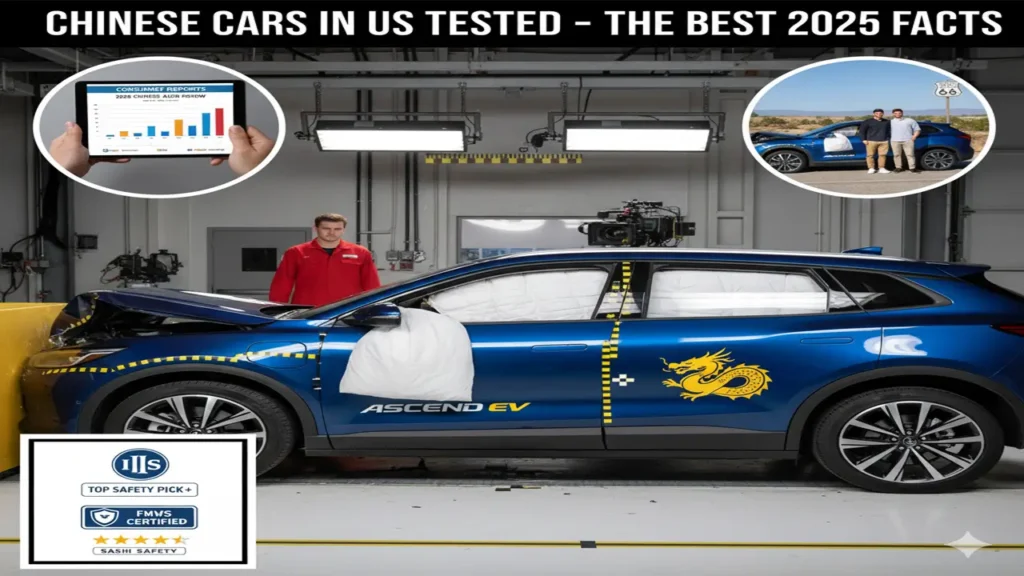
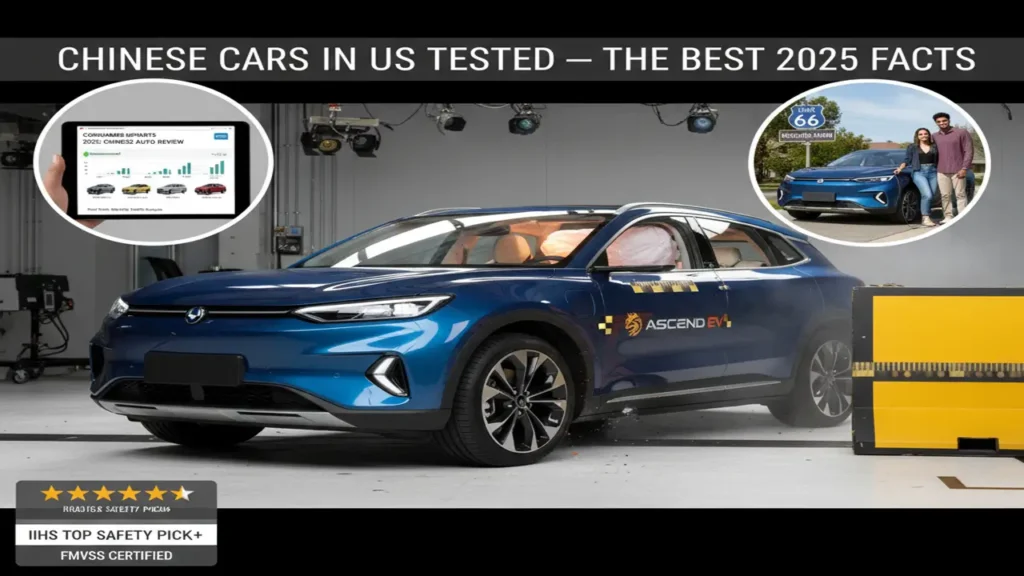
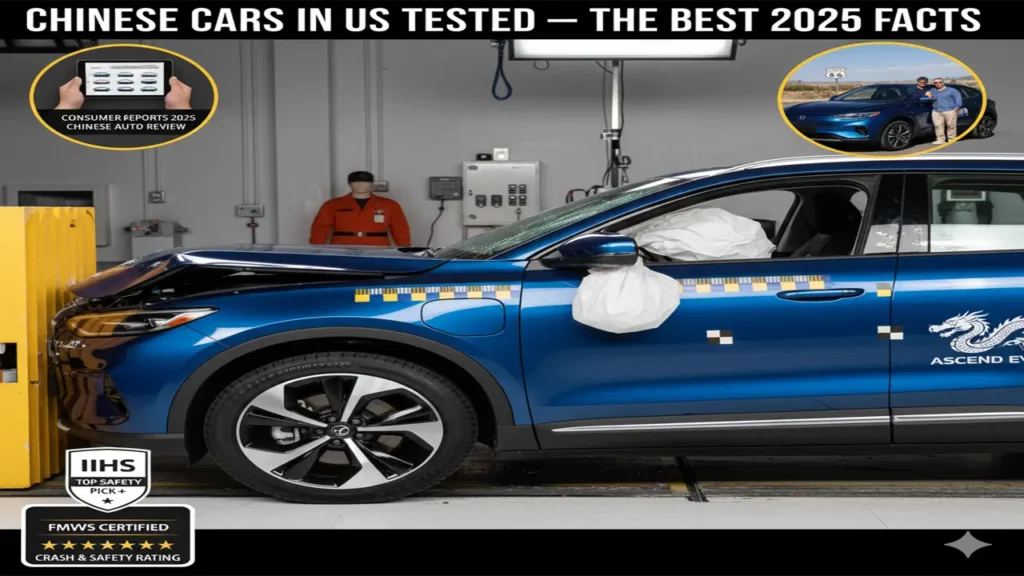
While FMVSS defines the minimum legal safety standard, the Insurance Institute for Highway Safety (IIHS) drives the industry toward excellence by setting a much higher, voluntary standard for crash safety. For Chinese cars in US tested models, a strong performance in the IIHS assessments is arguably more important for consumer confidence than simply meeting the regulatory minimum. The IIHS, funded by the insurance industry, conducts tests that are often more severe and reflective of real-world accident scenarios than government tests. These include the notoriously difficult Small Overlap Front test, which simulates a collision where only a small portion of the vehicle’s front end strikes a barrier or object, putting immense stress on the vehicle’s structure and occupant restraints.
To achieve a coveted Top Safety Pick or Top Safety Pick+ rating, a vehicle must earn a ‘Good’ rating in a sequence of demanding tests, including the Moderate Overlap Front, Side Impact, Roof Strength, and Head Restraint evaluations. Furthermore, the IIHS crash test Chinese cars models will be judged on the effectiveness of their front crash prevention systems (vehicle-to-vehicle and vehicle-to-pedestrian) and the quality of their headlights. Headlight performance, rated as Good, Acceptable, Marginal, or Poor, is a key component of the overall IIHS rating, as poor illumination significantly contributes to nighttime accidents.
It is crucial for consumers to know how to interpret the IIHS ratings (Good, Acceptable, Marginal, Poor) and understand that a ‘Good’ rating is the gold standard, demonstrating superior protection. When evaluating Chinese cars in US tested claims, buyers must be vigilant: look only for official results posted on the IIHS website. Avoid relying on “garage tests,” foreign C-NCAP (Chinese New Car Assessment Program) results, or European Euro NCAP ratings, as the specific test protocols and requirements differ, especially for the Small Overlap test.
The full IIHS evaluation provides the essential, independent proof that a manufacturer has engineered their vehicle not just to be compliant, but to be demonstrably safe in a wide range of common, high-severity accidents—the key metric US buyers rely on.
Chinese cars in US tested — purchase and availability
The question of Can you buy a Chinese car in the USA is complex and depends heavily on the intended sales channel and the vehicle’s certification status. For Chinese cars in US tested models entering the market, there are three main pathways, each with different risks for the buyer:
- Official Sales (OEM Entry): The most consumer-friendly channel. A Chinese manufacturer (OEM) establishes a formal US subsidiary, invests in full FMVSS/EPA certification, sets up a US dealer network, and provides comprehensive warranty and parts support. This is the model used by every major global automaker. For 2025, this remains the safest but most complex path, often constrained by high tariffs and political scrutiny.
- Private/Gray Market Import: This is generally not viable for new models. The US has a 25-year import rule, meaning vehicles not manufactured to FMVSS standards can only be imported once they are 25 years old. The vast majority of new Chinese cars in US tested models are not exempt. Furthermore, the complexities of registering, insuring, and obtaining parts for a non-certified vehicle are immense and often lead to state-level registration refusal, leaving the buyer with a legally unusable vehicle.
- Indirect/Rebadged Sales: A Chinese OEM might produce a vehicle for a non-Chinese partner brand that has an established US presence (e.g., some Volvo or Polestar models, which are owned by Geely). In this scenario, the buyer is purchasing a US-certified vehicle through a trusted US-allied brand, minimizing the risk.
When a manufacturer does officially enter, consumers will need assurance on key ownership factors: Warranty, Service, and Parts. A standard 3-year/36,000-mile warranty is insufficient without a comprehensive, authorized service network capable of handling complex EV powertrains and advanced ADAS systems. Buyers must verify the existence of local certified repair centers and a reliable supply chain for spare parts before committing to a purchase of any officially imported Chinese cars in US tested model. Risks associated with the gray market, such as fraudulent certifications or inability to obtain proper title/registration, are significant and generally outweigh any initial cost savings.
Chinese cars in US tested — EV import cost
Understanding the Import Chinese EV to USA cost requires looking past the vehicle’s initial Factory-Outlet-Price (FOB) and factoring in the multi-layered process of homologation, logistics, and compliance that dramatically transforms the Total Cost of Ownership (TCO). For any Chinese cars in US tested for legal sale, the basic cost structure is as follows:
- Procurement and Logistics: This includes the FOB price, plus ocean freight (shipping costs, which can fluctuate wildly), marine insurance, and US port/customs brokerage fees. These costs add thousands of dollars to the base price of the vehicle before it even clears customs.
- Certification and Conversion (Homologation): This is the single largest non-tariff-related hurdle for an EV not initially designed for the US market. The manufacturer (or a registered importer) must pay for extensive testing to ensure FMVSS and EPA compliance. This can involve crash-testing several vehicles and potentially re-engineering components (e.g., lighting, battery protection, software compliance). The cost of this process can range from tens of thousands to hundreds of thousands of dollars per model line, which is ultimately amortized into the final retail price.
- Tariffs and Duties: (Detailed in the next section) The current US tariff regime adds a significant percentage (e.g., over 27.5% combined) to the customs value of the vehicle, dramatically increasing the landed cost.
- Domestic Logistics and Distribution: Once legally in the US, the vehicle must be transported from the port to the dealer network or distribution centers, incurring rail or trucking fees.
- Dealer Markup: The final retail price includes the dealer’s margin, which must cover marketing, service infrastructure, and administrative costs.
For a mid-sized Chinese cars in US tested EV with a $25,000 FOB price, the final TCO for the owner in the first year (factoring in the tariffs, logistics, and the required cost of compliance testing) could easily push the final MSRP above $35,000 to $40,000. This calculation excludes the potential difficulty of finding affordable insurance and the higher depreciation risk associated with a new brand without an established resale market.
Chinese cars in US tested — rates and prices
The most significant immediate financial barrier for Chinese cars in US tested models is the current structure of US tariffs and duties. As of the 2025 planning window, vehicles imported from China are subject to a standard US automotive duty of 2.5%, plus a substantial Section 301 tariff, which has historically been set at 25% for most goods, including vehicles. This combined rate of approximately 27.5% applies to the declared customs value of the vehicle, fundamentally transforming the final retail price (MSRP).
This tariff regime has a cascading effect on pricing and market viability. For an EV with a production cost (Customs Value) of $30,000, the US tariffs on Chinese EVs 2025 alone would add $8,250 in taxes at the border. This vehicle now lands in the US for $38,250 (excluding freight, conversion, and port fees). By the time it reaches the consumer, the resulting MSRP is significantly higher than the domestic target price, often placing it in direct competition with established, tariff-free US, European, or Japanese models. This economic reality is why many Chinese manufacturers are exploring building factories in Mexico or the US, rather than directly importing finished cars, to bypass the tariffs.
The impact on residual (resale) value is also substantial. A vehicle whose high initial price is inflated by political tariffs carries a riskier residual value projection, as future tariff changes could drastically alter the replacement cost. There are three key scenarios that manufacturers and buyers are considering:
- Continuation of Tariffs: Prices remain inflated, limiting sales to niche or luxury segments willing to absorb the cost, or forcing Chinese brands to enter at a loss.
- Tariff Easing: A political change could reduce or eliminate the Section 301 tariff, allowing for massive price drops and highly competitive Chinese cars in US tested models in the mass market.
- Tariff Escalation: The US could increase tariffs further, effectively blocking all direct imports and making the gray market even riskier.
The tariff situation means that, for 2025, the competitive advantage of lower Chinese manufacturing costs is largely negated at the consumer level, making the final pricing of Chinese cars in US tested models a delicate balancing act between quality and political costs.
Chinese cars in US tested — software and connected vehicle risks
The modern vehicle is essentially a computer on wheels, relying on sophisticated telematics, Over-The-Air (OTA) updates, and advanced sensor data for operation. For Chinese cars in US tested for the US market, the security and privacy of this Connected vehicle ban Chinese cars 2027 risk is a major point of political and consumer scrutiny. Connected vehicles collect vast amounts of data—location, driving habits, biometric data, and diagnostic information—which is transmitted to the OEM’s servers. The core concern, especially in light of potential US government action, is the security and ownership of this data and whether it could be accessed by a foreign government.
In the US, regulatory scrutiny is focused on the potential for “foreign adversary” technology to compromise national security. This has led to discussions and proposed regulations, sometimes referred to as a potential 2027 “ban” or strict limitation, targeting connected vehicle technology from specific countries. Such limitations would likely focus on systems that control the vehicle’s operating system (OS) and telematics modules. If enacted, this could have severe consequences for Chinese cars in US tested and sold before the deadline, potentially making them unable to receive crucial software updates, security patches, or even utilize certain remote services necessary for operation.
Owners of any officially imported Chinese vehicle must prioritize privacy and security settings. Recommendations for owners include:
- Reviewing Privacy Policies: Scrutinizing the manufacturer’s data collection and retention policies to understand what data is collected and where it is stored.
- Limiting Telematics: Where possible, restricting or disabling non-essential data sharing features.
- Monitoring Updates: Ensuring all software updates are received via official, verified channels to prevent unauthorized access or system manipulation.
The long-term viability of Chinese cars in US tested depends on the OEMs’ ability to isolate and secure their data architecture to meet stringent US cybersecurity requirements. Any future restrictions on connected vehicle technology will significantly impact the functional and resale value of any affected models.
Chinese cars in US tested — brands and forecast
The list of Chinese car brands entering US market is constantly evolving, but the major players—backed by massive domestic sales and global expansion ambitions—are focusing on the US for long-term growth. Key brands include BYD (Build Your Dreams), a global EV powerhouse known for its battery technology; Nio, which targets the premium, tech-savvy segment with unique battery-swap technology; and Xpeng, known for its software and autonomous driving features. These companies represent a significant shift from the historical notion of low-quality imports, offering vehicles that are technologically competitive with Tesla, Hyundai, and European manufacturers.
The market entry strategy for Chinese cars in US tested models will likely focus on the high-volume EV segments, where their technological advantages and cost efficiencies can best counteract the current tariff burden. BYD, for instance, has a massive scale advantage that could enable aggressive pricing even with the tariffs, while Nio might focus on a subscription model for its premium vehicles and battery services. The main challenge for these brands is not the product itself, but the lack of brand recognition, the necessity of building an expensive, reliable service network from scratch, and the political/regulatory hurdles.
The prognosis for 2025–2027 is one of cautious, incremental growth. Direct sales volume of Chinese cars in US tested models will likely remain small in 2025 as manufacturers navigate the certification, dealer setup, and political landscape. We expect:
- 2025: Pilot fleet programs, establishment of US headquarters, and the first official, independent US crash tests (IIHS/CR).
- 2026: Limited regional sales launch in EV-friendly states, focused initially on one or two key models.
- 2027 and Beyond: Potential for mass-market entry, contingent on tariff resolution and the successful establishment of a trusted service and warranty infrastructure.
For the US reader, the recommendation is to wait for verified data. Do not consider purchasing any gray market import. Focus exclusively on models that have undergone full FMVSS certification and have earned high marks in independent US testing by Consumer Reports and the IIHS. While the technology is exciting, the safe, long-term ownership experience hinges on service, parts, and compliance, which are only guaranteed with an official, fully committed US market entry.