M-HERO M817 is the model that proves Dongfeng’s rugged-luxury ambitions were never a one-car story. Launched in 2025 as the second flagship in the brand’s off-road family, it takes the military-inspired look of its bigger sibling and fits it into a more practical, more affordable body. It combines a hybrid powertrain of up to 912 horsepower, a fast-charging 800-volt battery system, and Huawei’s latest driver-assistance and cabin technology. The result is a vehicle that wants to be a weekend adventure machine, a daily commuter, and a technology showcase at the same time.
Many buyers have only begun to notice the brand, so this review covers all ten things worth knowing before you form an opinion. We start with where the model sits in the company’s line-up, then work through design, powertrain, off-road hardware, batteries, range, interior technology, driver assistance, rivals, and finally trims and pricing. Each section is built around figures from the manufacturer so you can compare the SUV against anything else on your shortlist. Whether you are an enthusiast tracking China’s premium export push or a shopper considering a rugged plug-in, the following ten sections should leave you well informed.
1. Introduction and Where the Model Fits
To understand this SUV, you first have to understand the company behind it. Dongfeng Motor is one of China’s oldest state-owned carmakers, with decades of experience building military and utility vehicles. In recent years it has spun that heritage into a dedicated premium off-road identity. That identity is Dongfeng M-HERO, a sub-brand created to compete with the Land Rovers, Mercedes G-Classes, and increasingly the high-end Chinese electrified 4x4s that have appeared since 2023.
The second flagship after the 917
The first model to carry the badge was the large and expensive 917, an imposing machine aimed at buyers who wanted the maximum in size and status. The newer model arrives as the second flagship, deliberately smaller and easier to live with. It is shorter, lighter, and priced lower than the 917, yet it keeps the same design philosophy and much of the same technology. Think of it as the version of the idea that more people can actually park, afford, and use every day.
A global name and a domestic one
Inside China the vehicle uses a slightly different naming convention from the one adopted for export. On international markets it is also known as MHERO 2, a label that positions it clearly as the second chapter in the brand’s story. That dual naming can be confusing when you read early reviews, so remember that the Chinese-market and export-market names refer to the same SUV with only minor equipment differences.
Why it matters
The strategy behind it is clear. Dongfeng wants to show that a traditional manufacturer can compete with newer technology-first brands by borrowing the best of both worlds. It uses the rugged, body-on-style visual language that buyers associate with serious off-roaders, and it pairs it with electrification and software from the likes of Huawei and CATL. That combination is what makes the model interesting, and the rest of this article explains how each piece fits together.
2. M-HERO M817 Design: The Mengshi M817 Exterior and Dimensions
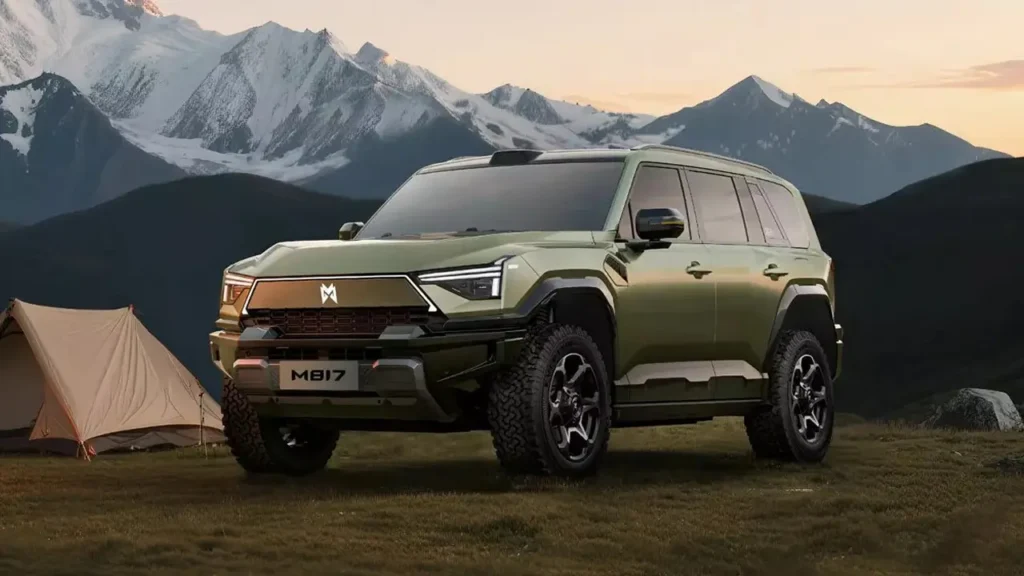
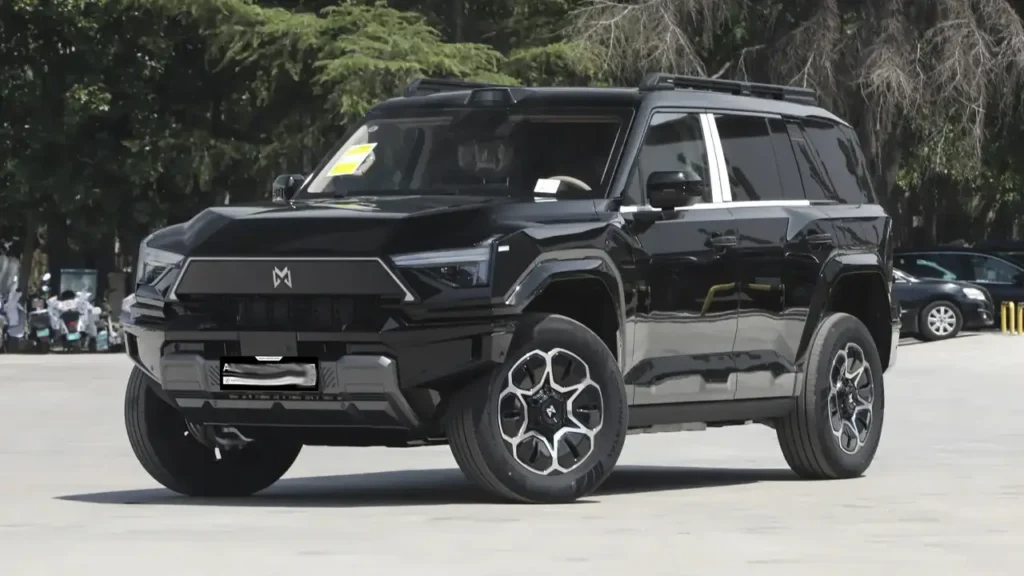
The styling is the first thing you notice, and it is deliberately uncompromising. Dongfeng calls the approach Heroic Soul Aesthetics 2.0, a design language built around the idea of combat armor. Flat, muscular surfaces run along the doors and hood, giving the body the look of plates bolted over a skeleton rather than smooth sheet metal wrapped in curves. In its home market the vehicle is sold as the Mengshi M817, and that Chinese name, which evokes a fierce warrior, fits the visual character perfectly.
Armor-style surfaces and protective hardware
At the front, a closed grille carries an illuminated logo, a nod to the electrified powertrain underneath. The bumpers are massive and fitted with visible protection, suggesting that the designers expect owners to drive over rocks and through ruts rather than park outside restaurants. Squared-off wheel arches, a tall beltline, and a near-vertical tailgate all reinforce the sense of strength. Even the lighting signature looks purposeful, with slim horizontal graphics that keep the front end from feeling like a cartoon.
Size and proportions
The dimensions explain why this model is easier to live with than its larger relative. It measures about 5,100 mm in length, 1,998 mm in width, and roughly 1,900 mm in height, riding on a 3,005 mm wheelbase. That makes it a true full-size SUV, but not an oversized one. The long wheelbase helps interior space and ride stability, while the width stays just under two meters, which is useful in narrow European streets and car parks.
How it looks in person
Photographs tend to exaggerate how boxy it appears. In person the surfaces are more nuanced, with subtle creases and sculpted shoulders that catch light well. A range of bright paint colors, including a standout yellow, make the design feel playful rather than purely militaristic. For buyers who want a vehicle that signals capability before the engine even starts, the exterior does an excellent job.
AndreevWebStudio.com
Professional web development and design services. Custom WordPress sites, landing pages, e-commerce solutions, and 3D printing content creation for businesses and creators.
- • WordPress Development
- • Custom Web Design
- • E-Commerce Solutions
- • 3D Printing Content
3. Powertrain: PHEV and EREV Performance
Underneath the armor sits a sophisticated electrified drivetrain. Dongfeng offers the SUV with a combination of a small turbocharged petrol engine and electric motors on both axles, delivering all-wheel drive through electronics rather than a heavy mechanical transfer case. Depending on the market and model year, the engine is a 1.5-liter turbo, while some 2026 versions move to a 2.0-liter unit. The layout can operate as a plug-in hybrid or, in range-extender configurations, with the petrol engine acting mainly as an on-board generator.
Output and acceleration
Power depends heavily on the version you choose. Base cars start at around 687 horsepower, which is already far beyond what most family SUVs deliver. Top versions climb to a remarkable 912 horsepower, a figure usually reserved for performance saloons and hypercars. With that output the manufacturer claims a 0 to 100 km/h time of 5.2 seconds, which is quick for a vehicle of this size and weight.
M-HERO M817 specs and how the dual-motor system works
Looking closely at the M-HERO M817 specs, the secret is the pairing of a motor at the front and another at the rear. Because the two units are controlled by software, torque can be shifted between axles in milliseconds, helping the vehicle claw forward on loose surfaces and remain stable on wet tarmac. There is no need for a traditional driveshaft tunnel, which frees up interior packaging and reduces mechanical losses. Drivers also get the instant response that electric torque provides, so overtaking and pulling away from junctions feel effortless.
Driving modes and refinement
Several drive modes alter throttle response, regenerative braking, and the behavior of the petrol engine. In electric-priority mode the vehicle can run silently for short trips, while hybrid mode keeps the battery topped up for longer journeys. The engine is designed to operate in its most efficient range, which keeps noise and vibration well controlled. For anyone worried that a hybrid might feel compromised, the numbers and the engineering strongly suggest otherwise.
4. Off-Road Arsenal and Capability
The M817 is a serious plug-in hybrid off-road SUV, and its hardware list supports the claim far better than most rivals in the segment. Many modern crossovers use rugged styling as decoration, but here the engineering follows the appearance. The vehicle is built for situations where a normal family car would be stranded, from muddy forest tracks to rocky mountain passes and sandy desert routes.
Intelligent torque distribution
The electric dual-motor setup works as an intelligent differential system. Sensors monitor wheel speed, steering angle, and slip, and the software redistributes torque in real time to the wheels with the most grip. This approach is faster and more precise than a mechanical center differential. Combined with terrain modes, it lets the driver select a setting for mud, snow, sand, or rock and trust the vehicle to adjust throttle and braking accordingly.
Adjustable ride height and wading
An adjustable air suspension lifts or lowers the body between 220 and 300 millimeters of ground clearance. At the lowest setting the SUV is stable and aerodynamic on highways, while at the highest setting it clears obstacles that would destroy the underbody of an ordinary crossover. Water crossings are no problem either, because the vehicle can wade through up to 800 millimeters of water. That figure is competitive with traditional off-road icons and much higher than most electrified vehicles dare to quote.
Maneuverability on tight trails
Size can be a handicap off-road, so Dongfeng has worked on agility. The turning radius is just 5.2 meters, remarkably tight for a vehicle more than five meters long. Rear-wheel steering assistance, where fitted, further helps in narrow switchbacks and urban parking. Together these features make the SUV feel smaller than it is, both on a trail and in a supermarket car park.
Real-world confidence
Specifications are one thing, but buyers care most about confidence. Strong approach and departure angles, protective skid plates, and robust suspension geometry give the vehicle an authentic character. It does not need a snorkel or a lift kit to take on serious terrain, which is rare in a plug-in at this level.
5. How the M-HERO M817 Uses the CATL Freevoy Battery and 800V Charging
Battery technology is where this model separates itself from older off-roaders. The pack comes from CATL, the world’s largest battery maker, and uses its Freevoy platform, a family of cells designed specifically for hybrid and range-extended vehicles. The CATL Freevoy battery is optimized for high power output, fast charging, and long life, all qualities that matter in a heavy, high-performance SUV.
Pack options
Buyers can choose between several capacities. The base version uses a lithium iron phosphate (LFP) pack of 31.7 kWh, which is durable and relatively affordable. Moving up, the Max+ trim gets a more advanced hybrid sodium-lithium-ion pack of 50.4 kWh that offers better cold-weather performance and higher energy density. For 2026 model-year versions, capacity can reach as high as 62.5 kWh, extending electric range further still.
800-volt architecture
The vehicle runs on an 800-volt electrical system, the same approach used by high-end performance EVs. Higher voltage reduces heat, allows thinner cables, and supports faster charging without damaging the cells. With 6C charging capability, the pack can go from 30 percent to 80 percent in as little as 9.6 to 15 minutes, depending on the battery and the charger. That is roughly the time it takes to enjoy a coffee and use the restroom, which removes much of the anxiety that surrounds plug-in ownership.
Durability and safety
Heavy off-road use puts extra stress on a battery, so protection matters. The pack is housed in a reinforced casing with underbody shielding and advanced thermal management. Cells are designed to remain stable under high temperatures and heavy loads, and the company has emphasized safety testing. For owners who plan to use the vehicle in remote areas, such protection is not a luxury but a necessity.
6. Range and Expedition Autonomy
Real-world usability depends on how far you can drive and how easily you can refuel. Here the SUV benefits from its hybrid layout, which offers two energy sources instead of one. In daily use you can plug in at home and cover commutes on electricity alone, while on long trips the petrol engine removes any fear of running out of charge in a remote area.
Electric-only distance
Depending on the battery fitted, pure-electric range ranges from 140 to 215 kilometers on the CLTC cycle. CLTC figures are more generous than European WLTP numbers, so real-world results will be lower, but the vehicle should still cover most daily journeys without using fuel. For city drivers and commuters who charge regularly, that means petrol consumption can be almost negligible.
Total range
Where the vehicle really shines is combined range. With a full battery and a full fuel tank, Dongfeng quotes between 1,300 and 1,365 kilometers. That is enough for a week of commuting or a long cross-country drive without a refuel stop. Few traditional large SUVs can match that distance, and no pure battery-electric rival comes close.
Power for camping and work
The SUV also offers vehicle-to-load (V2L) functionality with up to 6 kW of external output. That is enough to run a camping kitchen, power tools at a job site, or even support a small campsite during a storm. Owners can treat the vehicle as a mobile generator, which broadens its appeal well beyond ordinary transportation. Combined with the large fuel tank and quick charging, the M-HERO M817 range makes this one of the most expedition-ready plug-in SUVs available today.
AutoChina.blog
Your trusted guide to Chinese automotive technology. Expert reviews, comparisons, and insights on electric vehicles, hybrids, and innovative automotive solutions from China’s leading manufacturers.
- • EV & Hybrid Reviews
- • Tech Comparisons
- • Industry News & Trends
- • Buying Guides
7. Digital Cockpit and Interior Comfort
After the tough exterior, the cabin comes as a pleasant surprise. Dongfeng has focused on contrast, so the harsh appearance outside gives way to a calm, premium interior with high-quality materials and carefully designed surfaces. The layout is a five-seat configuration, which keeps legroom generous for adults in every row and prevents the compromises that three-row crossovers often impose.
Space and practicality
Luggage capacity is substantial, with 828 liters available behind the rear seats. Fold the seats down and the space grows into a cargo area suited to camping equipment, bikes, or large pieces of luggage. The low load floor and wide tailgate opening make loading easier, and storage cubbies throughout the cabin help keep small items organized.
HarmonyOS cockpit experience
The centerpiece of the interior is the HarmonyOS cockpit, developed with Huawei and built on its Harmony Space 5 platform. Dual screens dominate the dashboard, with one serving as the instrument display and another handling infotainment. The system is quick, fluid, and familiar to anyone who has used a modern Huawei smartphone or tablet. Because the M-HERO M817 driver’s seat is designed around this software, key functions are within easy reach, with logically arranged menus and minimal button clutter. Ergonomics feel thought through rather than improvised.
Voice assistant and connectivity
An AI-based voice assistant handles navigation, climate, media, and vehicle settings through natural speech. It can understand context and follow multi-step commands, so you can say that you feel cold and expect the cabin temperature to adjust. Over-the-air updates keep the system current, which means features can improve long after delivery. Seamless integration with phones and other devices rounds out a cockpit that feels more like a premium tech product than a traditional vehicle interior.
8. Intelligent Systems and Huawei Autopilot
Driver assistance is another area where the SUV punches above its price. Dongfeng has integrated Huawei’s fourth-generation system, branded Huawei Qiankun ADS 4.0, which represents the company’s most advanced approach to assisted and semi-autonomous driving. It is responsible for much of the vehicle’s active safety and convenience technology.
Sensors and perception
The vehicle relies on a combination of cameras, radar, ultrasonic sensors, and in some versions lidar to build a three-dimensional picture of its surroundings. In the first stage of the system, the M-HERO M817 uses these sensors and radars to detect vehicles, pedestrians, cyclists, and obstacles at long range and in poor visibility. Redundant sensing improves reliability, because if one sensor is blinded by glare or dirt, others can fill the gap. That is particularly important for a vehicle that may drive on dusty trails or in heavy rain.
Highway, urban, and parking assistance
On highways the system can manage speed, maintain lane position, and perform lane changes under driver supervision. In urban environments it handles traffic lights, junctions, and congestion with increasing sophistication. Automated parking can steer the SUV into tight spaces or even summon it from a parking spot, which is a genuine benefit for a vehicle of this size. Active safety features such as automatic emergency braking and collision avoidance operate constantly in the background.
Off-road assistance
Some of the system’s tools are tuned for rough terrain, including transparent-chassis camera views that help drivers place wheels over obstacles. These features make technical trails less intimidating for newcomers while still giving experienced drivers full control. Importantly, the driver remains responsible at all times, so the system should be viewed as a very capable assistant rather than a chauffeur.
9. Comparison with Rivals in the Premium Segment
Any new luxury vehicle must justify itself against established competition, and this one faces several strong opponents. The most obvious comparison is internal, against the larger and more expensive 917, followed by external rivals such as the BYD Yangwang U8 and the Land Rover Defender or Discovery.
Against the M-Hero 917
The 917 is bigger, more opulent, and more expensive, designed for buyers who want maximum presence. The M817 gives up some size and perhaps a little exclusivity, but it gains agility, efficiency, and a much more attractive price. For most families, the smaller model is the more sensible choice, and it still delivers nearly the same technology package.
Against the BYD Yangwang U8
The Yangwang U8 is a pure electric-focused flagship with extreme engineering, including the ability to float and rotate in place. It is also dramatically more expensive. Dongfeng’s alternative is easier to afford and offers far greater flexibility through its hybrid layout. Not every buyer needs the ultimate in spectacle, and many will prefer the practicality of a vehicle that can refuel in minutes anywhere in the world.
Against Land Rover
Land Rover remains the benchmark for premium off-road capability, with a legendary heritage and a vast dealer network. Yet in terms of raw power, electrified technology, and equipment per pound or dollar, the challenger looks extremely competitive. As a luxury electric 4×4, it offers more horsepower, faster charging, and a more advanced digital cabin than most petrol-powered rivals. The trade-off is brand heritage, resale history, and long-term service coverage, which Dongfeng must still prove outside China. The M-HERO M817 wins on power-to-weight and technology, while the established players win on pedigree.
Where it stands
The overall picture is of a vehicle that offers exceptional value on paper. It will not convince everyone, because brand perception matters in this segment, but buyers who prioritize hardware and features have a strong reason to take it seriously.
10. M-HERO M817 Price, Trims, and Final Verdict
Pricing and equipment determine whether an impressive specification sheet turns into a sensible purchase. The SUV is offered in several trims, each building on the previous one in terms of battery capacity, power, and comfort features, so it is worth understanding the differences before choosing.
Trims and colors
The line-up generally includes Pro, Max, and Max+ versions. Pro is the entry point, with the smaller LFP battery and the lower power output. Max adds more equipment and performance, while Max+ brings the larger hybrid sodium-lithium-ion battery and the highest horsepower. Paint options include Kunlun White, Mingsha Yellow, and Root Black, alongside other shades that vary by market. The yellow in particular suits the vehicle’s adventurous character and helps it stand out from conventional luxury SUVs.
Pricing expectations
Prices vary by region because of import duties, homologation, and local equipment. On international markets, estimates start from around £55,000 or the equivalent of roughly $60,000. That is substantial money, but it undercuts many European rivals that offer less power and less technology. In China the cost is lower still, which is one reason the model has attracted such strong attention.
Who should buy it
This SUV suits drivers who want genuine off-road ability combined with modern technology and low running costs for daily trips. Families will appreciate the space, tech enthusiasts will love the cockpit and driver assistance, and adventurers will value the range and V2L capability. Buyers who prioritize a long-established badge or a vast dealer network may prefer to wait until Dongfeng’s international presence matures.
Final verdict
Overall, Dongfeng has built something unusually complete. It looks tough, drives quickly, charges rapidly, and carries technology that many luxury brands struggle to match. The main questions concern long-term reliability and international support, but the hardware is persuasive. For anyone shopping in the premium hybrid SUV space, this is a vehicle that deserves a test drive, and everything considered, the M-HERO M817 is an excellent choice.
Discover more from AutoChina
Subscribe to get the latest posts sent to your email.