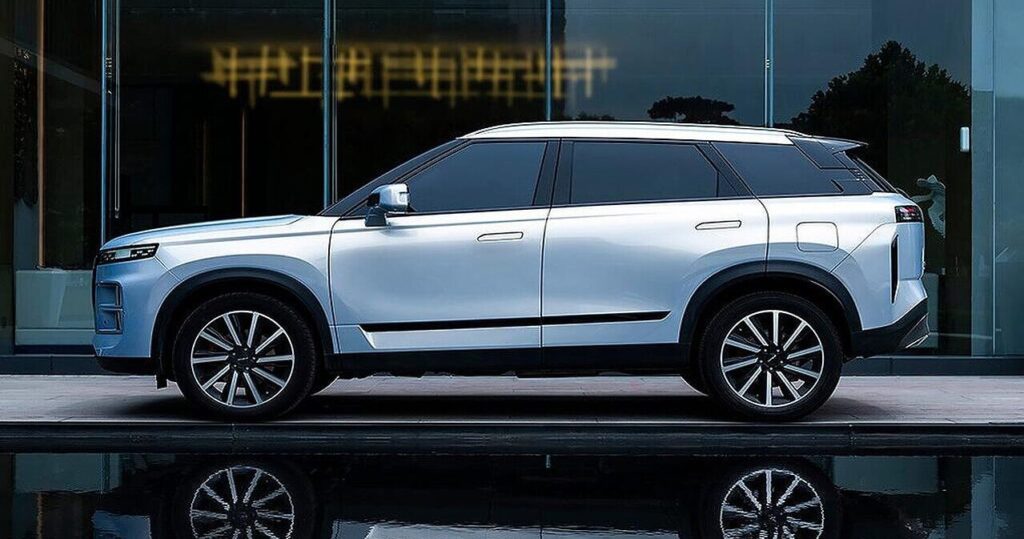
If you’ve been scrolling through EV news lately, you’ve probably noticed one name popping up more and more — the Aion V electric SUV. And here’s the thing: there’s a very good reason for that. This mid-size electric SUV from China’s GAC Group is not just another Chinese EV trying to undercut rivals on price. It’s making a genuine case to be one of the best-value family electric vehicles on the market today — not just because of what it costs, but because of how much it actually delivers.
We’re talking about a car with nearly a kilometre of WLTP range, 180kW DC fast charging, a cabin that folds flat into something close to a queen-size bed, vehicle-to-load (V2L) technology that can power your appliances off the grid, and a built-in fridge in the luxury trim. Yes, a fridge. In a car. That you’re driving your family to school in.
This full Aion V electric SUV review covers everything — from specs and battery range to camping mode and pricing in Europe. Let’s get into it.

1. Aion V 2026 Specs: Built on a Serious Platform
The second-generation Aion V debuted at the 2024 Beijing Auto Show and has since launched in Europe, Australia, Southeast Asia, and beyond. It’s built on GAC’s Architecture Electric Platform (AEP) 3.0, the same underpinnings that also support the Toyota bZ3X — a fact that tells you a lot about the engineering quality behind this car.
The Aion V measures 4,605mm long, 1,854mm wide, and 1,686mm high, with a 2,775mm wheelbase — placing it in the same size class as the Kia EV5 and Geely EX5, and notably larger than the BYD Atto 3.
A single powertrain option is available globally: a 75kWh LFP battery pack with a 400-volt architecture and a single front-mounted electric motor. Outputs are rated at 150kW and 210Nm of torque. In the Chinese domestic market, a higher-output 165kW/240Nm version is also available, along with a range-extended (EREV) variant.
Here’s a quick look at the core Aion V 2026 specs:
| Specification | Detail |
|---|---|
| Platform | GAC AEP 3.0 |
| Motor Power | 150 kW / 210 Nm (global); 165 kW / 240 Nm (CN) |
| Drive Type | Front-wheel drive |
| Battery | 75.26 kWh LFP (Magazine Battery 2.0) |
| 0–100 km/h | 7.9 sec (165kW) / 9.8 sec (150kW) |
| Top Speed | 160 km/h |
| Dimensions (L/W/H) | 4,605 / 1,854 / 1,686 mm |
| Wheelbase | 2,775 mm |
| Curb Weight | 1,860–1,880 kg |
| Seats | 5 |
| V2L | Yes (standard) |
The Aion V also comes with a 14.6-inch central touchscreen, wireless Apple CarPlay and Android Auto, an 8.8-inch digital instrument cluster, a panoramic glass roof with a power sunshade, and a 9-speaker audio system. Safety systems across both trims include AEB, adaptive cruise control, lane-keeping assist, blind-spot monitoring, and a 360° camera system. It’s also i-Size compatible for child seats — a point we’ll return to.
2. Aion V Battery Range: 510km WLTP That Holds Up in the Real World
Range anxiety is the one thing that still keeps many potential EV buyers up at night. The Aion V aims to put those worries to rest. The 75.26kWh LFP battery delivers a claimed 510km WLTP range — a figure that outperforms many rivals in this segment.
To put that in perspective: the 510km WLTP range compares favourably to the 420–425km offered by rival BYD and MG models.
Even more reassuring is how the Aion V battery range holds up in real-world conditions. One test recorded consumption as low as 13.6kWh/100km, suggesting the 510km WLTP claim could be genuinely achievable in real-world driving. In a Singapore test, a reviewer recorded 17.4kWh/100km — very close to the official 17.2kWh/100km figure. In China, the top-spec 90.2kWh variant claims up to 750km CLTC range, which would translate to approximately 615km on WLTP.
| Model | Battery | WLTP Range |
|---|---|---|
| Aion V (global) | 75.26 kWh | 510 km |
| BYD Atto 3 | 60.5 kWh | ~420 km |
| MG ZS EV | 72.8 kWh | ~425 km |
| Geely EX5 | 69.9 kWh | ~440 km |
The battery itself is GAC’s Magazine Battery 2.0 — an LFP chemistry pack with dual-layer liquid cooling and flame-retardant electrolytes. According to GAC, the battery maintains 95% capacity after 1,600 charge cycles, making it one of the more durable packs in the segment. GAC backs this confidence with an 8-year/200,000km battery warranty.
3. Aion V Fast Charging: 10–80% in 24 Minutes
This is where the Aion V genuinely impresses, even against pricier rivals. The Aion V supports a peak DC charge rate of 180kW, with GAC claiming a 10–80% top-up in just 24 minutes.
When charging from 30–80%, that can drop to just 16 minutes on a compatible 180kW charger. For AC home charging, an 11kW onboard charger provides a full charge in approximately 8.5 hours — perfectly overnight.
To put the Aion V fast charging performance in context, the 24-minute 10–80% charging speed is faster than what electric SUVs from many other Chinese manufacturers offer at this price point. The LFP chemistry also means you can safely charge to 100% regularly without degrading the battery, which is a practical everyday advantage over NMC packs that prefer to be kept below 80%.
| Charging Type | Max Power | Time |
|---|---|---|
| DC Fast Charge (10–80%) | 180 kW | ~24 min |
| DC Fast Charge (30–80%) | 180 kW | ~16 min |
| AC Home Charging | 11 kW | ~8.5 hours (full) |
4. Aion V Interior Space: More Room Than You’d Expect
Here’s where the Aion V starts to separate itself from the crowd. This is a car that prioritises human space over anything else, and it shows. Rear passengers benefit from up to 1.1 metres of legroom — that’s a figure you’d expect in business class, not a family SUV.
The Aion V interior space story continues in the boot. Boot capacity stands at 427 litres with the rear seats up, expanding to 978 litres with the rear seats folded flat. The boot itself is a double-floored design with adjustable floor heights, allowing you to configure the cargo area depending on what you’re loading.
Up front, the Luxury trim adds a 6.6-litre built-in refrigerator in the centre console armrest. According to GAC, the fridge uses just 0.5kWh of battery power in 24 hours when set to 4°C — less than 1% of the total battery capacity. That’s impressive efficiency for a feature that feels like it belongs in a business lounge, not a family SUV.
The interior itself features real quality materials in the Luxury trim — faux leather seating, tray tables for rear passengers, a 14.6-inch infotainment touchscreen that’s bright and responsive, and a cabin that independent reviewers have consistently described as notably quiet, particularly at lower speeds. The Aion V is measurably quieter in the cabin than some direct rivals.

5. Aion V Camping Mode: A Proper Outdoor Partner
Here’s something you don’t see every day in a mainstream family SUV: a genuine, usable camping setup. When the rear seats fold flat, they create what GAC describes as a queen-size sleeping surface — and it’s not marketing fluff. Fold-flat seats that are claimed to create a queen-size bed are available on both trim levels.
The front seats can also fold completely flat, extending the usable sleeping or lounging space even further. Combined with the 978-litre boot volume and the V2L power output (more on that below), the Aion V camping mode is one of the most compelling use-cases for this vehicle.
Imagine a scenario: you drive to a national park, fold everything flat, connect a portable fan or electric blanket via V2L, and sleep comfortably inside a quiet, well-insulated SUV. Add the built-in fridge (Luxury trim) for cold drinks and overnight provisions, and you’ve got a genuinely capable mini-camper — no tent required.
The heat pump comes standard on the European-spec model, meaning you can maintain cabin temperature without the massive energy draw of a resistive heater. That keeps overnight energy consumption low even in cooler weather, further extending your camping range.
6. Aion V V2L Technology: Your Car as a Power Station
Vehicle-to-Load (V2L) is the technology that lets you plug household appliances directly into your electric car and run them off the battery. The Aion V V2L technology comes standard across both trim levels — not as an optional extra.
This means you can, in practice, run a microwave, a small fridge, a laptop, a projector, or a set of camping lights directly from the Aion V’s battery. GAC confirms that the Aion V supports V2L capability for powering external domestic appliances.
The output is rated at 3.3kW via the external V2L connector — sufficient for most household appliances including a microwave (typically 700–1000W), a portable air conditioner, or a coffee maker. For reference, running a standard 1000W microwave for an hour would consume just 1kWh — roughly 0.2% of the battery. That’s genuinely useful on a camping trip, at a tailgate, on a job site, or during a power outage.
| Appliance | Typical Draw | Est. Run Time (75kWh) |
|---|---|---|
| Microwave (1000W) | 1.0 kW | ~75 hours |
| Laptop (65W) | 0.065 kW | 1,000+ hours |
| Built-in Fridge (Luxury) | 0.5 kWh/24h | 150 days |
| Electric Fan (50W) | 0.05 kW | 1,500+ hours |
This is what makes the Aion V so interesting as a crossover between a daily driver and a lifestyle tool. It’s not just a vehicle that takes you places — it can power your life when you get there. For a deeper dive into how V2L technology works across different EV platforms, smartchina.io has a thorough technical breakdown of the various system architectures currently used by Chinese manufacturers.

7. Aion V as a Family SUV: Safety, Comfort, and the Long Drive Test
Family SUV buyers want space, safety, comfort on long journeys, and practical features that make daily life easier. The Aion V ticks most of those boxes convincingly. GAC has submitted the Aion V for Euro NCAP testing and the company expects a strong result, noting the vehicle was designed with European family users specifically in mind.
Standard safety equipment across both trims includes adaptive cruise control, lane-keeping assistance, automatic emergency braking, blind-spot monitoring, and i-Size child seat compatibility — the international standard for safer child restraint anchoring. Seven airbags are also standard.
As an Aion V family SUV, the rear seating experience is particularly strong. The 1.1m of rear legroom means even tall adults won’t feel cramped, and those tray tables on the Luxury trim give kids a surface to use tablets, snacks, or books. The dual-zone climate control with heat pump keeps everyone comfortable regardless of the season. The panoramic glass roof (non-opening, with a motorised sunshade) adds a sense of airiness to what is already a genuinely spacious cabin.
On longer journeys, reviewers have consistently praised the Aion V’s cabin insulation and low road noise. The suspension — MacPherson struts at the front, torsion beam at the rear — is tuned firmly for comfort rather than sporty handling. The result is a smooth, unfussy motorway cruiser that won’t tire out its occupants over hundreds of kilometres.
The one area where the Aion V draws some criticism is its active safety alert system, which some reviewers have described as overly sensitive — issuing warnings more frequently than necessary. This is a calibration issue that may be addressed in future software updates, and is not unique to this vehicle among Chinese EVs.
8. Aion V Electric SUV Price and European Availability
Perhaps the most compelling part of the entire Aion V electric SUV story is the price. The Aion V launched in Europe at a starting price of €35,990, making it competitive against — and in many cases significantly cheaper than — established European and Korean rivals with comparable range and equipment.
In Australia, the Aion V is priced from AUD $42,590 for the Premium variant, with the Luxury trim just $2,000 more at $44,590 — placing it well below the Tesla Model Y (from $58,900) while offering comparable or superior range.
For the Aion V review Europe perspective: sales launched initially in Poland, Portugal, and Finland in September 2025, with distribution handled through Jameel Motors in Poland. GAC has set a target of 15,000 units in its first full year of European sales in 2026, rising to 50,000 vehicles annually by 2027 as market presence expands.
It’s worth noting that European pricing includes some additional tariffs applied to Chinese-built electric vehicles, which is why the €35,990 entry point is still a meaningful achievement. The European-spec model comes standard with a heat pump and the built-in console refrigerator, giving European buyers a slightly richer base specification than some other markets.
| Market | Starting Price | Notes |
|---|---|---|
| China | From ~129,800 CNY | Multiple battery options |
| Europe | From €35,990 | 75.3kWh, heat pump standard |
| Australia | From AUD $42,590 | Premium + Luxury trims |
| Singapore | Available from 2025 | Luxury trim, 75.3kWh |
9. Should You Buy the Aion V? The Final Verdict
So after all that — the specs, the range, the charging speed, the camping mode, the V2L microwave, the fridge, the queen-size bed, the 510 WLTP kilometres — what’s the verdict on this Aion V electric SUV review?
The honest answer: for most family buyers, the Aion V is genuinely hard to argue against.
Buy it if you:
- Need a practical, spacious family SUV with real-world range above 450km
- Want fast DC charging without paying Tesla prices
- Plan to use your car for occasional camping or outdoor trips
- Are looking for maximum equipment for the money in the mid-size EV segment
- Value a quiet, comfortable cabin over sporty driving dynamics
Think twice if you:
- Want engaging, dynamic handling — the Aion V is tuned firmly for comfort and efficiency
- Need AWD or higher towing capability
- Are in a market where Aion hasn’t yet established a service and parts network
What makes the Aion V particularly compelling isn’t any single feature — it’s the combination of all of them at this price point. The 510km WLTP range alone would justify consideration. Add V2L, fold-flat seats, a built-in fridge, 24-minute rapid charging, and a solid safety suite, and you have an SUV that covers virtually every use case a family could have.
It’s not perfect. The torsion-beam rear suspension can feel unsettled on poor surfaces, the active safety system can be overly alert, and the brand is still building its presence in Western markets. But these are manageable trade-offs against a genuinely compelling package.
GAC built the Aion V with the goal of making a global-standard electric SUV. The fact that Toyota’s Chinese joint venture uses the same AEP 3.0 platform is a significant quality signal — Toyota does not attach its technology to anything that doesn’t meet its engineering standards.
If you’re in the market for a family EV and you want the most space, the most technology, and the most range per euro or dollar spent — the Aion V deserves to be on your shortlist. Not just as a budget alternative, but as a genuine first choice.
For a full in-depth comparison with other large family EVs from China — including how the Aion V stacks up against models like the Li Mega in terms of interior volume and tech — check out the complete analysis at autochina.blog. And if you’re curious about the technical details of how V2L outputs are rated and compared across different platforms, smartchina.io has an excellent breakdown of the engineering behind these systems, while laptopchina.tech covers real power consumption figures for common devices when used in automotive V2L setups.
The king of space has arrived. And it brought a fridge.
If you’re interested in how Chinese innovation goes beyond electric vehicles and reshapes other industries, there’s another space worth exploring. From smart manufacturing to affordable high-performance machines, China is scaling fast. Discover cutting-edge models, comparisons, and expert insights at https://bestchina3dprinters.com/ and see how technology keeps evolving.
Discover more from AutoChina
Subscribe to get the latest posts sent to your email.