Remember when hitting 1,000 km on a single tank felt like winning the lottery? Yeah, those days are over. Welcome to 2026, where 1400km range EREV SUV comparison isn’t just a headline—it’s your new baseline. Chinese automakers have turned range anxiety into range bragging rights, and honestly? It’s getting ridiculous in the best possible way.
The best long-range EREV SUVs 2026 aren’t just stretching numbers—they’re rewriting what “road trip” means. We’re talking about vehicles that let you drive from Dublin to Prague without stopping for fuel. Or Beijing to Shanghai and back. Twice. With air conditioning on.
This isn’t marketing fluff. Extended Range Electric Vehicles (EREVs) have cracked a code that pure EVs and traditional hybrids couldn’t: unlimited range without the charging headache. And the Chinese brands leading this charge—Chery, Li Auto, Aito, Xpeng—are making Tesla’s Supercharger network look quaint.
For the complete breakdown of why EREVs are dominating China’s market right now, check out this deep dive on EREV vs BEV popularity—it explains the cultural and practical reasons behind this hybrid comeback.
Let’s dig into the numbers, because this 1400km range EREV SUV comparison reveals some genuinely wild engineering choices.
1400km range EREV SUV comparison: Spec Table (CLTC vs WLTP range conversion)
Here’s the reality check you need. All these range figures come from CLTC (China Light-duty Vehicle Test Cycle), which is… let’s call it “optimistic.” Think of CLTC as that friend who rounds 8 km runs up to 10 km. To get real-world WLTP-equivalent numbers, knock off about 15-25%.
| Model | Powertrain | Battery (kWh) | EV Range (CLTC) | Total Range (CLTC) | Fuel Tank (L) | Price (CNY) |
|---|---|---|---|---|---|---|
| Chery Fulwin T11 | EREV (1.5T generator) | 33.68 / 39.92 | 180-220 km | ~1400 km | ~60L | 159,900-189,900 |
| Li Auto L9 | EREV (1.5T generator) | 44.5 | 215 km | 1412 km | 65L | 429,800-469,800 |
| Aito M7 | EREV (1.5T generator) | 40-52 | 240-300 km | 1690 km | 70L | 249,800-329,800 |
| Xpeng G7 EREV | EREV (1.5L generator) | 43.2 | 205 km | 1704 km | 72L | 269,900-319,900 |
The CLTC vs WLTP range conversion matters because you’re not buying a spec sheet—you’re buying miles. Under WLTP testing (used in Europe), these same vehicles would probably claim 1,050-1,300 km total range. Still absurd. Still eliminates range anxiety. Just more honest.
What makes this 1400km range EREV SUV comparison fascinating is how differently each brand approaches the battery-versus-fuel-tank equation. Some prioritize pure EV range for daily commutes. Others just want to embarrass gas stations.
1400km range EREV SUV comparison: Chery Fulwin T11 Breakdown (Chery Fulwin T11 EREV specs)
The Chery Fulwin T11 EREV specs position this as the “people’s champion” of long-range SUVs. Starting at 159,900 yuan (roughly $22,000 USD), it undercuts the luxury brands by half while delivering the same party trick: you basically never need to charge it if you don’t want to.
Here’s what Chery engineered: two battery options (33.68 kWh or 39.92 kWh), yielding 180-220 km of pure electric range under CLTC. That’s your daily commute covered on electrons alone. The 1.5-liter turbocharged engine never directly drives the wheels—it’s purely a generator, keeping the battery topped up and the electric motors humming.
Combined range? That magical 1400 km figure, achieved by marrying the battery’s EV range with a ~60-liter fuel tank feeding the range extender. In real-world terms, you’re looking at maybe 1,100-1,200 km if you’re driving like a normal human (not hypermiling at 90 km/h with the AC off).
What’s genuinely clever: the Fulwin T11 treats gasoline like a portable power bank. You’re always driving on electric motors—smooth, quiet, instant torque. The gas engine just hums quietly in the background when the battery dips below 20%, keeping everything topped up. No transmission. No gear shifts. No range anxiety.
For context on where the Fulwin T11 fits in China’s broader hybrid landscape, this guide to Chinese hybrid SUVs shows how EREV tech is trickling down from luxury to mass-market.
The 1400km range EREV SUV comparison gets spicy when you realize Chery achieved 98% of Li Auto’s range at 35% of the price.
1400km range EREV SUV comparison: Li Auto L9 Benchmark (Li Auto L9 1412 km range)
The Li Auto L9 1412 km range isn’t just a number—it’s a philosophy. Li Auto essentially asked: “What if we took everything annoying about owning a car and deleted it?” Range anxiety? Gone. Charging station hunts? Optional. Seven-seat comfort? Standard.
This thing is the benchmark because Li Auto was first to the 1,400 km party and nailed the execution. The L9 rocks a 44.5 kWh battery (larger than most PHEVs) paired with a 65-liter fuel tank. You get 215 km of pure EV range for the school run and grocery trips, then 1,412 km total when you add the range extender’s contribution.
But here’s why the L9 costs 430,000-470,000 yuan: it’s not just about range. We’re talking refrigerated center console, three-screen cockpit, air suspension, Dolby Atmos audio, and a second-row seat that reclines more than business class. Li Auto positioned this as a “mobile living room,” and somehow it doesn’t feel like marketing.
The EREV system in the L9 is impressively refined. The 1.5-turbo generator kicks in so seamlessly you’ll barely notice, and the dual-motor setup (front and rear) delivers all-wheel-drive confidence without the complexity of traditional 4WD systems.
In this 1400km range EREV SUV comparison, the L9 represents the luxury ceiling—proof that EREVs don’t have to compromise on anything except… well, nothing really. Unless you count “having to visit gas stations occasionally” as a compromise.
It’s the vehicle that convinced China’s upper-middle class that EREVs were the smart play. And the Li Auto L9 1412 km range remains the number everyone else is chasing.
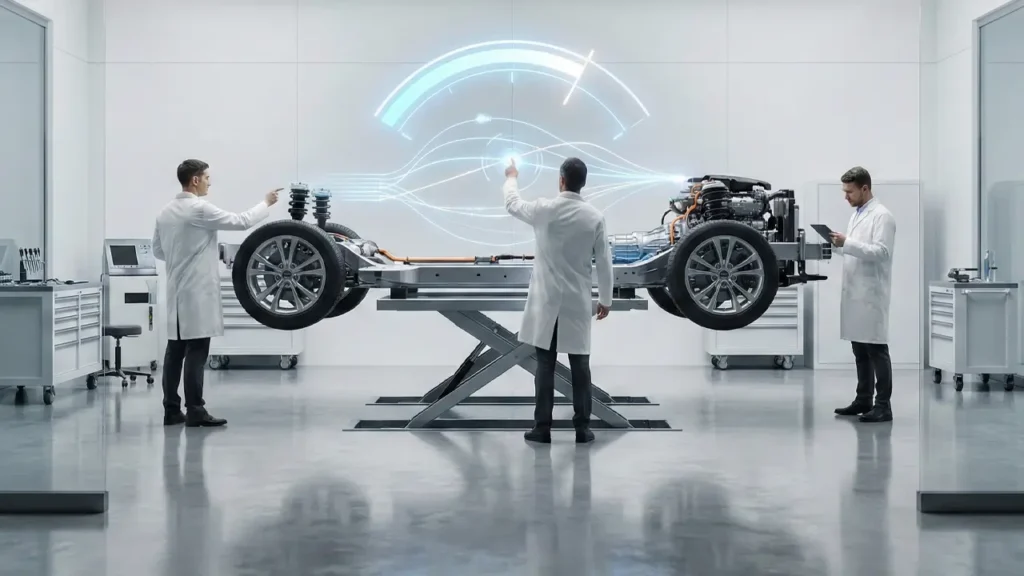
1400km range EREV SUV comparison: Aito M7 as the Range Escalation (Aito M7 1690 km range extender)
Just when you thought 1,400 km was ambitious, Aito (Huawei’s automotive brand) showed up with the M7 and said “hold my charging cable.” The Aito M7 1690 km range extender spec is almost comedic—that’s driving from Paris to Warsaw on a single tank and battery charge.
How’d they do it? Bigger battery options (40-52 kWh), bigger fuel tank (70 liters), and probably some aerodynamic wizardry. The newer M7 variants claim 240-300 km of pure EV range, meaning most owners will rarely burn gasoline unless they’re on a proper road trip.
This 1400km range EREV SUV comparison reveals that 1,400 km was just the threshold, not the ceiling. The M7 proved you could push past 1,600 km without resorting to hypermiling techniques or sacrificing interior space for extra fuel storage.
What makes the Aito M7 particularly interesting is the Huawei HarmonyOS integration. While other brands focus on mechanical range, Aito obsesses over the software experience—route optimization that accounts for charging availability, real-time range predictions that factor in weather and traffic, predictive energy management that pre-conditions the battery based on your calendar.
At 250,000-330,000 yuan, the M7 slots between Chery’s budget approach and Li Auto’s luxury positioning. You’re paying for Huawei’s tech ecosystem as much as the Aito M7 1690 km range extender capability.
In real-world use, owners report 1,300-1,500 km depending on driving style and conditions—still absurd, still eliminates the entire concept of range planning. The M7 essentially turned “how far can I go?” into an irrelevant question.
1400km range EREV SUV comparison: Xpeng G7 EREV Flex (Xpeng G7 EREV 1704 km range)
And then Xpeng entered the chat with the G7 EREV and its Xpeng G7 EREV 1704 km range claim, because apparently 1,690 km wasn’t enough. This is range wars on steroids, and we’re all here for it.
The G7 EREV runs a 43.2 kWh battery with 205 km of EV range, plus a generous 72-liter fuel tank. That tank size is key—at roughly 5-6 liters per 100 km when the range extender is running, you’re squeezing another 1,200-1,400 km out of the gasoline alone.
Who needs 1,704 km of range? Three groups: long-haul highway warriors who genuinely drive 500+ km regularly, people in regions where charging infrastructure is sparse (rural western China, for example), and anyone who derives psychological comfort from never thinking about fuel ever.
The G7 also brings Xpeng’s XNGP autonomous driving system, which—when combined with this range—creates an interesting proposition: semi-autonomous highway cruising for genuinely long distances without refueling stops interrupting the flow.
In this 1400km range EREV SUV comparison, the Xpeng G7 EREV 1704 km range represents peak excess. It’s the automotive equivalent of buying a phone with a week-long battery life. Objectively unnecessary for 95% of users. Subjectively glorious for peace of mind.
Priced at 270,000-320,000 yuan, Xpeng is betting that range-obsessed buyers will pay a premium to lead the spec sheet wars. Based on Chinese forum discussions, they’re not wrong—people love flexing their range numbers.
1400km range EREV SUV comparison: Why the Fuel Tank Is Back (EREV vs PHEV fuel tank size)
Here’s the irony that makes this whole 1400km range EREV SUV comparison fascinating: we spent a decade shrinking fuel tanks in hybrids, and now we’re supersizing them again. The EREV vs PHEV fuel tank size difference tells the whole story.
Traditional PHEVs (Plug-in Hybrids) run 40-50 liter tanks because they still use the engine for direct propulsion. Smaller battery, more engine use, less tank needed. Most PHEVs hit 600-800 km total range and call it a day.
EREVs flipped the equation: big battery (35-52 kWh) for pure EV daily driving, big tank (60-72 liters) for extended highway range. The engine never drives the wheels—it’s just a generator. So efficiency is optimized differently, and bigger tanks suddenly make sense.
Why does this matter? Economics. Battery capacity costs about $130-150 per kWh. Fuel tank capacity costs… basically nothing. To get an extra 200 km from a bigger battery, you’d need 30-40 kWh more capacity—that’s $4,000-6,000 in cost. To get 200 km from a bigger fuel tank? Add 10-15 liters of capacity for maybe $50 in manufacturing cost, then pay $15-20 to fill it with gas.
The fuel tank is back because it’s the cheapest range extender humanity ever invented. And in this 1400km range EREV SUV comparison, the manufacturers with the biggest tanks (Aito at 70L, Xpeng at 72L) claim the biggest total range numbers. Shocking precisely no one.
There’s humor here: the gasoline industry spent years watching EVs gain ground, and now EREVs are keeping gas stations alive by making fuel tanks cool again. The battery isn’t offended—it still handles the important work (daily driving, smooth power delivery, zero local emissions). The tank just plays supporting actor for road trips.
Understanding the EREV vs PHEV fuel tank size philosophy explains why China’s range numbers look ridiculous compared to Western PHEVs: different priorities, different engineering solutions.
1400km range EREV SUV comparison: The Engineering Tradeoff (battery capacity vs fuel tank tradeoff)
Let’s talk about the battery capacity vs fuel tank tradeoff, because it’s not as simple as “more of both equals better.” There’s actual engineering tension here.
Key characteristics every EREV balances:
- Battery size: Bigger battery = more EV-only range (daily driving covered) but adds weight, cost, and requires more powerful charging capability. Chery went conservative (34-40 kWh), Li Auto and Xpeng pushed higher (43-44 kWh), Aito offers up to 52 kWh for those who want maximum electric-only capability.
- Fuel tank size: Bigger tank = more total range but eats interior space and adds weight (fuel weighs ~0.75 kg/liter, so 70L is ~50 kg when full). Most Chinese EREVs settled around 60-72 liters—the sweet spot before you’re sacrificing cargo space.
- Aerodynamics: At highway speeds, drag matters enormously. The sleeker Xpeng G7 can stretch its range further than boxier SUVs with similar specs. Every 0.01 improvement in coefficient of drag saves 1-2% range at 100 km/h.
- Vehicle mass: Heavier vehicle = more energy to move it. The Fulwin T11 keeps weight under 2,200 kg; the L9 pushes 2,700 kg with all the luxury kit. That weight difference alone costs 10-15% range in real-world driving.
- Charging infrastructure access: Ironically, better charging networks enable bigger fuel tanks—if you can fast-charge the battery in 30 minutes when needed, you optimize for range-extender efficiency rather than pure EV capability.
Pros of the big-battery, big-tank approach:
- Genuine flexibility: EV mode for daily life, unlimited range for trips
- Lower operating costs than gas-only SUVs (electricity is 1/4 the cost of gas per km in China)
- Future-proof: charging infrastructure improves, you use less gas over time
- Performance: electric motors deliver instant torque and smooth power
- Reduced maintenance: range extender runs at optimal RPM, less wear than traditional engines
Cons of the big-battery, big-tank approach:
- Higher purchase price ($4,000-8,000 premium over traditional hybrids)
- Weight penalty affects handling and efficiency
- Complexity: you’re maintaining both electric and combustion systems
- Depreciation unknown: EREV resale values are still establishing themselves
- Charging discipline required: if you never plug in, you’re hauling a heavy battery for no reason
The battery capacity vs fuel tank tradeoff in this 1400km range EREV SUV comparison shows different philosophies: Chery optimizes for cost, Li Auto for luxury, Aito for tech integration, Xpeng for maximum spec-sheet bragging rights. No wrong answers, just different priorities.
For broader context on where automotive trends are heading in 2026, this analysis of China’s car trends highlights how “range without pain” has become the industry’s obsession.
1400km range EREV SUV comparison: Real Use + Reviews (range extender SUV real-world range)
Theory is fun. Reality is what you actually get when you’re stuck in traffic or blasting heat in winter. Let’s dig into range extender SUV real-world range based on owner forums and reviews.
City driving (Beijing/Shanghai traffic):
- Chery Fulwin T11: 150-180 km EV range, rarely needs the extender unless you forget to charge
- Li Auto L9: 180-200 km EV range, silky smooth in stop-and-go
- Aito M7: 200-250 km EV range depending on battery size, HarmonyOS energy management genuinely helps
- Xpeng G7: 170-190 km EV range, city efficiency is just okay due to weight
In urban use, all these vehicles basically function as pure EVs. The range extender is insurance you rarely file a claim on.
Highway driving (120 km/h cruise, climate control on):
- Fulwin T11: ~1,100 km total range, range extender efficiency around 5.5-6L/100km
- L9: ~1,200 km total range, but luxury features (air suspension, heavy build) cost efficiency
- M7: ~1,400 km if you’re gentle, ~1,200 km if you drive it spiritedly
- G7: ~1,450 km with disciplined driving, aerodynamics do help at speed
The 1400km range EREV SUV comparison shows highway is where total range claims get tested. Most owners report 80-85% of CLTC figures under sustained 110-120 km/h cruising.
Winter performance (-5°C to -15°C): This is the killer. Cold weather murders EV range, and EREVs aren’t immune. Battery capacity drops 20-30%, cabin heating draws serious power. Owner reports:
- EV-only range drops to 120-150 km even on the big batteries
- Range extender kicks in earlier and runs more frequently
- Total range still hits 900-1,100 km, but fuel consumption increases to 6.5-7.5L/100km
Towing (where applicable): Most of these aren’t rated for serious towing in China, but adventurous owners have tested:
- With 500-800 kg trailers, total range drops 25-30%
- EV range particularly hammered (down 40%), range extender works harder
- Still beats traditional SUVs on operating costs if you can charge overnight
FAQ: Your 1400km Range Questions Answered
What is an EREV SUV and how is it different from a PHEV?
An EREV (Extended Range Electric Vehicle) uses an electric motor for all propulsion—the gasoline engine never powers the wheels directly, it only generates electricity. A PHEV (Plug-in Hybrid) can use both the engine and electric motor to drive the wheels. EREVs feel like pure EVs with a built-in generator; PHEVs feel like traditional cars with electric assist. EREVs typically offer more EV-only range and better efficiency.
Is 1400km range realistic outside CLTC?
Realistically, expect 1,100-1,300 km under normal driving conditions—highway cruising at 100-120 km/h with climate control active. CLTC testing is optimistic and includes lots of low-speed cycles that favor electric efficiency. WLTP-equivalent range would be 75-85% of CLTC claims. Still, 1,100 km real-world range means Dublin to Munich without refueling, which is genuinely useful.
How much EV range do you actually use daily?
Most people drive under 60 km per day. With 180-220 km EV range on these EREVs, you’d charge maybe 2-3 times per week for typical commuting. Weekend warriors might use 100-150 km, still well within EV-only capability. The range extender becomes relevant mainly for monthly road trips or if you forget to charge for several days. Real-world EV usage is 70-90% of total driving for most EREV owners.
Does a bigger fuel tank beat a bigger battery for road trips?
For pure road trip capability, yes—fuel tanks are lighter, cheaper, and refill in 3 minutes versus 30+ minutes for fast charging. But for total cost of ownership, bigger batteries win because electricity is dramatically cheaper than gasoline per kilometer. The ideal is what these EREVs offer: enough battery for daily EV driving (saves money), enough tank for occasional long trips (saves time). Neither alone is optimal; the combination is brilliant.
Which is better: Chery Fulwin T11 or Li Auto L9 for families?
Depends on budget and priorities. Fulwin T11 offers 95% of the range capability at 35% of the price—it’s the smart money choice for value-focused families. Li Auto L9 justifies its premium with genuinely excellent second-row comfort, better sound insulation, superior tech integration, and luxury materials. If you’re doing 300+ km family road trips monthly, the L9’s extra refinement matters. For weekly grocery runs and occasional trips, the Fulwin T11 is plenty.
What should I check before buying a long-range EREV SUV?
First, verify home charging capability—EREVs work best when you can plug in overnight at home or work. Second, calculate your actual daily driving range to ensure the EV-only range covers it (otherwise you’re carrying a heavy battery you rarely use). Third, check local fuel costs versus electricity costs—in most markets, EVs cost 60-75% less per kilometer. Fourth, test drive in conditions you’ll actually face (highway speeds, cold weather if relevant). Finally, research warranty coverage for both battery and range extender components—these are complex systems, comprehensive coverage matters.
The range extender SUV real-world range data confirms what the specs promise: these vehicles genuinely eliminate range anxiety while offering EV-like daily driving. The 1400km range EREV SUV comparison isn’t just marketing—it’s a legitimate technological achievement.
1400km range EREV SUV comparison: Verdict — Who Should Buy What
After swimming through specs, real-world reviews, and engineering tradeoffs, here’s the 1400km range EREV SUV comparison verdict broken down by use case:
For city dwellers with occasional road trips (80% city, 20% highway): Aito M7 makes the most sense. The larger EV-only range (240-300 km) means you’ll spend weeks without burning gasoline, and the HarmonyOS integration genuinely improves the urban driving experience. When you do hit the road, that 1,690 km total range means you’re never hunting for charging stations in unfamiliar cities. Price is reasonable at 250,000-330,000 yuan, and Huawei’s tech ecosystem integrates with your phone seamlessly.
For frequent highway warriors (weekly 300+ km trips): Xpeng G7 EREV delivers maximum flexibility. That 1,704 km range isn’t overkill when you’re genuinely covering distance, and the XNGP autonomous features reduce highway fatigue significantly. The 72-liter tank means you can cross provinces without refueling anxiety. At 270,000-320,000 yuan, you’re paying for peace of mind and best-in-class range specs.
For families prioritizing space and luxury (6-7 seats, premium comfort): Li Auto L9 remains the benchmark. Yes, it’s 430,000-470,000 yuan, but you’re buying a mobile luxury lounge that happens to have 1,412 km range. Second-row recliners, third-row actual adult space, refrigerated storage, theater-quality audio—this is where the range extender format proves it can do everything a luxury SUV needs to do. Refined, comfortable, spacious, and you’ll drive past gas stations smugly for weeks.
For budget-conscious families who still want the EREV advantage: Chery Fulwin T11 is the obvious answer. At 160,000-190,000 yuan, it democratizes long-range EREV technology. You get 1,400 km capability, 180-220 km EV range for daily driving, and respectable build quality—all for half what the premium brands charge. It’s not luxurious, but it’s smart. Most buyers don’t need heated massage seats; they need reliable transport that doesn’t cost a fortune to run. The Fulwin T11 nails that brief.
The dark horse recommendation: If you value technology integration and software updates—features that improve over time—the Aito M7 deserves serious consideration at any use case. Huawei’s approach to automotive software mirrors Tesla’s: continuous improvement via OTA updates, intelligent energy management that learns your patterns, seamless ecosystem integration. The vehicle gets smarter over time, not just older.
Final Thoughts: The Range Wars Continue
This 1400km range EREV SUV comparison reveals something important: Chinese automakers have solved the EV adoption problem by not forcing people to fully commit to EVs. You get electric driving for daily life (cheap, smooth, quiet) with gasoline backup for everything else (fast refueling, unlimited range, zero infrastructure anxiety).
The 1,400 km threshold isn’t the ceiling—it’s the new floor. Aito and Xpeng have already pushed past 1,700 km, and rumors suggest next-gen models targeting 2,000 km. At some point the range wars become silly (who genuinely needs 2,000 km?), but we’re not quite there yet.
For the global market, the implications are massive. Western automakers are still arguing about whether PHEVs or pure BEVs are the future, while Chinese brands have essentially created a third category that might obsolete both. EREVs offer BEV-like daily driving with none of the infrastructure anxiety, and PHEV-like flexibility without the compromised electric range.
If you’re shopping in 2026 for a long-range family SUV and EREVs are available in your market, this technology deserves serious consideration. The engineering works, the economics work, and the real-world experience—based on hundreds of thousands of Chinese owners—validates the approach.
Stay updated on the latest developments in China’s ongoing “range wars” and EREV technology at www.autochina.blog, where we track new launches, compare real-world performance, and cut through the marketing to show you what actually matters.
The 1,400 km club is real. And it’s only getting started.
Discover more smart tech picks and practical gadget reviews at https://bestchinagadget.com/ — from budget-friendly devices to “why didn’t I buy this sooner?” accessories. If you’re building a modern car-and-tech lifestyle (without burning your wallet), this is the quick pit stop worth bookmarking.
Discover more from AutoChina
Subscribe to get the latest posts sent to your email.