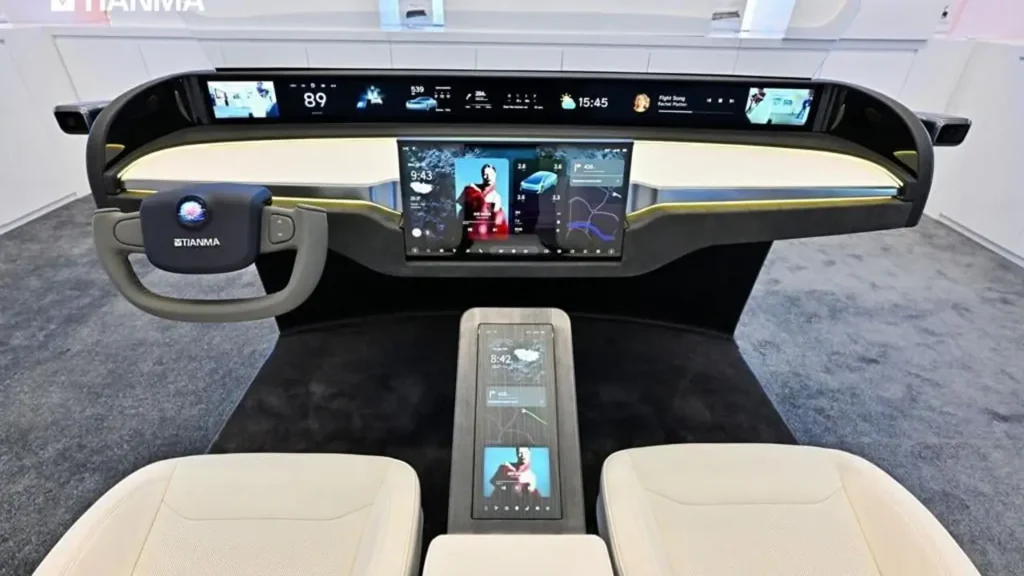
CES 2026 Tianma automotive displays made a statement in Las Vegas that’s hard to ignore. While automotive shows typically spotlight powertrain innovations and autonomous driving systems, this year’s Consumer Electronics Show showcased something equally transformative happening inside the vehicle cabin. Tianma presented more than 60 advanced technology demonstrations at CES 2026, with their Smart Cockpit 7.0 serving as the centerpiece that demonstrates how smart cockpit multi-screen linkage is reshaping the driver and passenger experience.
The Chinese display manufacturer didn’t just bring prototypes—they brought production-ready technologies that luxury automakers are already eyeing for 2027 model year vehicles. What makes this significant is that CES 2026 Tianma automotive displays represent a shift in where premium interior technology originates, with innovations like pixel-level local dimming and seamless curved integration setting new benchmarks that traditional suppliers are now scrambling to match.
If you’re into Chinese tech innovation beyond cars, you’ll love what’s happening in gadgets right now. From next-gen displays and smart accessories to fast-charging ecosystems and AI-powered devices, the pace is unreal. For quick, practical reviews and buyer-focused updates, check https://bestchinagadget.com/ and stay ahead of the next big release.
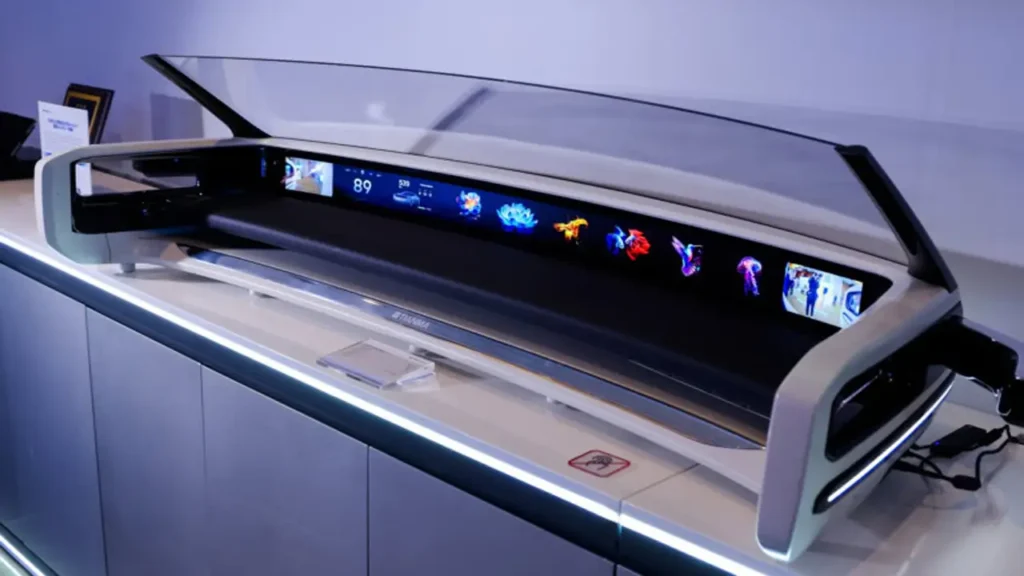
What Exactly Was Shown: Tianma ACRUS 8K Curved Display and Why a 1.25-Meter “Panorama” Matters in Real Cars
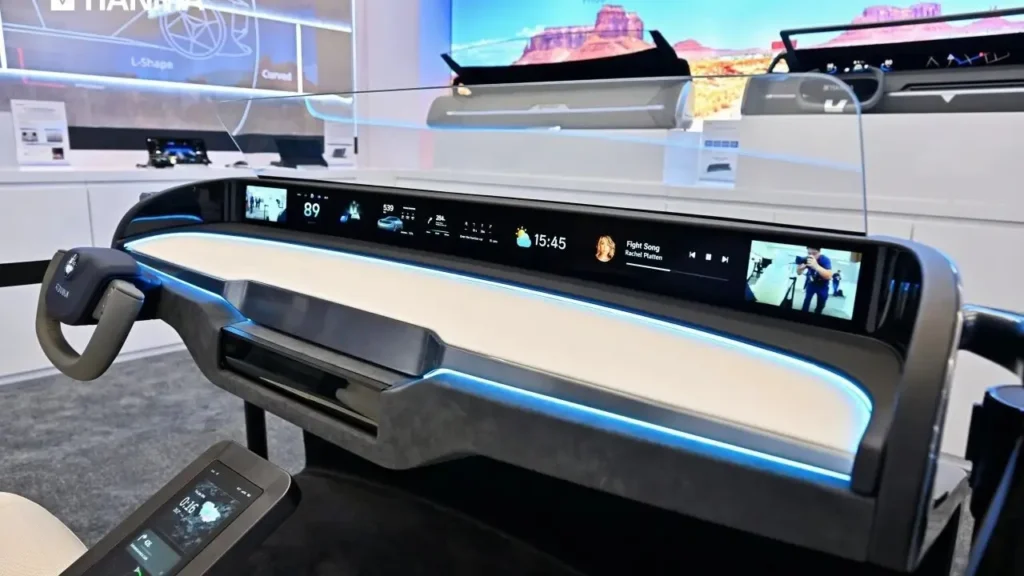
The star of Tianma’s exhibit was undoubtedly their Tianma ACRUS 8K curved display, a 49.6-inch behemoth that stretches across an effective viewing width of over 1.25 meters. To put this in perspective, that’s wider than most laptop screens are diagonal, creating a truly panoramic visual field that wraps around the driver’s peripheral vision. The ACRUS display delivers 8K resolution, which translates to approximately 7680×4320 pixels spread across that massive curved surface. This isn’t just spec-sheet bragging—the pixel density ensures that navigation maps remain crisp at the edges, instrument cluster graphics stay sharp in the driver’s direct line of sight, and infotainment content displayed for the passenger maintains clarity without pixelation.
The R3000 curvature aligns with the lower windshield for seamless integration, meaning the display’s curve radius matches modern windshield geometry. This careful matching isn’t just aesthetic—it reduces the visual disconnect drivers often experience with flat screens in curved dashboard spaces. In real-world terms, this means fewer reflections, better viewing angles for both driver and front passenger, and a more cohesive visual experience that feels integrated rather than bolted on.
| Feature | Tianma ACRUS | Typical OLED | Typical Mini-LED |
|---|---|---|---|
| Size | 49.6 inches | 12-15 inches | 15-32 inches |
| Resolution | 8K | FHD to 4K | QHD to 4K |
| Dimming Zones | 210,000 | Pixel-level | 500-2,000 |
| Contrast Ratio | 100,000:1 | 1,000,000:1 | 10,000:1 |
| Curvature | R3000 | Flat/R1000 | Flat/R1500 |
| Burn-in Risk | None | Moderate-High | None |
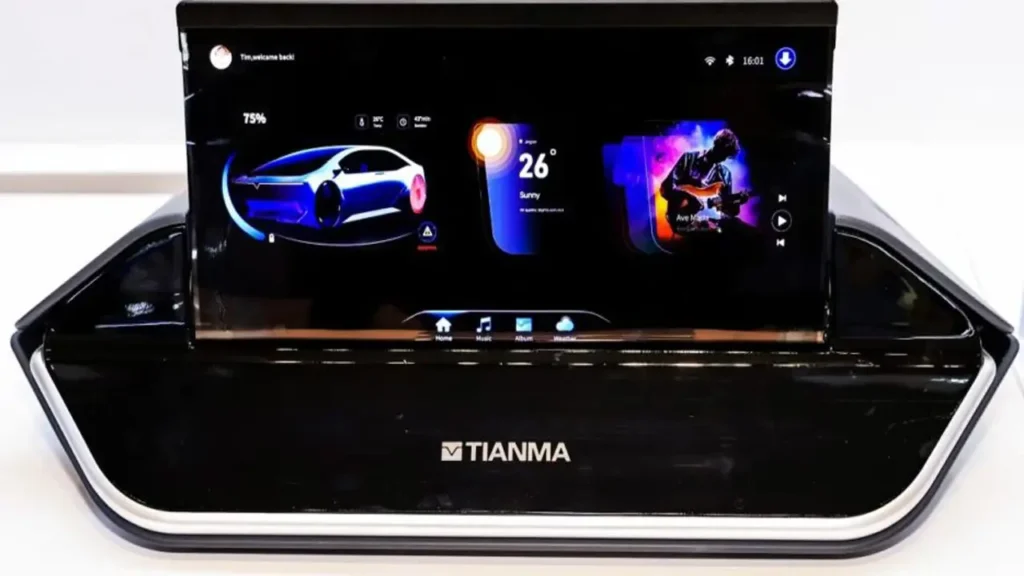
The Smart Cockpit 7.0 demonstration at CES 2026 Tianma automotive displays also integrated a dynamic slidable AM-OLED display that uses a precision gear-rack mechanism to support both concealed and dual-display operating modes. This means the cockpit can physically reconfigure itself—hiding screens when they’re not needed and revealing them for specific tasks. It’s the kind of flexibility that transforms static dashboard design into something more adaptive and user-centric.
The Core Magic of Contrast: Pixel-Level Local Dimming 210,000 Zones and What It Actually Delivers to Drivers
Here’s where CES 2026 Tianma automotive displays get technically impressive. The ACRUS display integrates pixel-level dimming technology with 210,000 zones, achieving an ultra-high contrast ratio of 100,000:1. To understand why this matters, consider what happens when you’re driving at night with a bright white navigation map displayed. On conventional displays, the entire backlight illuminates to show that white content, which means black areas of the screen (like the sky in your map view) still glow with residual light. This creates eye strain and reduces the perceived depth of the image.
With pixel-level local dimming across 210,000 zones, each tiny section of the display can independently control its brightness. When the screen needs to show a starlit sky in your navigation view, those specific zones turn nearly completely off, producing true blacks that rival OLED technology. Meanwhile, the road ahead on your map remains brilliantly illuminated. The result is a contrast ratio of 100,000:1, meaning the brightest whites are 100,000 times brighter than the darkest blacks. For context, most automotive displays offer contrast ratios between 1,000:1 and 5,000:1.
This technology directly addresses one of the biggest complaints about in-car displays: they’re either too bright at night (causing glare and distraction) or too dim in daylight (becoming unreadable). With 210,000 independently controlled zones, the CES 2026 Tianma automotive displays system can adapt in real-time—keeping critical information visible while dimming non-essential interface elements. It’s particularly valuable for split-screen scenarios where the driver needs high-contrast instrument data while the passenger watches darker video content.
The practical benefit shows up during dusk and dawn driving, those challenging lighting conditions where your eyes are constantly adjusting. A conventional display with limited local dimming struggles to remain readable without forcing your pupils to contract uncomfortably. The ACRUS system’s granular control means navigation instructions can stay bright and legible while the surrounding interface elements remain subdued, reducing the cognitive load on your visual system.
“Invisible Bezels” as an Effect: Always-Black One-Piece Black Effect Display and Why Premium Brands Love This
Walk past the Tianma booth at CES 2026, and you’d be forgiven for thinking their demo car had a single piece of black glass stretched across the dashboard. That’s the magic of the always-black one-piece black effect display, and it’s become a design obsession for luxury automakers. The display maintains a uniform “one-piece black” effect in both active and standby states, meaning when the screen is off, it doesn’t look like a screen at all—it looks like a seamless piece of high-gloss trim.
This matters because modern premium interior design emphasizes minimalism and visual cohesion. Traditional displays have visible bezels and edge lighting that breaks the visual flow of the dashboard. Even when turned off, you can see where the screen begins and ends, which creates a tech-forward but somewhat cluttered aesthetic. The CES 2026 Tianma automotive displays approach eliminates these visual boundaries. When the system boots up, content appears to materialize from within the dashboard itself rather than being displayed on a device mounted to the dashboard.
The technical achievement here involves careful management of edge lighting, backlight bleed, and the transition between active display area and inactive bezel regions. Many displays show a faint glow around edges when turned off, or develop a “halo” effect where light leaks from the active area into the bezel. Tianma’s solution maintains true black across the entire surface, creating that premium one-piece appearance that luxury buyers expect.
For automakers, this translates directly to higher perceived value. The same technology costs roughly the same to implement as a conventional display, but the visual impact is dramatically different. It’s the automotive equivalent of edge-to-edge smartphone displays—once you’ve seen it, conventional bezels feel dated. CES 2026 Tianma automotive displays demonstrate that this aesthetic is now achievable at the scale and durability requirements of automotive applications.
Windshield Integration: Corning ColdForm Windshield Display Glass and Manufacturing Reality Checks
Integrating a curved display into a windshield isn’t as simple as gluing a screen to glass. The CES 2026 Tianma automotive displays utilize Corning ColdForm Technology, a specialized glass forming process that creates complex curves without the thermal stress of traditional hot-bending methods. This matters because automotive windshields endure extreme temperature swings, stone impacts, and constant vibration—conditions that would quickly destroy conventionally bonded displays.
ColdForm technology works by mechanically shaping glass at room temperature, eliminating the internal stresses that develop during heat-based forming. For a display with an R3000 curvature radius, this means the cover glass can conform to the windshield’s geometry without creating weak points or distortion zones. The result is a laminated assembly where the display glass and windshield glass are bonded together with optical clarity and structural integrity.
The manufacturing challenge comes in the bonding process. Any tiny air gap between layers creates visual artifacts—those rainbow patterns or cloudy zones you sometimes see in poorly laminated displays. At the scale of a 49.6-inch curved display, maintaining uniform bonding pressure across the entire surface requires precision fixturing and carefully controlled adhesive curing. Tianma’s demonstration at CES 2026 automotive displays showed minimal optical defects, suggesting they’ve refined this process to production-ready quality levels.
Reliability concerns center on thermal cycling and impact resistance. A windshield-integrated display must survive temperatures from -40°C to +85°C without delamination or display failure. The ColdForm glass approach helps here because the reduced internal stress means less expansion and contraction mismatch between layers during temperature swings. For stone chip impacts, the laminated construction actually improves safety—the display layer adds structural reinforcement rather than creating a failure point.
The practical limitation is repairability. Unlike a conventional dashboard display that can be replaced relatively easily, a windshield-integrated system means any damage to the display glass likely requires full windshield replacement. This is where insurance costs and service network training become important considerations for mass-market adoption. Premium vehicles with CES 2026 Tianma automotive displays will need specialized service procedures and potentially higher insurance premiums to account for this integration.
Safety and Readability: Anti-Reflection Windshield Cockpit Screen and Real-World Performance Trade-offs
Glare is the enemy of any automotive display, and windshields are particularly challenging because they’re designed to let light in. The CES 2026 Tianma automotive displays address this with anti-reflection windshield cockpit screen technology. According to official specifications, the system achieves anti-reflection performance with reflections below 0.55% for windshield-integrated displays. For comparison, standard automotive displays typically reflect 4-8% of incident light, creating distracting mirror images of the dashboard and occupants.
The anti-reflection coating works through multiple thin-film layers that create destructive interference for reflected light waves. This is similar to the technology used in high-end camera lenses, but adapted for the larger surface area and harsher conditions of automotive applications. The coating must remain effective across a wide range of viewing angles and light sources—from low-angle sunrise glare to overhead tunnel lighting.
Pros:
- Dramatically reduces dashboard reflections in windshield-mounted displays
- Improves visibility in direct sunlight and high-contrast lighting conditions
- Maintains effectiveness across wide viewing angles needed for driver and passenger views
- Enhances perceived image quality by eliminating ghost reflections
Cons:
- Anti-reflection coatings can show fingerprints and smudges more readily than uncoated glass
- Long-term durability of coatings under UV exposure and temperature cycling needs validation
- Potential for coating damage from cleaning products not specifically designed for AR surfaces
- May increase initial manufacturing costs and replacement part pricing
The real-world performance of anti-reflection windshield cockpit screen technology shows up most dramatically during sunset driving, when conventional displays become nearly unreadable due to reflected glare. The CES 2026 Tianma automotive displays maintain crisp, clear visibility even with direct sunlight hitting the windshield. This isn’t just a comfort feature—it’s a safety consideration. A driver who can’t read their navigation display because of glare is more likely to glance down at their phone, creating a dangerous distraction.
One challenge that emerged during CES demonstrations was maintaining the anti-reflection performance in cold weather conditions. Condensation forming on the windshield interior can temporarily reduce the coating’s effectiveness until the defroster clears the moisture. This is an area where climate control integration becomes important—the display system needs to coordinate with the vehicle’s HVAC to ensure the screen remains readable in all conditions.
Hidden Displays: InvisiVue Hidden Display Technology and User Experience Implications
Perhaps the most visually striking technology at CES 2026 Tianma automotive displays was InvisiVue hidden display technology. InvisiVue is a display solution that remains visually indistinguishable from decorative surfaces such as brushed metal or wood grain when inactive, then reveals image content through a high-transmissivity layer when powered on. The latest generation achieves 80 percent transmissivity through the decorative layer, a significant improvement from earlier versions that maxed out at 50 percent.
The magic happens through a carefully engineered decorative layer that sits in front of a Mini-LED backlit display. When the display is off, all you see is the decorative pattern—realistic wood grain, brushed aluminum, carbon fiber, or any other material texture the designer chooses. Turn on the display, and the high-transmissivity layer allows the backlight to shine through clearly, revealing crisp graphics, gauges, or information displays. It’s like having a screen hidden inside your dashboard trim that materializes only when needed.
This technology opens up entirely new design possibilities for automotive interiors. Instead of dedicating specific dashboard real estate to visible screens, designers can embed displays throughout the cabin—in door panels, center consoles, seat backs, and even headliners. When not in use, these screens disappear into the interior aesthetic. When needed, they activate to show relevant information without disrupting the overall design language.
User Reactions and Experience Considerations:
What users love: The wow factor is undeniable. Passengers at CES demonstrations consistently reacted with surprise when hidden displays activated, emerging from what appeared to be solid wood or metal trim. This creates a premium, high-tech feeling that aligns perfectly with luxury brand positioning.
What might frustrate users: Discoverability can be an issue. If a display looks identical to trim when off, how do you know it’s there or where to touch it? This requires careful UX design—perhaps subtle LED indicators, haptic feedback zones, or proximity sensors that provide hints about interactive areas. There’s also a learning curve for new owners who might miss features simply because they don’t know certain trim pieces are actually displays.
The CES 2026 Tianma automotive displays InvisiVue demonstrations included a center armrest screen that appeared to be genuine wood veneer until activated. This exemplifies both the technology’s potential and its challenges. It’s impressive and exclusive, but it also requires a shift in how users interact with their vehicles. The best implementations will likely combine InvisiVue with subtle visual or haptic cues that guide users without breaking the aesthetic illusion.
FAQ: Automotive Mini-LED IRIS HUD 10,000 Nits and What It Means for 2026
Q1: What is IRIS HUD and why does 10,000 nits matter?
IRIS HUD refers to Tianma’s ultra-wide head-up display system. The 43.7-inch TIANMA Ultra-wide IRIS HUD features local peak brightness up to 10,000 nits, which is roughly 10-20 times brighter than conventional automotive displays. This extreme brightness is necessary because HUD systems project images onto the windshield, competing with direct sunlight. At 10,000 nits, the automotive Mini-LED IRIS HUD 10,000 nits system remains clearly visible even in harsh midday sun when you’re driving directly toward the light source. For reference, most smartphone displays max out around 1,000-2,000 nits, and typical automotive displays range from 500-1,500 nits.
Q2: Is local dimming better than OLED for cars?
It depends on priorities. OLED offers perfect blacks and infinite contrast because each pixel produces its own light. However, OLED struggles with peak brightness (typically maxing around 1,000-1,500 nits) and faces burn-in concerns with static interface elements displayed for hours. Local dimming with 210,000 zones, as seen in CES 2026 Tianma automotive displays, achieves near-OLED black levels while reaching much higher peak brightness and eliminating burn-in risk. For automotive use where displays show static navigation elements, gauges, and high-brightness requirements for sunlight readability, advanced local dimming currently offers better practical performance than OLED.
Q3: Can “invisible bezel” designs reduce driver distraction?
Research suggests yes. The always-black one-piece black effect display creates a cleaner visual field with less visual clutter. When bezels and edge lighting are eliminated, there are fewer bright edges and frames competing for the driver’s peripheral attention. The seamless integration also reduces the number of distinct visual elements in the dashboard, which can lower cognitive load. However, the content displayed on the screen matters more than the bezel design—a poorly designed interface on a bezel-free display is still distracting.
Q4: Will curved windshield displays increase repair costs?
Almost certainly. Windshield-integrated displays using Corning ColdForm windshield display glass technology create a single assembly that can’t be repaired separately. A cracked windshield or damaged display likely means replacing the entire unit, which will cost significantly more than current windshield replacement. Early estimates suggest 2-3x the cost of conventional windshield replacement, though economies of scale may reduce this premium as adoption increases. Insurance companies are already adjusting policies to account for these integrated systems in premium vehicles.
Q5: Does anti-reflection actually help in direct sun?
Yes, but with caveats. The anti-reflection windshield cockpit screen coatings reduce glare and ghost reflections dramatically, making displays more readable in bright conditions. However, no anti-reflection coating can overcome a display that’s fundamentally too dim. This is why CES 2026 Tianma automotive displays combine anti-reflection coatings with high-brightness backlighting (up to 10,000 nits in the HUD). The coating eliminates reflections while the brightness ensures visibility. In direct sunlight, you need both technologies working together.
Q6: When will these CES 2026 Tianma solutions hit mass production?
Based on Tianma’s demonstration of production-ready prototypes and existing automotive partnerships, early adoption should begin in 2027 model year vehicles from Chinese EV manufacturers. Premium European and Japanese brands typically follow 18-24 months later, suggesting 2028-2029 model years for wider availability. The InvisiVue hidden display technology and automotive Mini-LED IRIS HUD 10,000 nits systems will likely debut first in flagship models before trickling down to mid-range vehicles. The full curved windshield integration seen in CES 2026 Tianma automotive displays demonstrations may take longer due to manufacturing complexity and regulatory approval processes.
What Will Take Off First and Why Automotive Dimming Glass Privacy Window Is the Next Premium Trend
Looking at the technologies showcased in CES 2026 Tianma automotive displays, the automotive dimming glass privacy window stands out as the most likely candidate for rapid adoption. The 34-inch automotive dimming glass uses dye liquid crystal technology to achieve stepless dimming through precise voltage control, enabling millisecond-level response time of less than 300 ms. This means transitions between transparent and private modes happen almost instantly—faster than mechanical sunshades can deploy.
The appeal is immediately obvious. Rear seat passengers gain instant privacy for video calls, changing clothes, or simply avoiding paparazzi and curious glances. The system eliminates the mechanical complexity and maintenance issues of traditional power sunshades while providing more precise control over light transmission levels. Instead of just open or closed, users can dial in exactly how much privacy and light blocking they want, from fully transparent to nearly opaque.
Cost-wise, automotive dimming glass privacy window technology is more accessible than full windshield display integration or ultra-wide curved cockpit screens. The glass itself isn’t curved (reducing manufacturing complexity), doesn’t require the high brightness and resolution of display panels (simplifying electronics), and can be offered as an optional upgrade rather than a base vehicle architecture change.
The premium trend is already emerging in CES 2026 Tianma automotive displays demonstrations. Luxury buyers increasingly expect their vehicles to provide mobile privacy—a sanctuary from external observation. As remote work blurs the lines between office and vehicle, rear seat passengers want functional workspace privacy. The wide viewing angle and soft gray-black tone reduce glare and deliver a comfortable visual experience, making the dimmed glass pleasant to sit behind for extended periods rather than feeling confined in a darkened space.
What will drive mainstream adoption is the simple value proposition. Traditional power sunshades are mechanical nightmares—motors fail, tracks jam, fabric tears. They add weight, complexity, and service costs. Automotive dimming glass privacy window technology replaces all of that with solid-state electronics that have no moving parts to break. It’s lighter, more reliable, more flexible, and provides better user experience. That’s a rare combination in automotive technology, which is why this particular innovation from CES 2026 Tianma automotive displays will likely appear across vehicle segments faster than the flashier curved displays and hidden screens.
The writing is on the wall—or rather, in the glass. Within three years, expect automotive dimming glass privacy window technology to become a standard feature in premium sedans and SUVs, with mid-range vehicles offering it as a popular option package. It’s the kind of technology that, once experienced, becomes immediately essential to buyers. And that’s exactly the kind of innovation that transforms industry trends.
For more insights on automotive display technology and emerging cockpit innovations, visit www.autochina.blog
Discover more from AutoChina
Subscribe to get the latest posts sent to your email.